
Development Plan / Restrictions
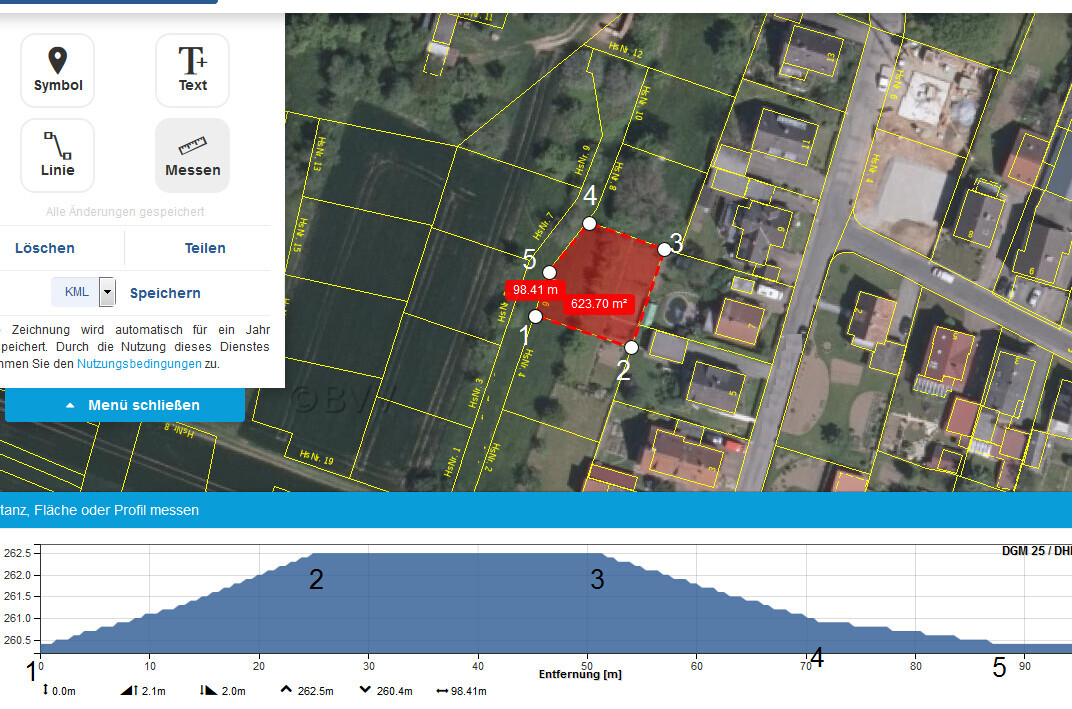
Plot size: 630 m² (6,780 sq ft)
Slope: slight incline toward the street
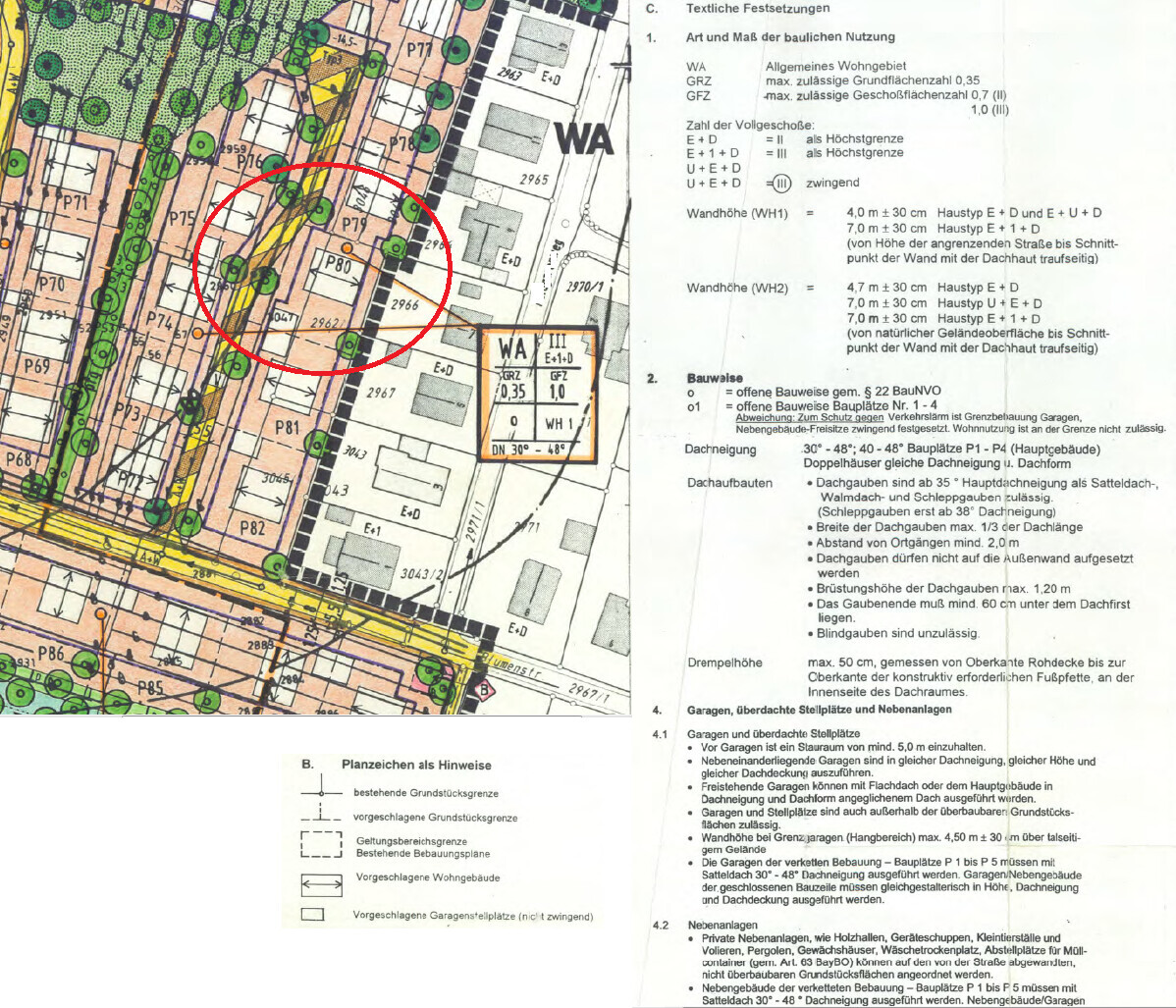
Floor area ratio (FAR): 0.35
Gross floor area ratio (GFAR): 1.0
Edge development: Located centrally in a dead-end street within a new residential development (infrastructure to be completed starting next year). The dead-end street ends to the north. A purely residential area with low traffic, as it is a small village (<2,000 inhabitants).
Number of parking spaces
Number of floors: Ground floor + 1 floor + attic as maximum limit
Roof type: gable roof
Architectural style
Orientation: east-west
Maximum height/limits: 7.0 m ±0.3 m (23 ft ±1 ft)
Additional requirements
Client Requirements
Basement, floors: No basement; 2 floors plus attic (desired knee wall height on upper floor still unclear)
Number of people, ages: Family of four – two children (ages 2 and 5 at move-in)
Space requirements on ground and upper floors
Office: family use or home office? Family use
Guest bedrooms per year: rarely
Open kitchen with island
Number of dining seats: 4
Fireplace: yes (centrally located in the living room with interior chimney or on the exterior wall?)
Music/speaker wall
Balcony, roof terrace: possibly garage roof as terrace; also terrace on the south side adjacent to the living room
Garage, carport:
Vegetable garden, greenhouse: vegetable garden
Photovoltaic system, cistern for garden (possibly also for toilet water use – cost question, still unclear)
House Design
Designed by:
- Do-it-yourself: yes
What do you particularly like? Why? Large living room facing south
What do you dislike? Why?
Estimated price according to architect/planner: €400,000 turnkey, KfW 55 standard prefabricated house with air-to-water heat pump (without garage; including foundation slab)
Personal price limit for house including fixtures: €500,000 including additional building costs
Preferred heating technology: heat pump with horizontal closed loop collector
If you have to give up, which details/upgrades
- can you give up: large garage
- cannot give up:
Why is the design the way it is now? For example:
Based on various prefabricated houses, we designed our own floor plan. The study on the ground floor should be large enough to possibly use as a bedroom. The living room faces south, and the children’s rooms are equally sized. The washing machine would go into the storage room.
What is the most important/basic question about the floor plan in 130 characters?
General room layout and positioning? Which knee wall height (1 m; 1.2 m; 1.6 m) would be optimal for space gain, cost savings, and daylight in the upper floor?
Hello,
I hope the notes on the drawings are legible and understandable.
According to the development plan, only a knee wall height of 50 cm (20 inches) is allowed, but according to telephone information, deviations are approved as long as the maximum ridge height is not exceeded.
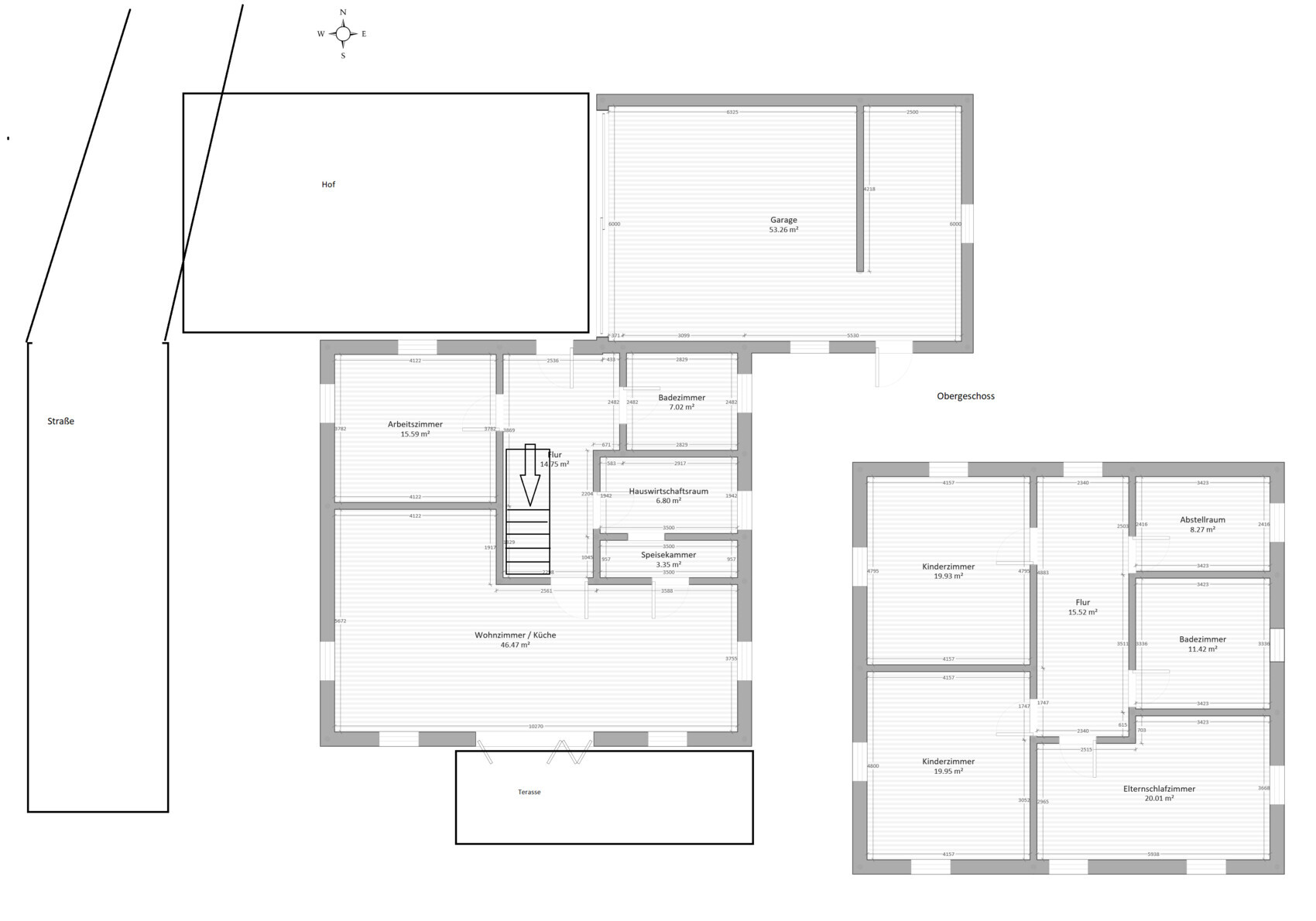
The drawing does not show any furniture.
The staircase should run straight in the hallway on the west side, so it opens in front of the two doors for the children’s rooms and the master bedroom.
Floor-to-ceiling windows are planned in the south-facing living room; all other windows will be "standard."
The kitchen is planned in the southeast corner of the house, hence the passage to the pantry. Originally, no pantry was planned; instead, there was a large utility room. On the advice of the house seller/consultant, a wall was added there so you don’t walk directly from the kitchen into the utility room.
A fireplace either next to the living room door or on the west wall.
Unfortunately, furniture was not included in the export: staircase runs straight in the hallway on the right side (when entering the house), so you reach the doors of the children’s and master bedrooms on the upper floor.
The current floor plan is based on external dimensions of 10.50 m by 11 m (34 ft 5 in by 36 ft 1 in).
If anything is unclear, please ask. Otherwise, feel free to ask questions or critique. I am not here just to receive praise (although that is always nice), but that’s not the purpose of this exercise.
Plot size: 630 m² (6,780 sq ft)
Slope: slight incline toward the street
Floor area ratio (FAR): 0.35
Gross floor area ratio (GFAR): 1.0
Edge development: Located centrally in a dead-end street within a new residential development (infrastructure to be completed starting next year). The dead-end street ends to the north. A purely residential area with low traffic, as it is a small village (<2,000 inhabitants).
Number of parking spaces
Number of floors: Ground floor + 1 floor + attic as maximum limit
Roof type: gable roof
Architectural style
Orientation: east-west
Maximum height/limits: 7.0 m ±0.3 m (23 ft ±1 ft)
Additional requirements
Client Requirements
Basement, floors: No basement; 2 floors plus attic (desired knee wall height on upper floor still unclear)
Number of people, ages: Family of four – two children (ages 2 and 5 at move-in)
Space requirements on ground and upper floors
Office: family use or home office? Family use
Guest bedrooms per year: rarely
Open kitchen with island
Number of dining seats: 4
Fireplace: yes (centrally located in the living room with interior chimney or on the exterior wall?)
Music/speaker wall
Balcony, roof terrace: possibly garage roof as terrace; also terrace on the south side adjacent to the living room
Garage, carport:
Vegetable garden, greenhouse: vegetable garden
Photovoltaic system, cistern for garden (possibly also for toilet water use – cost question, still unclear)
House Design
Designed by:
- Do-it-yourself: yes
What do you particularly like? Why? Large living room facing south
What do you dislike? Why?
Estimated price according to architect/planner: €400,000 turnkey, KfW 55 standard prefabricated house with air-to-water heat pump (without garage; including foundation slab)
Personal price limit for house including fixtures: €500,000 including additional building costs
Preferred heating technology: heat pump with horizontal closed loop collector
If you have to give up, which details/upgrades
- can you give up: large garage
- cannot give up:
Why is the design the way it is now? For example:
Based on various prefabricated houses, we designed our own floor plan. The study on the ground floor should be large enough to possibly use as a bedroom. The living room faces south, and the children’s rooms are equally sized. The washing machine would go into the storage room.
What is the most important/basic question about the floor plan in 130 characters?
General room layout and positioning? Which knee wall height (1 m; 1.2 m; 1.6 m) would be optimal for space gain, cost savings, and daylight in the upper floor?
Hello,
I hope the notes on the drawings are legible and understandable.
According to the development plan, only a knee wall height of 50 cm (20 inches) is allowed, but according to telephone information, deviations are approved as long as the maximum ridge height is not exceeded.
The drawing does not show any furniture.
The staircase should run straight in the hallway on the west side, so it opens in front of the two doors for the children’s rooms and the master bedroom.
Floor-to-ceiling windows are planned in the south-facing living room; all other windows will be "standard."
The kitchen is planned in the southeast corner of the house, hence the passage to the pantry. Originally, no pantry was planned; instead, there was a large utility room. On the advice of the house seller/consultant, a wall was added there so you don’t walk directly from the kitchen into the utility room.
A fireplace either next to the living room door or on the west wall.
Unfortunately, furniture was not included in the export: staircase runs straight in the hallway on the right side (when entering the house), so you reach the doors of the children’s and master bedrooms on the upper floor.
The current floor plan is based on external dimensions of 10.50 m by 11 m (34 ft 5 in by 36 ft 1 in).
If anything is unclear, please ask. Otherwise, feel free to ask questions or critique. I am not here just to receive praise (although that is always nice), but that’s not the purpose of this exercise.

The staircase is the central element around which a floor plan is designed. If that isn’t right, you can basically throw everything else away. In my opinion, your dimensions are too tight. This of course also depends on the floor-to-ceiling height. These are questions that homeowners often want to deal with last, but actually, they need to be addressed first.
A common ceiling height nowadays is around 2.60 meters (8 ft 6 in). Standard stairs from catalogs often still work with 2.40 meters (7 ft 10 in) from grandma’s time. But then you end up missing one step. So first check the ceiling height and decide now what you want or what the preferred builder actually offers.
You have a large house. The bigger the rooms, the higher the ceilings should be. In your case, I would almost go for 2.70 meters (8 ft 10 in). Adding a ceiling structure of about 30 cm (1 ft) gives a floor-to-floor height of 3 meters (9 ft 10 in), which is a good figure to work with. You won’t get fewer than 16 steps with that. There are online calculators where you can calculate your stairs. The dimensions for tread depth and riser height should be roughly these: Tread (A): 26 to 27 cm (10 to 11 inches) / Riser (S): 18 to 19 cm (7 to 7.5 inches).
The heating room is often especially warm. Everything spoils faster. Also, this is usually where things like buckets, brooms, vacuum cleaners, mops, dirty boots, and similar household items are stored. You could of course put canned pet food there as well, but that’s almost like storing it in the toilet (I’m exaggerating to make the point clear). A separation is particularly useful if you can cool the room down (or avoid heating it) so that fruits and vegetables stay fresh longer (e.g., tomatoes should not go in the fridge).
Having the chimney 3 meters (10 ft) away is a tricky issue. That means you have a pipe running across the room somewhere, right? I would rather try to place the stove on the gable wall, minimizing loss of space for photovoltaic panels.
If you are thinking about renting it out later, I would forget that idea or plan it consistently now. Then everything would have to be different, and you would need much more space for the staircase.
Separating living and dining areas usually works wonders. If I were building again today, I would have a kitchen with an integrated dining space—probably with a cozy corner bench by a nice window. That way, the kids can draw at a large table while mom cooks and dad prepares the salad. The chill-out area is completely separated or strongly zoned by a bay window.
I thought the same once, and we don’t have a walk-in closet either. I still think it’s absolutely fine, but if I had the choice today, I would want one, ideally right next to the utility room. However, it would be dispensable if the floor plan doesn’t allow for it.
A common ceiling height nowadays is around 2.60 meters (8 ft 6 in). Standard stairs from catalogs often still work with 2.40 meters (7 ft 10 in) from grandma’s time. But then you end up missing one step. So first check the ceiling height and decide now what you want or what the preferred builder actually offers.
You have a large house. The bigger the rooms, the higher the ceilings should be. In your case, I would almost go for 2.70 meters (8 ft 10 in). Adding a ceiling structure of about 30 cm (1 ft) gives a floor-to-floor height of 3 meters (9 ft 10 in), which is a good figure to work with. You won’t get fewer than 16 steps with that. There are online calculators where you can calculate your stairs. The dimensions for tread depth and riser height should be roughly these: Tread (A): 26 to 27 cm (10 to 11 inches) / Riser (S): 18 to 19 cm (7 to 7.5 inches).
The heating room is often especially warm. Everything spoils faster. Also, this is usually where things like buckets, brooms, vacuum cleaners, mops, dirty boots, and similar household items are stored. You could of course put canned pet food there as well, but that’s almost like storing it in the toilet (I’m exaggerating to make the point clear). A separation is particularly useful if you can cool the room down (or avoid heating it) so that fruits and vegetables stay fresh longer (e.g., tomatoes should not go in the fridge).
Having the chimney 3 meters (10 ft) away is a tricky issue. That means you have a pipe running across the room somewhere, right? I would rather try to place the stove on the gable wall, minimizing loss of space for photovoltaic panels.
If you are thinking about renting it out later, I would forget that idea or plan it consistently now. Then everything would have to be different, and you would need much more space for the staircase.
Neubau2020 schrieb:
What would be your suggestion to enliven the living room?
Separating living and dining areas usually works wonders. If I were building again today, I would have a kitchen with an integrated dining space—probably with a cozy corner bench by a nice window. That way, the kids can draw at a large table while mom cooks and dad prepares the salad. The chill-out area is completely separated or strongly zoned by a bay window.
Neubau2020 schrieb:
Although walk-in closets fall into the category of “rather unnecessary” for us. We have no problem changing in the bedroom and don’t feel the need to go to a separate adjacent room (I know it’s currently trendy).
I thought the same once, and we don’t have a walk-in closet either. I still think it’s absolutely fine, but if I had the choice today, I would want one, ideally right next to the utility room. However, it would be dispensable if the floor plan doesn’t allow for it.
kaho674 schrieb:
The original plan from the OP, slightly modified:
[ATTACH alt="EG.jpg"]43023[/ATTACH]
[ATTACH alt="OG.jpg"]43022[/ATTACH]
I removed the access to the utility room through the kitchen and instead increased the usable space there.
Well, I’m not sure. It can definitely be built, but in my opinion, it completely lacks character. It’s quite a large house yet the bedroom has very little floor space, and the living room feels somewhat cramped and plain. There is some zoning thanks to the fireplace, but initially it feels dull. You’d almost want to add a conservatory to avoid boredom. Good idea with the conservatory, why not?? And yes, there are probably much more exciting floor plans out there.
N
Neubau202014 Feb 2020 10:48I used to think the same and we don’t have a walk-in closet either. I still find that perfectly fine, but if I had the choice today, I would want one right next to the utility room.
Okay, why would you want that?
Okay, why would you want that?
Neubau2020 schrieb:
Okay, why would you want those?My husband likes to sleep later than I do, especially on Sundays. It used to be different, but nowadays I’m always awake at 7 a.m. and want to go to the garden or the kitchen or elsewhere... When I’m looking for my things in the bedroom, it’s dark so I can’t clearly see the sock colors, and my husband grumbles because I’m banging the wardrobe doors.N
Neubau202014 Feb 2020 10:58chrisw81 schrieb:
Good idea with the conservatory, why not? And yes, there are probably much more interesting floor plans. kaho674 schrieb:
Separating living and dining areas usually works wonders. If I were building again today, I would have a kitchen with an integrated dining space—probably with a cozy corner bench by a nice window. The kids can draw at a large table while mom cooks and dad prepares the salad. The lounge area is completely separated or strongly zoned using a bay window.
Something like this in principle?
Neubau2020 schrieb:
Something like this in principle?Not exactly. The main area is then the kitchen-dining space. It is larger and the first room you enter. The lounge or relaxation room is separate or completely enclosed.Similar topics