
Hello everyone,
We moved into our new house last summer (oh God, that already sounds so long ago). Since then, there has been a lot to do—and there still is. Now, however, the remaining work is increasingly shifting outdoors.
The well has already been drilled. At that spot, I installed a small pit, and the garden shed will be placed on top of it. Now I’ve been thinking about the irrigation system again and realized that it will be difficult to access the pit underground once the garden shed is in place, as I would then be undermining the base slab.
So, I’ve been giving it some thought and reading a lot, but not everything is clear to me yet.
Firstly: before I pour the base slab, I need to run the necessary pipes out of the pit. That means drilling a hole through the pit ring and laying 1 to x PVC pipes (KG pipes) extending 1 to 2 meters (3 to 6.5 feet) beyond the edge of the base slab, so that I can later feed the water line through them when the time comes.
By the way, the garden shed will also house the sub-distribution for the outdoor electrical system. So, I also need to run a cable from the pit through the base slab to the distribution board in the garden shed for the pump. Additionally, I need 2 to 3 PVC pipes from inside where the distribution board is mounted, under the base slab to the outside, for all the electrical wiring on the driveway—such as the gate, lighting, and control cables for the irrigation valves, etc.
Now to the main topic: the automatic irrigation system
In this forum, it seems @rick2018 has good knowledge about this subject. Maybe you could give me some tips as well.
Below is a plan of our property:
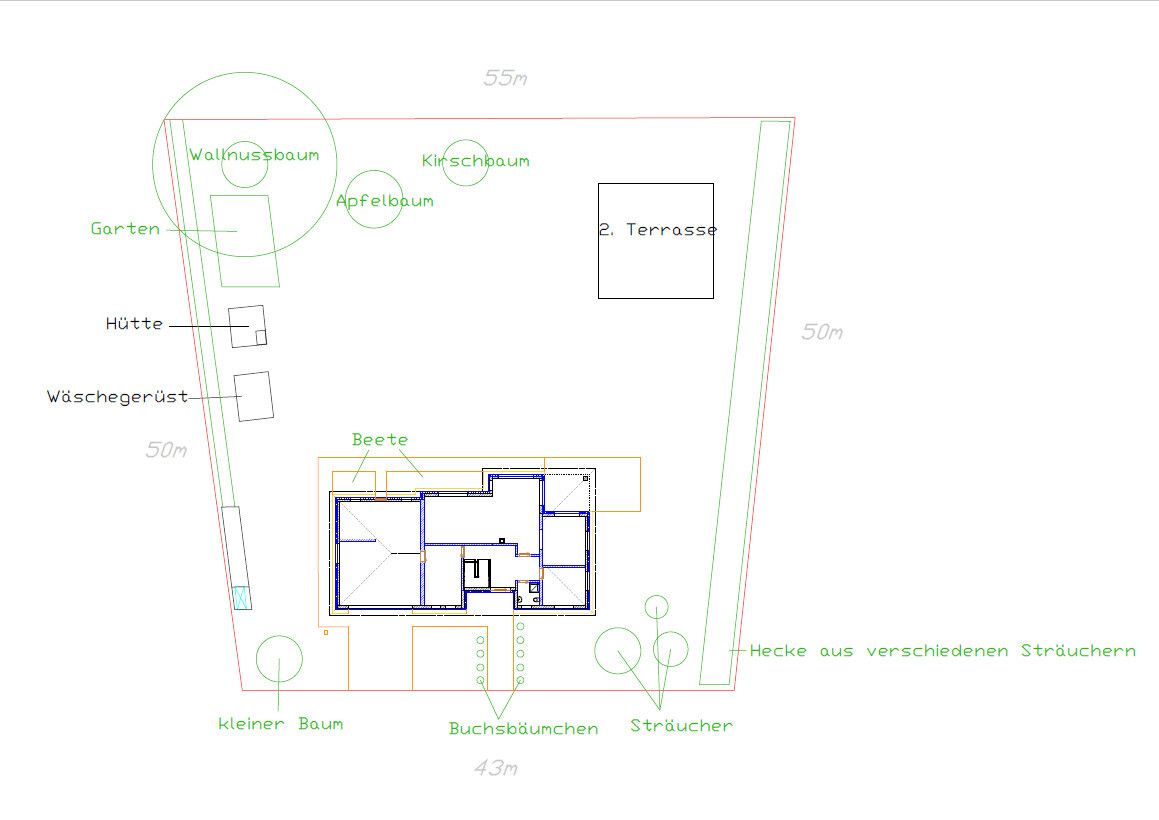
Except for the house, none of this has actually been implemented yet. The plants are just planned and may still change. The second terrace on the drawing is currently 10 x 10 meters (33 x 33 feet). It won’t actually be that large; that’s just a placeholder for the approximate future location. However, it definitely won’t be built in the next five years. That brings me to my first point:
1. How do you take that into account now? For example, regarding the second terrace, I would mostly plan the sprinklers as if the terrace will never be built, since it’s still uncertain whether and where exactly it will be placed. What about the trees? If I install the sprinklers now and then plant a tree 1 or 2 meters (3 to 6.5 feet) away next year, there will be shade along the axis behind the tree. In the first few years, this is probably negligible due to the small trunk diameter, but what happens when the trunk gets thicker?
2. What exactly should be irrigated? Lawn, flower beds, and vegetable garden are clear. I’ve read differing opinions about hedges, especially regarding adaptation to watering. What about trees? They should be able to cope on their own, right? Is it really overkill to install irrigation just for the first and maybe the second year?
3. For my large lawn areas, I’m considering Hunter gear-driven rotors. However, these are said to be rather sensitive to wind. Here, it’s usually windy because we’re on a small hill. But once everything around is planted, there shouldn’t be much wind close to the ground, right? @rick2018, why do you prefer rotators like the MP3000 over gear-driven rotors like the I20, for example?
4. My father-in-law took care of the well. I believe a Grundfos SQ2-55 pump is installed “in the hole.” The borehole depth was about 20 meters (66 feet) and the pump hangs at roughly 15 meters (49 feet) depth. The property slopes upwards by almost one meter (3 feet) to the right, so the pump has to push water up about 16 meters (52 feet). The pump is capable of 54 meters (177 feet) total head. So that leaves about 38 meters (125 feet), which corresponds to roughly 3.8 bar (55 psi) and, unfortunately, only about 2 cubic meters per hour (around 880 gallons per hour).
If I understand correctly, I can only operate two gear-driven I20 rotors with the 4.0 nozzle on one zone, since each requires 0.81 m³/h (about 360 gallons/hr) at 2.5 bar (36 psi) with a 11.9-meter (39 feet) radius (planning uses 10.5 meters). That will mean a lot of zones. Alternatively, I could try to return the pump to the well driller (as it wasn’t used before) and get one with 4 m³/h (about 1760 gallons/hr) or more. The question is whether that would make my well wear out faster (clogging?).
5. Let’s say I keep the existing pump and end up with 30 zones. How would that work in practice? Would each lawn irrigation zone run for 30 minutes? And every 3 days? That would cause problems with my planned robotic mower that will almost always be running over the large area. In the end, I won’t have time to enjoy the yard because either the mower is running or the sprinklers are on.
6. It is recommended to start the design in a corner of the property. So, for example, I start at the top right and place the first sprinkler in front of the hedge. The thing is: the hedge is currently very narrow, but will become 1 to 2 meters (3 to 6.5 feet) wide over time.
7. The sprinklers extend during operation and retract afterwards. How durable are these if someone steps on them? It looks like I will eventually have a “carpet” of pop-up sprinklers. The children should, of course, still be able to play freely.
That’s enough for now. Have a nice rest of the Sunday!
We moved into our new house last summer (oh God, that already sounds so long ago). Since then, there has been a lot to do—and there still is. Now, however, the remaining work is increasingly shifting outdoors.
The well has already been drilled. At that spot, I installed a small pit, and the garden shed will be placed on top of it. Now I’ve been thinking about the irrigation system again and realized that it will be difficult to access the pit underground once the garden shed is in place, as I would then be undermining the base slab.
So, I’ve been giving it some thought and reading a lot, but not everything is clear to me yet.
Firstly: before I pour the base slab, I need to run the necessary pipes out of the pit. That means drilling a hole through the pit ring and laying 1 to x PVC pipes (KG pipes) extending 1 to 2 meters (3 to 6.5 feet) beyond the edge of the base slab, so that I can later feed the water line through them when the time comes.
By the way, the garden shed will also house the sub-distribution for the outdoor electrical system. So, I also need to run a cable from the pit through the base slab to the distribution board in the garden shed for the pump. Additionally, I need 2 to 3 PVC pipes from inside where the distribution board is mounted, under the base slab to the outside, for all the electrical wiring on the driveway—such as the gate, lighting, and control cables for the irrigation valves, etc.
Now to the main topic: the automatic irrigation system
In this forum, it seems @rick2018 has good knowledge about this subject. Maybe you could give me some tips as well.
Below is a plan of our property:
Except for the house, none of this has actually been implemented yet. The plants are just planned and may still change. The second terrace on the drawing is currently 10 x 10 meters (33 x 33 feet). It won’t actually be that large; that’s just a placeholder for the approximate future location. However, it definitely won’t be built in the next five years. That brings me to my first point:
1. How do you take that into account now? For example, regarding the second terrace, I would mostly plan the sprinklers as if the terrace will never be built, since it’s still uncertain whether and where exactly it will be placed. What about the trees? If I install the sprinklers now and then plant a tree 1 or 2 meters (3 to 6.5 feet) away next year, there will be shade along the axis behind the tree. In the first few years, this is probably negligible due to the small trunk diameter, but what happens when the trunk gets thicker?
2. What exactly should be irrigated? Lawn, flower beds, and vegetable garden are clear. I’ve read differing opinions about hedges, especially regarding adaptation to watering. What about trees? They should be able to cope on their own, right? Is it really overkill to install irrigation just for the first and maybe the second year?
3. For my large lawn areas, I’m considering Hunter gear-driven rotors. However, these are said to be rather sensitive to wind. Here, it’s usually windy because we’re on a small hill. But once everything around is planted, there shouldn’t be much wind close to the ground, right? @rick2018, why do you prefer rotators like the MP3000 over gear-driven rotors like the I20, for example?
4. My father-in-law took care of the well. I believe a Grundfos SQ2-55 pump is installed “in the hole.” The borehole depth was about 20 meters (66 feet) and the pump hangs at roughly 15 meters (49 feet) depth. The property slopes upwards by almost one meter (3 feet) to the right, so the pump has to push water up about 16 meters (52 feet). The pump is capable of 54 meters (177 feet) total head. So that leaves about 38 meters (125 feet), which corresponds to roughly 3.8 bar (55 psi) and, unfortunately, only about 2 cubic meters per hour (around 880 gallons per hour).
If I understand correctly, I can only operate two gear-driven I20 rotors with the 4.0 nozzle on one zone, since each requires 0.81 m³/h (about 360 gallons/hr) at 2.5 bar (36 psi) with a 11.9-meter (39 feet) radius (planning uses 10.5 meters). That will mean a lot of zones. Alternatively, I could try to return the pump to the well driller (as it wasn’t used before) and get one with 4 m³/h (about 1760 gallons/hr) or more. The question is whether that would make my well wear out faster (clogging?).
5. Let’s say I keep the existing pump and end up with 30 zones. How would that work in practice? Would each lawn irrigation zone run for 30 minutes? And every 3 days? That would cause problems with my planned robotic mower that will almost always be running over the large area. In the end, I won’t have time to enjoy the yard because either the mower is running or the sprinklers are on.
6. It is recommended to start the design in a corner of the property. So, for example, I start at the top right and place the first sprinkler in front of the hedge. The thing is: the hedge is currently very narrow, but will become 1 to 2 meters (3 to 6.5 feet) wide over time.
7. The sprinklers extend during operation and retract afterwards. How durable are these if someone steps on them? It looks like I will eventually have a “carpet” of pop-up sprinklers. The children should, of course, still be able to play freely.
That’s enough for now. Have a nice rest of the Sunday!

Hello Denz,
let’s see how I can help you. Basically, you don’t have any special requirements.
1. Plan the irrigation zones as if everything is already there. For example, where a tree or hedge will be planted, simply install a pipe and cap it off. Once the tree or hedge is in place, activate the irrigation. The sprinklers need to be able to reach each other. Therefore, a tree usually isn’t a problem unless it’s located exactly between the sprinkler heads. Since, depending on the tree, it’s not ideal to keep watering it constantly, it’s better to design the sprinklers so that you can exclude that area when necessary.
2. I would plan irrigation for new hedges, trees, flower beds, lawns, etc. You don’t have to water all the time, but it’s especially helpful during the establishment phase. Many hedges are sensitive to drought. For a property like yours, you could easily spend several hours watering each day. Trees can be irrigated either with root watering (bubbler) or drip irrigation. Drip irrigation makes the most sense for hedges. If your different hedge plants have similar water needs, 2 zones for 50 meters should be enough. Drip lines take quite a while to water properly.
3. Rotators use less water, have pressure-compensated bodies for more uniform coverage, are more flexible in terms of range and arc adjustment, and can be combined with different ranges without changing precipitation rates. This allows for larger zones and more complex shapes. They are also less affected by wind. Gear-driven sprinklers are louder and were mainly used for large open areas before rotators were available. The downside of rotators is longer operating times.
4. What is the shut-off head of your well? In any case, your pump is far too small for your project. I looked at the pump curve. At 16 meters (52 feet) of head, the maximum flow rate is only about 1.5 m³/h (6.6 gpm), and this is without accounting for all the losses in the pipes. So in the best case, you could use a size i20 pump. Therefore, look for a pump with at least 4 m³/h (18 gpm), preferably 6 m³/h (26.4 gpm) at 20 meters (66 feet) of head (e.g. T.I.P. TIEFBRUNNENPUMPEN AJ – AJ 4 PLUS 100/57) or even larger. You need a sufficient volume to irrigate your property properly.
5. Your property is 2,500 m² (27,000 sq ft). Get a 5,000 m² (54,000 sq ft) robotic mower. Minus the house and driveways, it won’t even need to run half a day. How many zones you’ll have depends on your pump, piping, and sprinkler heads. Too many zones mean more valves and especially a more expensive controller. It’s much more cost-efficient to invest in a good pump and pipes. The sprinklers usually run less than 30 minutes at a time. During extreme dry spells, maybe 3 times per week. Ideally, no more than twice early in the morning. That leaves plenty of time for the mower to work, or you can split into two smaller mowers. You don’t need to water the entire lawn in one night. You could water some zones on Monday, others on Tuesday, then start again on Wednesday, and so on. Hedges and trees can be watered during the day without interfering with the mower.
6. Yes, start in the corner. Always calculate with a maximum of 90% range and place the next sprinkler accordingly. Leave about 1 meter (3 feet) space for hedges. You can slightly adjust the sprinkler heads’ arc to compensate for the hedge width. The sprinklers have a supply pipe connection that can easily be shifted a few centimeters if something larger needs to be adjusted later. If it’s windy, minor deviations are no problem.
7. The sprinklers are robust. You can even drive a lawn tractor over them. Playing children won’t cause issues either. With 3,000 series rotators (assuming sufficient pressure), you’d have a sprinkler every 8.5 meters (28 feet). In more complex areas, you might place them closer together or use smaller heads. After about 4 months, you’ll hardly notice the sprinklers anymore—only when they pop up.
How do you plan to handle the control system?
For your property size, it’s important to have:
- a large, powerful pump
- main supply lines with a large diameter; I’d even recommend DN40 (1½ inch nominal diameter), assuming the pump outlet is the same size. You could use 110 mm (4 inch) sewer pipe for very short distances if necessary.
- Then subdivide to several valve boxes with at least DN32 (1¼ inch). This way, you can create larger zones with some flexibility for changes, fewer valves, and shorter run times.
- The control cables will have to be relatively long since they run from all valve boxes back to the controller. But since the trenches are open anyway for the water pipes, that’s not an issue.
I hope I’ve answered most of your questions. Feel free to ask if you have more.
let’s see how I can help you. Basically, you don’t have any special requirements.
1. Plan the irrigation zones as if everything is already there. For example, where a tree or hedge will be planted, simply install a pipe and cap it off. Once the tree or hedge is in place, activate the irrigation. The sprinklers need to be able to reach each other. Therefore, a tree usually isn’t a problem unless it’s located exactly between the sprinkler heads. Since, depending on the tree, it’s not ideal to keep watering it constantly, it’s better to design the sprinklers so that you can exclude that area when necessary.
2. I would plan irrigation for new hedges, trees, flower beds, lawns, etc. You don’t have to water all the time, but it’s especially helpful during the establishment phase. Many hedges are sensitive to drought. For a property like yours, you could easily spend several hours watering each day. Trees can be irrigated either with root watering (bubbler) or drip irrigation. Drip irrigation makes the most sense for hedges. If your different hedge plants have similar water needs, 2 zones for 50 meters should be enough. Drip lines take quite a while to water properly.
3. Rotators use less water, have pressure-compensated bodies for more uniform coverage, are more flexible in terms of range and arc adjustment, and can be combined with different ranges without changing precipitation rates. This allows for larger zones and more complex shapes. They are also less affected by wind. Gear-driven sprinklers are louder and were mainly used for large open areas before rotators were available. The downside of rotators is longer operating times.
4. What is the shut-off head of your well? In any case, your pump is far too small for your project. I looked at the pump curve. At 16 meters (52 feet) of head, the maximum flow rate is only about 1.5 m³/h (6.6 gpm), and this is without accounting for all the losses in the pipes. So in the best case, you could use a size i20 pump. Therefore, look for a pump with at least 4 m³/h (18 gpm), preferably 6 m³/h (26.4 gpm) at 20 meters (66 feet) of head (e.g. T.I.P. TIEFBRUNNENPUMPEN AJ – AJ 4 PLUS 100/57) or even larger. You need a sufficient volume to irrigate your property properly.
5. Your property is 2,500 m² (27,000 sq ft). Get a 5,000 m² (54,000 sq ft) robotic mower. Minus the house and driveways, it won’t even need to run half a day. How many zones you’ll have depends on your pump, piping, and sprinkler heads. Too many zones mean more valves and especially a more expensive controller. It’s much more cost-efficient to invest in a good pump and pipes. The sprinklers usually run less than 30 minutes at a time. During extreme dry spells, maybe 3 times per week. Ideally, no more than twice early in the morning. That leaves plenty of time for the mower to work, or you can split into two smaller mowers. You don’t need to water the entire lawn in one night. You could water some zones on Monday, others on Tuesday, then start again on Wednesday, and so on. Hedges and trees can be watered during the day without interfering with the mower.
6. Yes, start in the corner. Always calculate with a maximum of 90% range and place the next sprinkler accordingly. Leave about 1 meter (3 feet) space for hedges. You can slightly adjust the sprinkler heads’ arc to compensate for the hedge width. The sprinklers have a supply pipe connection that can easily be shifted a few centimeters if something larger needs to be adjusted later. If it’s windy, minor deviations are no problem.
7. The sprinklers are robust. You can even drive a lawn tractor over them. Playing children won’t cause issues either. With 3,000 series rotators (assuming sufficient pressure), you’d have a sprinkler every 8.5 meters (28 feet). In more complex areas, you might place them closer together or use smaller heads. After about 4 months, you’ll hardly notice the sprinklers anymore—only when they pop up.
How do you plan to handle the control system?
For your property size, it’s important to have:
- a large, powerful pump
- main supply lines with a large diameter; I’d even recommend DN40 (1½ inch nominal diameter), assuming the pump outlet is the same size. You could use 110 mm (4 inch) sewer pipe for very short distances if necessary.
- Then subdivide to several valve boxes with at least DN32 (1¼ inch). This way, you can create larger zones with some flexibility for changes, fewer valves, and shorter run times.
- The control cables will have to be relatively long since they run from all valve boxes back to the controller. But since the trenches are open anyway for the water pipes, that’s not an issue.
I hope I’ve answered most of your questions. Feel free to ask if you have more.
Hello Rick,
Thank you very much for your quick response.
Flow rate – How can I find this out?
Yes, the Automower 450X is already planned.
Do I understand correctly that Sprinkler A should not only overlap the area covered by Sprinkler B, but actually Sprinkler B itself? So if I have three sprinklers in a row, the coverage areas of Sprinkler A and C overlap directly at Sprinkler B?
I didn’t want to control the system with a conventional irrigation controller from Hunter, but rather through KNX and Edomi. Although I haven’t gotten around to Edomi yet. (It was originally planned as a winter project.)
The borehole is 3” and the connection above the press control unit is 1”. Therefore, DN40 doesn’t make sense, and I can stick with DN25, or am I mistaken?
What puzzles me a bit is the large price difference between the Grundfos pump currently installed and the pump you suggested. But I also just noticed that it’s a 4” pump and therefore unfortunately too “big” anyway.
Thank you very much for your quick response.
Flow rate – How can I find this out?
Yes, the Automower 450X is already planned.
Do I understand correctly that Sprinkler A should not only overlap the area covered by Sprinkler B, but actually Sprinkler B itself? So if I have three sprinklers in a row, the coverage areas of Sprinkler A and C overlap directly at Sprinkler B?
I didn’t want to control the system with a conventional irrigation controller from Hunter, but rather through KNX and Edomi. Although I haven’t gotten around to Edomi yet. (It was originally planned as a winter project.)
The borehole is 3” and the connection above the press control unit is 1”. Therefore, DN40 doesn’t make sense, and I can stick with DN25, or am I mistaken?
What puzzles me a bit is the large price difference between the Grundfos pump currently installed and the pump you suggested. But I also just noticed that it’s a 4” pump and therefore unfortunately too “big” anyway.
Regarding overspray: yes, each sprinkler must reach the next sprinkler. So, with a throw radius of 10 meters (33 feet), you should place a sprinkler every 10 meters (33 feet), not every 20 meters (66 feet), as you described with three sprinklers in a row. This is one of the most critical mistakes when it comes to coverage and uniform water distribution, so it must be strictly followed. The lowest precipitation intensity occurs right at the sprinkler head and at the end of the throw radius.
It doesn't make much sense to use a connection larger than your pump inlet, except to slightly reduce line losses. A 1" pipe is DN32 with an internal diameter of about 25-26 mm (1 inch), while DN25 corresponds to ¾ inch.
There are huge differences between pumps. The Tipp models are more affordable and have proven reliable in several installations I know. We use Wilo pumps. When I think of well pumps, Grundfos is not the first brand that comes to mind. They do have a well-known name, which you partly pay for. Just look around to see if you can find a pump that delivers higher volume at the required head and fits the borehole.
Using DN32 pipe and the given line lengths, I would plan the irrigation circuits for a maximum flow of 2.3 m³/h (about 10 gpm). The correct pump and valves should also be 1" size.
The 450x model is great. I installed one for my mother last year. In your garden, it nearly reaches the theoretical maximum area coverage.
To measure flow rate, you can only do it by volume. Run the pump, collect water in a defined container, and time the process. Whether this also corresponds to the continuous operating capacity will only be clear after running the pump for a longer time.
Control can be done via KNX. Note that you will need an additional power supply (transformer) for the valves. However, this is neither as practical nor as easy as using a modern irrigation controller. It’s also not really cheaper. The only advantage of a KNX system is that it can activate several zones simultaneously. But in your case, that won’t work because you should be glad to be able to supply even a small zone at all. I considered this for a long time and finally chose KNX. We can run 2–3 zones at the same time (pump operating at required head, 30 m³/h (132 gpm)).
It doesn't make much sense to use a connection larger than your pump inlet, except to slightly reduce line losses. A 1" pipe is DN32 with an internal diameter of about 25-26 mm (1 inch), while DN25 corresponds to ¾ inch.
There are huge differences between pumps. The Tipp models are more affordable and have proven reliable in several installations I know. We use Wilo pumps. When I think of well pumps, Grundfos is not the first brand that comes to mind. They do have a well-known name, which you partly pay for. Just look around to see if you can find a pump that delivers higher volume at the required head and fits the borehole.
Using DN32 pipe and the given line lengths, I would plan the irrigation circuits for a maximum flow of 2.3 m³/h (about 10 gpm). The correct pump and valves should also be 1" size.
The 450x model is great. I installed one for my mother last year. In your garden, it nearly reaches the theoretical maximum area coverage.
To measure flow rate, you can only do it by volume. Run the pump, collect water in a defined container, and time the process. Whether this also corresponds to the continuous operating capacity will only be clear after running the pump for a longer time.
Control can be done via KNX. Note that you will need an additional power supply (transformer) for the valves. However, this is neither as practical nor as easy as using a modern irrigation controller. It’s also not really cheaper. The only advantage of a KNX system is that it can activate several zones simultaneously. But in your case, that won’t work because you should be glad to be able to supply even a small zone at all. I considered this for a long time and finally chose KNX. We can run 2–3 zones at the same time (pump operating at required head, 30 m³/h (132 gpm)).
rick2018 schrieb:
4. What is the output flow rate of the well? In any case, the pump is far too small for your project. I looked at the pump curve. At 16 meters (52 feet) of head, it only delivers a maximum of 1.5 m³/h (1,500 liters per hour). And that’s without accounting for all the losses in the pipes. So, at best a model i20, if that.I have now also looked at the performance curves. It’s not that easy to understand them.
How do you arrive at 1.5 m³/h (1,500 liters per hour)?
When I enter 16 meters (52 feet) and 1.5 m³/h (1,500 liters per hour) as the operating point, the chart outputs a curve showing that I still have about 45 meters (148 feet) of head and 2.513 m³/h (2,513 liters per hour) available. In other words, 2.5 m³/h (2,500 liters per hour) at 4.5 bar right at the top of the well casing.
Okay, with DN32 they mean the outer diameter. I thought it was the inner diameter, which is why I thought it was DN25.
Alright. Well, I can still deal with the control system at the end. I have to run the water and control lines to the garden house for both options anyway.
I only used the pump performance curve and read it off the diagram.
There were also different models shown in one graph.
The pump has a nominal flow rate of only 2m³/h (2.6 cubic feet per hour).
But even at 2.5m³/h (3.3 cubic feet per hour), you can't even calculate with 2m³/h (2.6 cubic feet per hour) in the loop...
There were also different models shown in one graph.
The pump has a nominal flow rate of only 2m³/h (2.6 cubic feet per hour).
But even at 2.5m³/h (3.3 cubic feet per hour), you can't even calculate with 2m³/h (2.6 cubic feet per hour) in the loop...