
Hello everyone,
We are currently planning the construction of our house and many questions keep coming up.
Our plot (approximately 770 m² (8,293 ft²)) is on a slope, which, based on quite a bit of reading, leads us to consider building our house with a basement, as we would rather not have to dig the house into the hill and look out onto an earth wall. I have attached some excerpts from the development plan.
The plot is rather elongated (about 20 m (66 ft) wide and 40 m (131 ft) deep) and slopes upward from the street. According to the Geoportal Hessen, we have an elevation difference of about 3 m (10 ft) over the 40 m (131 ft) depth.
Our first thought was: "Well, then we’ll just build with a basement." However, after examining the specific height specifications from the development plan, the eaves height of 5 m (measured from the street’s road surface edge, the highest point, measured vertically in front of the building center) might cause an issue. With the 5 m eaves height limit, wouldn’t we have to embed about half of the basement underground?
Our idea was that the basement (lower ground floor) would be level with the street at the front, allowing direct access from there, and at the back, the living area (ground floor) would have level access to the garden.
How do you assess the dimensions and requirements in the development plan?
Over the weekend, we visited a model home exhibition in Bad Vilbel and spoke with a representative from Fingerhaus, who suggested a kind of compact basement with access only from the outside, not from inside the house. Does anyone know this type of basement or have experience with it? Would it also be possible to build a “regular” basement in that case?
We roughly calculated the costs:
House (turnkey) according to Fingerhaus (Type Sento B): about 300,000€
Foundation + walls: about 20,000€
Additional features: about 50,000€
Basement + incidental building costs: about 80,000€
Do you consider these figures roughly realistic?
Can anyone recommend building companies from the Mittelhessen (Central Hesse) region? Can construction companies provide cost estimates based on the available data, or do we first need a soil survey and precise height measurements?
So many questions, but you have to start somewhere.
Thank you very much in advance for any tips or answers!
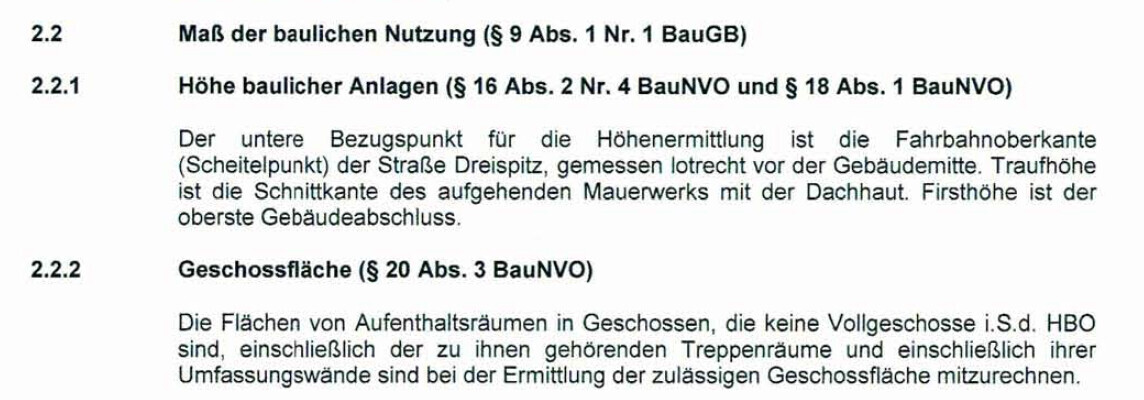
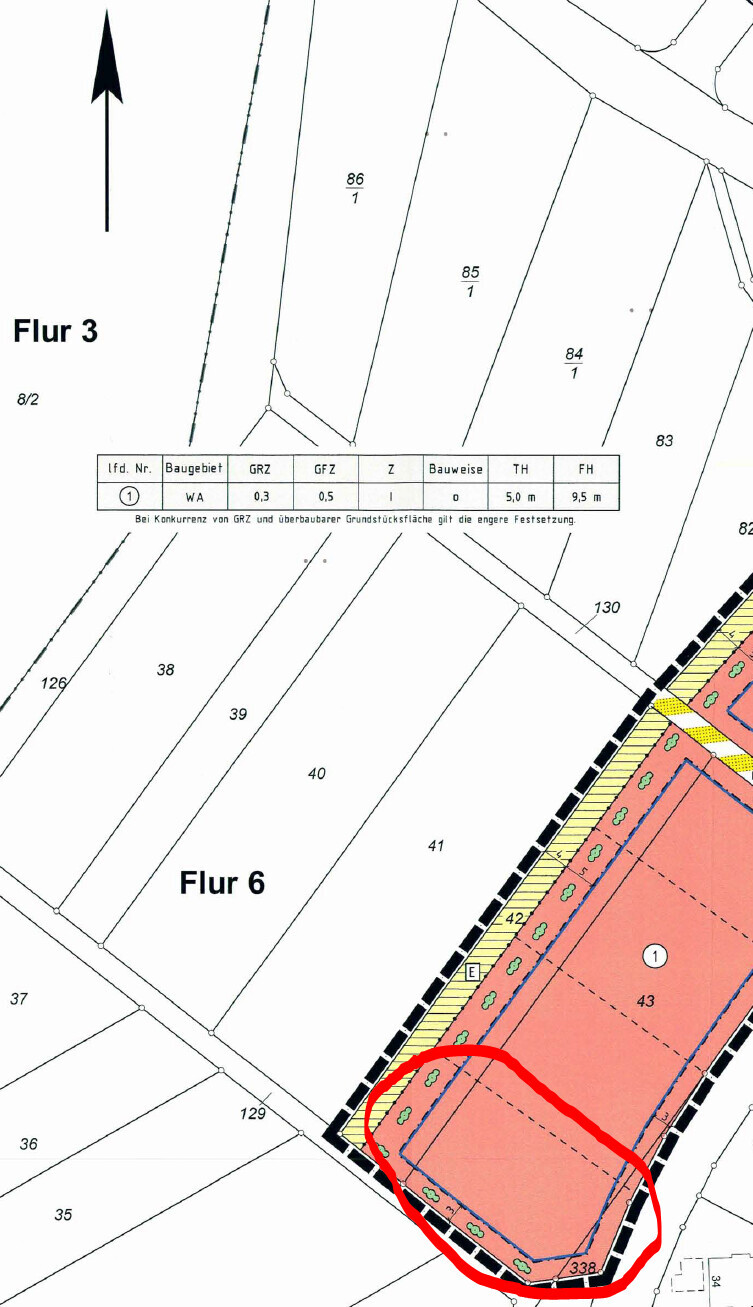
We are currently planning the construction of our house and many questions keep coming up.
Our plot (approximately 770 m² (8,293 ft²)) is on a slope, which, based on quite a bit of reading, leads us to consider building our house with a basement, as we would rather not have to dig the house into the hill and look out onto an earth wall. I have attached some excerpts from the development plan.
The plot is rather elongated (about 20 m (66 ft) wide and 40 m (131 ft) deep) and slopes upward from the street. According to the Geoportal Hessen, we have an elevation difference of about 3 m (10 ft) over the 40 m (131 ft) depth.
Our first thought was: "Well, then we’ll just build with a basement." However, after examining the specific height specifications from the development plan, the eaves height of 5 m (measured from the street’s road surface edge, the highest point, measured vertically in front of the building center) might cause an issue. With the 5 m eaves height limit, wouldn’t we have to embed about half of the basement underground?
Our idea was that the basement (lower ground floor) would be level with the street at the front, allowing direct access from there, and at the back, the living area (ground floor) would have level access to the garden.
How do you assess the dimensions and requirements in the development plan?
Over the weekend, we visited a model home exhibition in Bad Vilbel and spoke with a representative from Fingerhaus, who suggested a kind of compact basement with access only from the outside, not from inside the house. Does anyone know this type of basement or have experience with it? Would it also be possible to build a “regular” basement in that case?
We roughly calculated the costs:
House (turnkey) according to Fingerhaus (Type Sento B): about 300,000€
Foundation + walls: about 20,000€
Additional features: about 50,000€
Basement + incidental building costs: about 80,000€
Do you consider these figures roughly realistic?
Can anyone recommend building companies from the Mittelhessen (Central Hesse) region? Can construction companies provide cost estimates based on the available data, or do we first need a soil survey and precise height measurements?
So many questions, but you have to start somewhere.
Thank you very much in advance for any tips or answers!

Escroda schrieb:
Nobody is spreading panic, and 5 meters (16 feet) is not dramatic. But the layout shows that those 5 meters (16 feet) do limit the options. For a terrace, quite a bit of digging is required.
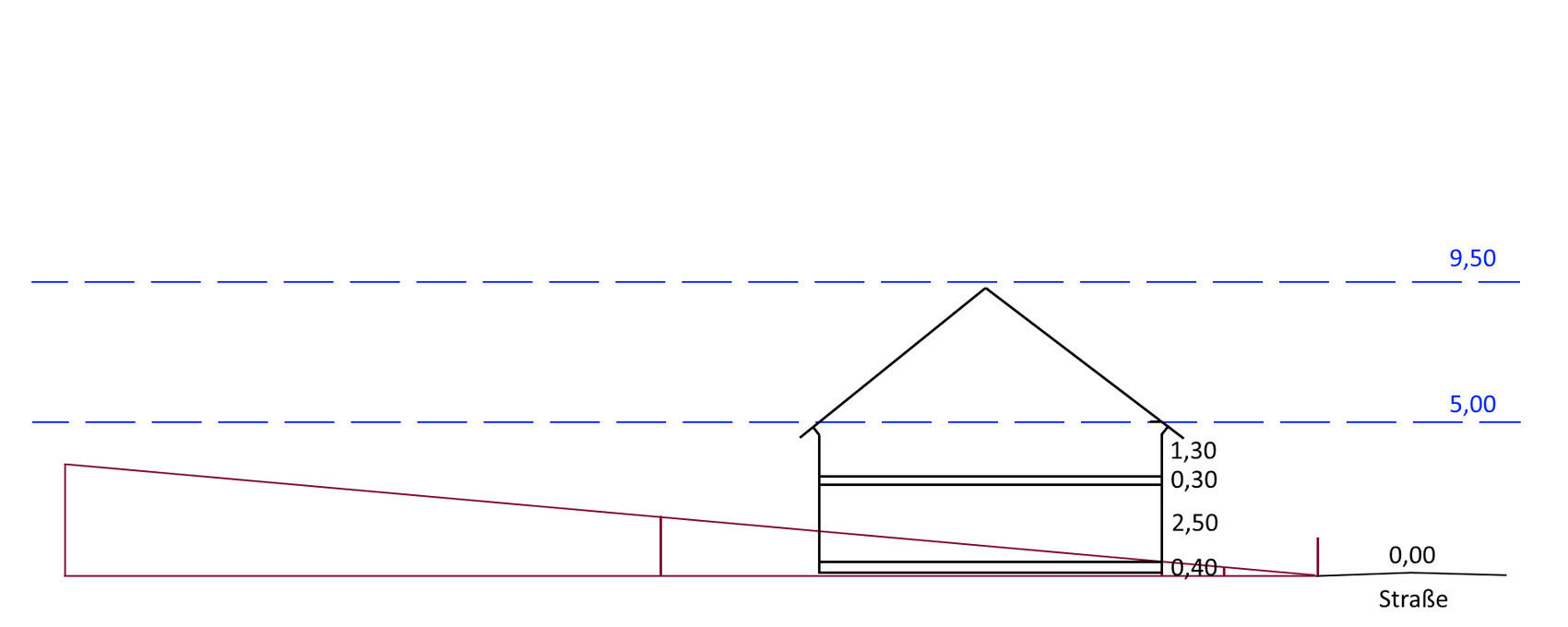
Yes, it’s definitely tricky. But once the excavator starts, the cubic meters (cubic yards) of soil will be moved quickly. Or you decide to go for the south-facing terrace – or maybe not. RomeoZwo schrieb:
Wouldn’t this plot be perfect for a split-level design?Who wants that anyway?
kaho674 schrieb:
Who would want that?I like split-level homes. They might be impractical, but I’ve always found the idea of a “partial separation” between living areas interesting. And it’s definitely better than sitting on a terrace in front of a 1.7m (5 ft 7 in) earth embankment.
H
hampshire5 Feb 2020 16:55You have a sloped site – be glad, because it gives you the opportunity to think somewhat “out of the box.” Setting a fixed elevation to place a flatland house on it will not lead to good architecture. Instead, think with the slope rather than against it, and seek experienced local help (architect).
Topic: staggered roof surfaces & knee walls – a good idea:
To meet the eave height requirement facing the street, my parents built a house with a staggered gable roof around 1970, similar to the example image by @RomeoZwo. However, the interior is not a split-level. The knee wall towards the garden is over 2m (6.5 feet) high.
Topic: terrace:
The terrace for relaxing, grilling, etc. does not necessarily have to be at the same level as the ground floor. Slightly reshaping the terrain and having a small path leading to it can be very attractive—perhaps a bit less practical, but definitely charming and enjoyable.
Topic: split-level:
From an ergonomic and space utilization point of view, a few steps here and there can certainly be debated – yet there are highly attractive solutions. I would avoid setting dogmas here and instead explore various options to see what works best and what an architect can come up with.
Topic: staggered roof surfaces & knee walls – a good idea:
To meet the eave height requirement facing the street, my parents built a house with a staggered gable roof around 1970, similar to the example image by @RomeoZwo. However, the interior is not a split-level. The knee wall towards the garden is over 2m (6.5 feet) high.
Topic: terrace:
The terrace for relaxing, grilling, etc. does not necessarily have to be at the same level as the ground floor. Slightly reshaping the terrain and having a small path leading to it can be very attractive—perhaps a bit less practical, but definitely charming and enjoyable.
Topic: split-level:
From an ergonomic and space utilization point of view, a few steps here and there can certainly be debated – yet there are highly attractive solutions. I would avoid setting dogmas here and instead explore various options to see what works best and what an architect can come up with.

hampshire schrieb:
Setting any fixed level to build a flatland house on will not lead to good architecture.This should actually be pinned here, for the memory books of all home builders: to design the house with the plot rather than against the plot.https://www.instagram.com/11antgmxde/
https://www.linkedin.com/company/bauen-jetzt/
H
Hausi190928 Feb 2020 23:11Hello everyone,
thank you for your great tips!
We have now established a few contacts with construction companies and already had two meetings. At the moment, we are looking into the additional building costs and trying to list everything out. I have a question about this. I have seen many lists mentioning house connection costs. Our plot is already fully developed. Does this mean we no longer have to pay these costs?
Also, I would appreciate your assessment of the included services from our currently preferred builder:
- Custom planning and preparation of the building permit application / planning permission
- Structural engineering, sound insulation, and heating demand calculation
- Application for all necessary approvals from utility companies, gas suppliers, local authorities, and other agencies
- Preparation of detailed construction drawings (1:50 scale)
- Construction management
- Official site plans for the building permit application / planning permission
- Official project staking out
- Official height surveys
- Temporary construction power connection and consumption costs during the construction phase
- Construction water connection and consumption costs during the construction phase
- Construction site toilet and maintenance during the construction phase
- Earthworks
- Drainage works
- Sewer connection works up to the handover point at the property boundary (up to 5m (16 feet))
- Inspection chamber
- Rainwater cistern
- Roof drainage ring pipe connected to the cistern
- Load-bearing foundation slab, 25cm (10 inches) thick
- Masonry and concrete works
- Exterior walls made of aerated concrete blocks (Ytong)
- Basement: convertible to living space, built with aerated concrete masonry, living room windows like ground floor, marble window sills, interior doors like ground floor, electrical installation, heating works, screed and interior plaster, staircase from basement to ground floor as a cantilevered solid beech wood staircase. Important: all earth and drainage works, light wells, insulation of basement exterior walls, backfilling and compaction of basement working area.
- Scaffolding works
- Carpentry work (using engineered timber)
- Metal cladding work (titanium zinc)
- Roofing work (e.g., brand Nelskamp)
- Screed work (anhydrite screed in all rooms)
- Two-layer exterior plaster
- Drywall construction (non-load-bearing interior walls are double-boarded!!)
- Window installation (brands Wirus or Schüco)
- Burglar-resistant main door with glass panels in various designs
- Roller shutter installation
- Burglar-resistant windows and doors
- Triple-glazed thermal insulation glazing
- Exterior window sills
- Interior window sills in Carrara marble
- Heating installation (brand Junkers)
- Air-to-water heat pump, brand Junkers
- Underfloor heating (pipe system, brand Uponor-Tecto)
- Sanitary installation (exclusively German brand products, e.g., Keramag, Villeroy & Boch, etc.)
- Electrical installation (e.g., brand Merten Atelier)
- Intercom system
- Tile work in bathroom and guest toilet (floors and walls), material cost 30 EUR/sqm (floors)/25 EUR/sqm (walls)
- Gravel driveway from the street to the main entrance (up to 5m (16 feet))
- Interior plaster
- Elegant, cantilevered solid beech wood staircase (brand Treppen-Weiß)
- Interior doors with hollow core and chipboard core (e.g., brand Garant, exclusive beech)
- Security package: smoke detectors, main door with triple locking, windows with mushroom head locks
- Application for funding and KfW loans for your building project
- Special purchasing conditions through our partners (from baseboards to fully custom-designed branded kitchens)
- Blower door test
- Including report and quality seal
- 5 years warranty according to the building code
To us, this sounds like quite a lot is already included?
Thank you very much for your help!
thank you for your great tips!
We have now established a few contacts with construction companies and already had two meetings. At the moment, we are looking into the additional building costs and trying to list everything out. I have a question about this. I have seen many lists mentioning house connection costs. Our plot is already fully developed. Does this mean we no longer have to pay these costs?
Also, I would appreciate your assessment of the included services from our currently preferred builder:
- Custom planning and preparation of the building permit application / planning permission
- Structural engineering, sound insulation, and heating demand calculation
- Application for all necessary approvals from utility companies, gas suppliers, local authorities, and other agencies
- Preparation of detailed construction drawings (1:50 scale)
- Construction management
- Official site plans for the building permit application / planning permission
- Official project staking out
- Official height surveys
- Temporary construction power connection and consumption costs during the construction phase
- Construction water connection and consumption costs during the construction phase
- Construction site toilet and maintenance during the construction phase
- Earthworks
- Drainage works
- Sewer connection works up to the handover point at the property boundary (up to 5m (16 feet))
- Inspection chamber
- Rainwater cistern
- Roof drainage ring pipe connected to the cistern
- Load-bearing foundation slab, 25cm (10 inches) thick
- Masonry and concrete works
- Exterior walls made of aerated concrete blocks (Ytong)
- Basement: convertible to living space, built with aerated concrete masonry, living room windows like ground floor, marble window sills, interior doors like ground floor, electrical installation, heating works, screed and interior plaster, staircase from basement to ground floor as a cantilevered solid beech wood staircase. Important: all earth and drainage works, light wells, insulation of basement exterior walls, backfilling and compaction of basement working area.
- Scaffolding works
- Carpentry work (using engineered timber)
- Metal cladding work (titanium zinc)
- Roofing work (e.g., brand Nelskamp)
- Screed work (anhydrite screed in all rooms)
- Two-layer exterior plaster
- Drywall construction (non-load-bearing interior walls are double-boarded!!)
- Window installation (brands Wirus or Schüco)
- Burglar-resistant main door with glass panels in various designs
- Roller shutter installation
- Burglar-resistant windows and doors
- Triple-glazed thermal insulation glazing
- Exterior window sills
- Interior window sills in Carrara marble
- Heating installation (brand Junkers)
- Air-to-water heat pump, brand Junkers
- Underfloor heating (pipe system, brand Uponor-Tecto)
- Sanitary installation (exclusively German brand products, e.g., Keramag, Villeroy & Boch, etc.)
- Electrical installation (e.g., brand Merten Atelier)
- Intercom system
- Tile work in bathroom and guest toilet (floors and walls), material cost 30 EUR/sqm (floors)/25 EUR/sqm (walls)
- Gravel driveway from the street to the main entrance (up to 5m (16 feet))
- Interior plaster
- Elegant, cantilevered solid beech wood staircase (brand Treppen-Weiß)
- Interior doors with hollow core and chipboard core (e.g., brand Garant, exclusive beech)
- Security package: smoke detectors, main door with triple locking, windows with mushroom head locks
- Application for funding and KfW loans for your building project
- Special purchasing conditions through our partners (from baseboards to fully custom-designed branded kitchens)
- Blower door test
- Including report and quality seal
- 5 years warranty according to the building code
To us, this sounds like quite a lot is already included?
Thank you very much for your help!
Similar topics