
Hello everyone,
We are currently planning the construction of our house and many questions keep coming up.
Our plot (approximately 770 m² (8,293 ft²)) is on a slope, which, based on quite a bit of reading, leads us to consider building our house with a basement, as we would rather not have to dig the house into the hill and look out onto an earth wall. I have attached some excerpts from the development plan.
The plot is rather elongated (about 20 m (66 ft) wide and 40 m (131 ft) deep) and slopes upward from the street. According to the Geoportal Hessen, we have an elevation difference of about 3 m (10 ft) over the 40 m (131 ft) depth.
Our first thought was: "Well, then we’ll just build with a basement." However, after examining the specific height specifications from the development plan, the eaves height of 5 m (measured from the street’s road surface edge, the highest point, measured vertically in front of the building center) might cause an issue. With the 5 m eaves height limit, wouldn’t we have to embed about half of the basement underground?
Our idea was that the basement (lower ground floor) would be level with the street at the front, allowing direct access from there, and at the back, the living area (ground floor) would have level access to the garden.
How do you assess the dimensions and requirements in the development plan?
Over the weekend, we visited a model home exhibition in Bad Vilbel and spoke with a representative from Fingerhaus, who suggested a kind of compact basement with access only from the outside, not from inside the house. Does anyone know this type of basement or have experience with it? Would it also be possible to build a “regular” basement in that case?
We roughly calculated the costs:
House (turnkey) according to Fingerhaus (Type Sento B): about 300,000€
Foundation + walls: about 20,000€
Additional features: about 50,000€
Basement + incidental building costs: about 80,000€
Do you consider these figures roughly realistic?
Can anyone recommend building companies from the Mittelhessen (Central Hesse) region? Can construction companies provide cost estimates based on the available data, or do we first need a soil survey and precise height measurements?
So many questions, but you have to start somewhere.
Thank you very much in advance for any tips or answers!

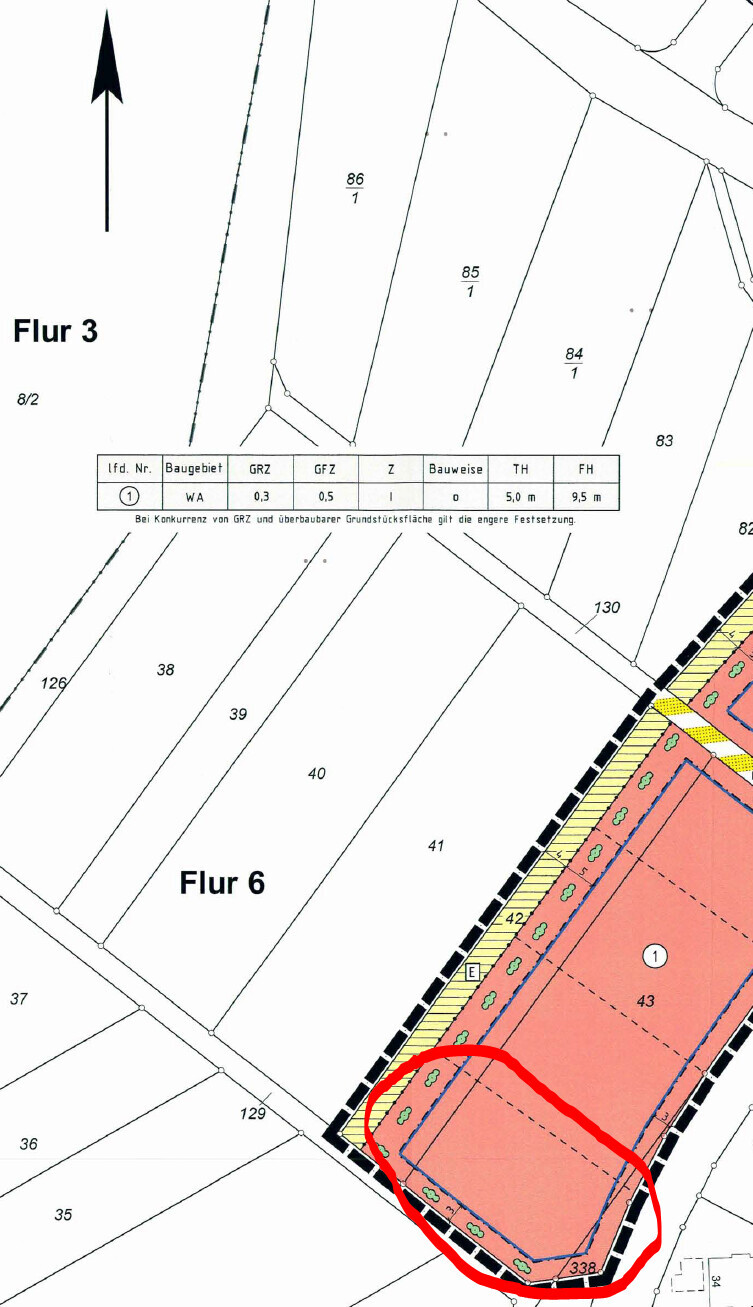
We are currently planning the construction of our house and many questions keep coming up.
Our plot (approximately 770 m² (8,293 ft²)) is on a slope, which, based on quite a bit of reading, leads us to consider building our house with a basement, as we would rather not have to dig the house into the hill and look out onto an earth wall. I have attached some excerpts from the development plan.
The plot is rather elongated (about 20 m (66 ft) wide and 40 m (131 ft) deep) and slopes upward from the street. According to the Geoportal Hessen, we have an elevation difference of about 3 m (10 ft) over the 40 m (131 ft) depth.
Our first thought was: "Well, then we’ll just build with a basement." However, after examining the specific height specifications from the development plan, the eaves height of 5 m (measured from the street’s road surface edge, the highest point, measured vertically in front of the building center) might cause an issue. With the 5 m eaves height limit, wouldn’t we have to embed about half of the basement underground?
Our idea was that the basement (lower ground floor) would be level with the street at the front, allowing direct access from there, and at the back, the living area (ground floor) would have level access to the garden.
How do you assess the dimensions and requirements in the development plan?
Over the weekend, we visited a model home exhibition in Bad Vilbel and spoke with a representative from Fingerhaus, who suggested a kind of compact basement with access only from the outside, not from inside the house. Does anyone know this type of basement or have experience with it? Would it also be possible to build a “regular” basement in that case?
We roughly calculated the costs:
House (turnkey) according to Fingerhaus (Type Sento B): about 300,000€
Foundation + walls: about 20,000€
Additional features: about 50,000€
Basement + incidental building costs: about 80,000€
Do you consider these figures roughly realistic?
Can anyone recommend building companies from the Mittelhessen (Central Hesse) region? Can construction companies provide cost estimates based on the available data, or do we first need a soil survey and precise height measurements?
So many questions, but you have to start somewhere.
Thank you very much in advance for any tips or answers!
H
Hausi19094 Feb 2020 17:08Thank you for your answers! We had already suspected that, but then we need to come up with a good solution involving a concrete slab.
The basement storage space would have been nice, but maybe we could build a large garage attached to the house, with an additional room where the utility room could also be placed?
Regarding the eaves height again: Assuming we build a one-and-a-half-story house with a knee wall of 1.3 m (4 feet 3 inches), how high would the house be allowed to be above street level? What height is typically used for a standard floor? 3 m (10 feet)? So, the house could start 0.7 m (2 feet 3 inches) above street level? Is this calculation correct?
Yes, I checked the Geoportal Hessen. However, the values there are rounded to the nearest meter (feet), and I’m not sure how accurate they are.
The basement storage space would have been nice, but maybe we could build a large garage attached to the house, with an additional room where the utility room could also be placed?
Regarding the eaves height again: Assuming we build a one-and-a-half-story house with a knee wall of 1.3 m (4 feet 3 inches), how high would the house be allowed to be above street level? What height is typically used for a standard floor? 3 m (10 feet)? So, the house could start 0.7 m (2 feet 3 inches) above street level? Is this calculation correct?
Yes, I checked the Geoportal Hessen. However, the values there are rounded to the nearest meter (feet), and I’m not sure how accurate they are.
Hausi1909 schrieb:
Is this calculation correct? That depends on how you measure the knee wall height. According to the development plan, the reference height is the intersection of the outer edge of the masonry with the roof covering, meaning it includes the roof structure, which the knee wall height generally does not account for.
Hausi1909 schrieb:
There, however, the measurements are rounded to meters (feet), and I’m not sure how reliable the values are. In your local GIS, the heights are displayed with a resolution of decimeters (decimeters), but I couldn't quickly find information on the actual accuracy. For preliminary planning, it should be sufficient. Alternatively, I suggest using a laser level, water level hose, or leveling instrument from a hardware store or equipment rental. Or just ask your neighbor—they probably have a site plan with heights from their building permit / planning permission.
H
Hausi19094 Feb 2020 19:59Escroda schrieb:
That depends on how you measure the knee wall. The reference height according to the building regulations is the intersection of the outer edge of the masonry with the roof covering, meaning it includes the roof structure, which is usually not considered in the knee wall height.Could you please explain this in a bit more detail? I don’t fully understand how the eave height is calculated. That would be really helpful!
Thanks for the tips!

Hausi1909 schrieb:
What is the typical height for a standard floor? 3 m (10 feet)? I couldn’t find the exact floor height for this specific model on its product page. Aside from the fact that measurements inside the house shift accordingly—which mainly affects headroom on the stairs, in the shower, or at the toilet—the default knee wall height for the 38° pitch version is 1.30 m (4 feet 3 inches), but this can usually be adjusted (it’s less advisable to change the roof pitch from the standard model). So if it turns out that the house would work with a knee wall height of, for example, 1.10 m (3 feet 7 inches), it’s not necessarily a problem. However, I don’t know what additional costs that might involve.
https://www.instagram.com/11antgmxde/
https://www.linkedin.com/company/bauen-jetzt/

Unfortunately, I can’t understand the panic.
Assuming a 5m (16 feet) distance from the street and a consistent slope as stated, with a 10m (33 feet) house depth:
Up to 5m (16 feet), you lose 0.375m (15 inches) in height, and there you add 0.35m (14 inches) of fill so that the rear rooms don’t end up underground. Rounding up to 0.75m (30 inches), this leaves, according to my calculation:
5m (16 feet) - 0.75m (30 inches) = 4.25m (14 feet) - 2.90m (9 feet 6 inches) story height (0.30m (12 inches) slab + 2.60m (8 feet 6 inches) ceiling height) = 1.35m (53 inches) knee wall. That’s a very good standard for a one-and-a-half-story house! You can comfortably place a bed under the sloped roof there.
Have I missed something, or why are the 5 meters considered so dramatic?
Assuming a 5m (16 feet) distance from the street and a consistent slope as stated, with a 10m (33 feet) house depth:
Up to 5m (16 feet), you lose 0.375m (15 inches) in height, and there you add 0.35m (14 inches) of fill so that the rear rooms don’t end up underground. Rounding up to 0.75m (30 inches), this leaves, according to my calculation:
5m (16 feet) - 0.75m (30 inches) = 4.25m (14 feet) - 2.90m (9 feet 6 inches) story height (0.30m (12 inches) slab + 2.60m (8 feet 6 inches) ceiling height) = 1.35m (53 inches) knee wall. That’s a very good standard for a one-and-a-half-story house! You can comfortably place a bed under the sloped roof there.
Have I missed something, or why are the 5 meters considered so dramatic?
Similar topics