
ᐅ Location of a city villa or detached single-family house on a 500 m² rectangular plot
Created on: 17 Jan 2020 18:03
T
Tolentino
Dear all,
after sharing the floor plans of my possible hamster cage with you in the other thread , here comes the next thread (thanks again for all the constructive suggestions there).
Just so you know, the semi-detached house is not off the table yet, as this plot of land is highly sought after and it’s not clear whether it will work out. But this one would be my favorite.
Now to this plot. For now, I’m mainly concerned with where and roughly how the house should be positioned on this plot.
Development plan / restrictions
Plot size: 500 m² (5400 sq ft)
Slope: none
Site coverage ratio: 0.2
Floor area ratio: 0.4
Building envelope, building line and boundary: 5 m (16 ft) from the street, 3 m (10 ft) from neighbors
Edge development: allowed for garages and sheds, none existing on the plot
Number of parking spaces: 1-2
Number of floors: 1.5–2.5
Roof shape: no preference
Architectural style: no preference
Orientation: aligned parallel to the street
Maximum heights / limits: ridge height max. 9 m (30 ft)
Below are the site plans I created myself based on the details from the listing.
This is a rough overview of the plot with building boundaries and dimensions.
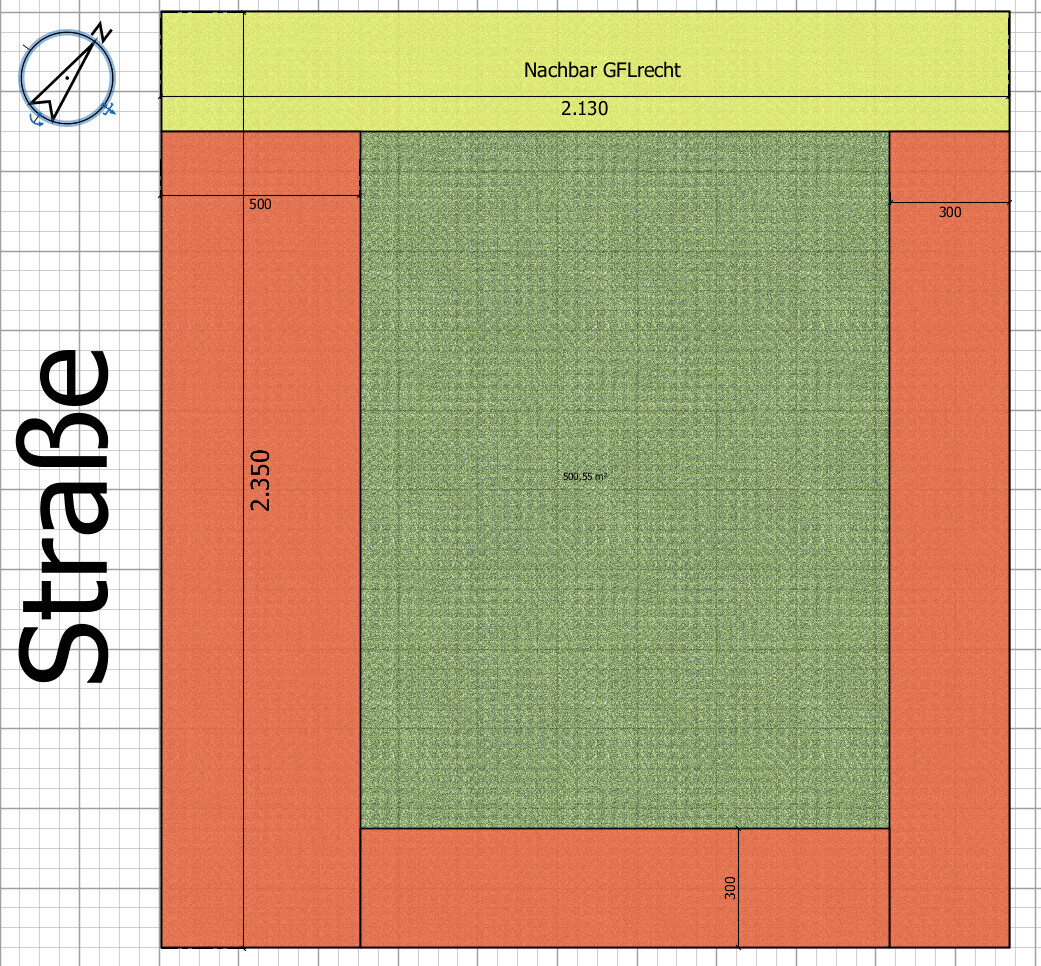
My question is: where to put the house?
The broker suggests placing it towards the back, since you already have the 5 m (16 ft) setback at the front and would “gain” about 3 m (10 ft) of garden. My partner doesn’t like this because of the visibility from the street. I say: privacy screen! But I also think, a fence too high might create a prison-yard feel.
But even if you follow this suggestion, I wonder if a more square floor plan (-> town villa style) would be better?
Like this, for example:
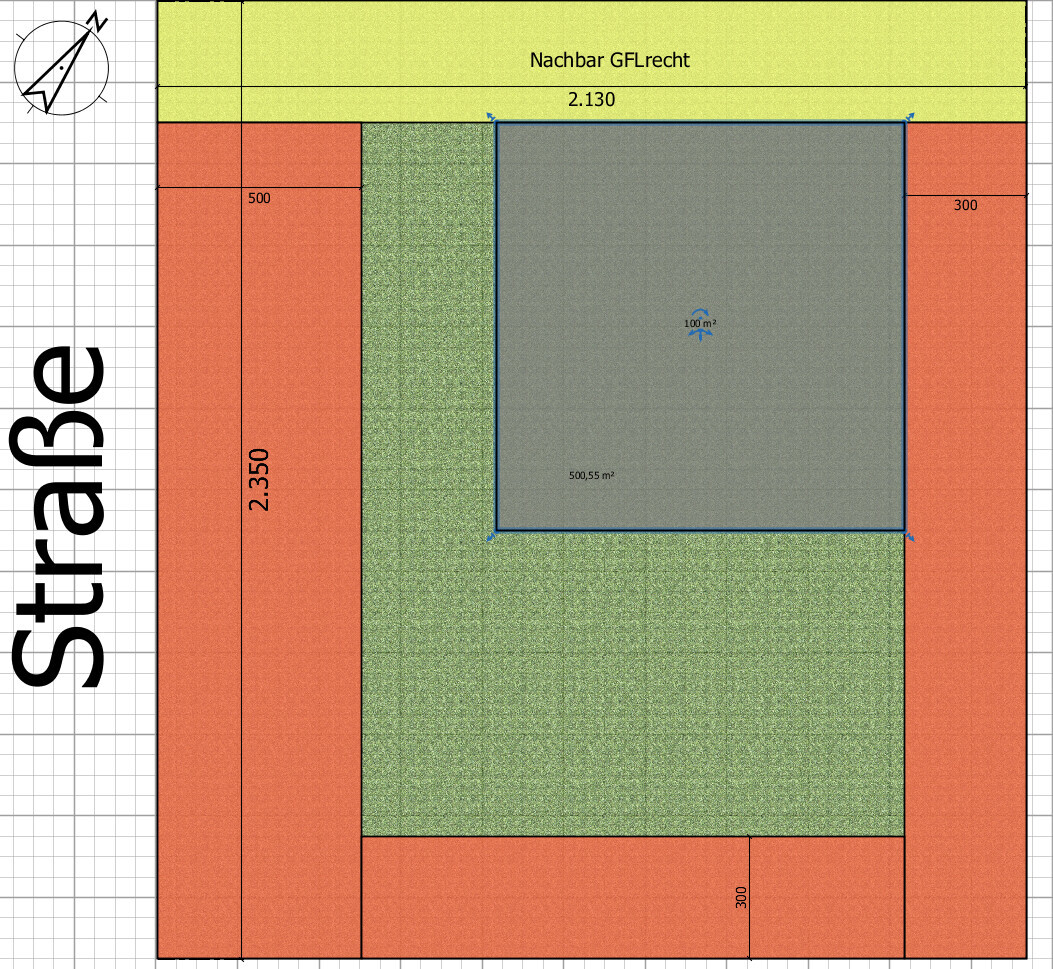
Then parking space might be tricky, right?
Or upright like this?
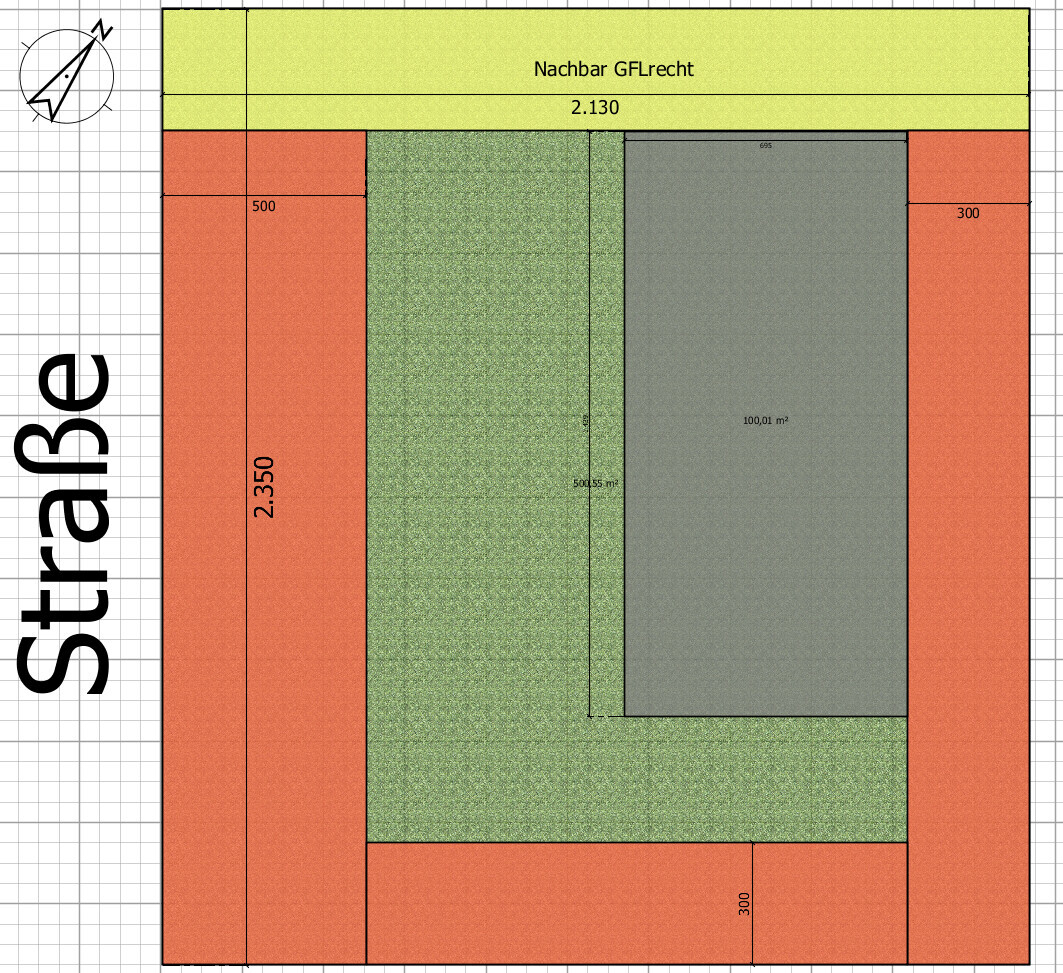
I really want as much of a west-facing view and garden as possible. I tend to be an evening person and that side is less built up, due to the road. So I think more light comes through.
But the narrow floor plan caused lots of problems with the semi-detached house already. Well, here you could build longer instead.
What do you think?
Best regards
Tolentino
after sharing the floor plans of my possible hamster cage with you in the other thread , here comes the next thread (thanks again for all the constructive suggestions there).
Just so you know, the semi-detached house is not off the table yet, as this plot of land is highly sought after and it’s not clear whether it will work out. But this one would be my favorite.
Now to this plot. For now, I’m mainly concerned with where and roughly how the house should be positioned on this plot.
Development plan / restrictions
Plot size: 500 m² (5400 sq ft)
Slope: none
Site coverage ratio: 0.2
Floor area ratio: 0.4
Building envelope, building line and boundary: 5 m (16 ft) from the street, 3 m (10 ft) from neighbors
Edge development: allowed for garages and sheds, none existing on the plot
Number of parking spaces: 1-2
Number of floors: 1.5–2.5
Roof shape: no preference
Architectural style: no preference
Orientation: aligned parallel to the street
Maximum heights / limits: ridge height max. 9 m (30 ft)
Below are the site plans I created myself based on the details from the listing.
This is a rough overview of the plot with building boundaries and dimensions.
My question is: where to put the house?
The broker suggests placing it towards the back, since you already have the 5 m (16 ft) setback at the front and would “gain” about 3 m (10 ft) of garden. My partner doesn’t like this because of the visibility from the street. I say: privacy screen! But I also think, a fence too high might create a prison-yard feel.
But even if you follow this suggestion, I wonder if a more square floor plan (-> town villa style) would be better?
Like this, for example:
Then parking space might be tricky, right?
Or upright like this?
I really want as much of a west-facing view and garden as possible. I tend to be an evening person and that side is less built up, due to the road. So I think more light comes through.
But the narrow floor plan caused lots of problems with the semi-detached house already. Well, here you could build longer instead.
What do you think?
Best regards
Tolentino

tumaa schrieb:
my view:
with children = two-storey
without children = one-and-a-half-storeyOkay, could you maybe explain the reasoning behind that a bit?
So far, our son actually finds the idea of sloping ceilings very cozy and would prefer to live in the converted attic space and never leave.
I understand that the idea of children doesn’t necessarily match reality. But until now, my assumption was that children generally cope quite well with sloped ceilings: they’re smaller at first, need less "head-height" furniture, and tend to spend a lot of time on the floor anyway...
Sure, if you need a bunk bed then a higher wall might make sense, but you don’t have to plan around that.
On the other hand, I need my 2.35m (7 ft 8.5 in) tall wardrobe, the 2.37m (7 ft 9.5 in) high shelving unit, and want to hang a few other things on the wall that aren’t practical with sloping ceilings.
But the house isn’t meant for me alone. That’s why a gable roof is definitely an option for me if there are significant advantages.
By the way, according to the builder, it’s not much cheaper (about 3,000 EUR on 150m² (1,615 sq ft)).
Good luck
Tolentino
Tolentino schrieb:
Ok, could you maybe explain the reasoning behind that a bit? As both an adult and a child, I wouldn’t have a problem with it, but as a teenager I would (the older you get, the more space you need). I want to get the most out of my room, and the one-and-a-half-story design would limit me in that regard.

I agree. Your house will be about the same size as mine at most: 11 x 10 m (36 x 33 ft). We also planned for 2 children's bedrooms. If I imagine it now with sloped ceilings and smaller rooms, etc. – that would be noticeably less space.
Okay – complaining at a high level, but if you have the choice anyway...
Okay – complaining at a high level, but if you have the choice anyway...
Tolentino schrieb:
The attic space that can be converted doesn’t seem to make much of a difference.It can be disregarded. That would only be a narrow roof peak. The attic under a hipped roof is even larger. But overall, the costs are naturally higher – of course.
Tolentino schrieb:
So far, our son has found the idea of sloped ceilings really cozy and would prefer to live in the finished attic space and never come out again. A vertical-walled upper floor has the least treehouse appeal
Tolentino schrieb:
What would you consider a reasonable knee wall height? 1m (3.3 ft)?
Well, I'm actually someone who tends to prefer two full stories for better room usability. I wouldn’t limit the concept of usability to the idea that every corner must be suitable for broom closets—that seems like too rigid a paradigm and unnecessary to me.
I see a knee wall as optimal exactly when it fully replaces a short wall (Drempel)—no more, no less—because then you don’t have to combine the two, which I consider highly undesirable. Regarding simpler sealing of the thermal envelope, it’s more practical to have a knee wall and attic space rather than a short wall and crawl space (or short wall, crawl space, and attic). As a guideline for the clear knee wall height, I would look at window sills or the height of headboards.
I wouldn’t consider finishing the attic space without either a knee wall or short wall. The most economical roof shapes are the shed roof as a truss structure with exposed underside, and the gable roof in various constructions. If it hadn’t disappeared from planners’ minds, the mansard roof would probably meet most self-builders’ usability requirements best—it works significantly better with a rectangular footprint, as cutbacks would be its Achilles' heel.
https://www.instagram.com/11antgmxde/
https://www.linkedin.com/company/bauen-jetzt/
Similar topics