
ᐅ Location of a city villa or detached single-family house on a 500 m² rectangular plot
Created on: 17 Jan 2020 18:03
T
Tolentino
Dear all,
after sharing the floor plans of my possible hamster cage with you in the other thread , here comes the next thread (thanks again for all the constructive suggestions there).
Just so you know, the semi-detached house is not off the table yet, as this plot of land is highly sought after and it’s not clear whether it will work out. But this one would be my favorite.
Now to this plot. For now, I’m mainly concerned with where and roughly how the house should be positioned on this plot.
Development plan / restrictions
Plot size: 500 m² (5400 sq ft)
Slope: none
Site coverage ratio: 0.2
Floor area ratio: 0.4
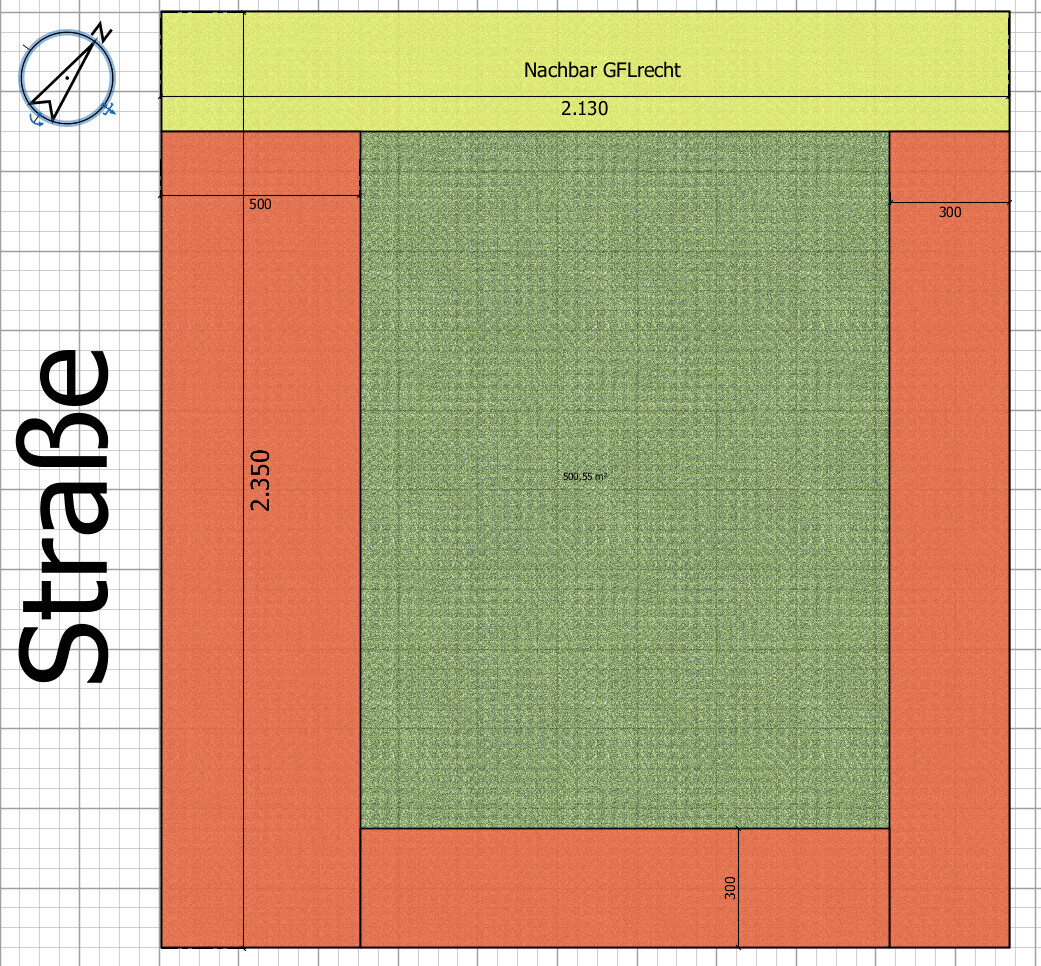
Building envelope, building line and boundary: 5 m (16 ft) from the street, 3 m (10 ft) from neighbors
Edge development: allowed for garages and sheds, none existing on the plot
Number of parking spaces: 1-2
Number of floors: 1.5–2.5
Roof shape: no preference
Architectural style: no preference
Orientation: aligned parallel to the street
Maximum heights / limits: ridge height max. 9 m (30 ft)
Below are the site plans I created myself based on the details from the listing.
This is a rough overview of the plot with building boundaries and dimensions.
My question is: where to put the house?
The broker suggests placing it towards the back, since you already have the 5 m (16 ft) setback at the front and would “gain” about 3 m (10 ft) of garden. My partner doesn’t like this because of the visibility from the street. I say: privacy screen! But I also think, a fence too high might create a prison-yard feel.
But even if you follow this suggestion, I wonder if a more square floor plan (-> town villa style) would be better?
Like this, for example:
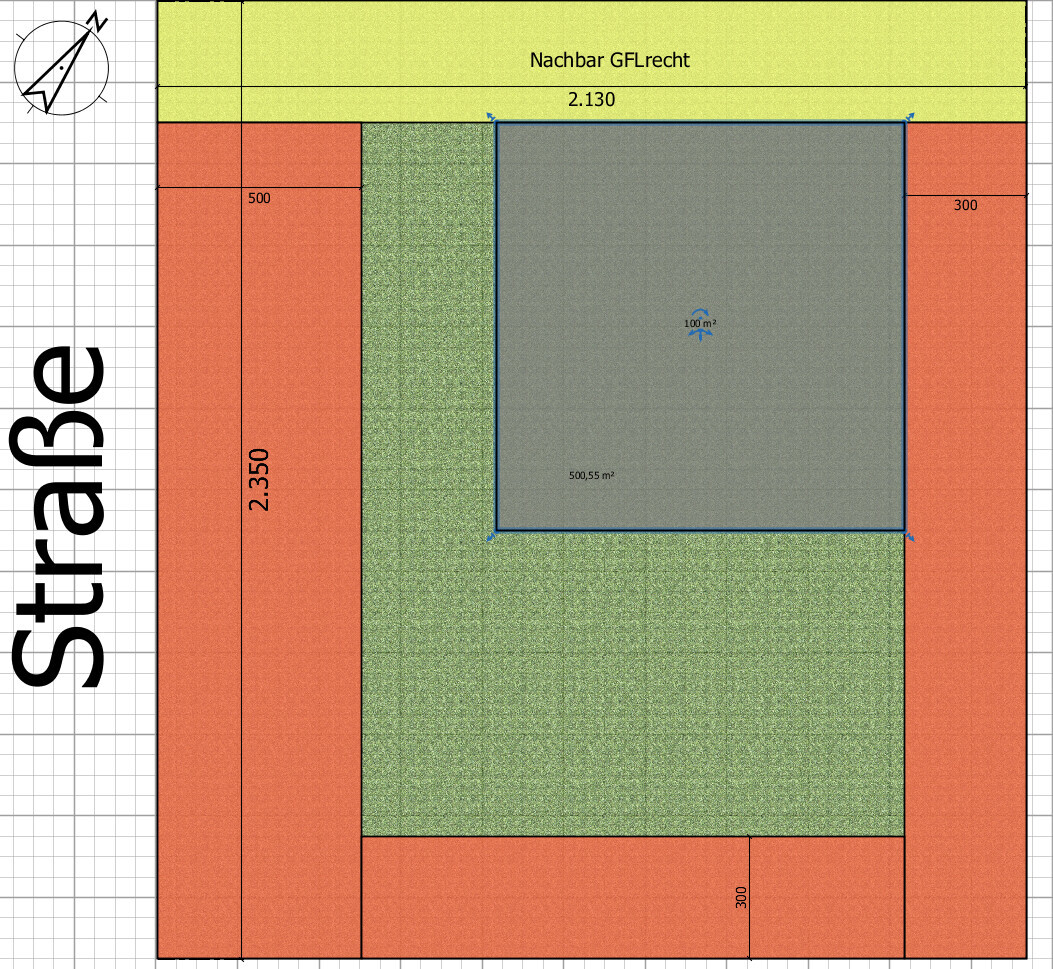
Then parking space might be tricky, right?
Or upright like this?
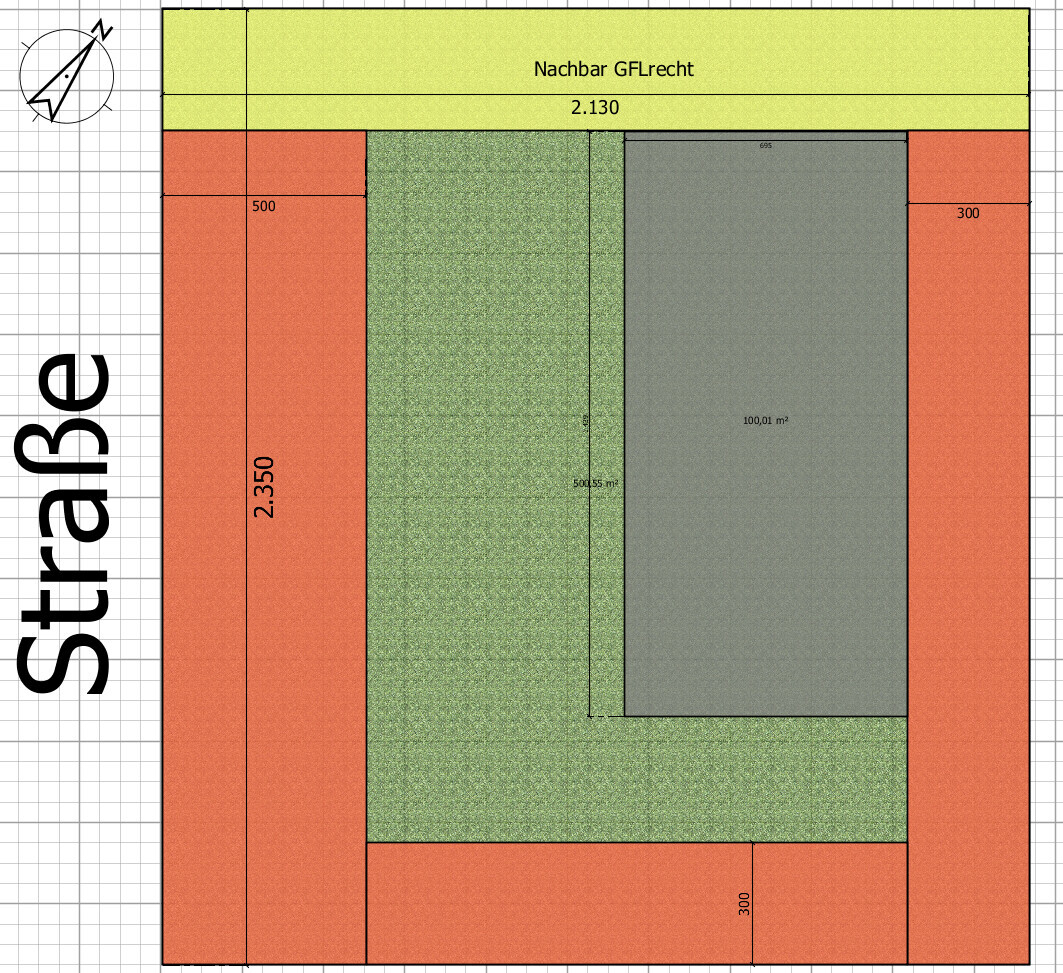
I really want as much of a west-facing view and garden as possible. I tend to be an evening person and that side is less built up, due to the road. So I think more light comes through.
But the narrow floor plan caused lots of problems with the semi-detached house already. Well, here you could build longer instead.
What do you think?
Best regards
Tolentino
after sharing the floor plans of my possible hamster cage with you in the other thread , here comes the next thread (thanks again for all the constructive suggestions there).
Just so you know, the semi-detached house is not off the table yet, as this plot of land is highly sought after and it’s not clear whether it will work out. But this one would be my favorite.
Now to this plot. For now, I’m mainly concerned with where and roughly how the house should be positioned on this plot.
Development plan / restrictions
Plot size: 500 m² (5400 sq ft)
Slope: none
Site coverage ratio: 0.2
Floor area ratio: 0.4
Building envelope, building line and boundary: 5 m (16 ft) from the street, 3 m (10 ft) from neighbors
Edge development: allowed for garages and sheds, none existing on the plot
Number of parking spaces: 1-2
Number of floors: 1.5–2.5
Roof shape: no preference
Architectural style: no preference
Orientation: aligned parallel to the street
Maximum heights / limits: ridge height max. 9 m (30 ft)
Below are the site plans I created myself based on the details from the listing.
This is a rough overview of the plot with building boundaries and dimensions.
My question is: where to put the house?
The broker suggests placing it towards the back, since you already have the 5 m (16 ft) setback at the front and would “gain” about 3 m (10 ft) of garden. My partner doesn’t like this because of the visibility from the street. I say: privacy screen! But I also think, a fence too high might create a prison-yard feel.
But even if you follow this suggestion, I wonder if a more square floor plan (-> town villa style) would be better?
Like this, for example:
Then parking space might be tricky, right?
Or upright like this?
I really want as much of a west-facing view and garden as possible. I tend to be an evening person and that side is less built up, due to the road. So I think more light comes through.
But the narrow floor plan caused lots of problems with the semi-detached house already. Well, here you could build longer instead.
What do you think?
Best regards
Tolentino

kaho674 schrieb:
I think the key point is that you shouldn’t rely solely on the statements from the building authority when calculating the floor area ratio, as this might unnecessarily limit you. Also, it’s worth remembering that you will most likely have to pay property transfer tax on the house if you build with the land seller.Yes, I realize that. No, the seller is a third party; the real estate agent and the building authority know each other.
Dear all,
A brief update from my side.
I have now received a draft purchase agreement from the notary. It clearly outlines how the easement (the pedestrian, vehicle, and utility access right of the neighbor at the back) is regulated: I have to grant it to him. If we use it together (meaning I drive along the same strip to reach my parking space), then we share maintenance and security responsibilities. If I don’t use the strip, he has to take care of everything himself.
Regarding taxes: it seems that the property transfer tax is unavoidable.
The property tax will be reduced, as the easement is visible and considered during assessment by the tax office.
Regarding building permissions, I visited the building authority:
There is no zoning plan available. This means that §34 of the Building Code applies. Unfortunately, this refers to the predominant development in the neighborhood. So, the neighbor who clearly built 4m (13 feet) from the street boundary does not necessarily serve as a precedent, or it may be a matter of discretion. The floor area ratio is similar; the officer said it “could also be 0.23. We’ll have to see.” But in any case, only the main building counts. Outbuildings are allowed to exceed the floor area ratio by 50%.
A ridge height of 9m (30 feet) is possible.
What I unfortunately forgot to ask is whether the setback from the street boundary (5m (16 feet), possibly 4m (13 feet)) can be built upon with outbuildings—I will need to follow up on that.
Question to the kind forum community:
Would you prefer a two full-story house with a crawl space, or a 1.5-story gable roof with an expandable attic?
Thank you and regards,
Tolentino
A brief update from my side.
I have now received a draft purchase agreement from the notary. It clearly outlines how the easement (the pedestrian, vehicle, and utility access right of the neighbor at the back) is regulated: I have to grant it to him. If we use it together (meaning I drive along the same strip to reach my parking space), then we share maintenance and security responsibilities. If I don’t use the strip, he has to take care of everything himself.
Regarding taxes: it seems that the property transfer tax is unavoidable.
The property tax will be reduced, as the easement is visible and considered during assessment by the tax office.
Regarding building permissions, I visited the building authority:
There is no zoning plan available. This means that §34 of the Building Code applies. Unfortunately, this refers to the predominant development in the neighborhood. So, the neighbor who clearly built 4m (13 feet) from the street boundary does not necessarily serve as a precedent, or it may be a matter of discretion. The floor area ratio is similar; the officer said it “could also be 0.23. We’ll have to see.” But in any case, only the main building counts. Outbuildings are allowed to exceed the floor area ratio by 50%.
A ridge height of 9m (30 feet) is possible.
What I unfortunately forgot to ask is whether the setback from the street boundary (5m (16 feet), possibly 4m (13 feet)) can be built upon with outbuildings—I will need to follow up on that.
Question to the kind forum community:
Would you prefer a two full-story house with a crawl space, or a 1.5-story gable roof with an expandable attic?
Thank you and regards,
Tolentino

Tolentino schrieb:
The floor area ratio is calculated similarly; the officer said, "it could also be 0.23. We would have to check." But in any case, only the main building counts. Outbuildings are allowed to exceed the floor area ratio by 50%.
I’m a bit skeptical about that. In my opinion, the 23% is already the remainder from floor area ratio II minus I. With a strict interpretation, you might only be able to use that allowance for everything else. The 50% exceedance is almost completely used up by the driveway anyway.I could imagine the building authority being lenient if you don’t go overboard and also provide some valid examples from neighboring properties. It also helps to include a special contribution, such as environmental protection measures (e.g. green roofs, bird protection hedges, species-poor meadows, etc.), to persuade the officials. But I wouldn’t expect too much.
Tolentino schrieb:
Prefer two full floors plus crawl space, or one and a half stories with a gable roof and expandable attic?With such a small footprint, I would lean towards two full stories with a basement.ypg schrieb:
I always prefer the latter... with a usable knee wall. I find sloped ceilings cozier.
Most people here can’t handle this slope and the limitations it brings for furnishing.
Whatever you prefer, you have to decide for yourself What would you consider a usable knee wall? 1m (3.3 feet)?
Well, I’m actually someone who tends to favor two full stories for better space usability. On the other hand, we want to fit in 6 rooms. And with limited floor space, an attic that can be converted would be a nice "double floor."
The question is whether it still won’t get too cramped because of the limited floor space on the upper floor and the general lack of storage.
kaho674 schrieb:
I’m skeptical. In my opinion, the 23% are already the remainder from floor area ratio II minus I. With strict interpretation, you could only use this for everything else. The 50% overrun is almost fully used by the driveway already. I already clarified this with the building authority but forgot to mention it here. If the driveway isn’t sealed/permeable, it doesn’t count as sealed surface (which sounds logical). Specifically, I discussed grass pavers with the case officer. Clear statement: "They are OK!"
And the 0.23 figure is indeed given without considering any specific floor area ratio II numbers; it’s the case officer’s estimate of the neighborhood’s building density without a detailed review.
She also told me that it partly depends on the overall appearance of the area (whether the building fits in well) and not solely on the numbers. I interpret this as meaning that even 0.25 could be acceptable as long as my house doesn’t end up looking like a skyscraper among three-story buildings.
kaho674 schrieb:
I could imagine that the building authority might be flexible if you don’t overdo it and provide some convincing examples from the neighborhood. Added merit from environmental contributions (e.g., green roofs, bird protection hedges, species-rich meadows, etc.) can also help to gain favor. But I wouldn’t expect too much. Yes, I see many sealed surfaces in the neighborhood, in my opinion — half of the lot is already paved. But thanks anyway for the tips regarding other "peace offerings."
kaho674 schrieb:
With such a small plot, I would rather go for two full stories with a basement. Well, the basement issue. The groundwater level is generally quite high in Berlin. Here it’s even worse. You’d have to build with a waterproof concrete shell (white bathtub), and even then there’s no guarantee it will remain watertight forever. The cost is around +87,000 EUR (according to an offer for another building project nearby). Unfortunately, that’s beyond my budget...
In fact, hardly anyone builds basements here anymore, even in existing buildings after the 1990s (at least I haven’t seen any during my viewings).
Further update:
The 5m (possibly 4m (13 feet)) setback from the street must not be built on. So the parking space has to be either behind the house (if it’s set forward, as most here prefer) or behind the 5m setback.
Best regards
Tolentino
Tolentino schrieb:
Prefer a two full-story house with a crawl space or a 1.5-story gable roof with an attic that can be converted?my opinion:
with children = two stories
without children = 1.5 stories
Similar topics