
ᐅ The wall is not aligned properly with the concrete slab and extends about 2 cm beyond it.
Created on: 4 Jan 2020 09:37
B
Bauherr am L
Hello dear fellow builders,
We are currently at the shell construction stage. The workers on the lower floor have now set the walls onto the slab. Unfortunately, on one side of the house, the walls protrude about 2cm (0.8 inches) beyond the edge of the slab. That means the 20cm (8 inches) thick blocks sit roughly 18cm (7 inches) on the slab or waterproofing membrane, with 2cm (0.8 inches) overhanging. This 2cm (0.8 inches) gap was filled with mortar.
This can be seen in the attached photos. We visited the site with the construction manager (PS: our architect, not a general contractor, but individual contracts assigned through our architect) to inspect the situation. He said this is probably within acceptable tolerances and should not have major consequences. We all agreed on site that the slab is likely about 2cm (0.8 inches) too short and the workers set the walls according to the original plan dimensions.
Still, we wonder if we should address this again. Time is pressing since next week the formwork for the concrete ceiling, which will be placed on the walls, is scheduled to be installed.
Another point: A small section on the affected side was built with cast-in-place concrete. This piece fits exactly on the slab, so this wall section is offset by 2cm (0.8 inches) compared to the masonry parts on the same side of the house. This projection in alignment will need to be corrected at the latest during the exterior insulation and finishing system (EIFS) on the outside and plastering inside. We were told this should not be a major issue either.
How do you assess this situation? Are we being too picky, or is this a serious defect that must be fully corrected?
Thank you!
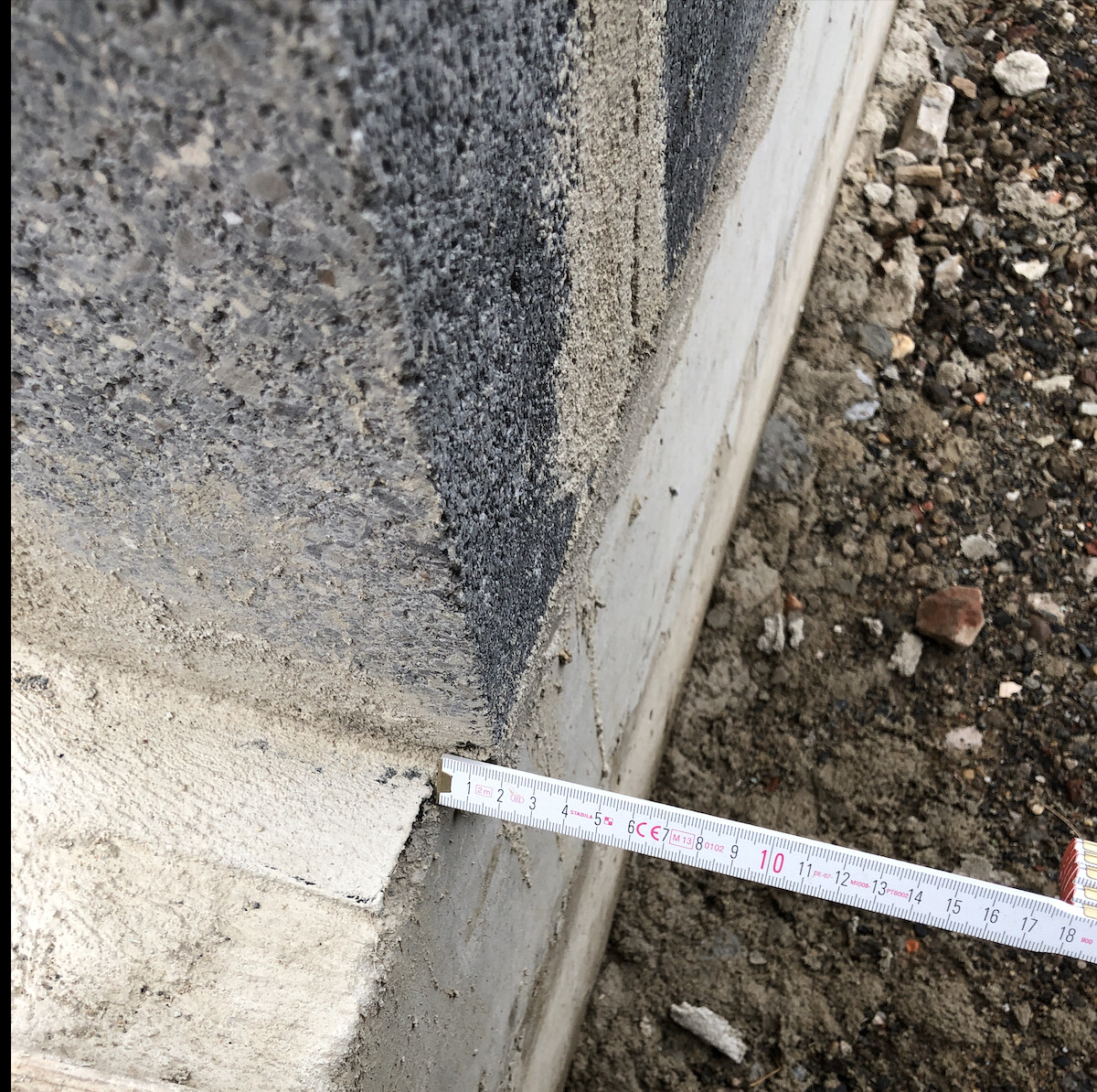
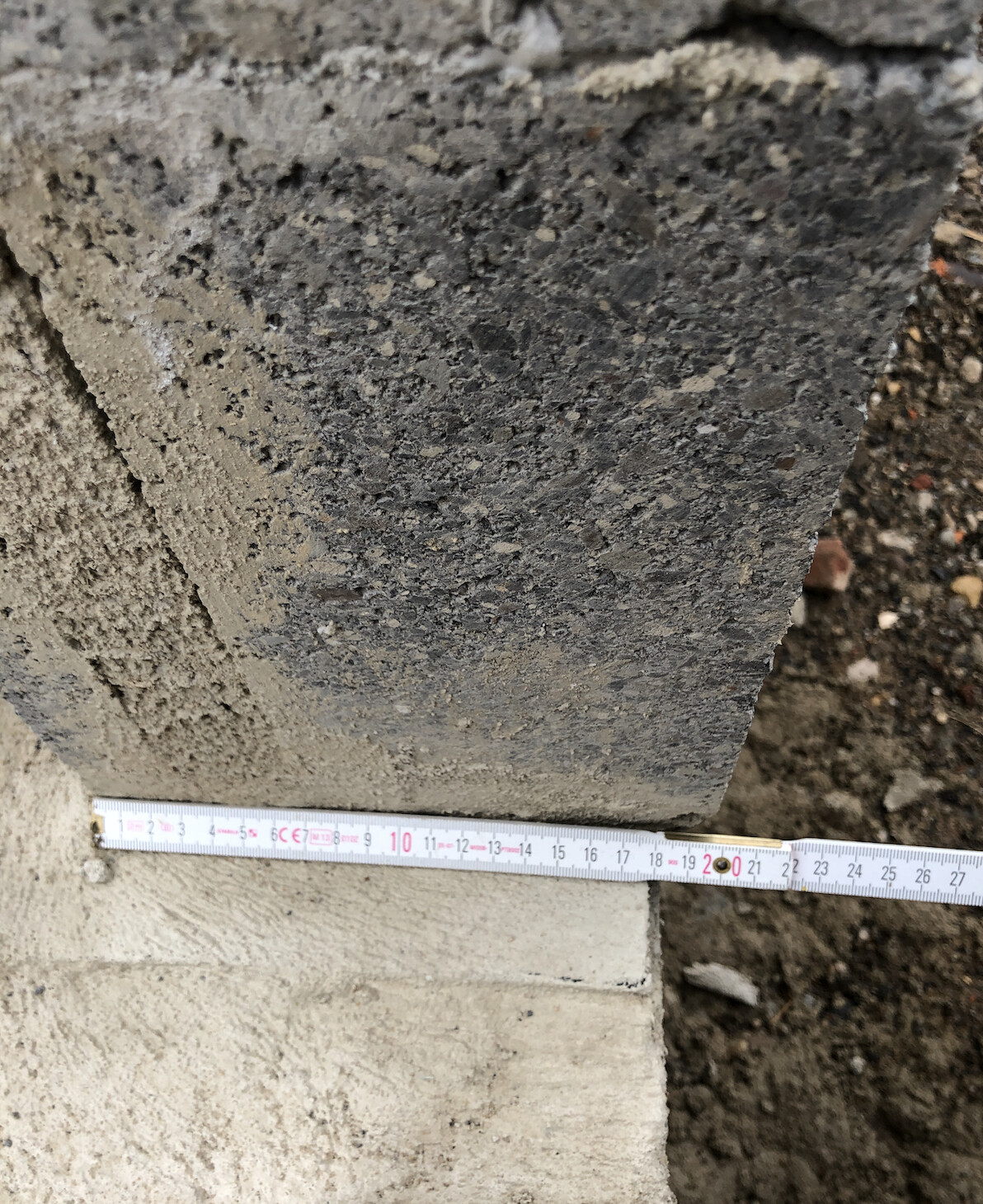
We are currently at the shell construction stage. The workers on the lower floor have now set the walls onto the slab. Unfortunately, on one side of the house, the walls protrude about 2cm (0.8 inches) beyond the edge of the slab. That means the 20cm (8 inches) thick blocks sit roughly 18cm (7 inches) on the slab or waterproofing membrane, with 2cm (0.8 inches) overhanging. This 2cm (0.8 inches) gap was filled with mortar.
This can be seen in the attached photos. We visited the site with the construction manager (PS: our architect, not a general contractor, but individual contracts assigned through our architect) to inspect the situation. He said this is probably within acceptable tolerances and should not have major consequences. We all agreed on site that the slab is likely about 2cm (0.8 inches) too short and the workers set the walls according to the original plan dimensions.
Still, we wonder if we should address this again. Time is pressing since next week the formwork for the concrete ceiling, which will be placed on the walls, is scheduled to be installed.
Another point: A small section on the affected side was built with cast-in-place concrete. This piece fits exactly on the slab, so this wall section is offset by 2cm (0.8 inches) compared to the masonry parts on the same side of the house. This projection in alignment will need to be corrected at the latest during the exterior insulation and finishing system (EIFS) on the outside and plastering inside. We were told this should not be a major issue either.
How do you assess this situation? Are we being too picky, or is this a serious defect that must be fully corrected?
Thank you!
B
Bauherr am L6 Jan 2020 13:5911ant schrieb:
Site managers are also individuals with very different preferences – that’s why I appreciate having a standard like the DIN to guide the interpretation of what the proper professional approach is. In this case, the 2 cm (approximately 1 inch) protruding wall thickness won’t be cut back, and you will benefit more from the planned positioning of the wall than from its irrelevant precise alignment with the edge of the floor slab.I can't fully follow your comment. On the affected side of the house, there is now a concrete wall section that is offset by several centimeters compared to the masonry wall section (even within the same room). So the centimeters will be lost anyway during leveling with plaster or similar. The planned position of the wall is essentially no longer maintained.
My comment was more meant to emphasize that better solutions can still be found through communication than without it. And I specifically asked the initial question to better assess the situation with collective expertise.
Furthermore: If the DIN standard were applied strictly on site, acceptance of the construction probably wouldn’t happen anymore. Here it’s often said, “don’t take the DIN too literally”...

Bauherr am L schrieb:
Furthermore: If the DIN standards were applied strictly on site, no final inspection would probably ever pass. Here, it is often said, "Don’t take the DIN standards too literally"... On one hand, this summary is probably easier to say than to explain in detail to the homeowner, for example that the standard for interior doors does not apply to terrace doors. On the other hand, exceeding a DIN tolerance is not a guarantee of structural failure, but rather a benchmark for an objective claim for reduction or correction.
Bauherr am L schrieb:
On the affected side of the house, there is now a concrete wall section that is offset by several centimeters (inches) compared to the masonry wall section (even within the same room). So, these centimeters (inches) will at least be compensated for by plaster or similar finishes. The planned position of the wall is therefore effectively lost anyway. This, in turn, I did not understand: the position of the wall, which is correct in itself but not aligned with the edge of the floor slab, creates an unsatisfactory fit at a "third" junction?
https://www.instagram.com/11antgmxde/
https://www.linkedin.com/company/bauen-jetzt/
B
Bauherr am L6 Jan 2020 14:1611ant schrieb:
What I didn’t understand is this: the positioning of the wall, which is correct on its own but not aligned with the edge of the floor slab, creates an unsatisfactory fit at a "third" junction?The root cause is probably that the window openings (floor-to-ceiling) on one side of the wall are each a few millimeters too large, which added up to a total of 2cm (0.8 inches). When the affected side was continued around the corner and the wall dimensions were adhered to, this resulted in a 2cm (0.8 inches) overhang beyond the floor slab edge.
However, there is already a section on the affected side that was previously poured (for structural reasons). This section is essentially 100% correctly positioned and flush with the floor slab (it is also connected to it by reinforcement).
So now we have on the affected side a piece of concrete wall that, separated by a window opening, is offset by 2cm (0.8 inches) from the masonry wall. I am wondering how this will be compensated, which measures will be required, and whether this will cause additional costs.
The problem can be divided into two parts:
1. Structurally, the masonry wall is not flush with the floor slab. This seems less critical, if I understand most of you correctly.
2. How do you compensate for the difference between the concrete section and the masonry section on the inside and outside? Inside, presumably with varying plaster thicknesses (costs?), but how is this handled on the outside with the external thermal insulation composite system (ETICS) / external wall insulation?
Bauherr am L schrieb:
First of all, the cause is probably that the window openings (floor-to-ceiling) on one side of the wall are each a few millimeters too large, which has added up to a total of 2cm (0.8 inches). 2cm (0.8 inches) over, let's say, 10 meters (33 feet) in length corresponds to a deviation of two per mille. This complies with the DIN standard (DIN 18202). And to talk about millimeters on masonry — seriously?
Aside from this obsession with millimeters, what exactly is the supposed problem caused by this, and why do you believe you know more about it than your architect?
Why do you think it would benefit your house to chip off 2cm (0.8 inches) by hand from your cornerstones — since that’s what your demands would ultimately amount to?
B
Bauherr am L6 Jan 2020 15:52I have no professional opinion on this matter, which is why I asked in the forum. In a similar case elsewhere, it was said that the structure had to be taken down and the foundation slab had to be enlarged (it was too small, which might also be the case here). Confused by this, I brought up the issue for discussion. Thank you for the constructive responses.
@Scout
Unfortunately, your reply misses the mark by more than just a few centimeters (inches). I pointed out that communication helps to avoid unnecessary problems, generally speaking, regardless of the issue or even the industry. If you doubt that, I don’t understand why you would post at all.
Otherwise, this is a technical question, which is exactly what a forum is for. People can calmly respond that the supposed problem isn’t really one or that it can be easily solved with measure X, and that’s that. In my last post, I simply asked how such issues are compensated for (with plaster and external thermal insulation composite systems - ETICS)…
@Scout
Unfortunately, your reply misses the mark by more than just a few centimeters (inches). I pointed out that communication helps to avoid unnecessary problems, generally speaking, regardless of the issue or even the industry. If you doubt that, I don’t understand why you would post at all.
Otherwise, this is a technical question, which is exactly what a forum is for. People can calmly respond that the supposed problem isn’t really one or that it can be easily solved with measure X, and that’s that. In my last post, I simply asked how such issues are compensated for (with plaster and external thermal insulation composite systems - ETICS)…
Bauherr am L schrieb:
@Scout
Unfortunately, your answer is way off—by more than just a few centimeters.But then I wouldn’t have pinned a like to it.https://www.instagram.com/11antgmxde/
https://www.linkedin.com/company/bauen-jetzt/
Similar topics