
ᐅ The wall is not aligned properly with the concrete slab and extends about 2 cm beyond it.
Created on: 4 Jan 2020 09:37
B
Bauherr am L
Hello dear fellow builders,
We are currently at the shell construction stage. The workers on the lower floor have now set the walls onto the slab. Unfortunately, on one side of the house, the walls protrude about 2cm (0.8 inches) beyond the edge of the slab. That means the 20cm (8 inches) thick blocks sit roughly 18cm (7 inches) on the slab or waterproofing membrane, with 2cm (0.8 inches) overhanging. This 2cm (0.8 inches) gap was filled with mortar.
This can be seen in the attached photos. We visited the site with the construction manager (PS: our architect, not a general contractor, but individual contracts assigned through our architect) to inspect the situation. He said this is probably within acceptable tolerances and should not have major consequences. We all agreed on site that the slab is likely about 2cm (0.8 inches) too short and the workers set the walls according to the original plan dimensions.
Still, we wonder if we should address this again. Time is pressing since next week the formwork for the concrete ceiling, which will be placed on the walls, is scheduled to be installed.
Another point: A small section on the affected side was built with cast-in-place concrete. This piece fits exactly on the slab, so this wall section is offset by 2cm (0.8 inches) compared to the masonry parts on the same side of the house. This projection in alignment will need to be corrected at the latest during the exterior insulation and finishing system (EIFS) on the outside and plastering inside. We were told this should not be a major issue either.
How do you assess this situation? Are we being too picky, or is this a serious defect that must be fully corrected?
Thank you!
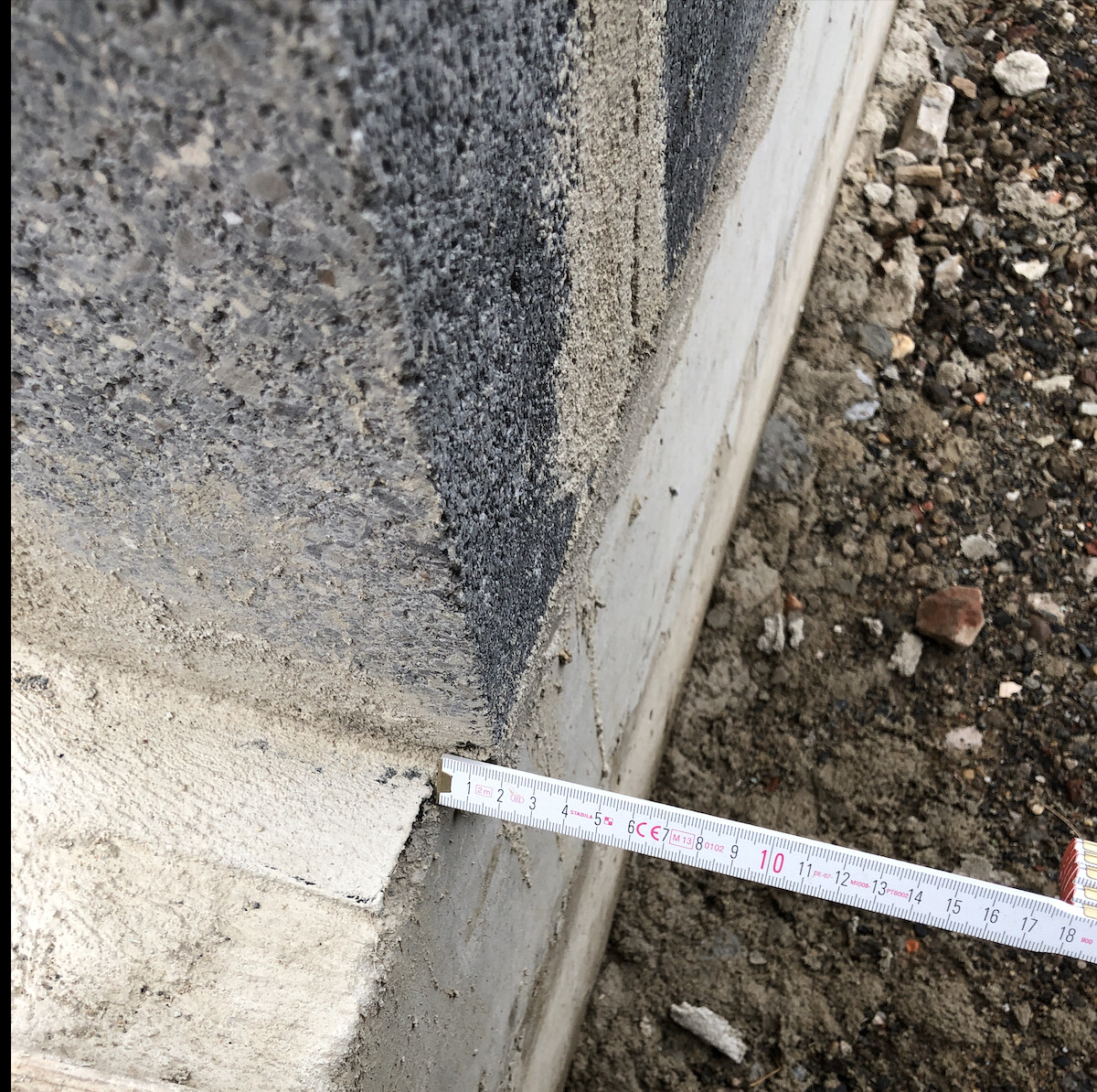
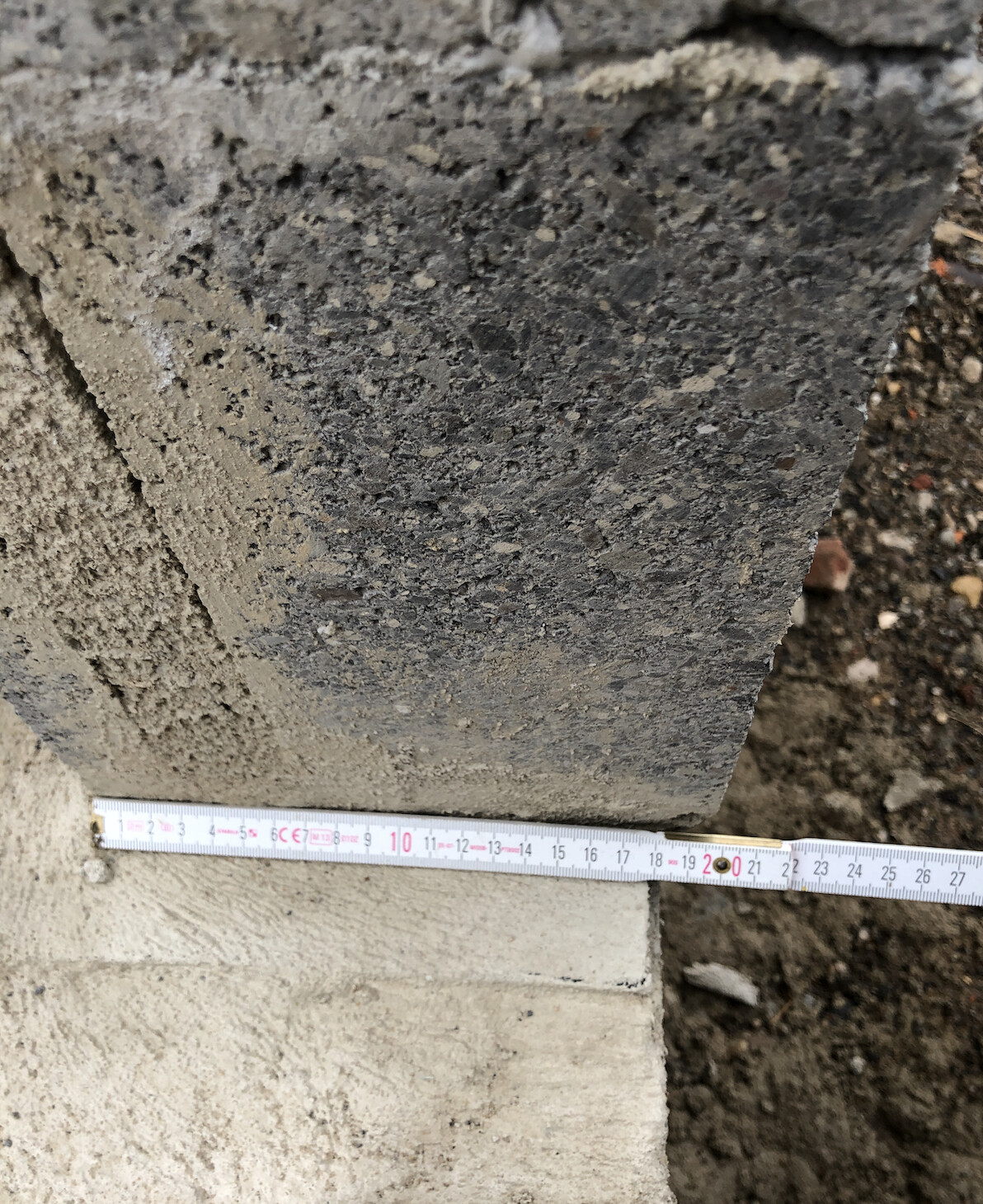
We are currently at the shell construction stage. The workers on the lower floor have now set the walls onto the slab. Unfortunately, on one side of the house, the walls protrude about 2cm (0.8 inches) beyond the edge of the slab. That means the 20cm (8 inches) thick blocks sit roughly 18cm (7 inches) on the slab or waterproofing membrane, with 2cm (0.8 inches) overhanging. This 2cm (0.8 inches) gap was filled with mortar.
This can be seen in the attached photos. We visited the site with the construction manager (PS: our architect, not a general contractor, but individual contracts assigned through our architect) to inspect the situation. He said this is probably within acceptable tolerances and should not have major consequences. We all agreed on site that the slab is likely about 2cm (0.8 inches) too short and the workers set the walls according to the original plan dimensions.
Still, we wonder if we should address this again. Time is pressing since next week the formwork for the concrete ceiling, which will be placed on the walls, is scheduled to be installed.
Another point: A small section on the affected side was built with cast-in-place concrete. This piece fits exactly on the slab, so this wall section is offset by 2cm (0.8 inches) compared to the masonry parts on the same side of the house. This projection in alignment will need to be corrected at the latest during the exterior insulation and finishing system (EIFS) on the outside and plastering inside. We were told this should not be a major issue either.
How do you assess this situation? Are we being too picky, or is this a serious defect that must be fully corrected?
Thank you!
I think it’s normal to feel quite uncertain at the beginning and not be able to tell what is standard practice and what is poor workmanship. I visited the construction site every day and called the general contractor, asking exactly these kinds of questions. Eventually, I still made daily calls, but the questions became fewer. If you have the opportunity, do the same—it provides a great sense of security.
p.s. In your case, talk to the architect or the trade professional.
p.s. In your case, talk to the architect or the trade professional.
H
hampshire4 Jan 2020 12:23Bookstar schrieb:
Trust is very unreliable in construction. You are doing the right thing by carefully checking and questioning everything. It’s better to have one too many work stoppages than too few! Trust works well on construction sites if there is proper management. Otherwise, it can sometimes backfire. It’s the same as in professional life.
Asking questions politely and factually without blaming is always a good approach. No one ever criticizes a homeowner for being a layperson.
hampshire schrieb:
Trust in construction works well when you can lead. Otherwise, it can sometimes backfire. It’s the same as in professional life.
It’s always good to ask politely and factually without blame. No one accuses a homeowner of being an amateur. I don’t see it that way. To me, trust means I can rely on someone and the consequences remain manageable. In construction, that would require professionals and options for correction. Qualified craftsmen are currently very rare and almost unavailable. And if you wait too long to file a complaint, you often just hear, “It’s too late now; the effort to fix it isn’t reasonable...” Craftsmen are often the masters of excuses and reassurance.
That’s why you need to be on site every day, inform yourself meticulously, and stop work immediately if necessary. Ideally (even if it’s difficult), have a second company on standby that can step in right away. The extra cost then has to be accepted.
Bookstar schrieb:
I don’t agree with that. To me, trust means being able to rely on someone and that the consequences remain manageable. In construction, that requires professionals and the possibility to correct mistakes. Qualified craftsmen are currently very scarce and almost unavailable. And if you wait too long to complain, you often hear, "it’s too late now, the effort to fix this is disproportionate...". Unfortunately, craftsmen are often masters of excuses and downplaying issues.
That’s why it’s important to be on site every day, inform yourself meticulously, and stop work immediately if needed. Ideally (even if it’s difficult), have a second contractor ready to step in at any time. The additional cost then has to be accepted. Doesn’t that seem somewhat contradictory?
I can’t agree with the general statement that there are hardly any qualified workers in construction.
If that reflects your experience, I’m sorry for you, but there are also positive examples.
From a technical standpoint, many things went well for us, except the drywall installer, whom I had redo the kitchen soffits three times because he was unable to read the measurements correctly.
However, I wouldn’t generalize that based on this experience...
Bauherr am L schrieb:
We were on site with the construction manager (PS: our architect, not a general contractor or construction manager, but individual contracting through our architect) and inspected everything. He said this is probably within acceptable tolerances and won’t have any major impact anyway. Trust him. If not, then part ways with him and hire another construction manager.
Bookstar schrieb:
Trust is a very poor approach in construction. You’re doing the right thing by checking and questioning everything critically. Better to have one too many work stoppages than too few! Building without trust doesn’t work.
I don’t mean blind trust.