
ᐅ Integration of Air-to-Water Heat Pump, Photovoltaic System, and Energy Storage
Created on: 29 Dec 2019 23:12
A
Appel2000
Hello everyone,
In our new build, an air-to-water heat pump will be installed as the heating system. The system will be installed by our general contractor (GC) or their heating company.
I would now like to have a photovoltaic (solar) system installed on the roof (not through the GC, but by a specialist company that I select myself), with the unused electricity being stored.
The idea behind this is, among other things, to generate part of the electricity needed for the air-to-water heat pump ourselves.
Since I wanted to inform myself a bit before talking to the heating company and the solar company, I searched online. Unfortunately, it wasn’t really helpful.
What I found out is the order in which photovoltaic electricity is used:
1) Current consumers in the house
2) Battery charging
3) Air-to-water heat pump
4) Feeding into the grid
Is this correct so far?
Then you need the technical prerequisites so that the inverter, battery, and air-to-water heat pump can communicate with each other.
Who provides these prerequisites and who usually configures this? The heating company or the solar installer? Are special devices required for this?
When the air-to-water heat pump needs electricity again, the battery should of course be used first before drawing from the public grid. Does this also work if we have a special heat pump tariff?
I would appreciate it if someone could shed some light on this!
Thanks in advance and best regards
A
In our new build, an air-to-water heat pump will be installed as the heating system. The system will be installed by our general contractor (GC) or their heating company.
I would now like to have a photovoltaic (solar) system installed on the roof (not through the GC, but by a specialist company that I select myself), with the unused electricity being stored.
The idea behind this is, among other things, to generate part of the electricity needed for the air-to-water heat pump ourselves.
Since I wanted to inform myself a bit before talking to the heating company and the solar company, I searched online. Unfortunately, it wasn’t really helpful.
What I found out is the order in which photovoltaic electricity is used:
1) Current consumers in the house
2) Battery charging
3) Air-to-water heat pump
4) Feeding into the grid
Is this correct so far?
Then you need the technical prerequisites so that the inverter, battery, and air-to-water heat pump can communicate with each other.
Who provides these prerequisites and who usually configures this? The heating company or the solar installer? Are special devices required for this?
When the air-to-water heat pump needs electricity again, the battery should of course be used first before drawing from the public grid. Does this also work if we have a special heat pump tariff?
I would appreciate it if someone could shed some light on this!
Thanks in advance and best regards
A
B
boxandroof1 Jan 2020 12:01Maybe take a look at your shading management, as it might reduce yield somewhat in winter.
I also have significant shading from trees due to the low sun angle. 25% of the panels are not facing south, so they produce noticeably less in winter. The weather in southern Germany was also much better at comparison sites than here.
However, most of the yield comes in summer anyway.
I also have significant shading from trees due to the low sun angle. 25% of the panels are not facing south, so they produce noticeably less in winter. The weather in southern Germany was also much better at comparison sites than here.
However, most of the yield comes in summer anyway.

guckuck2 schrieb:
Your yields sound very good! I agree. For us, the total for December is 87 kWh, with a maximum of 6.8 kWh per day (December 5). However, our system is only 6.3 kWp with south- and west-facing roofs, and the west-facing roof performs quite poorly in December. Of the 87 kWh, we used 71 kWh directly. Considering the house’s total consumption of 758 kWh, the 16 kWh that could have gone into storage is negligible.
It really depends a lot on the design of the photovoltaic system. We tried to schedule the hot water preparation during sunny periods and to increase the storage temperature somewhat. In winter, even with sunlight, we don’t manage to reach 1.8 kW to operate the hot water program directly from photovoltaic electricity.
H
hampshire1 Jan 2020 14:04@guckuck2: Great return. Everything done right and apparently still room for improvement. Shadow management is a good tip from @boxandroof.
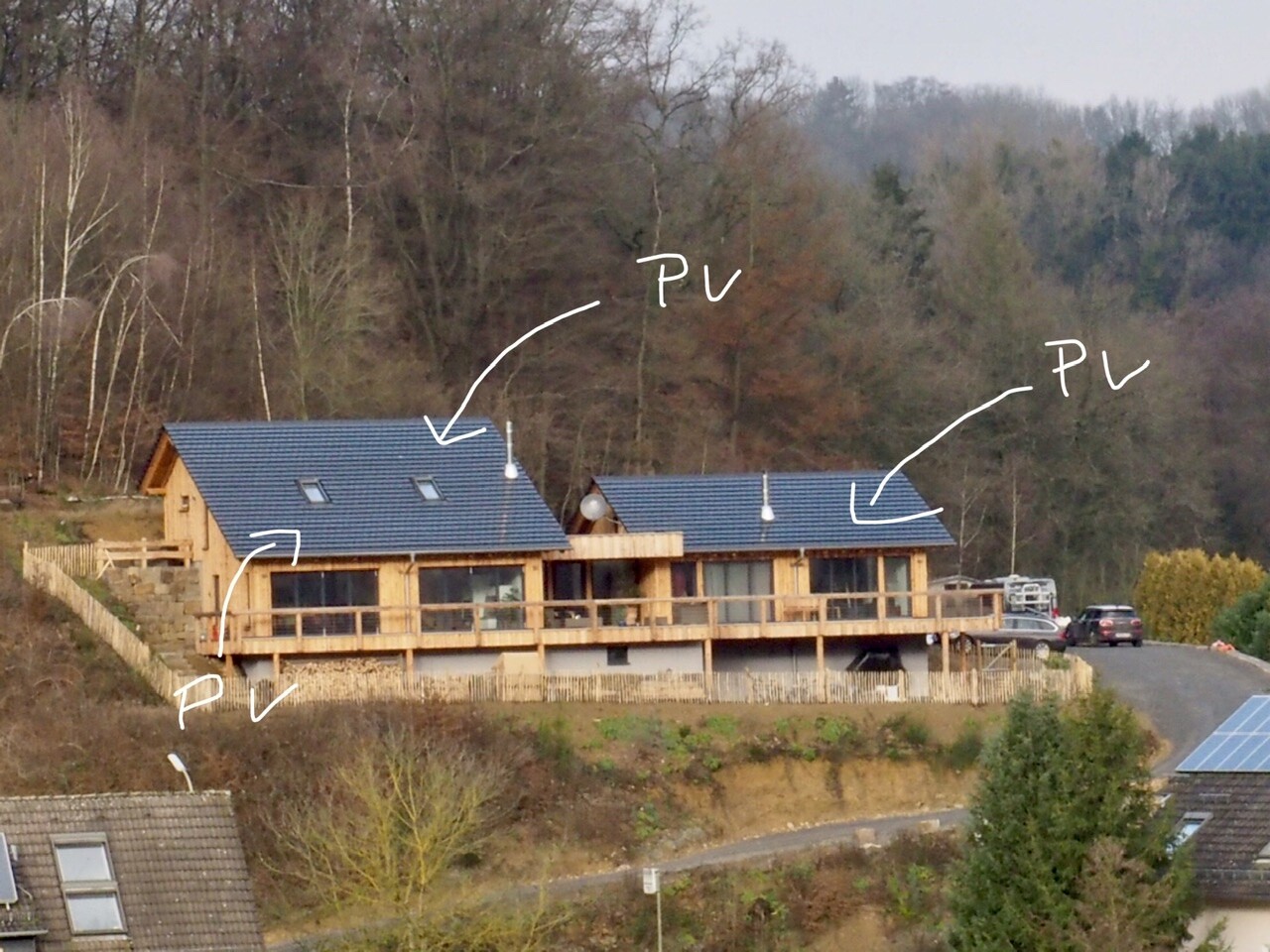
My system pays off a bit later than yours but doesn’t have any shadow issues—only the two slim chimneys would cause shading anyway. The modules themselves are built with 2-busbar cells arranged in parallel. The photovoltaic tiles are all connected in parallel. That might be a reason for relatively good yield. The roofs face south with about a 15-degree tilt toward the east.
The left roof has two strips of photovoltaic tiles, the right roof a larger area. The arrows help to identify.
 .
.
@Appel2000: To figure out which system fits best, you can list your major consumers and see when they run. If you have “outliers” (sauna, ceramic kiln, whirlpool/pool, high-power servers, heat pump, vehicle charging station, tools, air conditioning, infrared panels...), that is relevant for your calculations. That’s actually a good starting point before deciding on the technical setup.
My system pays off a bit later than yours but doesn’t have any shadow issues—only the two slim chimneys would cause shading anyway. The modules themselves are built with 2-busbar cells arranged in parallel. The photovoltaic tiles are all connected in parallel. That might be a reason for relatively good yield. The roofs face south with about a 15-degree tilt toward the east.
The left roof has two strips of photovoltaic tiles, the right roof a larger area. The arrows help to identify.
@Appel2000: To figure out which system fits best, you can list your major consumers and see when they run. If you have “outliers” (sauna, ceramic kiln, whirlpool/pool, high-power servers, heat pump, vehicle charging station, tools, air conditioning, infrared panels...), that is relevant for your calculations. That’s actually a good starting point before deciding on the technical setup.
A
Appel20003 Jan 2020 21:08Hello everyone,
Thank you very much for all your useful information and suggestions!
Although this is slightly off-topic:
I came across the Bafa subsidy for the first time in connection with air-to-water heat pumps.
The subsidy applies to air-to-water heat pumps that achieve a seasonal performance factor of at least 4.5.
Does a photovoltaic system help in reaching this seasonal performance factor?
The heating engineer should take this into account in their calculations, right? And if so, are the costs of the photovoltaic system also eligible for subsidies in this context?
Best regards
Thank you very much for all your useful information and suggestions!
Although this is slightly off-topic:
I came across the Bafa subsidy for the first time in connection with air-to-water heat pumps.
The subsidy applies to air-to-water heat pumps that achieve a seasonal performance factor of at least 4.5.
Does a photovoltaic system help in reaching this seasonal performance factor?
The heating engineer should take this into account in their calculations, right? And if so, are the costs of the photovoltaic system also eligible for subsidies in this context?
Best regards
Similar topics