
ᐅ Underfloor heating with an air-to-water heat pump. House gets too warm when the sun is shining.
Created on: 4 Dec 2019 14:18
C
chewbacca123
Hello everyone,
I have a general question.
We moved into our new build four months ago. The living area on the ground floor has three large floor-to-ceiling windows facing south. We have underfloor heating and an air-to-water heat pump.
It provides a really comfortable temperature inside the house, but we have a problem – whenever the sun is shining in winter, even if it’s -2°C (28°F) outside, the temperature suddenly rises to 24°C (75°F) in the living room. It gets uncomfortably warm in here, and the underfloor heating can’t be turned down quickly.
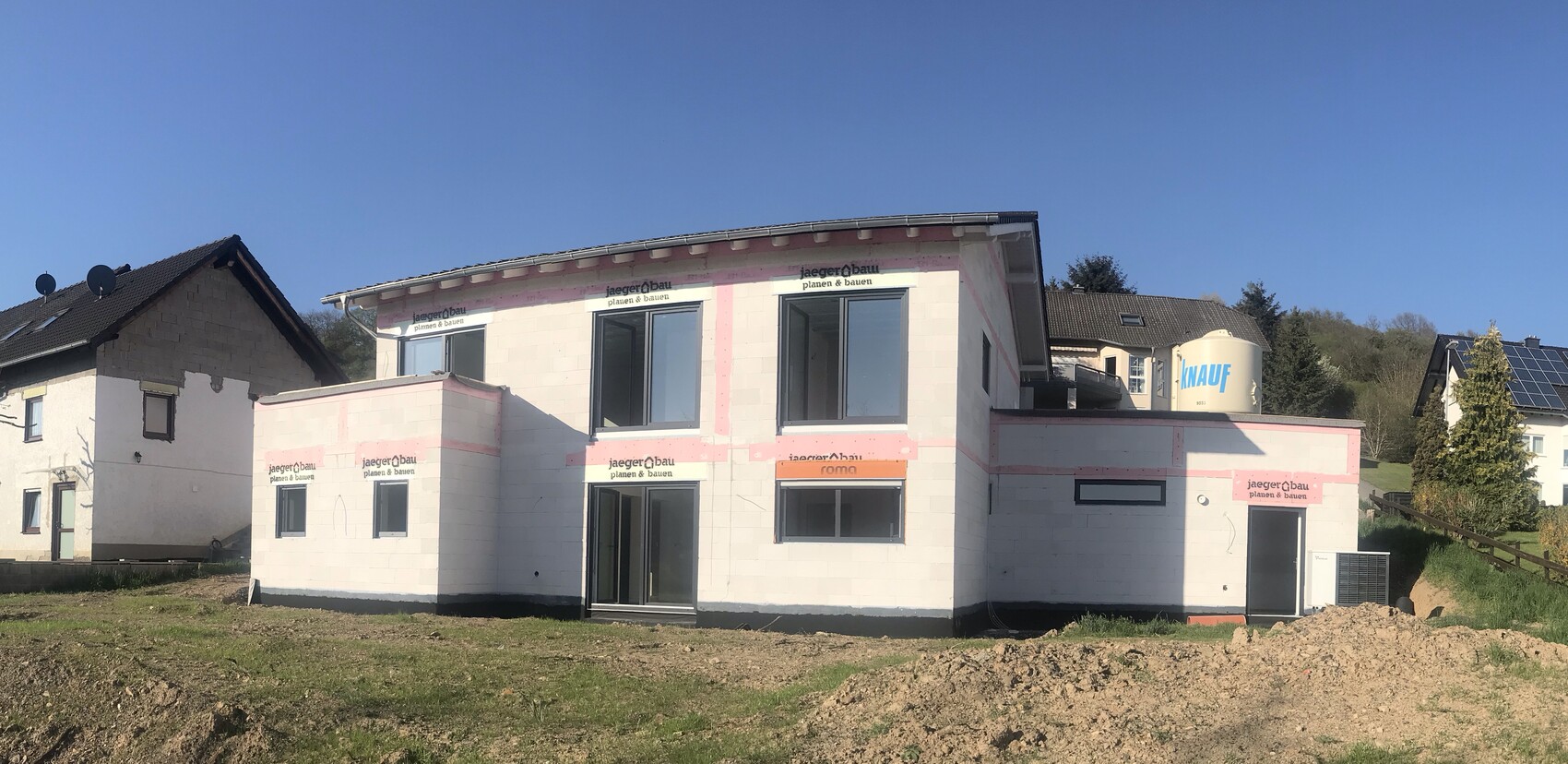
Should we assume that the large floor-to-ceiling windows are responsible for the heat gain? A photo of the south-facing side of the house is attached.
What would you do – always lower all the blinds as soon as sunlight is forecast? That seems quite annoying...
We have motorized blinds controlled by Somfy. Would you consider buying a sensor that automatically lowers the blinds at a certain temperature?
Thanks in advance for your replies.
I have a general question.
We moved into our new build four months ago. The living area on the ground floor has three large floor-to-ceiling windows facing south. We have underfloor heating and an air-to-water heat pump.
It provides a really comfortable temperature inside the house, but we have a problem – whenever the sun is shining in winter, even if it’s -2°C (28°F) outside, the temperature suddenly rises to 24°C (75°F) in the living room. It gets uncomfortably warm in here, and the underfloor heating can’t be turned down quickly.
Should we assume that the large floor-to-ceiling windows are responsible for the heat gain? A photo of the south-facing side of the house is attached.
What would you do – always lower all the blinds as soon as sunlight is forecast? That seems quite annoying...
We have motorized blinds controlled by Somfy. Would you consider buying a sensor that automatically lowers the blinds at a certain temperature?
Thanks in advance for your replies.
 chewbacca12330 Dec 2019 18:36
KingSong schrieb:
Unfortunately, the 21°C (70°F) in the bedroom and dressing room are also a compromise. The large bathroom is directly adjacent to the dressing room, separated by a sliding door. Through several attempts, I have found that if I lower the temperature in the bedroom and dressing room enough to make them really cooler, the dressing room then draws energy from the bathroom floor. So, if I want to keep the bathroom temperature averaging between 21.5°C (70.7°F) and sometimes even 23°C (73.4°F), I can’t reduce the temperature too much in the adjoining rooms.
At some point, I realized that I no longer want to obsess over every single kilowatt-hour while still maintaining comfort for me and my family. Thanks to photovoltaic panels and a storage system, last heating season was almost free — in 2019, we had a total electricity consumption of 5,000 kWh and fed back 6,300 kWh into the grid. And that’s for 5 people living across two complete households. Of course, it would be great to use even less energy... but maybe I shouldn’t be too demanding.
Sure, I’m not concerned about every single kilowatt-hour either, but since this is the first winter in the new house, I want to find the best possible settings. Efficiency is important, that’s why we invested in a new, expensive heating system. We are also planning to install photovoltaics or at least solar panels—really impressive results you have there.chewbacca12330 Dec 2019 22:20Slava_S schrieb:
Is there a general guideline for when a room might be too cold and therefore more prone to mold?
I also like it cool when sleeping (<=18°C (64°F)). But in the new house, I don’t want to risk neglecting the drying of the walls (Ytong) anywhere. If I were you, I would place a hygrometer in every room to measure the humidity. You can use that as a reference. That’s what we are doing in our new build, which uses aerated concrete blocks.
D
Daniel-Sp31 Dec 2019 00:11chewbacca123 schrieb:
We are also installing photovoltaic panels or at least solar, really great result you have there Please avoid solar thermal systems. You will not recoup the investment within 20 years. Additionally, solar thermal complicates the efficient operation of the heat pump. It requires complex hydraulic modifications (which cost extra) along with an appropriate control system. Photovoltaics are much better suited to work with a heat pump.
chewbacca12331 Dec 2019 06:42Daniel-Sp schrieb:
Please avoid solar thermal systems. You will not recoup the investment within 20 years. Additionally, solar thermal complicates the efficient operation of the heat pump. You will then need complex hydraulic modifications (which also incur extra costs) along with appropriate controls. Photovoltaic systems are much better suited to heat pumps.Oh, really? Good to know! I need to do some research on that.

Musketier schrieb:
I did it this way myself, since the bathroom was/is the "troublesome area." A larger heating surface means a lower supply temperature is needed.
I also installed this in the guest bathroom, where you can nicely dry wet kids’ clothes on it. Now I have read in the Rosa forum the explanation of why it is wrong to operate a towel radiator like that. So it's not about an extended heating surface.
As I understand it, the problem is related to the return flow.
If the towel radiator is connected to its own heating circuit, it is probably the shortest circuit and allows a high return temperature to flow back to the heat pump in the shortest possible time.
This then reduces the supply temperature, which is counterproductive.
Of course, you can throttle it, but never so much that it becomes beneficial.
Similar topics