
ᐅ Underfloor heating with an air-to-water heat pump. House gets too warm when the sun is shining.
Created on: 4 Dec 2019 14:18
C
chewbacca123
Hello everyone,
I have a general question.
We moved into our new build four months ago. The living area on the ground floor has three large floor-to-ceiling windows facing south. We have underfloor heating and an air-to-water heat pump.
It provides a really comfortable temperature inside the house, but we have a problem – whenever the sun is shining in winter, even if it’s -2°C (28°F) outside, the temperature suddenly rises to 24°C (75°F) in the living room. It gets uncomfortably warm in here, and the underfloor heating can’t be turned down quickly.
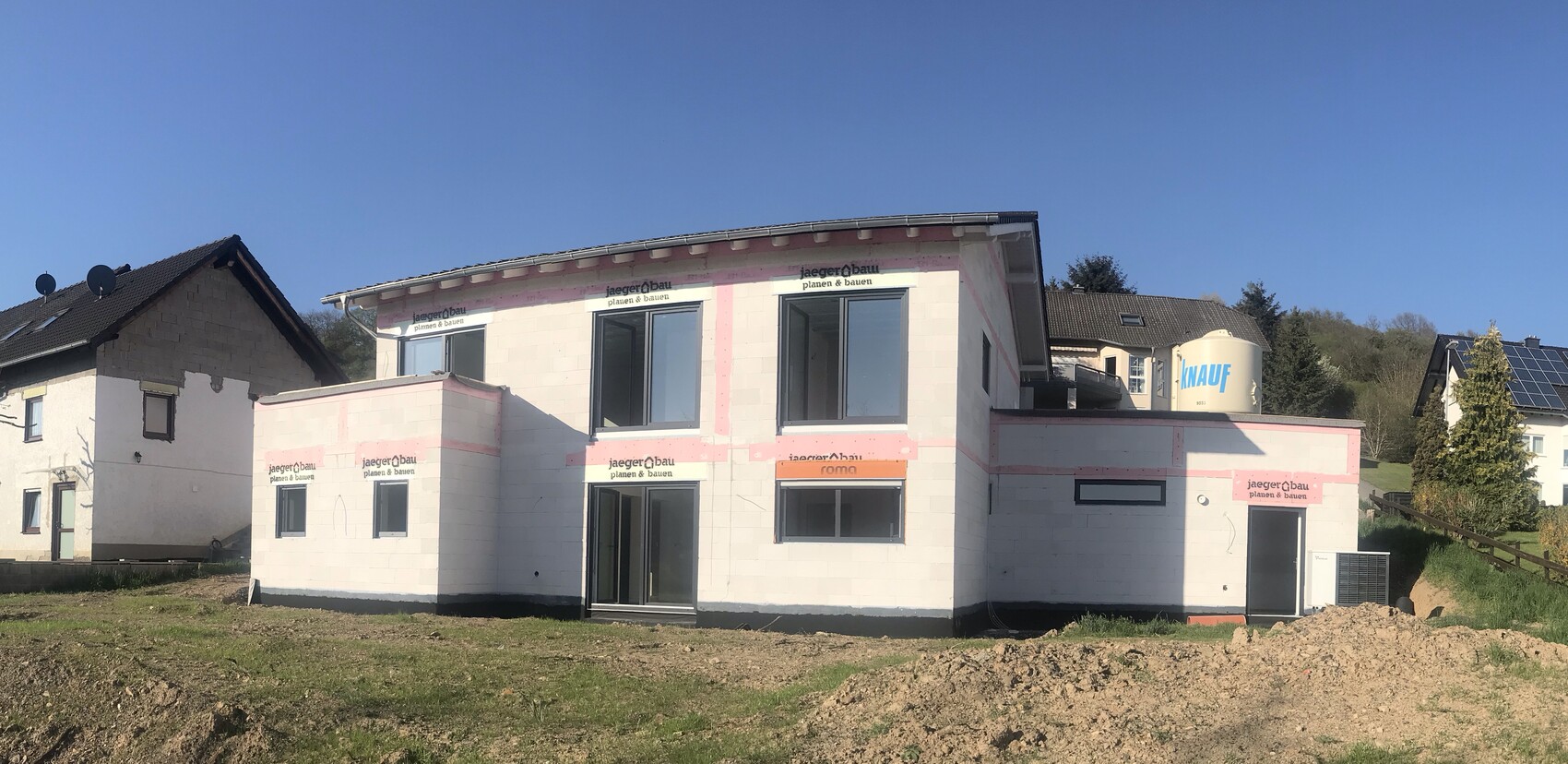
Should we assume that the large floor-to-ceiling windows are responsible for the heat gain? A photo of the south-facing side of the house is attached.
What would you do – always lower all the blinds as soon as sunlight is forecast? That seems quite annoying...
We have motorized blinds controlled by Somfy. Would you consider buying a sensor that automatically lowers the blinds at a certain temperature?
Thanks in advance for your replies.
I have a general question.
We moved into our new build four months ago. The living area on the ground floor has three large floor-to-ceiling windows facing south. We have underfloor heating and an air-to-water heat pump.
It provides a really comfortable temperature inside the house, but we have a problem – whenever the sun is shining in winter, even if it’s -2°C (28°F) outside, the temperature suddenly rises to 24°C (75°F) in the living room. It gets uncomfortably warm in here, and the underfloor heating can’t be turned down quickly.
Should we assume that the large floor-to-ceiling windows are responsible for the heat gain? A photo of the south-facing side of the house is attached.
What would you do – always lower all the blinds as soon as sunlight is forecast? That seems quite annoying...
We have motorized blinds controlled by Somfy. Would you consider buying a sensor that automatically lowers the blinds at a certain temperature?
Thanks in advance for your replies.


Daniel-Sp schrieb:
According to my information, the pump optimization time only applies when the outside temperature is above 1°C (34°F). Since the change was made last night, it has been colder. The effect will be noticeable on warmer days.
The setting is now 5 minutes; I have seen the current CSV. Okay, what about the efficiency pump nominal and minimum settings? Is there room for adjustment, or is the flow rate too low?
D
Daniel-Sp30 Dec 2019 16:54tomtom79 schrieb:
Okay, what about the efficiency pump nominal and minimum values? Is there any room for adjustment, or is the flow rate too low? First, carry out the hydraulic balancing properly, then check the total flow rate and see what further improvements are possible. That would be my approach for now.

chewbacca123 schrieb:
What really annoys me is that we’ve been using 30 kWh per day for four days now, and from yesterday to today it even went up to 35. The sun has been shining strongly, so I just don’t understand this. We hardly have any heating cycles, and we no longer have hot water running 24 hours a day. Right now, at an outdoor temperature of -6°C (21°F), we have a consumption of 28 kWh over 24 hours. We are heating a living area of 265 m² (2,854 sq ft) including hot water at 45°C (113°F). Our heating curve is set to a slope of 0.3 and level 0, meaning at 20°C (68°F) outdoor temperature the flow temperature is 20°C (68°F), at 0°C (32°F) it is 26°C (79°F), and at -20°C (-4°F) it is 31°C (88°F), with an indoor target temperature of 20°C (68°F). This results in 21.8°C (71°F) in the bathrooms (despite them being installed with 8 cm (3 inches) pipe spacing and fully open) and 23°C (73°F) in the living area, while the bedroom reaches 21°C (70°F). All electrical radiators have been removed. My biggest problem is the unfortunately installed buffer tank. I think I could save something if I didn’t have it, but you can’t just deactivate it easily, or maybe you can?
What I’ve noticed is that when the underfloor heating has a flow temperature of, say, 26°C (79°F) at 0°C (32°F) outdoor temperature, the buffer tank charging has a switch-off hysteresis of 2 K. So, my air-to-water heat pump operates at 32°C (90°F) flow temperature on the generation side to get the buffer tank 2 K warmer than the set flow temperature… quite annoying.
 chewbacca12330 Dec 2019 17:21
KingSong schrieb:
Currently, at -6°C (21°F) outdoor temperature, we are consuming 28 kWh over 24 hours, heating a living area of 265 m² (2852 sq ft) including domestic hot water at 45°C (113°F). Our heating curve is set to a slope of 0.3 / level 0k, meaning at 20°C (68°F) outdoor temperature, the flow temperature is 20°C (68°F); at 0°C (32°F) outdoor, it’s 26°C (79°F); and at -20°C (-4°F) outdoor, it’s 31°C (88°F), with a room temperature setpoint of 20°C (68°F). This results in 21.8°C (71°F) in the bathrooms (even though the underfloor heating pipes were installed with 8 cm (3 inches) spacing and are fully open) and 23°C (73°F) in the living area, with the bedroom at 21°C (70°F). All ERRs are removed... My biggest issue is unfortunately the installed buffer tank. I think I could save more energy if I didn’t have it, but simply deactivating it isn’t possible, or is it?
What I’ve noticed is when the underfloor heating runs a supply temperature of about 26°C (79°F) at 0°C (32°F) outdoor temperature, the buffer tank charging has an off hysteresis of 2K. So my air-to-water heat pump runs at 32°C (90°F) supply temperature on the production side to get the tank 2K warmer than the set supply temperature... not ideal at all. Our domestic hot water is set to 49°C (120°F), and our current heating curve is 27.5 - 22 - 0.
I find 21°C (70°F) in the bedroom too warm; I’m very comfortable at 20°C (68°F). However, I admit that the individual room control in the bedroom is almost closed, not fully open. I find sleeping in a warm room completely unrestful. All other controllers are fully open.
If necessary, I really warm up with the towel heater, because 21°C (70°F) in the bathroom is too low for me—especially with a small baby at home, I find it too chilly in the mornings.
Overall, we heat 190 m² (2045 sq ft), and the domestic hot water is set to 49°C (120°F).
The 21°C (70°F) in the bedroom and dressing room is unfortunately a compromise as well. The large bathroom is directly adjacent to the dressing room, separated by a sliding door. I have found through several attempts that if I lower the temperature in the bedroom and dressing room enough to make it truly cooler, the dressing room then draws heat from the bathroom floor. So, if I want to keep the bathroom temperature on average between 21.5°C and (sometimes) 23°C (70.7°F and 73.4°F), I can’t reduce the temperature in the adjoining rooms too much.
At some point, I also reached the conclusion that I no longer need to obsess over every single kWh without punishing myself and my family. Thanks to the photovoltaic system and battery storage, the last heating season was essentially free; for 2019, we had a total electricity consumption of 5,000 kWh and fed 6,300 kWh back into the grid. And that’s with five people across two full households. Of course, it would be nice to need even less... but maybe I should keep things realistic.
At some point, I also reached the conclusion that I no longer need to obsess over every single kWh without punishing myself and my family. Thanks to the photovoltaic system and battery storage, the last heating season was essentially free; for 2019, we had a total electricity consumption of 5,000 kWh and fed 6,300 kWh back into the grid. And that’s with five people across two full households. Of course, it would be nice to need even less... but maybe I should keep things realistic.
Similar topics