
Hello everyone,
We have a spiral U-shaped concrete staircase with a landing and want to build a railing on the inside that is as slim as possible. Since a masonry version would take up too much space, we would like to realize the railing as thin as possible using drywall construction.
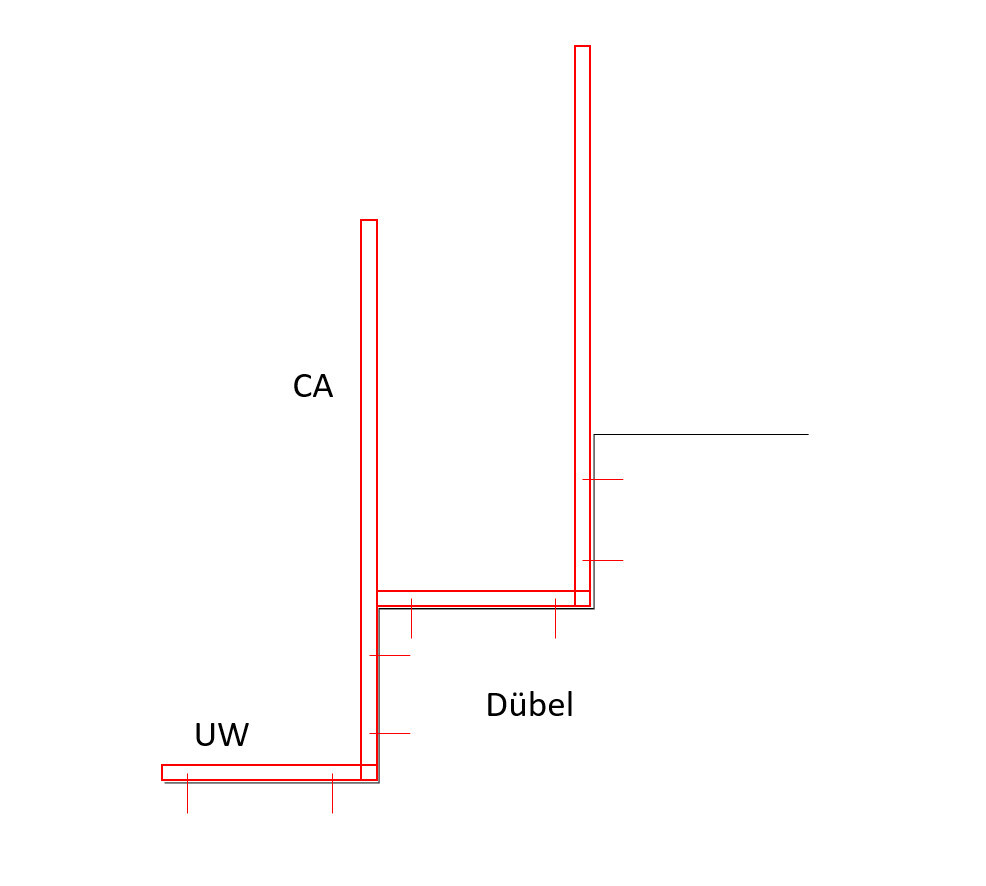
For this, I thought about attaching horizontal UW profiles to each stair tread and a vertical UA profile to the stair tread itself. I’ve attached a sketch to illustrate this.
I would use a 50mm (2-inch) profile and fix 12.5mm (0.5-inch) gypsum fiberboard on both sides. That would give a total thickness of 7.5cm (3 inches).
I have two questions and hope you can help me out:
1. Would this construction be stable enough as a stair railing? Since it’s on the inside of the staircase, the railing stands free without a wall connection.
2. With a 50mm (2-inch) profile, the anchors would be placed in the center. Adding the 12.5mm (0.5-inch) board means the anchor would be positioned 37.5mm (1.5 inches) from the edge. I’m a bit concerned that the concrete might chip here. Maybe not when drilling the hole, but possibly when fastening the anchor, or if someone falls against the railing. An alternative would be chemical anchors, but there is still the concern of concrete spalling under pressure on the railing.
What do you think?
cheers
We have a spiral U-shaped concrete staircase with a landing and want to build a railing on the inside that is as slim as possible. Since a masonry version would take up too much space, we would like to realize the railing as thin as possible using drywall construction.
For this, I thought about attaching horizontal UW profiles to each stair tread and a vertical UA profile to the stair tread itself. I’ve attached a sketch to illustrate this.
I would use a 50mm (2-inch) profile and fix 12.5mm (0.5-inch) gypsum fiberboard on both sides. That would give a total thickness of 7.5cm (3 inches).
I have two questions and hope you can help me out:
1. Would this construction be stable enough as a stair railing? Since it’s on the inside of the staircase, the railing stands free without a wall connection.
2. With a 50mm (2-inch) profile, the anchors would be placed in the center. Adding the 12.5mm (0.5-inch) board means the anchor would be positioned 37.5mm (1.5 inches) from the edge. I’m a bit concerned that the concrete might chip here. Maybe not when drilling the hole, but possibly when fastening the anchor, or if someone falls against the railing. An alternative would be chemical anchors, but there is still the concern of concrete spalling under pressure on the railing.
What do you think?
cheers
No problem, I’ve attached it.
I took another look on site, and the staircase is 111cm wide (edge of step to plaster). Theoretically, I could also use the 75mm (3 inch) profile since 100cm (39 inch) is acceptable for a staircase. The question is whether it’s necessary. Ideally, the staircase should be 10cm (4 inch) wider, and 2.5cm (1 inch) can make a big difference when carrying a sofa.
However, I believe the drywall solution is completely sufficient. I had a mental image of a traditional railing, with posts spaced every 60-100cm (24-39 inch). I was also concerned that the anchors for the UW profile wouldn’t hold. But those assumptions turned out to be wrong. The UW profile is only there to attach the panel at the bottom. The stability comes from the UA profile, which is mounted on the side of EVERY stair step. This means I have a UA profile every 26cm (10 inch), and if I fix each with two anchors, the leverage effect is much less. The UA profiles are then connected by gypsum fiber boards, so the force will be distributed to the other UA profiles as well.
This should be stable. Before I get started, I’ll mount one profile first to test how stable it is.
What do you think?
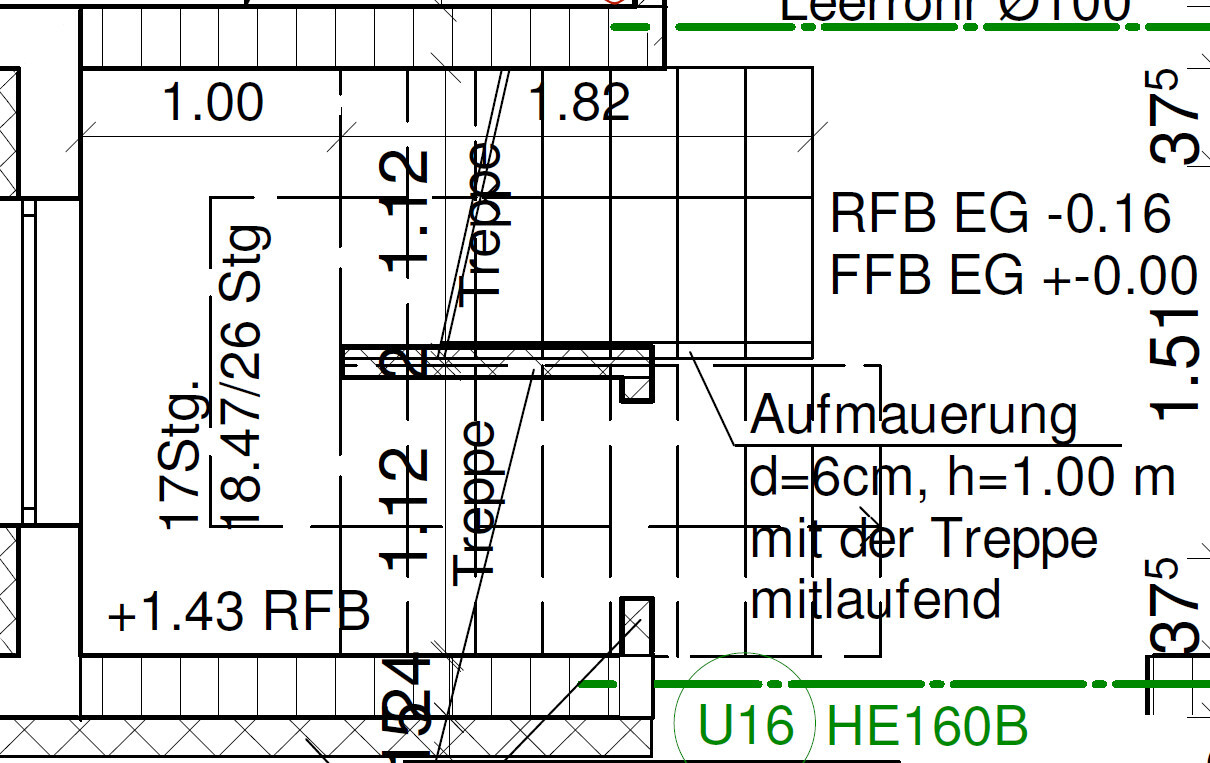
I took another look on site, and the staircase is 111cm wide (edge of step to plaster). Theoretically, I could also use the 75mm (3 inch) profile since 100cm (39 inch) is acceptable for a staircase. The question is whether it’s necessary. Ideally, the staircase should be 10cm (4 inch) wider, and 2.5cm (1 inch) can make a big difference when carrying a sofa.
However, I believe the drywall solution is completely sufficient. I had a mental image of a traditional railing, with posts spaced every 60-100cm (24-39 inch). I was also concerned that the anchors for the UW profile wouldn’t hold. But those assumptions turned out to be wrong. The UW profile is only there to attach the panel at the bottom. The stability comes from the UA profile, which is mounted on the side of EVERY stair step. This means I have a UA profile every 26cm (10 inch), and if I fix each with two anchors, the leverage effect is much less. The UA profiles are then connected by gypsum fiber boards, so the force will be distributed to the other UA profiles as well.
This should be stable. Before I get started, I’ll mount one profile first to test how stable it is.
What do you think?
If an experienced (?) shell builder wouldn’t go below 12.5cm (5 inches) to achieve a sufficiently large surface connection, I would have serious concerns about a freestanding drywall with only a point connection.
The railing also serves a purpose when you need to hold on to avoid falling, for example. If 100kg (220 lbs) were to act on the bottom profile with a lever arm of 1m (3.3 feet)…
The wall itself will be stable, but with a one-sided connection, it seems too risky to me.
Better to leave it out altogether so nobody gets the idea to hold onto it somewhere.
From what I remember about railings, they are primarily (all?) connected on the side to the end face, most likely due to the edge distance required for the anchors.
I would do the same in your case and use steel profiles.
Attach the profiles solidly with proper anchors to the end face, then fix wooden battens to the steel profiles and screw the drywall panels to those.
If you don’t have space to build on the side, you could also make slots in the stair treads to recess the profiles accordingly.
The railing also serves a purpose when you need to hold on to avoid falling, for example. If 100kg (220 lbs) were to act on the bottom profile with a lever arm of 1m (3.3 feet)…
The wall itself will be stable, but with a one-sided connection, it seems too risky to me.
Better to leave it out altogether so nobody gets the idea to hold onto it somewhere.
From what I remember about railings, they are primarily (all?) connected on the side to the end face, most likely due to the edge distance required for the anchors.
I would do the same in your case and use steel profiles.
Attach the profiles solidly with proper anchors to the end face, then fix wooden battens to the steel profiles and screw the drywall panels to those.
If you don’t have space to build on the side, you could also make slots in the stair treads to recess the profiles accordingly.
Winjoe1 schrieb:
If an experienced (?) structural shell builder wouldn’t go below 12.5cm (5 inches) to achieve a sufficiently large surface connection, I would have serious concerns about a point-connected, freestanding drywall partition. Hmm, I find that comparison difficult because the two aren’t really related. A freestanding masonry wall can almost always be knocked over since it’s only superficially connected. I want to screw the UA track to the staircase.
B
Baubaubau29 Dec 2019 15:41M. Gerd schrieb:
That should be stable. Before I start, I will first install a single stud and see how stable it is.
What do you think?I get the impression that you are already so focused on the drywall partition that you don’t want to consider any alternatives…
A single stud as a test probably won’t be very convincing, since it’s actually the sheathing that provides the necessary stability.
That’s my opinion on the matter…
Yes, we would like to solve this with a drywall partition because we can't think of any other way to achieve the thinnest possible wall. Of course, we are open to other suggestions, but we don’t want to dismiss our idea immediately just because someone "thinks" it wouldn’t work. This is not meant as criticism, as some of the responses here have given us valuable input.
One alternative is, for example, a post bracket like in the attachments. The first option would be more stable, but the downside is that the flange would be visible from the side. The second post bracket would be better in that regard. Here, a wooden post could be inserted, and the panels attached to it. But would this be more stable than using UA profiles?
Of course, the cladding adds additional stability, but if the concrete with a UA profile breaks off easily under light pressure, I wouldn’t choose that solution. If it already seems stable, then the cladding would only improve it even more. That’s what I meant.
As I said, I am open to other implementation suggestions. We would like something like what is attached
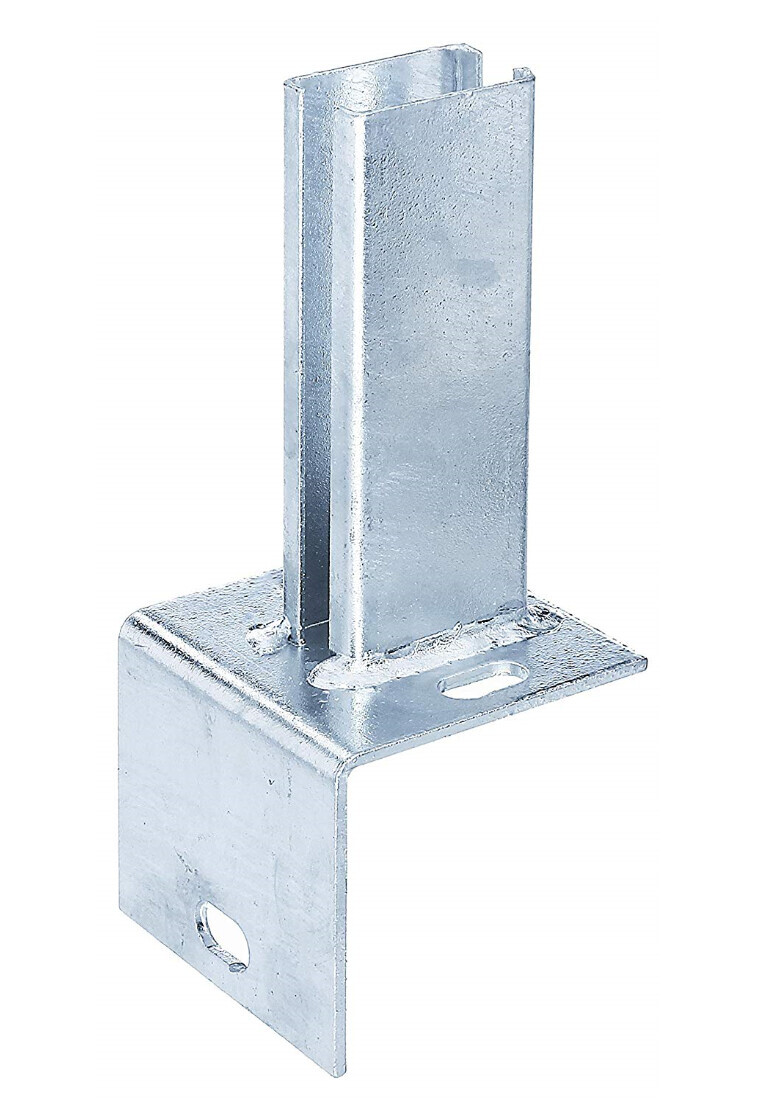
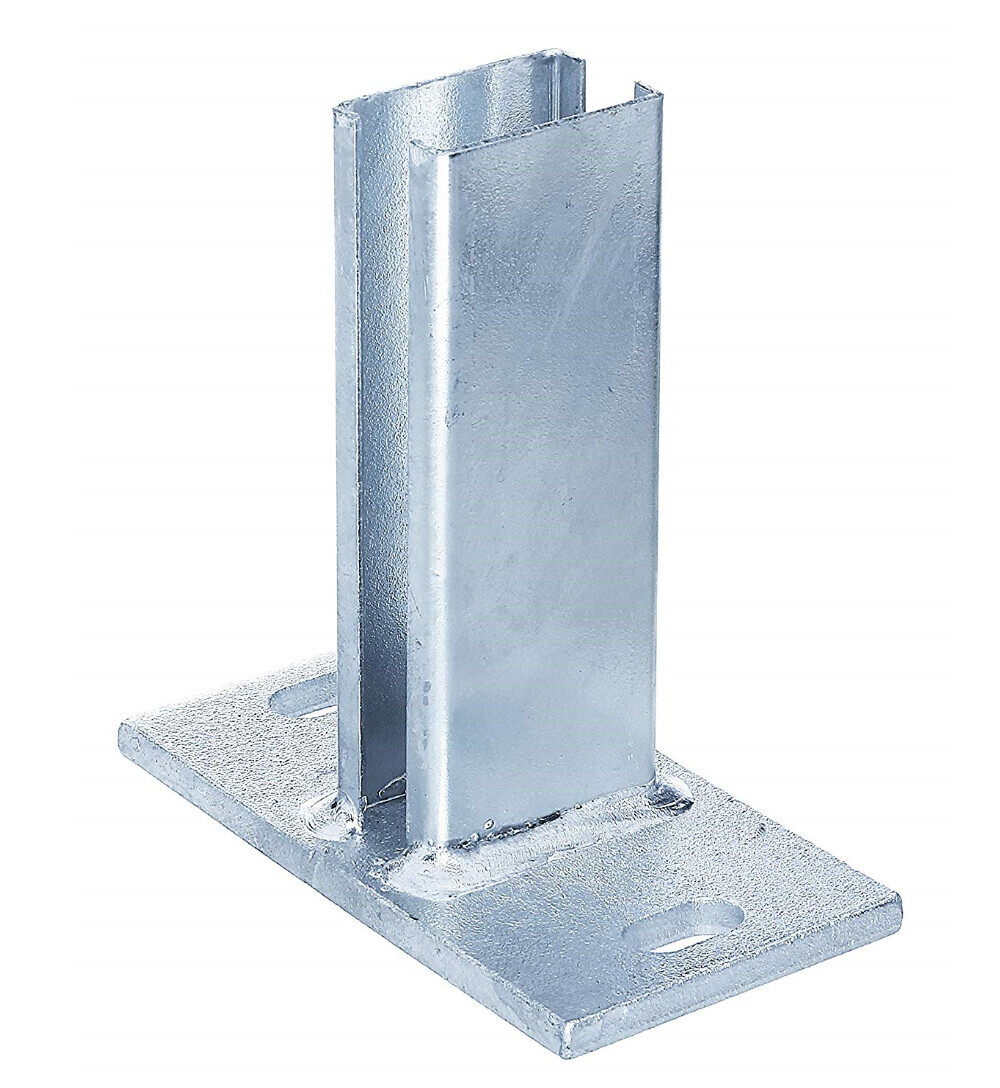
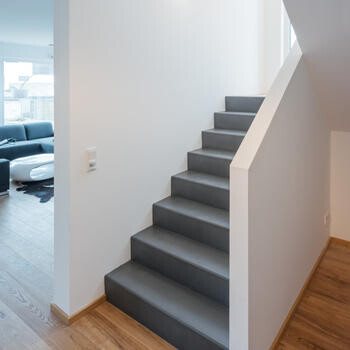
One alternative is, for example, a post bracket like in the attachments. The first option would be more stable, but the downside is that the flange would be visible from the side. The second post bracket would be better in that regard. Here, a wooden post could be inserted, and the panels attached to it. But would this be more stable than using UA profiles?
Of course, the cladding adds additional stability, but if the concrete with a UA profile breaks off easily under light pressure, I wouldn’t choose that solution. If it already seems stable, then the cladding would only improve it even more. That’s what I meant.
As I said, I am open to other implementation suggestions. We would like something like what is attached

What you want to alternatively build in drywall is the masonry wall shown with a thickness of 6 cm (2.4 inches)? – that would be 14 cm (5.5 inches) including the gap if both sides are built into one assembly. The geometry of the structure will probably take the rest of the Christmas holidays to draw, and in my opinion, it would also be advisable to switch to a timber frame substructure. On the other hand, this would significantly stabilize the whole thing. The reality is different from the example picture, since in your case this structure basically grows out of the wall around the storage room under the stairs.
https://www.instagram.com/11antgmxde/
https://www.linkedin.com/company/bauen-jetzt/
https://www.instagram.com/11antgmxde/
https://www.linkedin.com/company/bauen-jetzt/
Similar topics