
Hello everyone,
We are currently in the process of purchasing a plot of land and have already had initial discussions with our potential builder. They mentioned that building without a basement on our plot would be more complex due to the slope (we actually do not want a basement).
The situation is that at the front over about 21.5 meters (70.5 feet), there is a height difference of 2 meters (6.6 feet), and at the back over 26 meters (85 feet), there is a height difference of approximately 1.3 meters (4.3 feet).
How do you assess this? I have attached a sketch for better visualization. The house is planned to be placed on the front left side, with the garage/carport right beside it, so that the garden extends at the back.
Best regards
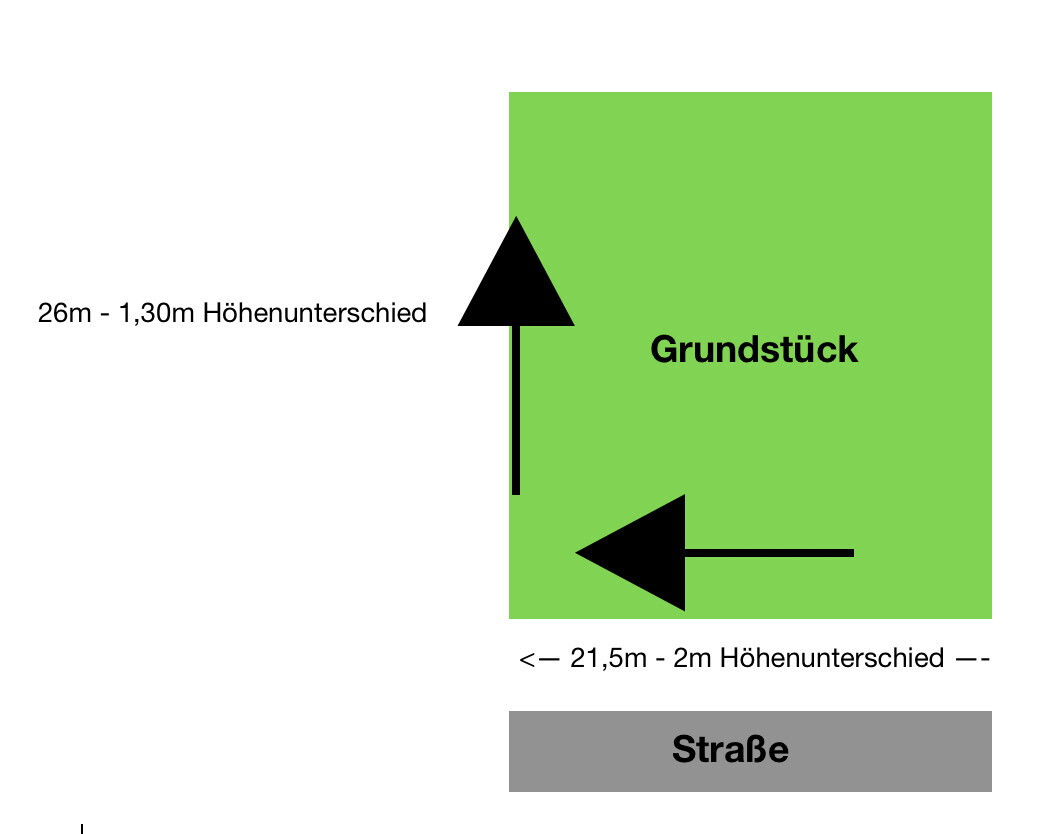
We are currently in the process of purchasing a plot of land and have already had initial discussions with our potential builder. They mentioned that building without a basement on our plot would be more complex due to the slope (we actually do not want a basement).
The situation is that at the front over about 21.5 meters (70.5 feet), there is a height difference of 2 meters (6.6 feet), and at the back over 26 meters (85 feet), there is a height difference of approximately 1.3 meters (4.3 feet).
How do you assess this? I have attached a sketch for better visualization. The house is planned to be placed on the front left side, with the garage/carport right beside it, so that the garden extends at the back.
Best regards

Basically, I wouldn’t decide on having a basement based on the topography of the overall property, but rather look at the conditions within the building plot or even more specifically in the area of the actual desired building footprint.
One of my regular readers’ already familiar mantras is that about 20 cm (8 inches) of height difference translates to roughly a 10% increase in basement costs — meaning that a built basement and a required but avoided basement (which is then replaced by terrain modification, slope support, and so on, often a Pyrrhic victory at best) involve practically the same effort and costs. The mentioned 20 cm (8 inches) = 10% means that with a 2 m (6.5 ft) height difference (in the relevant area, as noted), you will almost always pay for a basement — regardless of whether you choose a realized basement or one “avoided” through complicated terrain adjustments. If the height difference equals the ceiling height of a usable basement, the basement costs remain basically the same. With an 80 cm (31 inches) height difference, the example calculation shows about 40% of basement costs that are then spent on earthworks.
https://www.instagram.com/11antgmxde/
https://www.linkedin.com/company/bauen-jetzt/
One of my regular readers’ already familiar mantras is that about 20 cm (8 inches) of height difference translates to roughly a 10% increase in basement costs — meaning that a built basement and a required but avoided basement (which is then replaced by terrain modification, slope support, and so on, often a Pyrrhic victory at best) involve practically the same effort and costs. The mentioned 20 cm (8 inches) = 10% means that with a 2 m (6.5 ft) height difference (in the relevant area, as noted), you will almost always pay for a basement — regardless of whether you choose a realized basement or one “avoided” through complicated terrain adjustments. If the height difference equals the ceiling height of a usable basement, the basement costs remain basically the same. With an 80 cm (31 inches) height difference, the example calculation shows about 40% of basement costs that are then spent on earthworks.
BiffBiff schrieb:A split-level house is, purely considering the terrain, optimal with a height difference of about 140 to 150 cm (55 to 59 inches) in the relevant area; however, personal preferences obviously play a role as well, since split-level homes tend to work better with fairly open floor plans. A common misconception here is the “compulsive” idea of offsetting by exactly half a storey height and/or splitting the floor areas roughly in half.
Personally, I would skip the basement and build a split-level house.
goalkeeper schrieb:I’ll spare you the long rant you really deserve for that at least provocative, if not outright cheeky, comment and instead ask: would you care to share which forum you think enthusiastically supports slab-on-grade houses?
You’re asking the wrong forum. Here, they’d advise a basement even with a slope of 0.5 degrees.
https://www.instagram.com/11antgmxde/
https://www.linkedin.com/company/bauen-jetzt/
11ant schrieb:
Basically, I wouldn’t base the decision about the basement on the topography of the entire plot, but rather look at the conditions within the building area or even more specifically in the area of the actually desired footprint.
One of my regular readers’ familiar mantras is that around 20 cm (8 inches) of height difference translates to roughly 10% of the basement cost—in the sense that a constructed basement and a basement that is needed but avoided (and then compensated with terrain modeling, slope reinforcement, etc., which is more of a Pyrrhic victory) basically require the same (including cost) effort. The mentioned 20 cm (8 inches) = 10% means that with a 2 m (6.5 feet) height difference (in the relevant area, see above), you will almost always pay for a basement—whether you decide to build it or to “avoid” it using some kind of terrain workaround. If the height difference is as high as the clear height of a usable basement, then the basement costs are basically the same either way. With an 80 cm (31 inches) height difference, the calculation example results in about 40% basement costs, which then go to earthworks.
This was also more or less the opinion of our planner. That it might get a bit more expensive, but not as dramatically as expected, especially if you put in some own work (flooring, painting, perimeter insulation). Also, we can reduce the planned 150 sqm (1,615 sq ft) house with two full stories by about 15 sqm (160 sq ft), since the utility room on the ground floor can be eliminated and moved to the basement.
Unfortunately, we have no real sense yet of the terrain, but that will surely change after an upcoming site visit together.
According to the building regulations, walls may only be built up to 20 cm (8 inches) above the traffic area and absolutely no walls may be built along the neighbors’ side (in this case, slopes of 1:1.5 must be constructed).
It definitely remains exciting whether to have a basement or not.
I just had a really practical idea for using the basement: an integrated double garage. Whether this would be more cost-effective than a separate garage or even feasible from a construction perspective... good question. Do you have any experience with this? The driveway would also be lower than the street level, so it would slope downhill... something to consider further.
Kuota88 schrieb:
I just had a really practical idea on how to utilize the basement:Relatively too expensive due to the energy-saving regulations.
Similar topics