
Hello everyone,
We have received a quote for a photovoltaic system on the roof of our single-family house planned for next year.
Our plan is to fully cover the south-facing roof.
The house measures approximately 9 x 12 m (30 x 40 feet) with the roof ridge running along the longer side, featuring a gable roof with a 45-degree pitch. There will be no roof overhang and one dormer.
You can find a floor plan of the attic with the basic dimensions attached. The photovoltaic system will be installed on the roof shown in the floor plan with the single dormer, not on the side with the two dormers.
What surprises us about the quote is that the supplier calculates a photovoltaic area of 45.8 sqm (493 sq ft), or 28 modules (just to be clear, photovoltaic area, not roof area), which results in a system size of 8.8 kWp according to the offer.
I won’t say what I calculated for the roof area myself (I’m really bad at math, but there are online calculators for that), but it seems to us that the system could be much larger based on the roof size. The original goal was to fully utilize at least 10 kWp or more. Does the dormer really take up that much space?
Additionally, our architect mentioned that there may be regulations regarding minimum distances to the roof edge and the dormer or something similar — is that possible?
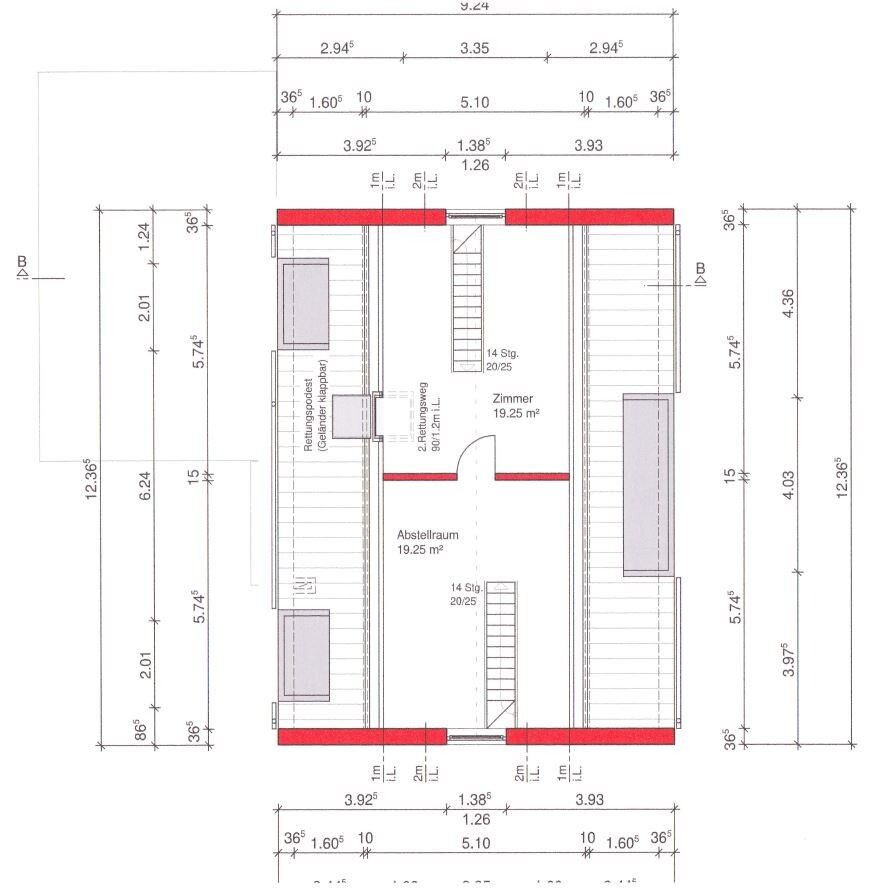
Are we making a fundamental (calculation) error here, or is the system much too small given the roof size?
It would be great if you could share your assessment.
As an additional optional question, the system is proposed with IBC modules and an SMA inverter for a total net price of about 11,500 € (approx. 11.5K euros).
Are these components any good, and is that a reasonable price in NRW?
Best regards,
Tarnari
We have received a quote for a photovoltaic system on the roof of our single-family house planned for next year.
Our plan is to fully cover the south-facing roof.
The house measures approximately 9 x 12 m (30 x 40 feet) with the roof ridge running along the longer side, featuring a gable roof with a 45-degree pitch. There will be no roof overhang and one dormer.
You can find a floor plan of the attic with the basic dimensions attached. The photovoltaic system will be installed on the roof shown in the floor plan with the single dormer, not on the side with the two dormers.
What surprises us about the quote is that the supplier calculates a photovoltaic area of 45.8 sqm (493 sq ft), or 28 modules (just to be clear, photovoltaic area, not roof area), which results in a system size of 8.8 kWp according to the offer.
I won’t say what I calculated for the roof area myself (I’m really bad at math, but there are online calculators for that), but it seems to us that the system could be much larger based on the roof size. The original goal was to fully utilize at least 10 kWp or more. Does the dormer really take up that much space?
Additionally, our architect mentioned that there may be regulations regarding minimum distances to the roof edge and the dormer or something similar — is that possible?
Are we making a fundamental (calculation) error here, or is the system much too small given the roof size?
It would be great if you could share your assessment.
As an additional optional question, the system is proposed with IBC modules and an SMA inverter for a total net price of about 11,500 € (approx. 11.5K euros).
Are these components any good, and is that a reasonable price in NRW?
Best regards,
Tarnari
B
boxandroof9 Nov 2019 15:30@hampshire, you have clearly put a lot of thought into your house. It should not go unmentioned that many people’s main motivation is cost-effectiveness or, if you prefer, CO2 reduction. From that perspective, many of your recommendations seem to me counterproductive.
String lengths, shading: it is clear that these are important, but there are solutions that do not require sacrificing surface area.
The reference to another forum has already been made; I also received many helpful tips there for our system, which I then discussed and implemented with my solar installer.
String lengths, shading: it is clear that these are important, but there are solutions that do not require sacrificing surface area.
The reference to another forum has already been made; I also received many helpful tips there for our system, which I then discussed and implemented with my solar installer.
hampshire schrieb:
The standard modules are connected in series. A dormer casts a shadow. Shadows on series-connected panels reduce total output. Ask the solar installer about the panel layout and why they recommend and calculate it that way.
Anyone who just strings together panels in series and promises full power despite shading may have a better kWp/€ ratio on paper but usually delivers a less efficient system in reality.
Sometimes greed clouds judgment, and that’s how these guys get their contracts.
Additionally, you pay an energy surcharge for production over 10 kWp (kilowatt peak). This will rise significantly in 2020.
Tip: Size your system generously based on your own consumption, use a hybrid inverter, and store excess energy reasonably in batteries and a hot water storage tank.
If you don’t want to spoil the look of your house, consider solar roof tiles. Although much more expensive, they also increase the property value (so it’s a good investment) — and with a low-voltage system on the roof and parallel connection, you avoid shading issues, have no electrician climbing on the roof, no fire load concerns, and no high voltage above living spaces. These are all disadvantages of standard photovoltaic panels that nobody talks about but everyone accepts because no one questions them anymore. I would like to comment on a few points:
The renewable energy surcharge for consumers is increasing. However, the current surcharge on self-consumption will soon be abolished due to an upcoming EU regulation. So this should not be a decisive factor.
A competent solar installer will provide a shading analysis. From that, you can see the losses caused by shading and decide which areas are worthwhile to cover. Standard modules nowadays have bypass diodes and good inverters feature shading management. This prevents losses at individual shaded panels, for example caused by the dormer.
Aesthetically pleasing systems can also be built with standard modules. They are available in all-black versions as well, which are hardly noticeable on dark roofs. Solar roof tiles are rare, tend to get warmer and less efficient, and also age faster. Unless required for heritage protection reasons, it is better to avoid them.
Systems are usually rated for a maximum of 1000 V. This is not high voltage but still in the same medium-voltage category as the household mains voltage at the outlet. This is well understood by fire departments today, and they can handle it. Magnetic fields can be minimized by proper cable routing, which should be done anyway for lightning protection.
One kWh from your solar system costs about 6 to 7 cents. One kWh from stored energy costs 40 to 50 cents. So it is generally not economically worthwhile.
Conclusion: Use the help of the Photovoltaic Forum to find a good offer and install as many panels as your roof allows. It pays off.
H
hampshire10 Nov 2019 02:18miho schrieb:
A professional solar installer will provide a shading analysis. From this, you can identify losses due to shading and consider which areas are worth covering.That’s exactly what I meant—the original poster was surprised by the relatively small area offered compared to the potentially available area they had calculated.miho schrieb:
Systems typically operate at a maximum of 1000V. This is not high voltage but still within the same medium voltage category as the mains voltage at a socket outlet.Correct. That’s why an electrician has to go on the roof. Below 120V this is no longer required, and such solutions do exist.Mentioning a technical and aesthetic alternative does not diminish the mature and technically sound standard systems. They remain the first choice purely from a return on investment standpoint. Some people invest in the design of their house, landscaping, lighting, and colors—so pointing out design options for the roof can be quite valuable and not “counterproductive.”
B
boxandroof10 Nov 2019 09:26hampshire schrieb:
A reference to design options for the roof can definitely be valuable and not “counterproductive.”Your comments are certainly valuable, that’s not how I meant it. I just didn’t want to present the notes about storage and possibly smaller areas or orientation toward self-consumption as a general recommendation, since these often clearly conflict with other goals and this is not always obvious to beginners.Read through the forum a bit first. You’ll quickly move away from solar roof tiles (for various reasons…), especially if cost-effectiveness and CO2 footprint are important to you — their efficiency simply suffers too much. I’m also a fan of good aesthetics, but my environmental concerns ultimately took priority.
Regarding sizing: a simple rule is as much as possible… even if that means paying the energy surcharge (you can find various calculations here in the forum). Many inverters now have really good shade management (together with careful planning of the strings, this is already a good step forward).
Depending on the roof color, you can choose all-black modules, which are much more visually appealing than standard modules (with only a slight efficiency loss). On black or anthracite roofs, the appearance is acceptable, sometimes barely noticeable.
Everything has been said about batteries: nowadays, for single-family homes they are mostly a luxury if you want them, but you usually lose money. There is also no ecological advantage, since electricity that is not stored in a battery isn’t lost, but fed into the grid.
Regarding sizing: a simple rule is as much as possible… even if that means paying the energy surcharge (you can find various calculations here in the forum). Many inverters now have really good shade management (together with careful planning of the strings, this is already a good step forward).
Depending on the roof color, you can choose all-black modules, which are much more visually appealing than standard modules (with only a slight efficiency loss). On black or anthracite roofs, the appearance is acceptable, sometimes barely noticeable.
Everything has been said about batteries: nowadays, for single-family homes they are mostly a luxury if you want them, but you usually lose money. There is also no ecological advantage, since electricity that is not stored in a battery isn’t lost, but fed into the grid.

Hello everyone,
sorry for the late reply. We asked our architect to follow up again. Apparently, it wasn’t clear enough that we might want to use as much of the roof space as possible.
In response, the solar installer said that increasing to 9.96 kWp would only result in an additional cost of about €350 (around $350), so basically nothing.
Unfortunately, he didn’t answer our main question about the maximum capacity that can be installed on the roof.
Instead, he explained what additional equipment is required for systems over 10 kWp and how this affects costs, as well as how the overall return on feed-in payments is generally reduced as a result.
So at least we now know that obviously more panels can fit on the roof than initially offered. However, the real question of how much actually fits and whether the additional feed-in income compensates for or exceeds the Renewable Energy Act surcharge and extra costs has still not been answered.
Nevertheless (because I feel very well supported and advised), I would also like to ask you how I can calculate from which kWp the Renewable Energy Act surcharge becomes worthwhile. As silly as it sounds, I’m really bad at math and therefore uncertain about how to set up the calculation and which variables to include…
sorry for the late reply. We asked our architect to follow up again. Apparently, it wasn’t clear enough that we might want to use as much of the roof space as possible.
In response, the solar installer said that increasing to 9.96 kWp would only result in an additional cost of about €350 (around $350), so basically nothing.
Unfortunately, he didn’t answer our main question about the maximum capacity that can be installed on the roof.
Instead, he explained what additional equipment is required for systems over 10 kWp and how this affects costs, as well as how the overall return on feed-in payments is generally reduced as a result.
So at least we now know that obviously more panels can fit on the roof than initially offered. However, the real question of how much actually fits and whether the additional feed-in income compensates for or exceeds the Renewable Energy Act surcharge and extra costs has still not been answered.
Nevertheless (because I feel very well supported and advised), I would also like to ask you how I can calculate from which kWp the Renewable Energy Act surcharge becomes worthwhile. As silly as it sounds, I’m really bad at math and therefore uncertain about how to set up the calculation and which variables to include…
Similar topics