
Hello everyone,
We are currently looking for a developer for our house. At the same time, of course, we are also focusing on the right design, features, and price of the house.
Building a house is truly an adventure, and as you can imagine, there are a thousand questions and it’s hard to know where to start.
What I would like to know here is whether we are on the right track with a specific offer and if it can be implemented without any major concerns.
The key details are as follows:
Single-family house with approximately 140m² (1,507 sq ft) of living space, gable roof without dormers, KfW 70 standard, and
- central mechanical ventilation with heat recovery
- triple glazing with a U-value of 0.5
- solar rooftop system for domestic hot water with a 300-liter (79-gallon) storage tank
- roller shutters on the ground floor and upper floor
- underfloor heating return circuits in bathroom and kitchen
- triangular windows in the gable ends
The price for the whole package is supposed to be 180,000 euros. Overall, I find the price fair, but of course I’m also interested in your opinion.
Then I have a few more questions:
1. The construction description has very little information about the ventilation system installation. Should I follow up on this?
2. A condensing boiler from Vaillant, Junkers, Elco, or equivalent will be installed. Is this recommended, or are there specific things I should look out for?
3. What other aspects of the construction description should I pay attention to before accepting the offer? Are there any critical points I should be aware of?
Looking forward to your answers.
Best regards,
Matthias
We are currently looking for a developer for our house. At the same time, of course, we are also focusing on the right design, features, and price of the house.
Building a house is truly an adventure, and as you can imagine, there are a thousand questions and it’s hard to know where to start.
What I would like to know here is whether we are on the right track with a specific offer and if it can be implemented without any major concerns.
The key details are as follows:
Single-family house with approximately 140m² (1,507 sq ft) of living space, gable roof without dormers, KfW 70 standard, and
- central mechanical ventilation with heat recovery
- triple glazing with a U-value of 0.5
- solar rooftop system for domestic hot water with a 300-liter (79-gallon) storage tank
- roller shutters on the ground floor and upper floor
- underfloor heating return circuits in bathroom and kitchen
- triangular windows in the gable ends
The price for the whole package is supposed to be 180,000 euros. Overall, I find the price fair, but of course I’m also interested in your opinion.
Then I have a few more questions:
1. The construction description has very little information about the ventilation system installation. Should I follow up on this?
2. A condensing boiler from Vaillant, Junkers, Elco, or equivalent will be installed. Is this recommended, or are there specific things I should look out for?
3. What other aspects of the construction description should I pay attention to before accepting the offer? Are there any critical points I should be aware of?
Looking forward to your answers.
Best regards,
Matthias
M
Matthias1826 Jul 2012 11:37Der Da schrieb:
I find the guest bathroom next to the front door too small, and it doesn’t even have a door 🙂 Depending on the building services, the utility room might be too small since it has a dead corner.
You won’t be able to fit a coat rack or shoe cabinet in the hallway.
Overall, there’s little wall space for shelves in the living area.
Upstairs is a very standard 0815 floor plan... so it’s okay.
It will definitely feel tight without a basement. There isn’t much storage space with a room size upstairs of 15 m² (161 sq ft). But it can work if you’re not the “collector” type. 🙂Yes, that’s true. I’ve noticed it too, but at the moment I don’t know how to improve it sensibly without having to accept significant losses in the other rooms. Do you have any suggestions?
I had considered using the “dead corner” in the utility room for the washing machine or heating system, so at least it would be somewhat utilized. I’ve also thought about rotating the bathroom 90 degrees and then placing the door along the longer side, provided there’s enough space.
In any case, I would appreciate any suggestions on how to improve it further.

I have no idea exactly what you expect. Since you’ve apparently dealt with the costs enough, you probably turned to a construction company. Hopefully, they have professional architects involved and will be able to solve your problems. I certainly can’t. And I don’t think anyone here in the forum can either, because almost all relevant information is missing. Location of the plot or the house, for example.
Upstairs, you don’t have many options; the space is simply tight. I estimate you have a knee wall height of about 1m (3 feet 3 inches).
In the basement, your problem is that the house’s footprint is too small. I think you’ve allocated too much space for the kitchen and dining area. I would put the utility room on the left behind the stairs from the upper entrance. Then the kitchen and dining room on the right side. Downstairs near the entrance, a guest toilet, and then the kitchen and dining table. The living room would then be in the upper left area.
But I assume the side entrance door has to be on the right? If so, you could check whether it’s possible to mirror the floor plan.
Depending on the heating system you want to install, you need space—and not too little. A small gas condensing boiler with a 150l (40-gallon) water tank takes up hardly any space, but if you have 300l (80 gallons) or more, the utility room will get cramped.
Have you thought about where you’ll store laundry or place a drying rack? That would fit well in the utility room. Be sure to provide good ventilation there, or you risk mold growing.
My advice is to let the architect take another look. If your construction company doesn’t have one and is just messing around with floor plans on the PC, I would consider switching providers.
I think some issues should have been noticed by the architect. Our architect spent almost 15 hours with us on our floor plans. We walked through everything in our minds, placed a stroller and imaginary furniture, and that’s how we achieved the perfect layout for us. My mother-in-law and my mother also had complaints, but they don’t have to live there. It’s always a matter of personal preference what one considers good or not, so no forum will help you with the floor plan. Such things can only develop through discussion with a good architect... that’s my opinion.
Upstairs, you don’t have many options; the space is simply tight. I estimate you have a knee wall height of about 1m (3 feet 3 inches).
In the basement, your problem is that the house’s footprint is too small. I think you’ve allocated too much space for the kitchen and dining area. I would put the utility room on the left behind the stairs from the upper entrance. Then the kitchen and dining room on the right side. Downstairs near the entrance, a guest toilet, and then the kitchen and dining table. The living room would then be in the upper left area.
But I assume the side entrance door has to be on the right? If so, you could check whether it’s possible to mirror the floor plan.
Depending on the heating system you want to install, you need space—and not too little. A small gas condensing boiler with a 150l (40-gallon) water tank takes up hardly any space, but if you have 300l (80 gallons) or more, the utility room will get cramped.
Have you thought about where you’ll store laundry or place a drying rack? That would fit well in the utility room. Be sure to provide good ventilation there, or you risk mold growing.
My advice is to let the architect take another look. If your construction company doesn’t have one and is just messing around with floor plans on the PC, I would consider switching providers.
I think some issues should have been noticed by the architect. Our architect spent almost 15 hours with us on our floor plans. We walked through everything in our minds, placed a stroller and imaginary furniture, and that’s how we achieved the perfect layout for us. My mother-in-law and my mother also had complaints, but they don’t have to live there. It’s always a matter of personal preference what one considers good or not, so no forum will help you with the floor plan. Such things can only develop through discussion with a good architect... that’s my opinion.
B
Bauexperte6 Jul 2012 14:19Hello,
The “perfect solution” doesn’t exist for you either; if you need to stay within your budget/building envelope, compromises are necessary 😕
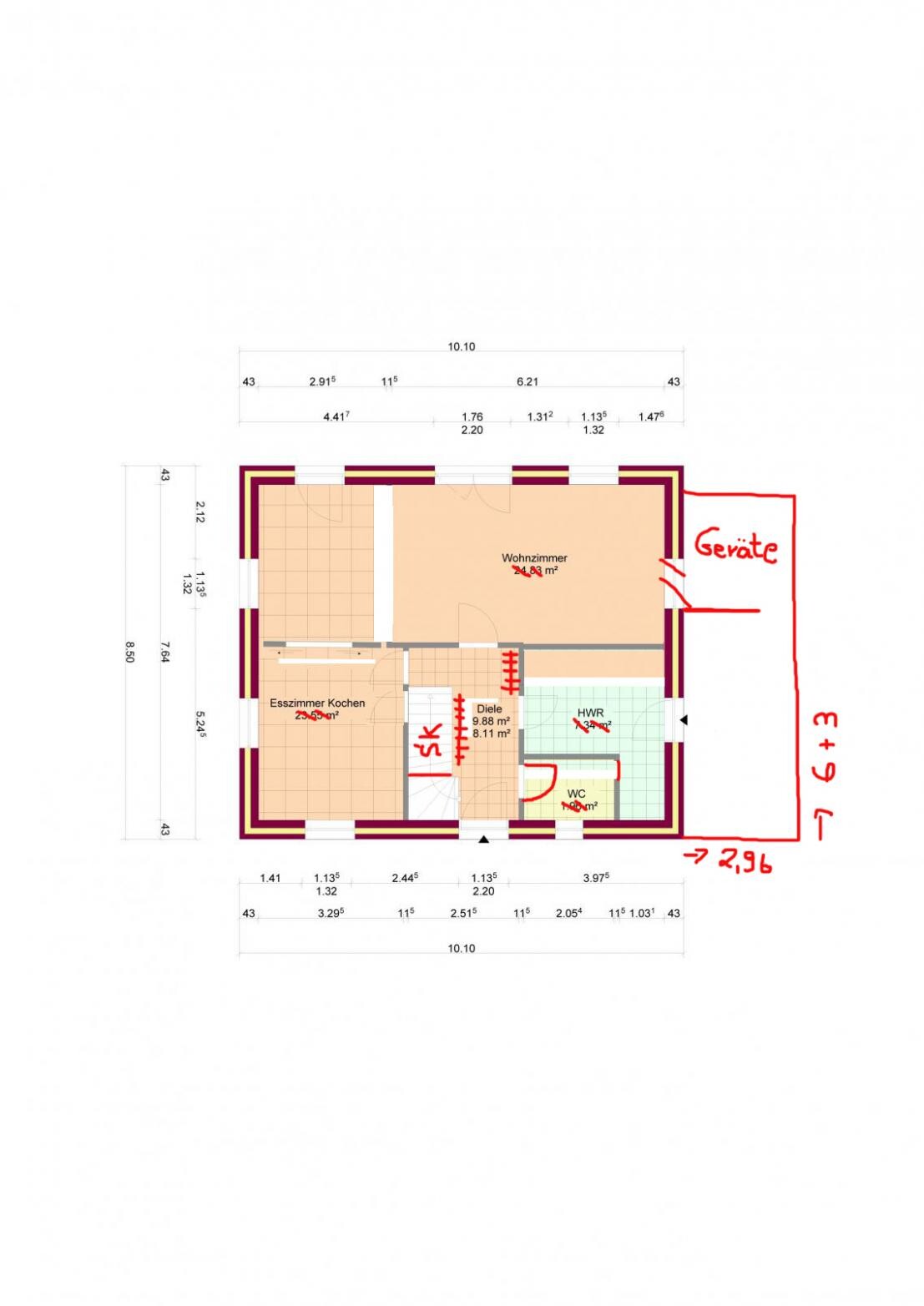
I have some time and feel like sketching a bit. Attached is a possible layout for your ground floor that remains functional and has a clear architectural concept. I enlarged the utility room—not so much for the technical equipment, assuming that your budget won’t allow for very complex systems, and a gas condensing boiler or air-to-water heat pump with an indirect hot water tank will be sufficient—but rather to accommodate your valid point about being able to place a drying rack there in winter. I would connect the entrance on the right side of the utility room with a prefabricated garage measuring 3 x 9 meters (10 x 30 feet approx.) including a rear storage area; the fire-rated T 90 door is less expensive than a secondary entrance door and, in my opinion, more practical.
You should have the stairs to the upper floor constructed as concrete stairs, which will give you a pantry for the kitchen. The sliding door running in front of the wall I would set into the wall to save space—for both the kitchen and the adjacent dining room. The dining and living rooms remain visually spacious by removing the wall. I would also adjust the window front facing the garden and plan for more windows.
Your upper floor will change on the right side of the stairs, as a small open space will be created there, making the master bedroom slightly smaller. I would also straighten the angled hallway—the children’s rooms don’t need to be huge at this house size; kids spend more time outside anyway, and as they grow older, they prefer their own space, which doesn’t necessarily have to be their bedrooms 😉 Also, the attic room must have practical access.
What I don’t quite understand is why you’re doing the planning yourself? If you hire a construction manager/general contractor/architect, they’ll make the plans for you anyway, and usually, the final design ends up quite different from what you originally imagined….
Kind regards
Matthias182 schrieb:
Yes, that’s true. I’ve noticed it too, but at the moment, I don’t know how to improve it meaningfully without sacrificing a lot in the other rooms. Do you have any suggestions?
The “perfect solution” doesn’t exist for you either; if you need to stay within your budget/building envelope, compromises are necessary 😕
I have some time and feel like sketching a bit. Attached is a possible layout for your ground floor that remains functional and has a clear architectural concept. I enlarged the utility room—not so much for the technical equipment, assuming that your budget won’t allow for very complex systems, and a gas condensing boiler or air-to-water heat pump with an indirect hot water tank will be sufficient—but rather to accommodate your valid point about being able to place a drying rack there in winter. I would connect the entrance on the right side of the utility room with a prefabricated garage measuring 3 x 9 meters (10 x 30 feet approx.) including a rear storage area; the fire-rated T 90 door is less expensive than a secondary entrance door and, in my opinion, more practical.
You should have the stairs to the upper floor constructed as concrete stairs, which will give you a pantry for the kitchen. The sliding door running in front of the wall I would set into the wall to save space—for both the kitchen and the adjacent dining room. The dining and living rooms remain visually spacious by removing the wall. I would also adjust the window front facing the garden and plan for more windows.
Your upper floor will change on the right side of the stairs, as a small open space will be created there, making the master bedroom slightly smaller. I would also straighten the angled hallway—the children’s rooms don’t need to be huge at this house size; kids spend more time outside anyway, and as they grow older, they prefer their own space, which doesn’t necessarily have to be their bedrooms 😉 Also, the attic room must have practical access.
What I don’t quite understand is why you’re doing the planning yourself? If you hire a construction manager/general contractor/architect, they’ll make the plans for you anyway, and usually, the final design ends up quite different from what you originally imagined….
Kind regards

We designed our floor plan ourselves as well. I believe that when you design it on your own, you put more thought into it and can even virtually furnish the rooms. You simply don’t have that time when you are at the architect’s or the sales office. You can still make adjustments to your custom floor plan there.
Especially women (perhaps except for building experts) are known to have difficulty visualizing objects in 3D. The 3D view was very helpful for my wife in this regard.
Especially women (perhaps except for building experts) are known to have difficulty visualizing objects in 3D. The 3D view was very helpful for my wife in this regard.
I am sure that a do-it-yourself design program can be a fun tool—I myself have spent a lot of time drawing with Google SketchUp. However, it can NEVER replace a professional architect. In the end, trying to save money here is simply the wrong place to cut costs.
An architect needs to take as much time as the client requires because the architect only gets paid once the client is satisfied. Lack of time is not a valid excuse.
What you can do is create a draft yourself and then take it to the architect. I would say 90% of self-designed plans are discarded and then properly rebuilt. The architect will at least have an idea of what you envision. After all, an architect has formally learned the craft and can see things that a layperson simply cannot. Almost anything you create on a computer can be built, but whether it is economically viable is something private builders cannot assess. Utility routing, structural engineering, staircase calculations, practical layouts, number of windows, and so on—these are all aspects that need professional consideration.
An architect needs to take as much time as the client requires because the architect only gets paid once the client is satisfied. Lack of time is not a valid excuse.
What you can do is create a draft yourself and then take it to the architect. I would say 90% of self-designed plans are discarded and then properly rebuilt. The architect will at least have an idea of what you envision. After all, an architect has formally learned the craft and can see things that a layperson simply cannot. Almost anything you create on a computer can be built, but whether it is economically viable is something private builders cannot assess. Utility routing, structural engineering, staircase calculations, practical layouts, number of windows, and so on—these are all aspects that need professional consideration.
M
Matthias18212 Jul 2012 16:03Hello everyone,
Even though I had already gone a bit beyond the building specification, I came across one point again while reading.
The wall construction of the exterior walls is described as follows:
- approx. 1.0 to 1.5 cm (0.4 to 0.6 inches) plaster thickness, interior plaster (gypsum plaster)
- 17.5 cm (7 inches) masonry (Poroton) (according to structural requirements)
- 2 layers of 6.0 cm (2.4 inches) thermal insulation (according to the requirements of the thermal insulation calculation based on the Energy Saving Ordinance 2009)
- approx. 2.0 cm (0.8 inches) finger-jointed cavity facing masonry with a thickness of approx. 11.5 cm (4.5 inches) (depends on manufacturer)
As an addition, we have planned an insulation package in the offer. It is described as follows:
- 100 mm (4 inches) perimeter insulation under the footing
- 140 mm (5.5 inches) mineral wool insulation in the wall
- 240 mm (9.5 inches) mineral wool insulation in the roof
Right now, I am surprised by the 2.0 cm (0.8 inches) finger-jointed cavity (so an air layer) in the exterior wall. I know that this is allowed. I also understand that the air cavity can be omitted if core insulation is used.
However, the question is whether that makes sense. With 140 mm (5.5 inches) mineral wool insulation in the wall, my understanding is that the air cavity would be eliminated. Is that correct? That would correspond to core insulation without an air layer. Is that right?
I am simply interested in whether this is an acceptable approach and if I might have overlooked something.
Thanks and best regards
Matthias
Even though I had already gone a bit beyond the building specification, I came across one point again while reading.
The wall construction of the exterior walls is described as follows:
- approx. 1.0 to 1.5 cm (0.4 to 0.6 inches) plaster thickness, interior plaster (gypsum plaster)
- 17.5 cm (7 inches) masonry (Poroton) (according to structural requirements)
- 2 layers of 6.0 cm (2.4 inches) thermal insulation (according to the requirements of the thermal insulation calculation based on the Energy Saving Ordinance 2009)
- approx. 2.0 cm (0.8 inches) finger-jointed cavity facing masonry with a thickness of approx. 11.5 cm (4.5 inches) (depends on manufacturer)
As an addition, we have planned an insulation package in the offer. It is described as follows:
- 100 mm (4 inches) perimeter insulation under the footing
- 140 mm (5.5 inches) mineral wool insulation in the wall
- 240 mm (9.5 inches) mineral wool insulation in the roof
Right now, I am surprised by the 2.0 cm (0.8 inches) finger-jointed cavity (so an air layer) in the exterior wall. I know that this is allowed. I also understand that the air cavity can be omitted if core insulation is used.
However, the question is whether that makes sense. With 140 mm (5.5 inches) mineral wool insulation in the wall, my understanding is that the air cavity would be eliminated. Is that correct? That would correspond to core insulation without an air layer. Is that right?
I am simply interested in whether this is an acceptable approach and if I might have overlooked something.
Thanks and best regards
Matthias
Similar topics