
ᐅ Single-family house (2 floors + finished basement + converted attic), approximately 200 sqm – modifications
Created on: 20 Oct 2019 21:50
G
grericht
Hello,
We are currently working with an architect on the design of our single-family home. Since we have three children, the house should accommodate several future scenarios. These include:
Plot:
Since the plot already has a building, and we want to keep the rear building (it is fully shaded by the apartment building, is in reasonable condition, and might provide future expansion potential—at least suitable for workshops and storage), and since the plot is not very large, we decided on a tall house with a small footprint.
About the house
We have already developed a fairly comfortable floor plan with our chosen architect. Our biggest concern is accidentally planning a wall or something else 5 cm (2 inches) too far to the left or right and then being unable to fit our furniture. I would appreciate it if you would be interested in looking over the current design and giving feedback.
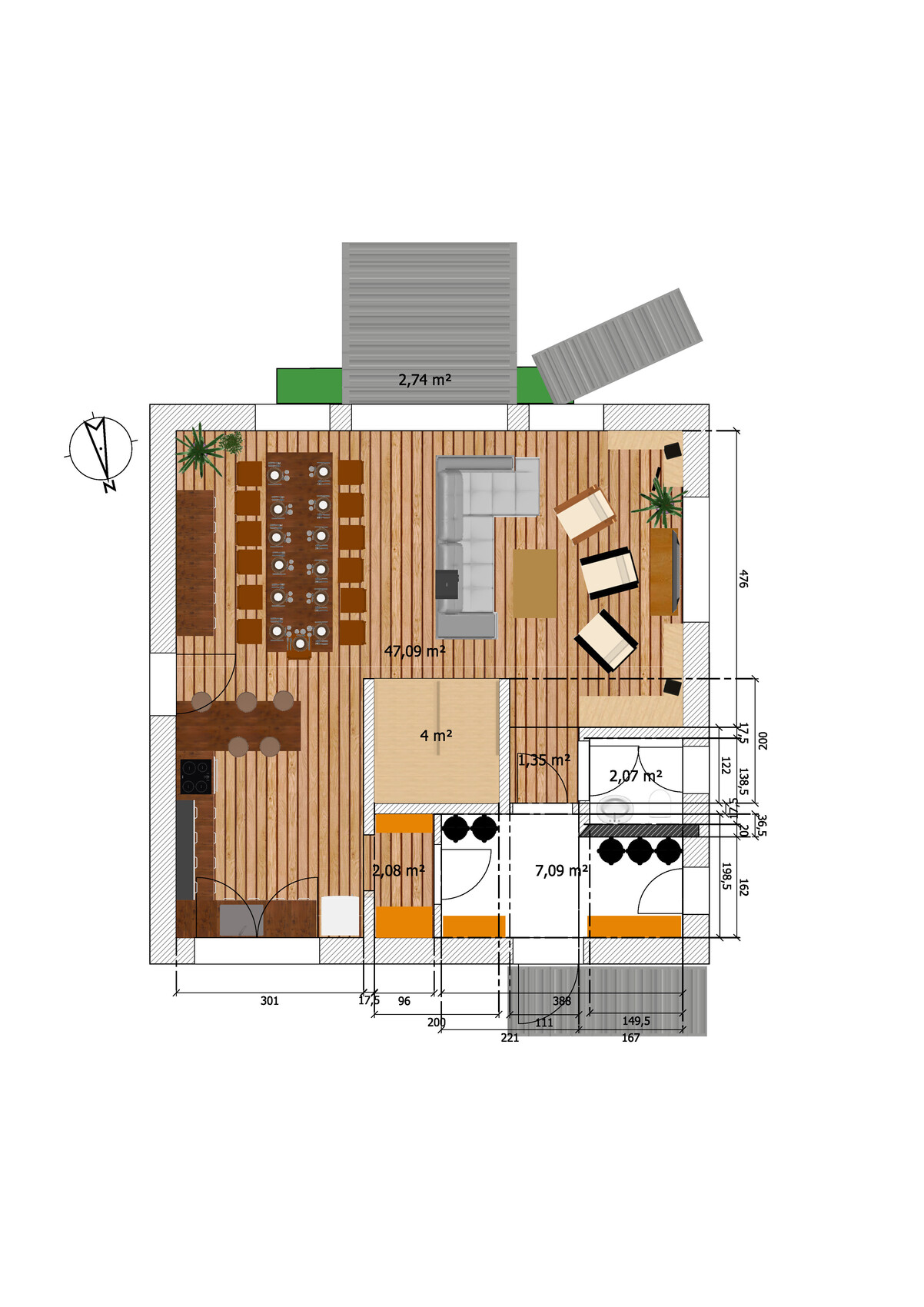
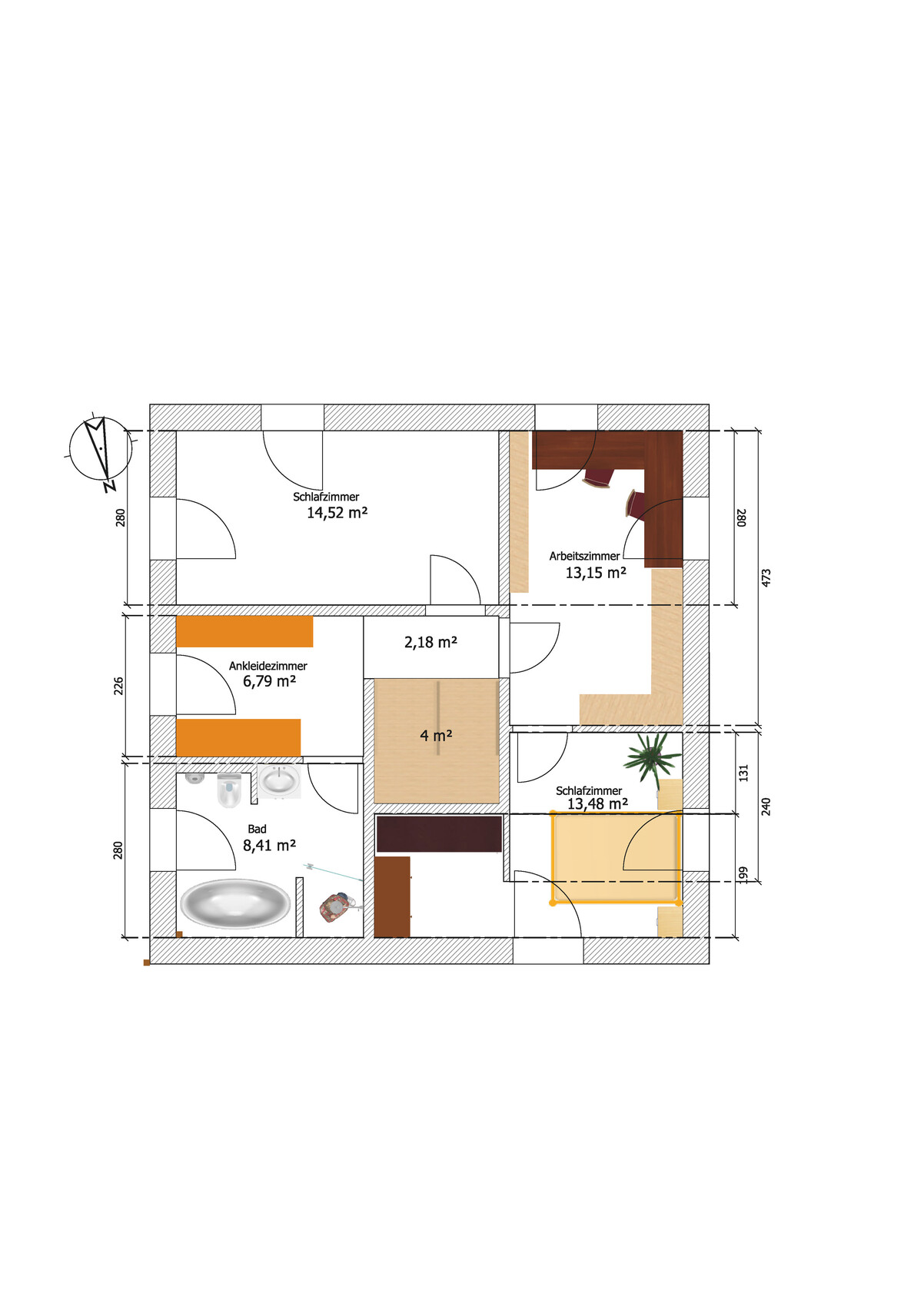
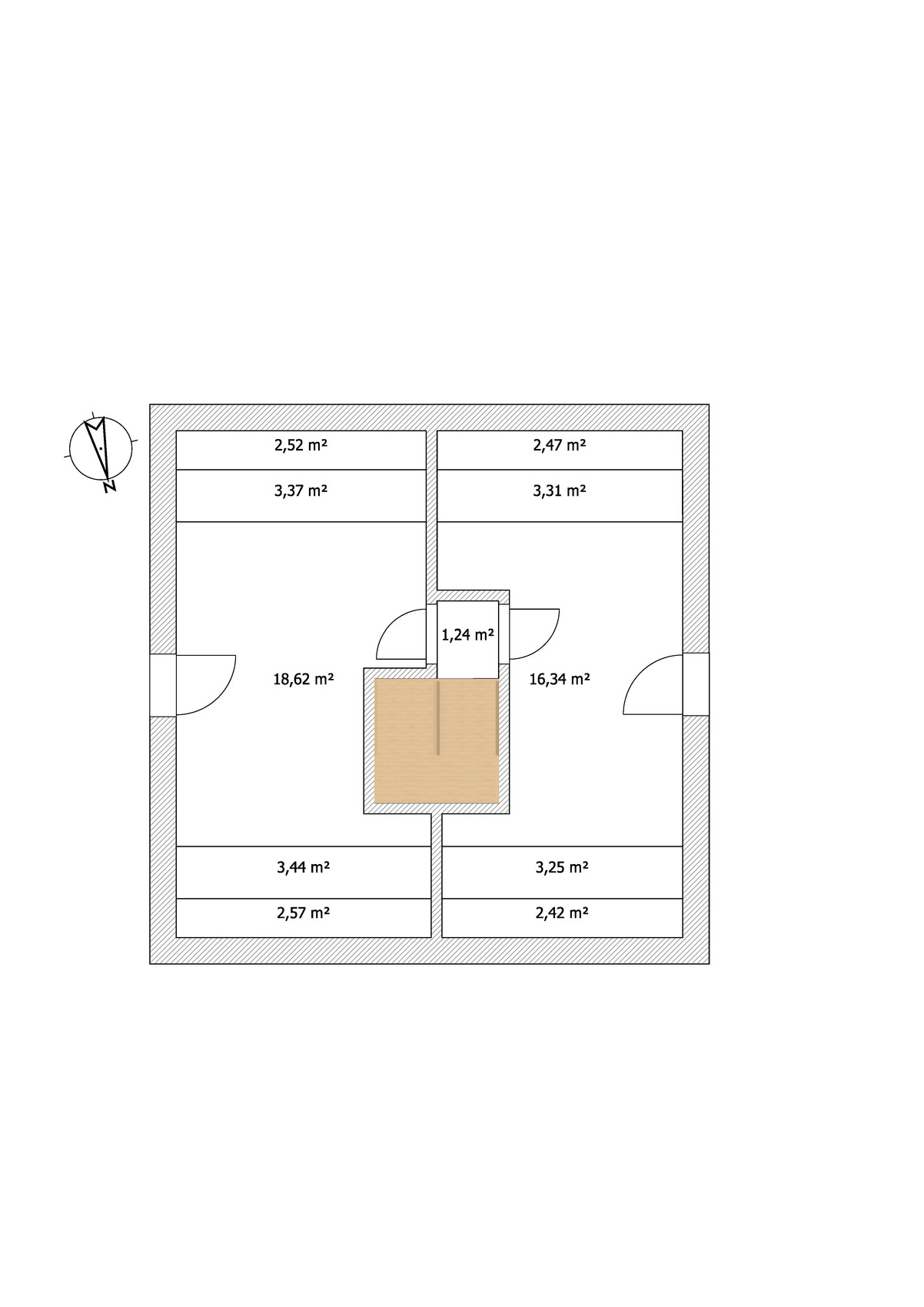
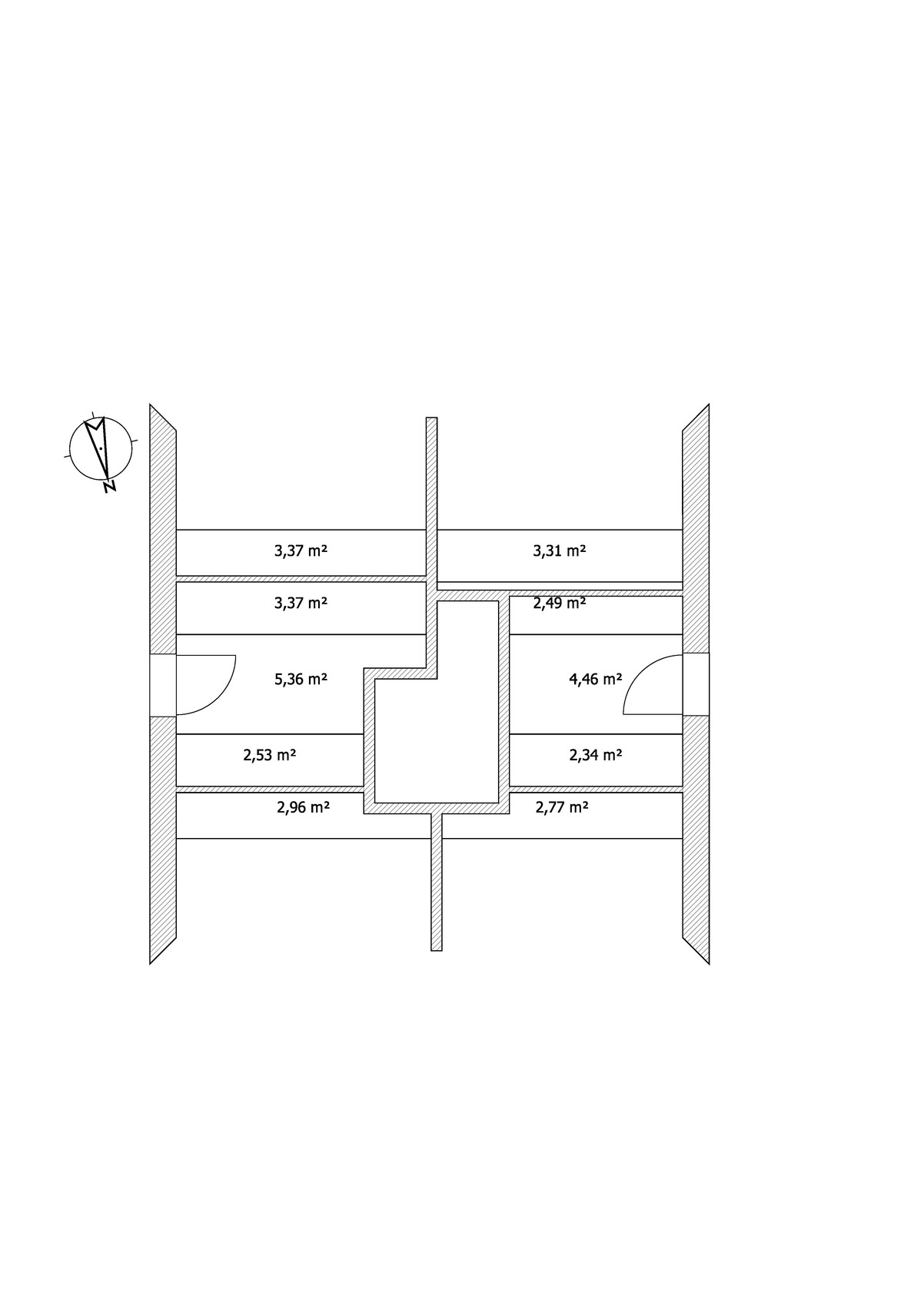
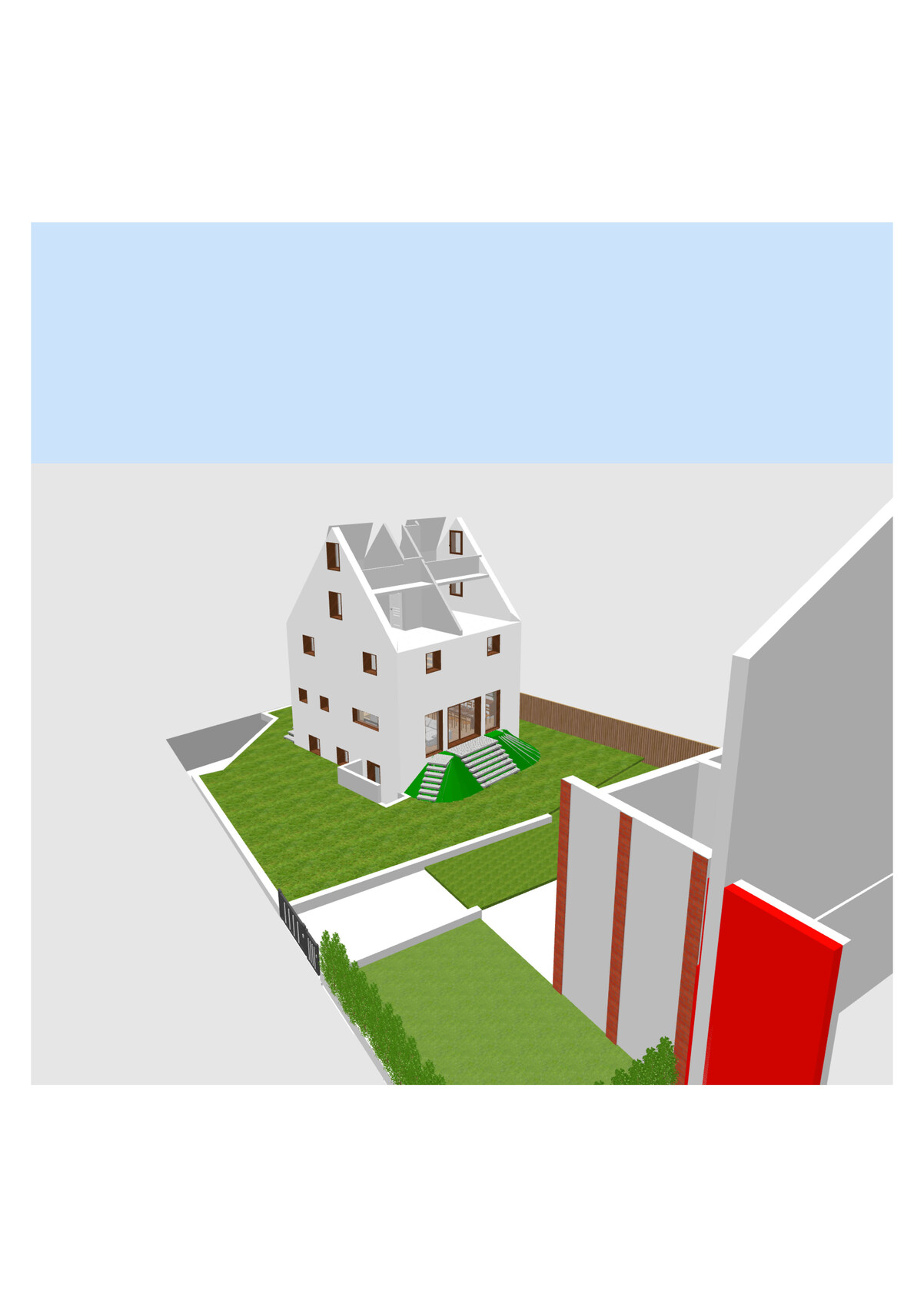
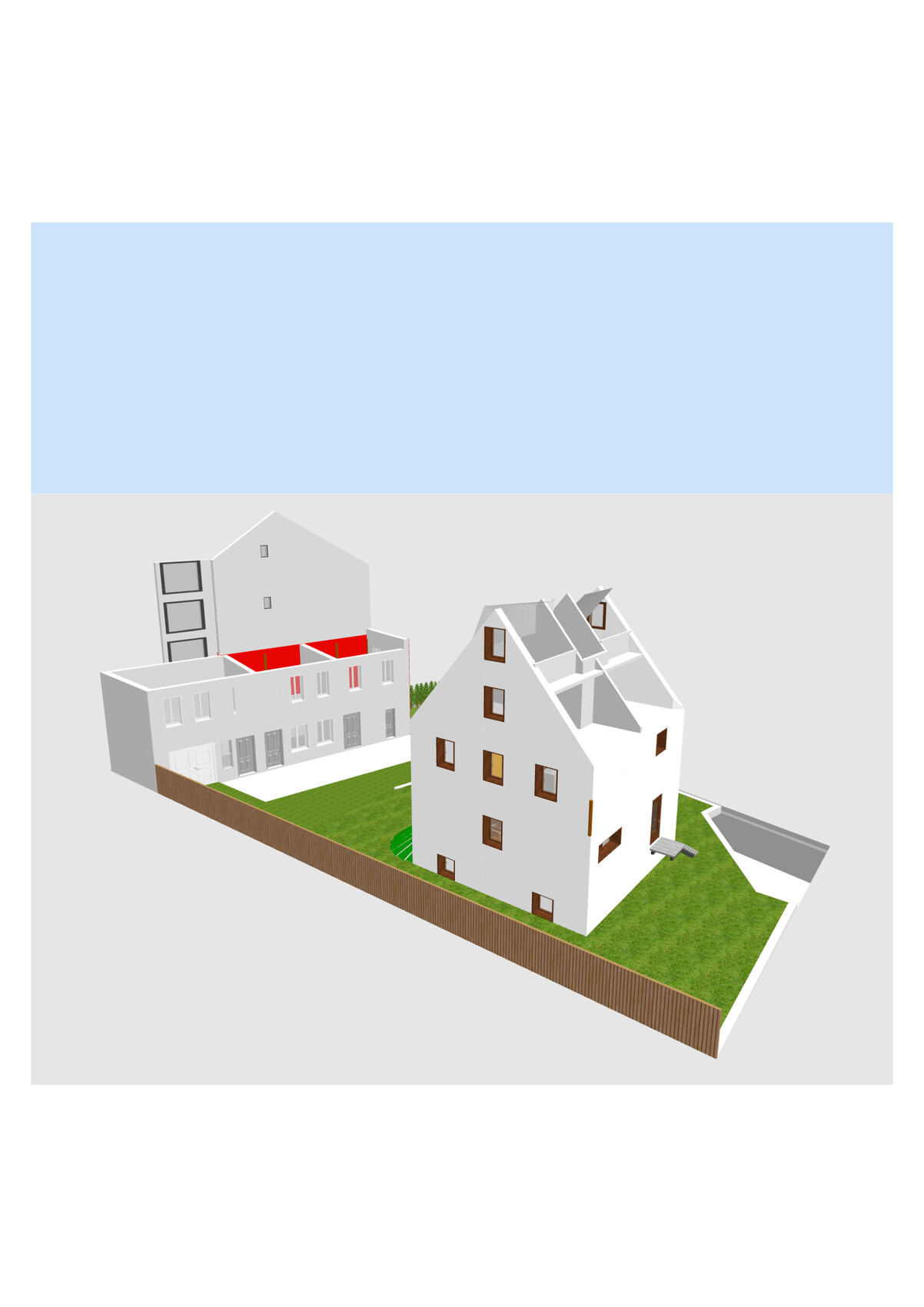
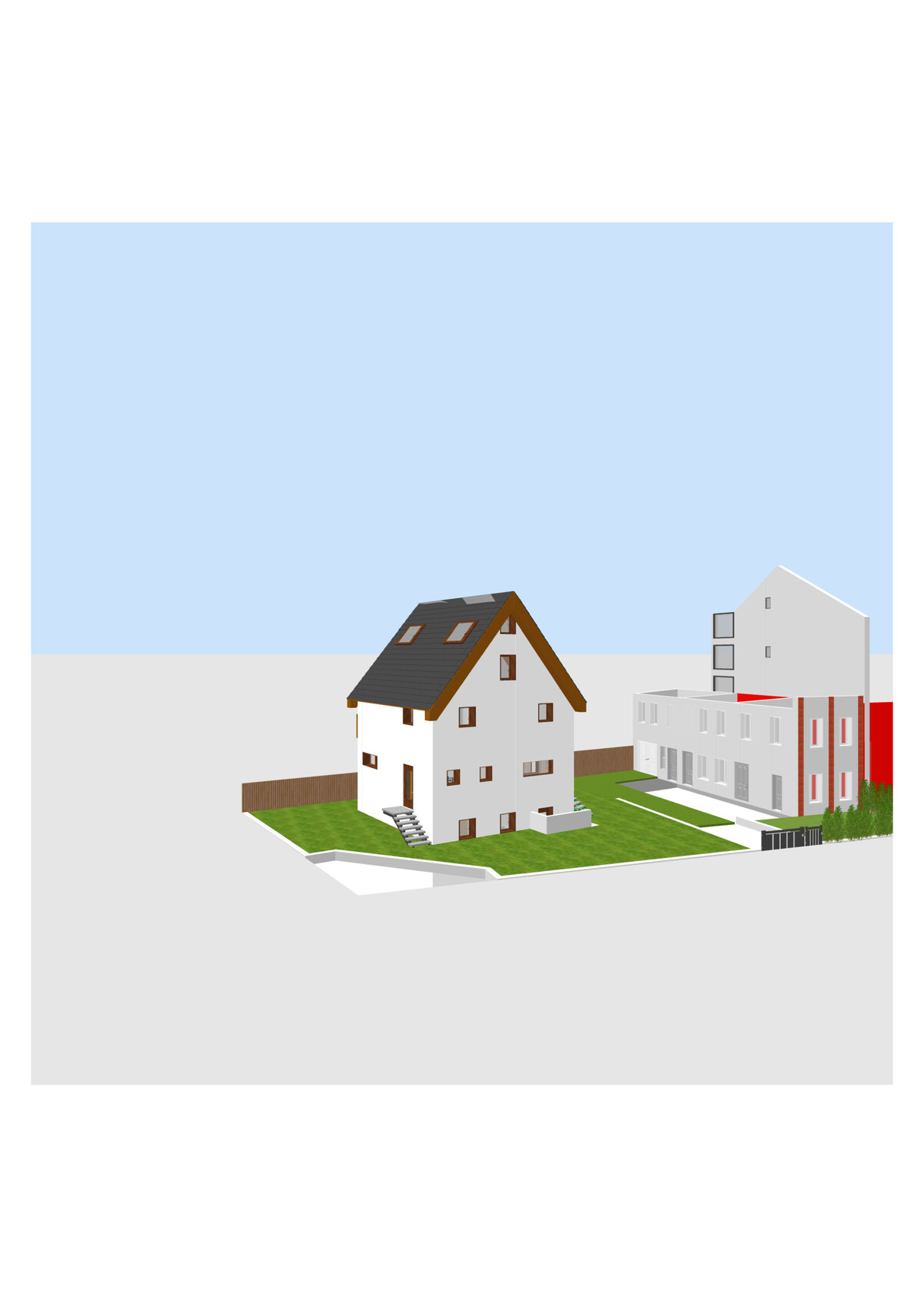
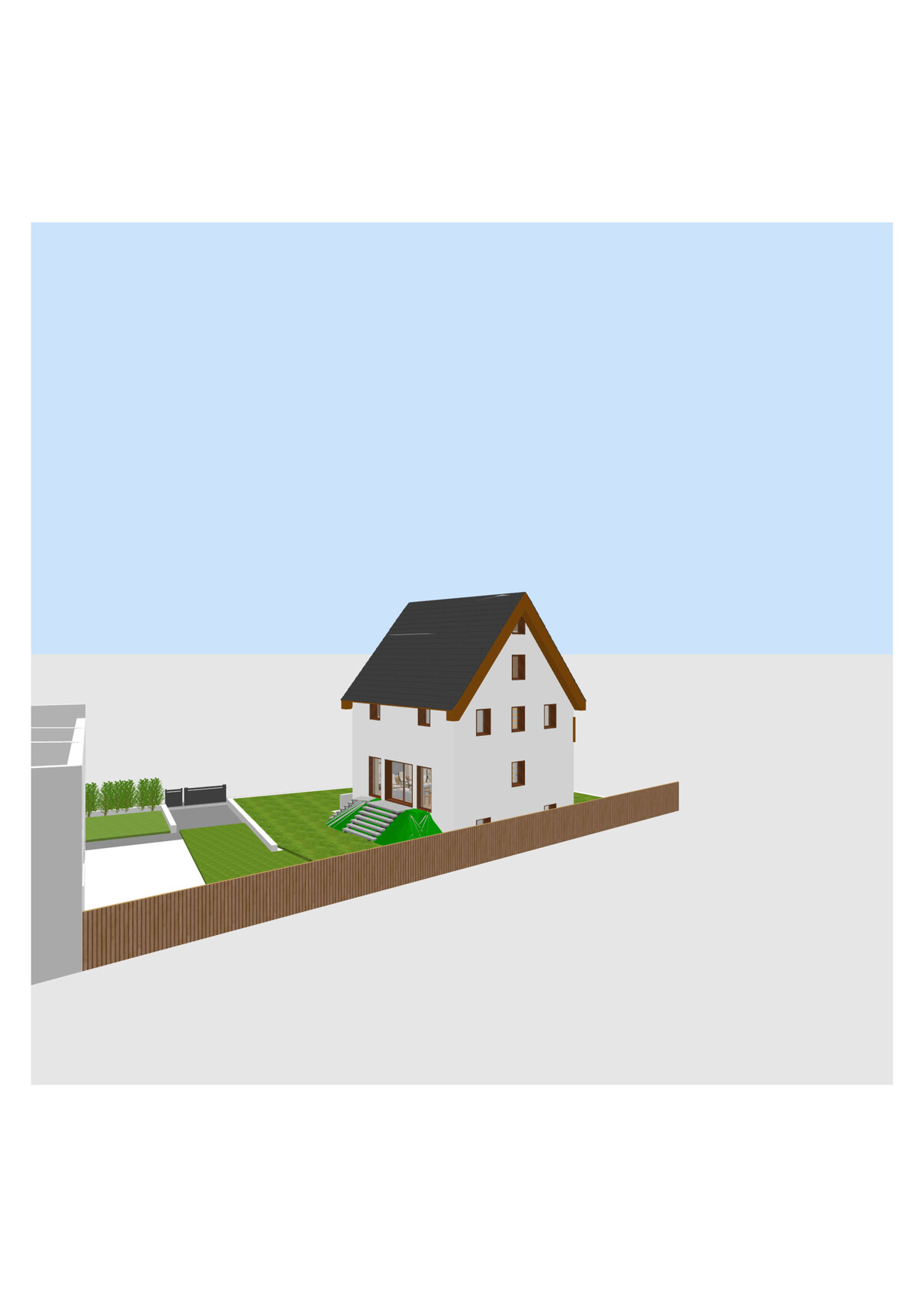
We are currently working with an architect on the design of our single-family home. Since we have three children, the house should accommodate several future scenarios. These include:
- Enough space for everyone
- At some point, the children will move out, and we will downsize to the living basement while renting out the rest
- One or two children might continue living with us (multi-generational living) – possibly in the basement with a separate entrance
- Possibly one child even starts a family in the house, and we move to the basement
Plot:
- 710 sqm (8,000 sq ft) close to the city center
- To the south is our rear building (two stories) attached to a 3.5-story apartment building (boundary development)
- To the north and west are the streets (a corner plot)
- Behind to the west is a large green plot with a single-family house
- To the north beyond the street are apartment buildings
- To the east there is a narrow parking lot followed by a green recreational garden area
- We have to keep a 6 m (20 ft) setback to the streets and the usual 3 m (10 ft) to the parking lot
Since the plot already has a building, and we want to keep the rear building (it is fully shaded by the apartment building, is in reasonable condition, and might provide future expansion potential—at least suitable for workshops and storage), and since the plot is not very large, we decided on a tall house with a small footprint.
About the house
- Eder XP9 or 10 (timber frame) in 42.5 or 49 cm (17 or 19 inches) thickness
- Living basement (150 cm (5 ft) below ground / 100 cm (3 ft) above ground) – if affordable (this allows for the utility room in the basement and more space on the ground floor for a large open-plan living/dining/kitchen area as the main living space)
- Knee wall either 150 cm (5 ft) or, if not much more expensive, a dormer wall above the full upper floor (both options allow the roof space to be used for two rooms; with the dormer, these rooms are very large and could even accommodate an attic instead of bunk beds)
- 50-degree roof pitch (for solar energy efficiency in winter)
- The basement should be designed to eventually allow for a small separate living unit
- Both bathrooms should have a standing toilet or urinal
- We definitely want a windbreak/entry vestibule
- The terrace should be raised with fill
- Underfloor heating with geothermal energy
- Solar energy planned for the future
We have already developed a fairly comfortable floor plan with our chosen architect. Our biggest concern is accidentally planning a wall or something else 5 cm (2 inches) too far to the left or right and then being unable to fit our furniture. I would appreciate it if you would be interested in looking over the current design and giving feedback.

Your wish to do all the work yourself is admirable, but you also mention that you hardly have any time for it. If I may list what you plan to do yourself:
- Tiling (with no prior experience, mind you – yikes!)
- Electrical work (still unsure, but willing to try)
- Painting (have you ever primed and painted an entire house? On five floors, no less! :eek)
- Flooring (floorboards, vinyl, and tiles – impressive!)
- Entire landscaping (paths, earthworks, stairs, etc. – go for it!)
On top of that, you want to source affordable sanitary fixtures and floorboards, all while handling three children. Wow!
How many vacation days do you have per year?
Just as an example, my husband and I have no children and only did the electrical and painting work ourselves. That used up our entire annual leave. We also had help from six additional family members, not just occasionally, but fully involved with both trades.
You say you wasted five years. I hope you don’t waste another three by insisting on doing all the work yourself.
Overall, this might have come across the wrong way: I think your budget for a nice house is quite reasonable. You can definitely work with that. But in my feeling, the wishes exceed the budget by about $70,000 to $80,000. So, trimming down a bit will make everything just fine—apart from the floor plan itself.
- Tiling (with no prior experience, mind you – yikes!)
- Electrical work (still unsure, but willing to try)
- Painting (have you ever primed and painted an entire house? On five floors, no less! :eek)
- Flooring (floorboards, vinyl, and tiles – impressive!)
- Entire landscaping (paths, earthworks, stairs, etc. – go for it!)
On top of that, you want to source affordable sanitary fixtures and floorboards, all while handling three children. Wow!
How many vacation days do you have per year?
Just as an example, my husband and I have no children and only did the electrical and painting work ourselves. That used up our entire annual leave. We also had help from six additional family members, not just occasionally, but fully involved with both trades.
You say you wasted five years. I hope you don’t waste another three by insisting on doing all the work yourself.
Overall, this might have come across the wrong way: I think your budget for a nice house is quite reasonable. You can definitely work with that. But in my feeling, the wishes exceed the budget by about $70,000 to $80,000. So, trimming down a bit will make everything just fine—apart from the floor plan itself.
grericht schrieb:
since kaho674 set the direction) has degenerated into a financial discussion. If I had wanted to settle the finances, I would have gone to the finance section. There are simply many different ways to describe things here. When I talk about 60-70k for the basement costs, I am not referring to the price of the basement if you just build it “bare,” but rather to the difference in house construction costs with and without a basement.Here, there is little interest in discussing a design that cannot be built due to lack of liquidity.grericht schrieb:
Only the south side would remain and our garden would get smaller. We don’t want that and are looking for the smallest possible footprint.Unfortunately, you haven’t shared the site plan. So, we don’t know the building envelope or the exact dimensions of the plot. And you’re talking about a south-facing garden—oops:By the way, this concerns a 710 sqm (7,645 sq ft) lot, which can easily accommodate a normal-sized or even somewhat larger house. There’s no need to be so restrictive and act as if only about 400 sqm (4,300 sq ft) were available.
Therefore, an extra 10 or even 50 sqm (108 or 538 sq ft) of footprint doesn’t make much difference. With a 700 sqm (7,535 sq ft) plot, you don’t have to look for living space underground.
grericht schrieb:
There is a door to the pantry from the vestibule. Whether it will be just a frame or a door is still unclear.??? A kind of airlock. Quite attractive...
grericht schrieb:
We see no alternative to the central staircase without enlarging the corridors and losing more floor area that then wouldn’t be livable.To be honest: you’re confused. No offense intended.
You are planning your living room, which should be a retreat for individual family members or everyone together, as a passage room, so retreat, relaxation, and peace are completely ruled out. To top that off, you put the staircase, which also accesses the basement, inside the living room.
grericht schrieb:
Of the many rooms in the house, there are exactly 2 passage rooms (in my opinion).This is the point about passage rooms. A passage room is a room with its own purpose that is also misused as a route to another room. This is usually applied around kitchens/pantries or bedrooms/walk-in closets.
grericht schrieb:
As described above, we barely gain any additional footprint and, above all, that would also mean larger corridors.No! Definitely not! You just have to plan it properly and not leave the corridor in the corner. Corridors serve to connect rooms, and here the corridor’s function is not considered at all.
I’d say: someone involved here has mental limitations and never even opens their mind to consider different perspectives.
You’re your own obstacle!
grericht schrieb:
The additional 10 sqm (108 sq ft) of floor area would be spread over 3 floors, cost about 60k, and provide about 25 sqm (269 sq ft) of living space.Yes, great! Seriously* they are actually cheaper because less technical installation is needed. You can even get by without heating.
grericht schrieb:
That means we would save 10k, have no basement,Exactly. Real living space above ground and not this molehill nonsense. Even if you positively describe the “living space” as having “real windows,” it remains basement space that people generally do not like to live in, at least not permanently.
grericht schrieb:
We actually are among those people who take off their shoes when entering.Oh... who doesn’t? You’re no different from anyone else here. You’re not smarter just because you want to omit corridors. You’re not cleaner or otherwise different because you take off your shoes.
grericht schrieb:
But we are very open to ideas. Actually, I intended with this post to get such suggestions.I don’t think so. I didn’t count your reasons for why this or that is the way it is.
You know: first, you have to get a feel for where the design is headed. What paths the builder, i.e., the original poster— you in this case— can or want to take (e.g., financially). I don’t get the impression that you want changes.
To be honest: this design is one of the worse ones here on the forum. Building a basement to gain 10/15 sqm (108/161 sq ft) extra footprint and thus more space than necessary, which you then want to rent out as a flat*; then having a staircase with noise transmission and basement access right in the living room, which restricts openness... entering the kitchen through a storage “airlock”... a ground-floor bedroom only 2.8 m (9 ft 2 in) wide (I had that in a terraced house), and so on... An open (messy) walk-in closet as a passage to the bathroom... none of this is thoughtfully planned. It’s neither half nor whole. The principle of minimizing corridor area (which is not new and not bad) was simply not successfully implemented here.
I keep shaking my head: placing a staircase centrally in a small space removes openness on all sides and only restricts... everywhere just walls... living room furniture as stumbling blocks... what is this corridor-like tube between hall and living room?
*Would you want to live like this yourself? As a student in a new development?
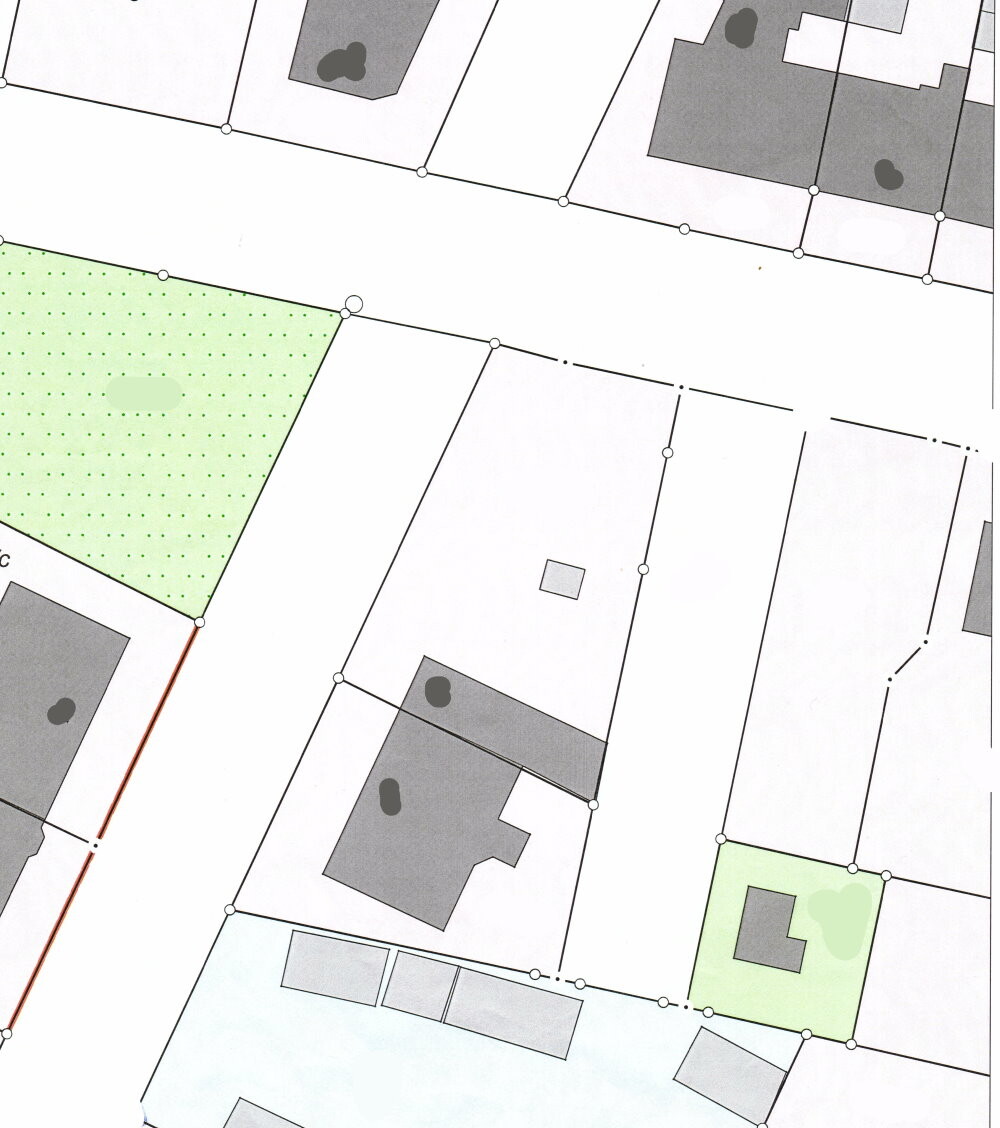
For better understanding, I have attached the land registry excerpt along with the site plan showing the building lines toward the street and the setback distance to the neighboring property.
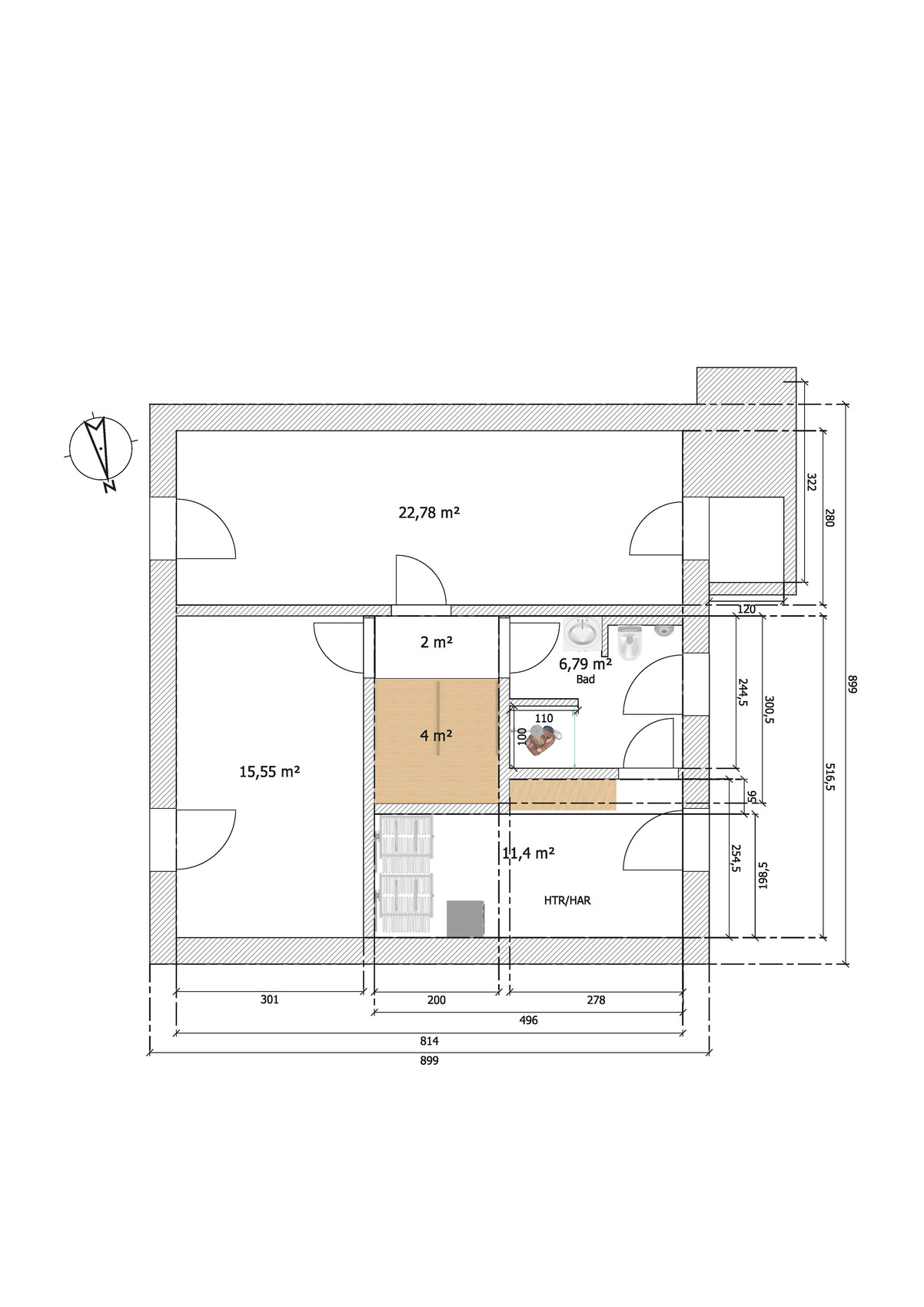
Additionally, we spent some more time reworking the basement floor plan. While it still has a similar number of internal passage rooms, it now works much better for planning a separate apartment (in our opinion). The utility/technical room (HAR/HTR) is now usable as a cloakroom, and the technical area is accessible to all parties. Each party could have their own washing machine there. It basically functions like a shared laundry room, as I remember from before.
The rear room could eventually be used as a bedroom with a closet, and the room in front could serve, depending on preferences, as a living kitchen, kitchen/dining room, or living room. The single room could be used as a small office or living room, or kitchen/dining area. For planning purposes, an additional water connection in the partition wall could be of interest.
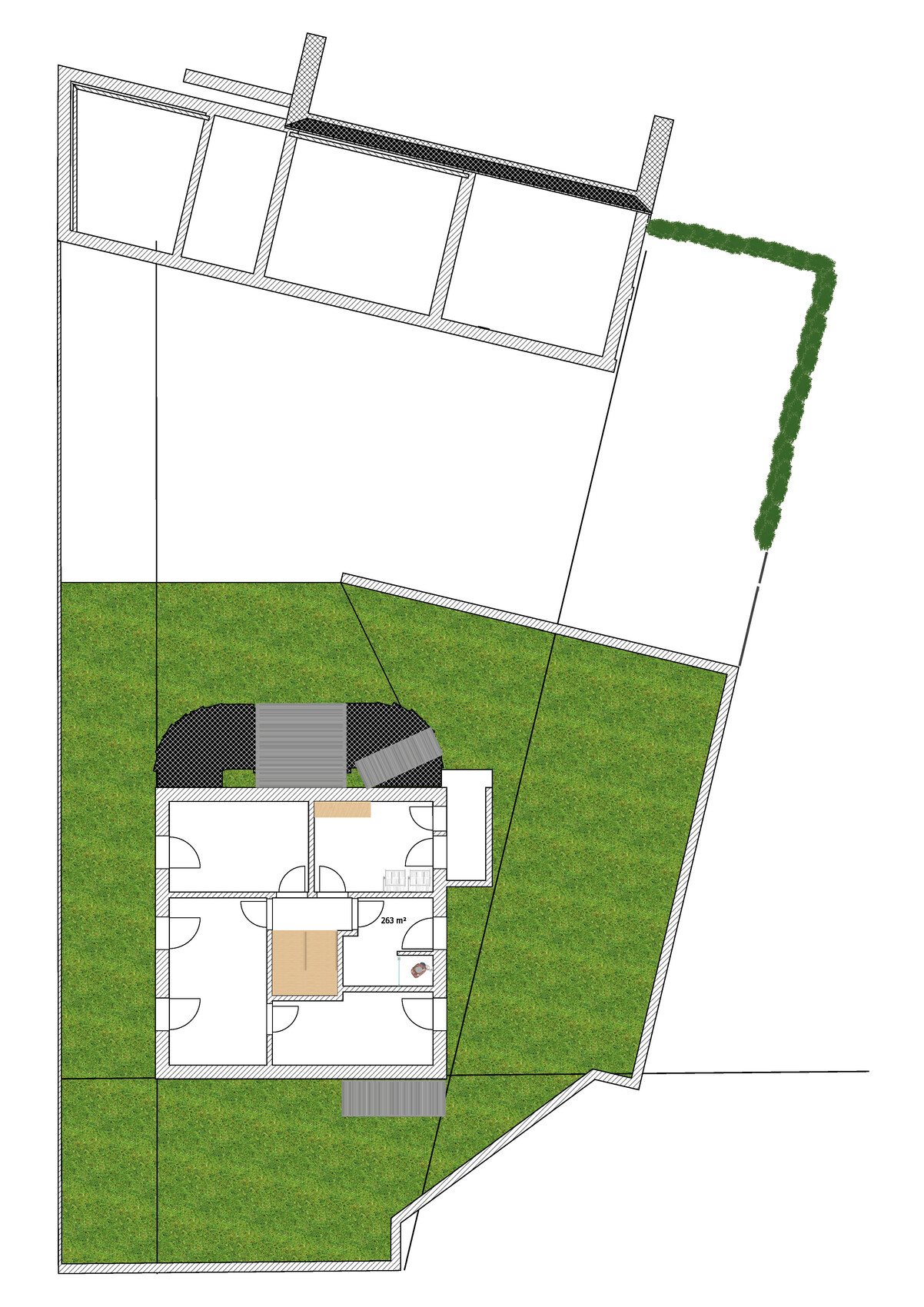
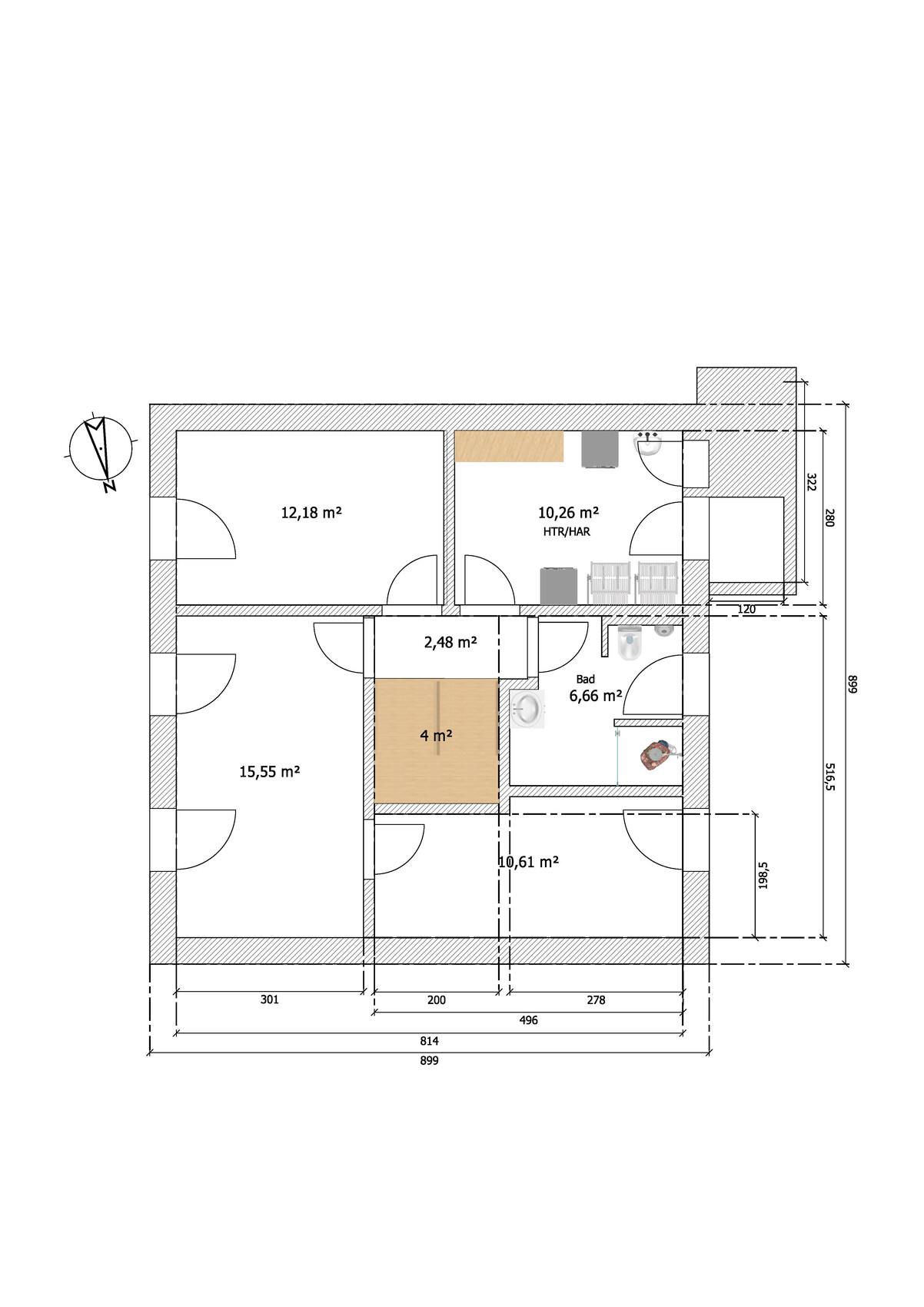
Additionally, we spent some more time reworking the basement floor plan. While it still has a similar number of internal passage rooms, it now works much better for planning a separate apartment (in our opinion). The utility/technical room (HAR/HTR) is now usable as a cloakroom, and the technical area is accessible to all parties. Each party could have their own washing machine there. It basically functions like a shared laundry room, as I remember from before.
The rear room could eventually be used as a bedroom with a closet, and the room in front could serve, depending on preferences, as a living kitchen, kitchen/dining room, or living room. The single room could be used as a small office or living room, or kitchen/dining area. For planning purposes, an additional water connection in the partition wall could be of interest.
ypg schrieb:
Then the stairwell with sound transmission and the basement located right in the middle of the living room,Yes. The idea becomes truly absurd when a tenant runs from room to room downstairs and every word from above carries through clearly without any soundproofing.kaho674 schrieb:
Your wish to do all the work yourself is commendable, but you also admit that you basically don’t have time for it. Let me list what you want to do yourself:
- Laying tiles (untrained, mind you – wow!)
- Electrical work (still uncertain, but you’d like to try)
- Painting (have you ever primed and painted an entire house? On 5 floors, no less! :eek
- Floors (planks, vinyl, and tiles – impressive!)
- Entire exterior landscaping (paths, earthworks, stairs, etc. – impressive!)
On top of that, you want to source sanitary fixtures and flooring materials cheaply, all while managing 3 children. Wow!
How many vacation days do you get annually?I have personally seen a family break apart during a renovation. Naturally, that’s what I want to avoid.
Priming and painting won’t be stressful.
Flooring will be tough but necessary because of budget constraints. I will try tiling under professional supervision, and if it doesn’t work out, a pro will take over.
I’m not doing any electrical work myself! I’m not confident with electricity. What I want to avoid is paying a lot for running a LAN cable from room A to B, especially when the standard changes, Wi-Fi is invented, or we need internet in room C. So I prefer to handle phone, TV, and internet myself. In apartment rentals, I managed that through ducts and ceilings. Having conduit pipes here would be invaluable!
No landscaping work needs to happen before moving in. We just need a new fence or hedge around the property. That can be done over a weekend with various methods and helpers. I’m comfortable with that and not worried.
I work 34 hours over 4 days, and my wife can care for the kids except in the early morning. With 3-day weekends, vacation days, and evenings, things just need to get done.
As I said, tiling is a test and flooring will be a lot. The rest doesn’t worry me — I’ve done way too much gardening and many moves involving painting to be concerned.
kaho674 schrieb:
Maybe it came across wrong: I actually think your budget for a nice house is quite good. It’s very doable. But your wishes appear to be about 70,000 to 80,000 more than your budget. So you need to scale back a bit and everything will be fine — apart from the floor plan. Thanks for that! The most critical comments have been the best so far. Because of your comment, I took another practical look at the small staircase and hallways. The small hallways are fine for us. The small staircase still makes me uneasy, but I rely on the architect and the example at my parents’ house. The plan simply doesn’t allow for a bigger one!
ypg schrieb:
People here don’t like discussing designs that can’t be built due to lack of funds.
Unfortunately, you didn’t share the site plan. So we don’t know the building envelope or the plot dimensions.
You mentioned a south-facing garden – oops:
It’s a 710 m² (7,645 sq ft) plot, which can very well fit a normal-sized house or even larger. There’s no reason to scrimp and act like you only have 400 m² (4,300 sq ft).
So whether it’s 10 m² (100 sq ft) or 50 m² (540 sq ft) more floor area doesn’t matter. With 700 m² (7,535 sq ft), you don’t have to look for living space underground. I’ve uploaded the site plan. We see little option to build larger besides building over the only sunny spot.
ypg schrieb:
??? An airlock. Quite elegant... The idea isn’t for heavy use. Probably the door will be built as planned and usually kept closed. The temptation to walk through there will exist only when arriving or leaving – about 1 to 3 times per day, so 5 to 15 times total. It’s not comparable to the staircase in terms of traffic.
ypg schrieb:
Honestly: You have a mental block. No offense intended.
You’re designing your living room, which should be a retreat for individual family members or everyone together, as a pass-through room where retreat, relaxing, and quiet are totally impossible. To crown it all, you place the staircase – including access to the basement – right in the living room. Such mental blocks usually have something to do with socialization. The house I lived in from ages 14 to 18 is exactly like that. My parents still live there and I see no problems. The living room isn’t really meant to be a chill-out room. Someone will almost always be there on a laptop, watching TV, or using the stereo – often mixed. It’s a living space. Anyone needing quiet can go to their own room.
ypg schrieb:
No! Definitely not! You just have to plan it and not leave the corridor in the corner. It serves the purpose that rooms open off it. And the corridor doesn’t serve any function in your plan.
I’d say: someone involved here has mental blocks and refuses to think about things differently.
You’re standing in your own way! I don’t understand that? I thought the “criticism” is that too many rooms open off too small a space? Could you explain that in more detail?
ypg schrieb:
Yes, great! Seriously * they’re cheaper because they don’t consume a lot of technical systems. You can even do without heating. But the price of the house will still go up if the floor area increases. Matching that with the basement as usable space will be difficult.
ypg schrieb:
Yes, great. Real living space above ground, not this molehill stuff. Even if you positively describe the "living space" by “proper windows.” It remains basement space that nobody likes to live in – at least not permanently.
... *Would you live in such a space yourself? As a student in a new housing area? Honestly: at every stage of my life (child in an old building with grumpy old neighbors / child/teen in a row house estate / adult or student with or without partner in an old building with difficult neighbors), I would have preferred to live in that basement. I believe this basement could actually rent out well. It’s near a unit. I think many students would prefer it to a flat-share or dormitory.
ypg schrieb:
Oh... who wouldn’t? You’re no different from anyone here. You’re not smarter just because you want to leave out corridors. You’re not cleaner or different because you take off your shoes. Then I don’t understand how the apartment door can open into the living room or the staircase lead into the entrance area. And there are hardly any alternative floor plans.
ypg schrieb:
I don’t believe that. I haven’t counted your explanations for why this or that is the case.
You see, you first need to get a feel for where the design is going. What paths the builder – that is you – has (financially or otherwise) or wants.
I don’t get the impression you want changes. Of course, I don’t want changes!
I want to be made aware of problems I may have missed, then weigh those against the advantages I see in the current plan. If the problems outweigh the advantages, changes must happen. So far, I’ve justified to myself that the advantages still outweigh the disadvantages (except for the basement, for example). This forum isn’t about blindly leading the blind to the light. As I said, we have spent quite some time on the floor plan. It’s not a sudden thought. And yes, my life shows me that my ideas are rarely compatible with those of others. But this is a large forum, and I hoped to find people who would give advice without expecting those suggestions to be followed literally.
As described above, I did take another look at the small staircase and hallway to make sure it’s okay.
ypg schrieb:
Honestly, this design is one of the worse ones here on the forum: building a basement for an extra 10-15 m² (100-160 sq ft) of floor area, and then renting it out as an apartment*,
Then the staircase with sound and the basement right in the middle of the living room, which restricts openness... entrance to the kitchen via a storage airlock... a ground floor bedroom only 2.80 m (9 feet) wide (I had that in a row house)... and so on...
Open (messy) dressing area as a passage to the bathroom... none of this is thoughtfully planned. It’s neither half nor whole. The concept to minimize corridor space (which is old and not bad) is not successfully executed here.
I have to shake my head again and again: placing a staircase in the middle of a tight space removes openness on all sides and only tightens things... walls everywhere... living room furniture causing trip hazards... what is that tube between corridor and living room supposed to be? - I never expected, nor asked, for my floor plan to please anyone here. My question was about “overlooked” and “ignored” issues – your list, for example, helps me a lot!
- I already described the storage airlock above – it fits our needs.
- I explained the staircase in the living room. For us, it’s not a quiet room but where everyone arrives when they don’t want quiet.
- For me, the bedroom’s function is to fit a 1.40 m (55 inches) bed with small storage, a power outlet, and a wardrobe. It could even be an internal room without a window. I go in and out in the dark. It’s the least important room. If I weren’t married, I’d skip it first and install a quick-hanging hammock in the living room or sleep in a tent in the garden.
- I don’t understand the “open (messy) dressing area as a passage to the bathroom” comment. That room will be where the kids put their clothes and tidy up themselves. If they go to the bathroom early, they get fresh clothes and that’s it. If unused, it could become a quiet space with a chair, small stereo, small bookshelf, or as storage. Clothes would then be stored in the bedrooms.
- “Living room furniture as trip hazards” – we deliberately drew in the largest possible table and sofa. They can be smaller.
- “Removes openness on all sides and tightens... walls everywhere...” The living room is intended to be open. The rest of the house doesn’t have to be. Which walls are bothersome?
- “What is that tube between corridor and living room?” What do you mean?
kaho674 schrieb:
Yes. The idea becomes really absurd when a tenant downstairs runs from room to room and every word from above is transmitted directly down without any soundproofing. IF a tenant who is not part of the family moves in downstairs, there will definitely be a sound/room separation between the living room and the basement! In the simplest case, a sound-insulated "intermediate ceiling construction" would be installed; in the more advanced case, the basement stairs could be removed and replaced by stairs supported by steel beams or columns in the ground floor?!
Similar topics