
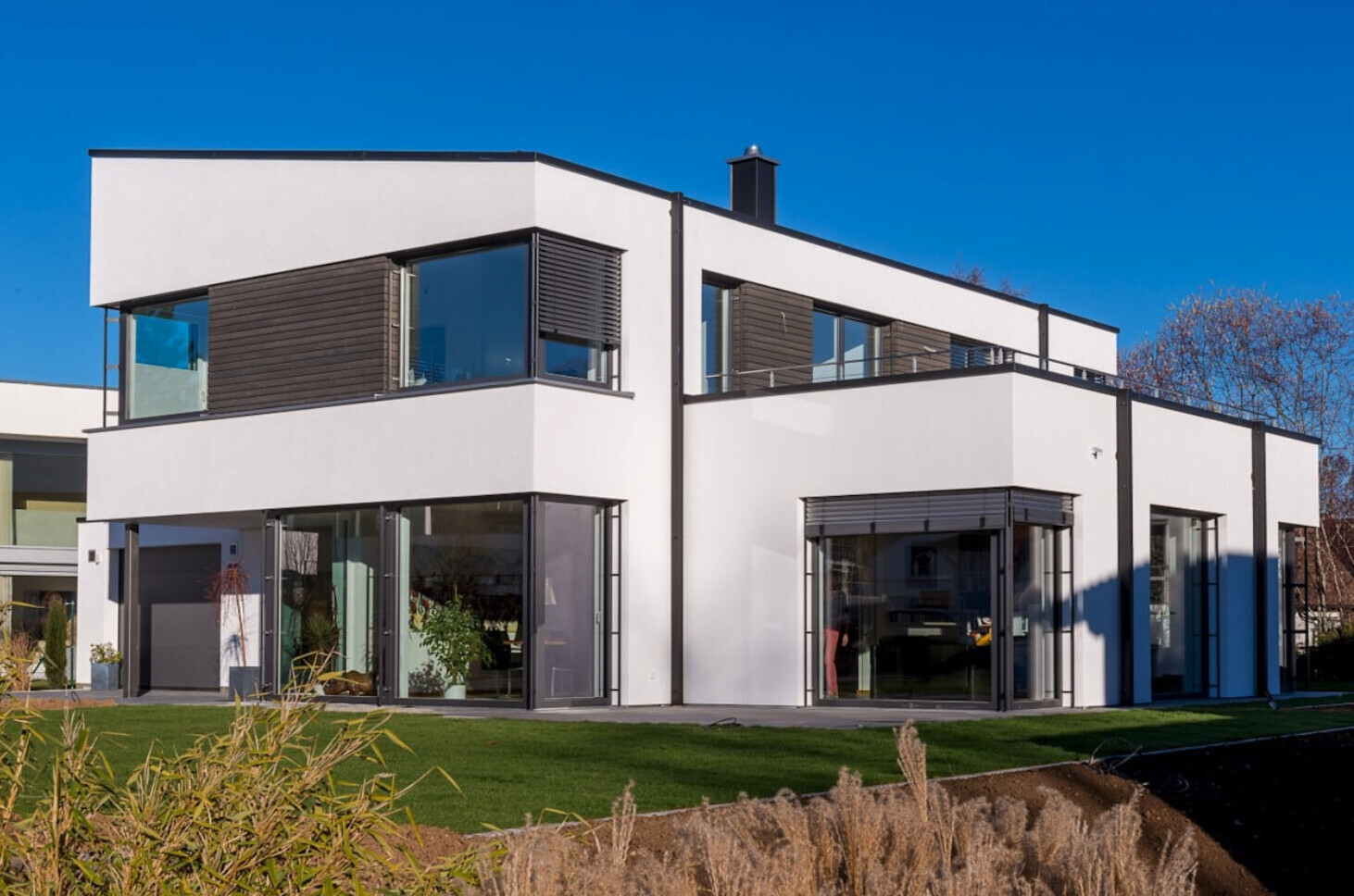
I am interested in what are called window-connecting transverse elements in my new build (I can’t find another term for it).

Source: Pinterest
Here as examples, one made of wood and in the second image with slate panels.
Can someone explain the building technology of how this is implemented in a construction method without external thermal insulation composite system (ETICS) / external wall insulation, and how the depth differences are adjusted? Can the elements be attached directly to the exterior wall and the rest simply plastered, or how should this be understood?
Thanks in advance for the answers!
Source: Pinterest
Here as examples, one made of wood and in the second image with slate panels.
Can someone explain the building technology of how this is implemented in a construction method without external thermal insulation composite system (ETICS) / external wall insulation, and how the depth differences are adjusted? Can the elements be attached directly to the exterior wall and the rest simply plastered, or how should this be understood?
Thanks in advance for the answers!
B
benediktr22 Oct 2019 18:52guckuck2 schrieb:
Behind that is simply masonry and ETICS (External Thermal Insulation Composite System)That’s exactly the question here. What does it look like when building with monolithic construction? Is the plaster system sufficient to install either counter battens plus rhombus boards or facing brick slips?
How many centimeters of plaster layers are normally applied?

benediktr schrieb:
Is the plaster thickness sufficient to install either counter battens plus rhombus cladding or brick slips?
How many centimeters of plaster thickness are usually applied? On average, about two and a half centimeters of plaster are applied, which is just enough for the battens. Brick slips can be reasonably well installed flush, at least the joints, otherwise it would probably look odd.
benediktr schrieb:
How does it look when building with monolithic construction? That’s the question of whether on façades designed like those common with ETICS (external thermal insulation composite systems), one would then switch to ETICS after all. Your house design is rather unusual for the monolithic construction group.
https://www.instagram.com/11antgmxde/
https://www.linkedin.com/company/bauen-jetzt/
B
benediktr22 Oct 2019 19:2411ant schrieb:
Your house design is rather atypical for the monolithic construction group.That's why I'm asking here. So far, I have held back with my architect and given him complete freedom. Once there is a draft, I think we can focus on the details. It might even be necessary, since it’s already clear that, for example, the ceiling of the covered terrace will need insulation.
I am a fan of avoiding insulation if the required values can be met using aerated concrete blocks.
benediktr schrieb:
I am a fan of avoiding insulation when the required values can be achieved with an aerated concrete block.That was not the impression I had so far: the "terrace slab" is only one detail; I also mean a cantilever of the floor slab intended to act as a kind of profile strip on the facade. That doesn’t really sound like an effort to avoid unnecessary insulation hacks at first glance.https://www.instagram.com/11antgmxde/
https://www.linkedin.com/company/bauen-jetzt/
B
benediktr22 Oct 2019 20:0611ant schrieb:
I also mean a cantilever of the floor slab serving as a kind of profile strip for the facade.I have already moved away from that idea, precisely for the reasons mentioned. As you pointed out, I also agree that the right proportions can achieve a desired effect.
To summarize my findings, it is generally more challenging to implement detailed design features with a monolithic construction method, such as aerated concrete or clay blocks.
Perhaps another point: Are there any issues with monolithic construction when combined with large window areas?
Similar topics