
Good evening, dear community!
I have been a silent reader for weeks but now need expert opinions and fresh ideas as we can’t reach a consensus on our issues.
This will probably be a very long text, so please forgive me if I’m asking questions that have already been answered elsewhere or are misplaced.
So.
We (me, my wife, and my parents) have the opportunity to buy a house from a close relative.
It is a detached single-family house with three floors? (basement, ground floor, attic). The footprint is 9 x 13 meters (29.5 x 42.6 feet) on both basement and ground floor. That means approximately 230 m² (2475 sq ft) plus attic space.
I estimate the lot to be about 500 m²+ (5400 sq ft+). I haven’t received exact numbers yet.
Year built: 1987/88.
What needs to be done?
- The house has wooden windows installed — so new windows are needed, but which type? PVC (vinyl) or wood/aluminum composite?
- The interior condition reflects about 30 years of use. A few tiles are broken here and there, door frames damaged. Bathroom dated in ’90s style.
Basically, we want to renovate EVERYTHING inside: walls, electrical wiring, plumbing, flooring, bathrooms.
- When I inspected the roof from the inside, I could see through to the outside. So it is not fully insulated.
- As far as I understand, the house has no insulation. Maybe the attached documents clarify?
- The house has no energy performance certificate.
- The heating system also needs to be replaced.
We want to buy the house because it represents the "final" step in terms of space enlargement.
My parents want to occupy the entire basement, and my wife and I would take the rest.
We want to separate the basement as a granny flat (secondary dwelling), also considering the possibility of renting it out in the future.
Now to the basic problems and questions.
My father insists on having one boiler/heating unit per dwelling. To better calculate the consumption.
My question to you: Is this common practice?
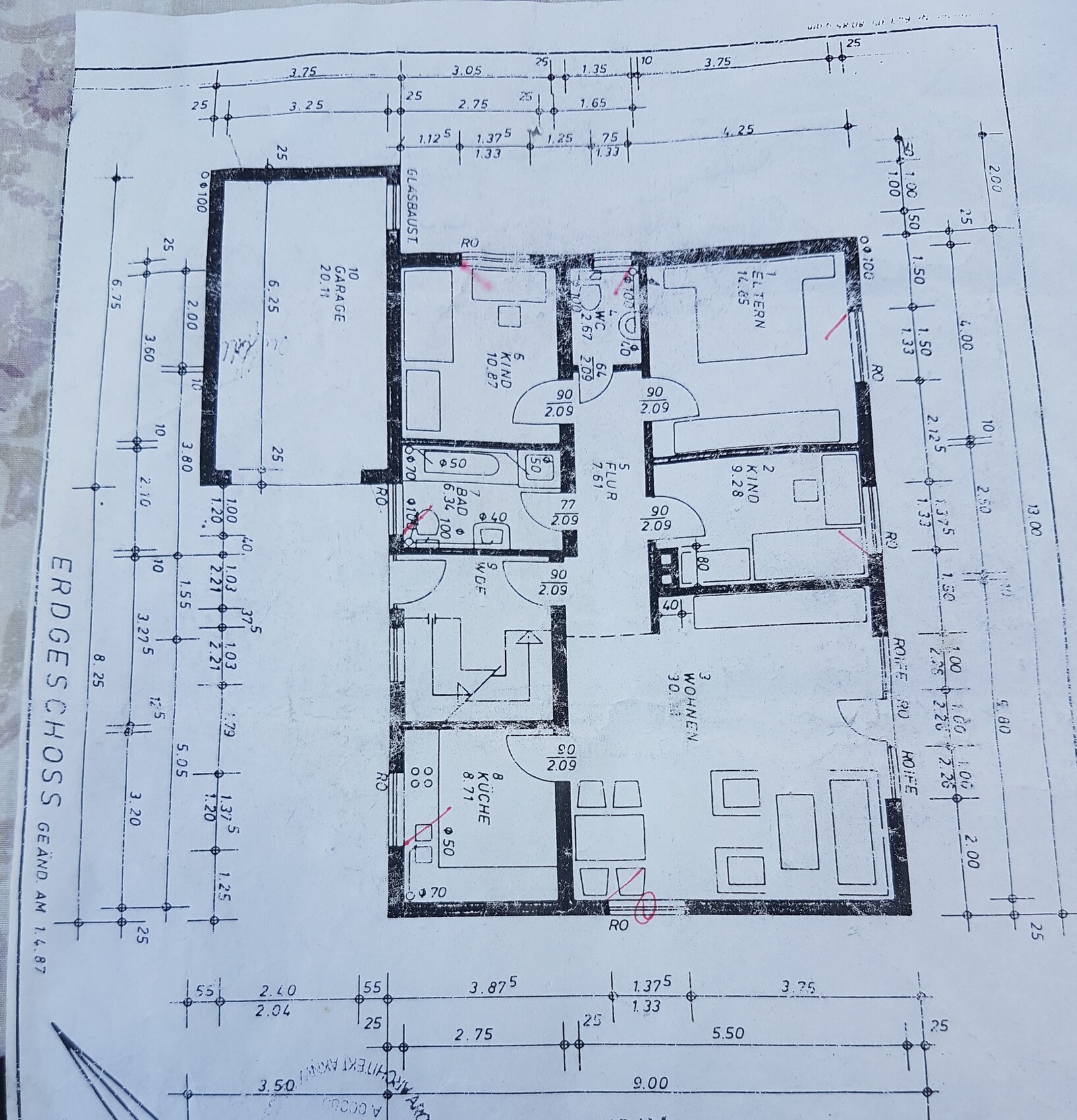
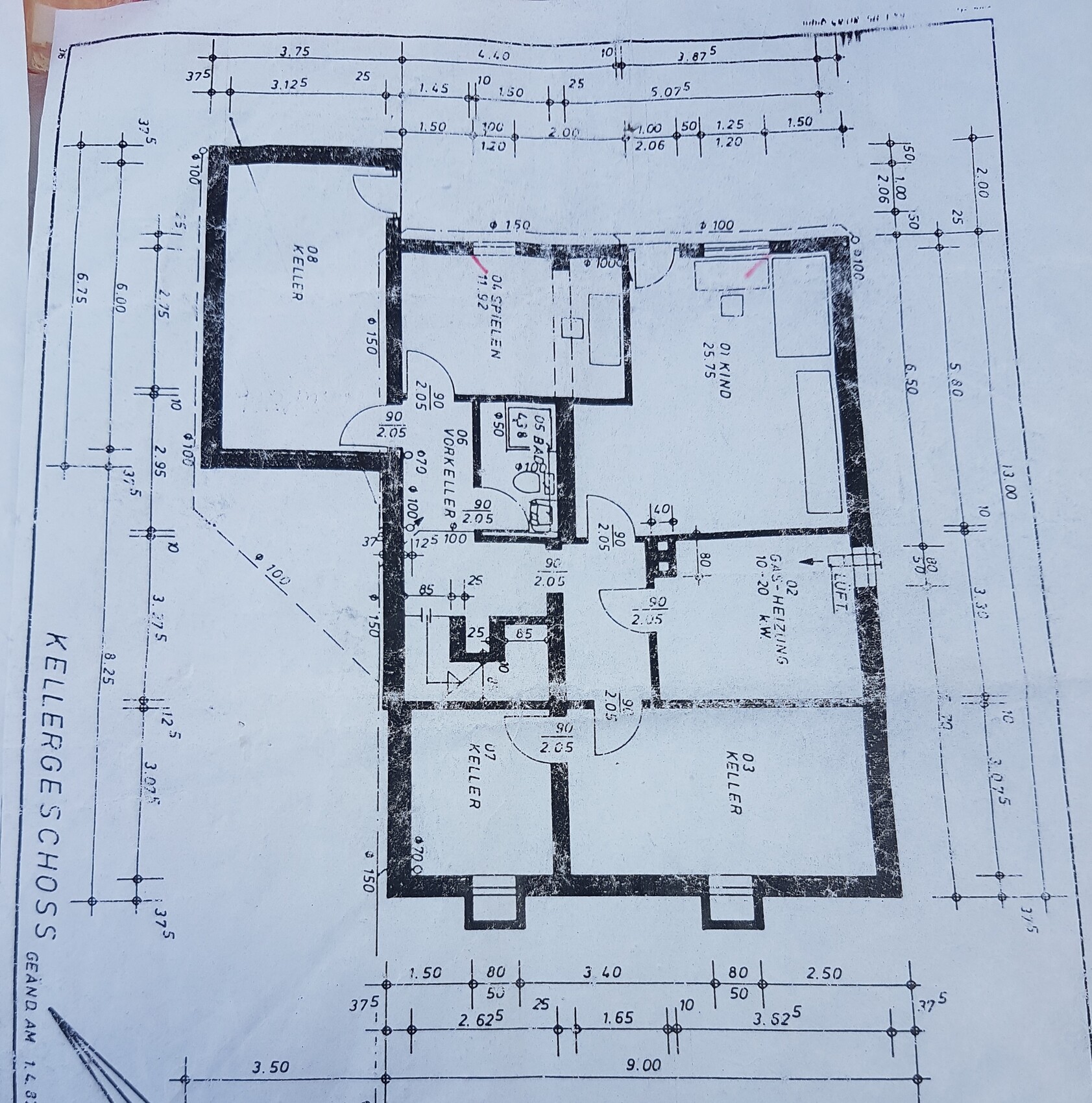
Is it true that these boilers require an air supply and exhaust flue similar to a chimney? During the renovation, some walls will be removed. In the basement, the boiler room (please see the attachments) would connect to room 01Child to create a larger living area. Room 04Play becomes the kitchen without a wall to room 01Child; 08Cellar turns into a bedroom. The small bathroom will be removed and a new bathroom created in room 03Cellar. I’m not 100% sure what will happen to 07Cellar.
On the ground floor, walls will also be removed. Rooms 2Child and 3Living will be combined; rooms 7Bathroom and 5Child will form the new bathroom. Room 4WC will be removed completely.
How exactly would one integrate a boiler in this configuration if my assumption above is correct? Am I right in thinking that these boilers are those tank-type units hung in bathrooms/kitchens, like in caravans or older apartments? That would be a complete deal-breaker for me.
Is it possible to run an exhaust duct several meters through the apartment up to the chimney? Or do you have other ideas? Please feel free to get creative!
Next problem. In the entrance area on the ground floor, there are two spiral staircases. One goes clockwise upwards on the right, the other, located deeper in the room, goes clockwise downwards. Is this description correct?
To define a secondary dwelling, you need separate residential units. However, if the status remains as is, I would have to install a lockable door for the ground floor and attic to prevent my father from simply walking upstairs and entering my bedroom. I consider that a bit absurd — I hope you agree. The door for the basement apartment will likely be near the last few steps of the staircase.
I hope this problem is explained clearly. I’m also asking for suggestions here!
The attic is largely unfinished except for one room and is currently used as storage. Here I really have freedom to design the rooms as I like. A bedroom with a walk-in closet, a small toilet, a small hallway, and 2–3 children’s/guest rooms should definitely be feasible. I already have some ideas, but I would greatly appreciate any floor plan suggestions!
From the outside, the façade shows some spots where it looks like something dripped down, best described as a stain on a T-shirt that has dried. Could this be moisture or leaks in the roof?
As mentioned, the house apparently has no insulation. Is it worth adding insulation now? Is it still worthwhile?
Regarding the heating system, I don’t know much. Except for room 3Living on the ground floor, every other room has radiators. Room 3Living apparently has underfloor heating. What would you recommend?
Complete underfloor heating for the whole house? Using liquid medium? Electric? Underfloor heating combined with radiators — is that worth it?
There are also some outdoor tasks. The terraces need to be leveled, there is a fish pond, and the path needs attention, weeds, etc.
Now for the numbers.
At the very first discussion, the seller mentioned a price between €180,000 and €200,000.
She now wants to have the house formally appraised. The property is located in Märkischer Kreis.
From my preliminary calculations, I expect renovation costs between €100,000 and €120,000. Is this realistic?
Recently, I went with my father to the local savings bank. On our side, we would include two condominiums (one fully paid off, the other with 8 years left on the mortgage) with rental income. We will cover the purchase incidental costs ourselves.
Additional questions:
Do I need to involve the building authority to convert a single-family house into a single-family house with a secondary dwelling (granny flat)?
Should only my wife and I be listed on the title, or all four of us?
Does an architect need to be engaged due to the extensive structural changes?
Is it worth applying for government support programs (like KfW) given the scale?
I hope I was able to explain my concerns understandably and thank everyone who has read this far.
I am already looking forward to reading your ideas and suggestions.
Good night
I have been a silent reader for weeks but now need expert opinions and fresh ideas as we can’t reach a consensus on our issues.
This will probably be a very long text, so please forgive me if I’m asking questions that have already been answered elsewhere or are misplaced.
So.
We (me, my wife, and my parents) have the opportunity to buy a house from a close relative.
It is a detached single-family house with three floors? (basement, ground floor, attic). The footprint is 9 x 13 meters (29.5 x 42.6 feet) on both basement and ground floor. That means approximately 230 m² (2475 sq ft) plus attic space.
I estimate the lot to be about 500 m²+ (5400 sq ft+). I haven’t received exact numbers yet.
Year built: 1987/88.
What needs to be done?
- The house has wooden windows installed — so new windows are needed, but which type? PVC (vinyl) or wood/aluminum composite?
- The interior condition reflects about 30 years of use. A few tiles are broken here and there, door frames damaged. Bathroom dated in ’90s style.
Basically, we want to renovate EVERYTHING inside: walls, electrical wiring, plumbing, flooring, bathrooms.
- When I inspected the roof from the inside, I could see through to the outside. So it is not fully insulated.
- As far as I understand, the house has no insulation. Maybe the attached documents clarify?
- The house has no energy performance certificate.
- The heating system also needs to be replaced.
We want to buy the house because it represents the "final" step in terms of space enlargement.
My parents want to occupy the entire basement, and my wife and I would take the rest.
We want to separate the basement as a granny flat (secondary dwelling), also considering the possibility of renting it out in the future.
Now to the basic problems and questions.
My father insists on having one boiler/heating unit per dwelling. To better calculate the consumption.
My question to you: Is this common practice?
Is it true that these boilers require an air supply and exhaust flue similar to a chimney? During the renovation, some walls will be removed. In the basement, the boiler room (please see the attachments) would connect to room 01Child to create a larger living area. Room 04Play becomes the kitchen without a wall to room 01Child; 08Cellar turns into a bedroom. The small bathroom will be removed and a new bathroom created in room 03Cellar. I’m not 100% sure what will happen to 07Cellar.
On the ground floor, walls will also be removed. Rooms 2Child and 3Living will be combined; rooms 7Bathroom and 5Child will form the new bathroom. Room 4WC will be removed completely.
How exactly would one integrate a boiler in this configuration if my assumption above is correct? Am I right in thinking that these boilers are those tank-type units hung in bathrooms/kitchens, like in caravans or older apartments? That would be a complete deal-breaker for me.
Is it possible to run an exhaust duct several meters through the apartment up to the chimney? Or do you have other ideas? Please feel free to get creative!
Next problem. In the entrance area on the ground floor, there are two spiral staircases. One goes clockwise upwards on the right, the other, located deeper in the room, goes clockwise downwards. Is this description correct?
To define a secondary dwelling, you need separate residential units. However, if the status remains as is, I would have to install a lockable door for the ground floor and attic to prevent my father from simply walking upstairs and entering my bedroom. I consider that a bit absurd — I hope you agree. The door for the basement apartment will likely be near the last few steps of the staircase.
I hope this problem is explained clearly. I’m also asking for suggestions here!
The attic is largely unfinished except for one room and is currently used as storage. Here I really have freedom to design the rooms as I like. A bedroom with a walk-in closet, a small toilet, a small hallway, and 2–3 children’s/guest rooms should definitely be feasible. I already have some ideas, but I would greatly appreciate any floor plan suggestions!
From the outside, the façade shows some spots where it looks like something dripped down, best described as a stain on a T-shirt that has dried. Could this be moisture or leaks in the roof?
As mentioned, the house apparently has no insulation. Is it worth adding insulation now? Is it still worthwhile?
Regarding the heating system, I don’t know much. Except for room 3Living on the ground floor, every other room has radiators. Room 3Living apparently has underfloor heating. What would you recommend?
Complete underfloor heating for the whole house? Using liquid medium? Electric? Underfloor heating combined with radiators — is that worth it?
There are also some outdoor tasks. The terraces need to be leveled, there is a fish pond, and the path needs attention, weeds, etc.
Now for the numbers.
At the very first discussion, the seller mentioned a price between €180,000 and €200,000.
She now wants to have the house formally appraised. The property is located in Märkischer Kreis.
From my preliminary calculations, I expect renovation costs between €100,000 and €120,000. Is this realistic?
Recently, I went with my father to the local savings bank. On our side, we would include two condominiums (one fully paid off, the other with 8 years left on the mortgage) with rental income. We will cover the purchase incidental costs ourselves.
Additional questions:
Do I need to involve the building authority to convert a single-family house into a single-family house with a secondary dwelling (granny flat)?
Should only my wife and I be listed on the title, or all four of us?
Does an architect need to be engaged due to the extensive structural changes?
Is it worth applying for government support programs (like KfW) given the scale?
I hope I was able to explain my concerns understandably and thank everyone who has read this far.
I am already looking forward to reading your ideas and suggestions.
Good night
T
Tschitschi7 Aug 2019 11:44Good morning everyone.
Thank you very much for your comments!
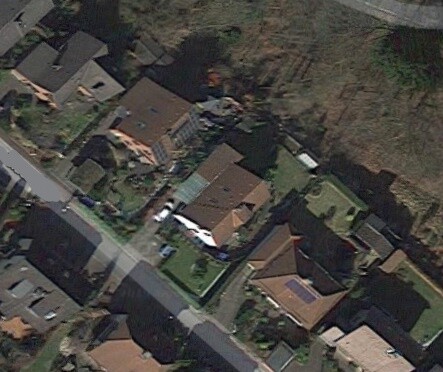
You are right! I have uploaded the plot via Google Maps in the attachment. It is the white house with the white car parked. There is a small path running along the short side up to the first terraces, then the path slopes downhill toward the basement. I hope this description is clear enough. Such situations are difficult to implement, especially if tenants move in later, as they would have to walk across my terrace every time to reach their apartment.
The rooms used for living are dry; the oldest child still lives there. The basement rooms also looked dry. As a layperson, it is hard for me to judge. A moisture meter for walls would definitely provide clarity!
Can’t the wall thickness be derived from the plans? I vaguely recall the word “aerated concrete” for the walls, as 11ant mentioned before. I’m not entirely sure, though!
I talked to a colleague who believes that highly insulated windows in a house from this year of construction promote mold growth—is this true? What type of insulation would you suggest?
It’s also a security question: many windows are at ground level, so easily reachable. How well can one protect against break-ins in such a case?
By consumption meter, do you mean those small devices attached to the radiators? My father said, “You don’t want to have those on the heaters, do you?” I’ll leave your interpretation open for that statement.
Regarding underfloor heating: would it be advisable in the basement? My parents prefer warm floors and like having warm feet. Since they do not benefit from indirect heat like I do on the ground floor, and they live directly above the ground, can it be defined that way?
The roof was insulated from the inside, BUT when I looked towards the roof ridge, I could see the open sky. At the dormer, I could also see outside next to the windows. I have no idea how it looks under the current insulation. I haven’t noticed or checked the gutters, so I can’t comment on that.
Electricity: In some areas, wires with terminal connectors are sticking out of the walls...
The main electrical panel is currently in the basement. Since both of us will need our own meter and panel, the cables will have to be routed from the bottom to the top anyway. Also, I want to control the blinds electrically in every room and provide network connections to rooms with internet-enabled devices (TV, PC, receiver). Just some small things like that.
Water: The existing bathrooms look old. One bathroom will be enlarged, two bathrooms will be completely removed, and one room that is currently not a bathroom will become one. So some pipes will definitely need to be installed. Additionally, there are many reports of water damage in our town. Whether with my parents’ house, where I witnessed four water damages in 20 years, or in my current apartment, where I experienced three water damages in almost three years. This is apparently due to the water quality and is a known problem that’s hard to avoid. To ease my conscience, I would recommend a new pipe system. Convince me otherwise!
Thank you very much for your suggestions and contributions. But what would you do in my situation? Every room with tiles has at least 2–3 broken tiles. Almost all doors are damaged around the frames or locks. The hallway is paneled with wood, but in some places the wood paneling is missing, exposing the masonry. How am I supposed to “fix cosmetic issues” starting from there?
Do half-measures make sense? Since the tiles are going to be removed anyway to install new flooring—laminate or similar in the hallway—I could implement the electrical lines with my ideas at the same time, including those needed for electrically controlled blinds. Then I can start working on the walls in the rooms. Or am I making a HUGE mistake by thinking this way?
Thank you for your attention!
Thank you very much for your comments!
kaho674 schrieb:
- It seems to be a sloped plot of land. The basement level is accessible from the uphill side and even has two entrances! Of course, the question of access paths comes up immediately. Do you have a picture of the entire plot—if needed, you could copy it from Google Maps and mark on it by hand? Maybe the entrance for the electric bikes could be moved there.
You are right! I have uploaded the plot via Google Maps in the attachment. It is the white house with the white car parked. There is a small path running along the short side up to the first terraces, then the path slopes downhill toward the basement. I hope this description is clear enough. Such situations are difficult to implement, especially if tenants move in later, as they would have to walk across my terrace every time to reach their apartment.
kaho674 schrieb:
- Is the basement dry? Like completely dry, suitable for living? I assume yes, since it says “child” there, but with older buildings you never really know.
The rooms used for living are dry; the oldest child still lives there. The basement rooms also looked dry. As a layperson, it is hard for me to judge. A moisture meter for walls would definitely provide clarity!
kaho674 schrieb:
- For questions about insulation, you first need to know the current condition. What type of walls are there, and how thick? Otherwise, I would primarily look at replacing windows and the roof for energy savings. Likely, more won’t make much sense.
Can’t the wall thickness be derived from the plans? I vaguely recall the word “aerated concrete” for the walls, as 11ant mentioned before. I’m not entirely sure, though!
kaho674 schrieb:
- Which windows to replace is a matter of price. I recommend Polish windows—a real bargain. Here in Saxony, quite literally “local.” Very good quality at half the price. I would always choose plastic frames for minimal maintenance, unless it’s a listed building.
I talked to a colleague who believes that highly insulated windows in a house from this year of construction promote mold growth—is this true? What type of insulation would you suggest?
It’s also a security question: many windows are at ground level, so easily reachable. How well can one protect against break-ins in such a case?
kaho674 schrieb:
- Two heating systems are nonsense—just a consumption meter is enough. I wouldn’t push for new underfloor heating either—the cost of retrofitting is huge. Modern radiators are better. Their design allows for low-temperature heating. This way you can also integrate existing underfloor heating. Maybe the current radiators are not that bad? You need a professional to calculate that and assess the building’s condition. What kind of heating is used now? Gas?
By consumption meter, do you mean those small devices attached to the radiators? My father said, “You don’t want to have those on the heaters, do you?” I’ll leave your interpretation open for that statement.
Regarding underfloor heating: would it be advisable in the basement? My parents prefer warm floors and like having warm feet. Since they do not benefit from indirect heat like I do on the ground floor, and they live directly above the ground, can it be defined that way?
kaho674 schrieb:
- Have you taken a close look at the roof? Is it in good condition? What about the gutters? All okay?
The roof was insulated from the inside, BUT when I looked towards the roof ridge, I could see the open sky. At the dormer, I could also see outside next to the windows. I have no idea how it looks under the current insulation. I haven’t noticed or checked the gutters, so I can’t comment on that.
kaho674 schrieb:
- What exactly is the problem with the electrical system? And why does the water system need to be redone?
Electricity: In some areas, wires with terminal connectors are sticking out of the walls...
The main electrical panel is currently in the basement. Since both of us will need our own meter and panel, the cables will have to be routed from the bottom to the top anyway. Also, I want to control the blinds electrically in every room and provide network connections to rooms with internet-enabled devices (TV, PC, receiver). Just some small things like that.
Water: The existing bathrooms look old. One bathroom will be enlarged, two bathrooms will be completely removed, and one room that is currently not a bathroom will become one. So some pipes will definitely need to be installed. Additionally, there are many reports of water damage in our town. Whether with my parents’ house, where I witnessed four water damages in 20 years, or in my current apartment, where I experienced three water damages in almost three years. This is apparently due to the water quality and is a known problem that’s hard to avoid. To ease my conscience, I would recommend a new pipe system. Convince me otherwise!
kaho674 schrieb:
Looking at what you plan to do, I don’t think your budget is sufficient. I would estimate double.
Maybe you’re going too far with the “everything has to be new” approach. I would focus first on the bathrooms and heating, and of course the attic conversion. Otherwise, start with painting and fixing cosmetic issues.
I would try to avoid an architect. Unless you remove load-bearing walls, you don’t need a structural engineer.
Thank you very much for your suggestions and contributions. But what would you do in my situation? Every room with tiles has at least 2–3 broken tiles. Almost all doors are damaged around the frames or locks. The hallway is paneled with wood, but in some places the wood paneling is missing, exposing the masonry. How am I supposed to “fix cosmetic issues” starting from there?
Do half-measures make sense? Since the tiles are going to be removed anyway to install new flooring—laminate or similar in the hallway—I could implement the electrical lines with my ideas at the same time, including those needed for electrically controlled blinds. Then I can start working on the walls in the rooms. Or am I making a HUGE mistake by thinking this way?
Thank you for your attention!

Year of construction, dimensions, wall thicknesses: to me, this almost certainly points to aerated concrete, although without guarantee, but highly likely. Depending on the overall package, including the heating system, it might even comply with current energy saving regulations.
Polish windows are said to be cheap: I cannot confirm that. After our own production, we carried third-party products for a while. If the quality is "on a Western level," the prices are reasonable but not a bargain. Removing thirty-year-old “good PVC windows” (even though, in my opinion, that’s already a contradiction in terms) to replace them with cheap Polish products would, to say the least, not be an upgrade, but at best unnecessary and pointless. Better to apply foil or cladding if you find them unattractive.
“Too airtight causes mold” is basically correct, but a bit oversimplified, and it’s not an argument against windows with better thermal insulation and protection values. Maybe @Nordlys can provide an assessment regarding retrofitting with trickle vents?
Overall, I strongly advise against considering the property even remotely a bargain. The age is particularly unfavorable: the materials are not yet dilapidated enough to be considered worthless for demolition, but replacing them costs nearly as much as if they were twenty years older. So the ratio of renovation effort to value increase is so unbalanced that it becomes an enthusiast’s project—however, from a layout perspective, it’s suboptimal and not an architectural gem worth that investment.
As a businessman, I would quickly walk away.
https://www.instagram.com/11antgmxde/
https://www.linkedin.com/company/bauen-jetzt/
Polish windows are said to be cheap: I cannot confirm that. After our own production, we carried third-party products for a while. If the quality is "on a Western level," the prices are reasonable but not a bargain. Removing thirty-year-old “good PVC windows” (even though, in my opinion, that’s already a contradiction in terms) to replace them with cheap Polish products would, to say the least, not be an upgrade, but at best unnecessary and pointless. Better to apply foil or cladding if you find them unattractive.
“Too airtight causes mold” is basically correct, but a bit oversimplified, and it’s not an argument against windows with better thermal insulation and protection values. Maybe @Nordlys can provide an assessment regarding retrofitting with trickle vents?
Overall, I strongly advise against considering the property even remotely a bargain. The age is particularly unfavorable: the materials are not yet dilapidated enough to be considered worthless for demolition, but replacing them costs nearly as much as if they were twenty years older. So the ratio of renovation effort to value increase is so unbalanced that it becomes an enthusiast’s project—however, from a layout perspective, it’s suboptimal and not an architectural gem worth that investment.
As a businessman, I would quickly walk away.
https://www.instagram.com/11antgmxde/
https://www.linkedin.com/company/bauen-jetzt/
You want to convert a single-family house into a two-family house.
I’m not very familiar with the costs, but renovating plus creating separate living spaces will cost more than just the renovation alone.
I’d estimate at least double, if you don’t do everything yourself.
But first, you need to check whether the zoning plan/building permit allows for an accessory apartment. Then, whether the requirements for living spaces can be met in the basement—such as ceiling height, lighting, and also parking spaces.
But honestly: does the house currently belong to your parents?
You’re supposed to buy it and renovate it according to your father’s wishes. Is that correct?
What he has worn down, you’re now expected to renovate at great expense?
I’ll put it this way: even after the purchase, he will likely still see himself as the owner. That will cause conflicts. I would advise staying away from the whole project. It already starts with the purchase price. And there are siblings involved as well...
I’m not very familiar with the costs, but renovating plus creating separate living spaces will cost more than just the renovation alone.
I’d estimate at least double, if you don’t do everything yourself.
But first, you need to check whether the zoning plan/building permit allows for an accessory apartment. Then, whether the requirements for living spaces can be met in the basement—such as ceiling height, lighting, and also parking spaces.
But honestly: does the house currently belong to your parents?
You’re supposed to buy it and renovate it according to your father’s wishes. Is that correct?
What he has worn down, you’re now expected to renovate at great expense?
I’ll put it this way: even after the purchase, he will likely still see himself as the owner. That will cause conflicts. I would advise staying away from the whole project. It already starts with the purchase price. And there are siblings involved as well...
T
Tschitschi7 Aug 2019 21:23ypg schrieb:
But honestly: the house belongs to your parents now?!
...And there are siblings too... Um, yes. Sorry, but I have no idea where you’re getting this nonsense from.
Tschitschi schrieb:
We (my wife, my parents, and I) have the opportunity to buy a house from a close relative. Tschitschi schrieb:
The oldest of the children still lives there. Have I been unclear?
ypg schrieb:
But first, it should be clarified whether the zoning plan / building permit allows a separate apartment. Then, whether the requirements for living spaces can be met in the basement—
-> ceiling height, natural light, etc., and also parking spaces. Definitely a very good suggestion! I hadn’t thought of that at all!
11ant schrieb:
Year built, dimensions, wall thickness: this “smells” to me almost like aerated concrete, though without guarantee, but highly likely. Depending on the overall package and the heating system, it might even comply with current energy-saving regulations. In what way should I interpret the “smells”? As negative or positive?
Tschitschi schrieb:
How am I supposed to interpret that "stink"? As something negative or positive?That evidence, when present in a certain density, can almost be considered proof.https://www.instagram.com/11antgmxde/
https://www.linkedin.com/company/bauen-jetzt/
Tschitschi schrieb:
Uh, yeah. Sorry, but I have no idea where you are pulling this nonsense from. If someone responds to you by asking questions or making assumptions based on what they understand, and gives you a suggestion, that is not nonsense!
Your post is not exactly flawless or technically perfect either, so you shouldn’t speak like that here.
Good luck with your project!
Similar topics