
ᐅ Modernist Concrete Villa with Cavity Wall Insulation – Experiences
Created on: 11 Sep 2018 07:32
R
rick2018
Hello everyone,
I just wanted to briefly introduce myself and say thank you.
For about a year and a half, I have been a silent reader here to gather inspiration and especially to gain more knowledge about construction technology.
Now a bit about me:
After more than a year of searching for a plot of land, I was able to purchase one from a developer who couldn’t move forward quickly with his plans.
So we found our dream plot (good location, 2500 m² (0.62 acres), slight slope, underground private spring that we have to preserve and are allowed to use).
There was an old house on the property, which we have since demolished.
There is no zoning plan, so §34 applies. During an initial informal inquiry at the building authority, almost everything we planned was rejected.
So we submitted an official preliminary building inquiry, involved the right people, and had lengthy discussions. In the end, we received a positive decision.
Therefore, there is nothing standing in the way of the building permit. The building permit should be granted within the next few weeks as there are no changes from the preliminary inquiry.
My wife (37) and I (36) want to build a Bauhaus-style villa in southern Baden-Württemberg.
It will be constructed from concrete (with core insulation) or in combination with insulated precast elements.
A lot of glass (full-glass system), textile shading, KNX, fast network both wired and wireless, strong mechanical ventilation with additional cooling coils, stainless steel pool, large cistern, and more.
The electrical planning must be 100% spot on since it’s almost impossible to make changes afterward.
Since I am friends with an architect from a larger firm, it was clear which route we would take. Such a house can basically only be realized with an architect.
I also personally know the electrician and KNX system integrator, as well as the owners and work approach of the heating, plumbing, and ventilation companies involved.
Some trades have already been contracted, and part of the equipment has already been ordered.
I’m really looking forward to getting started and to the final result. The goal is to move in by the end of 2019.
Once again, many thanks for the information I have received from you so far.
If you have any questions, just let me know.
Attached is the design, though not the final version. There have been a few minor changes.
Greetings from Swabia
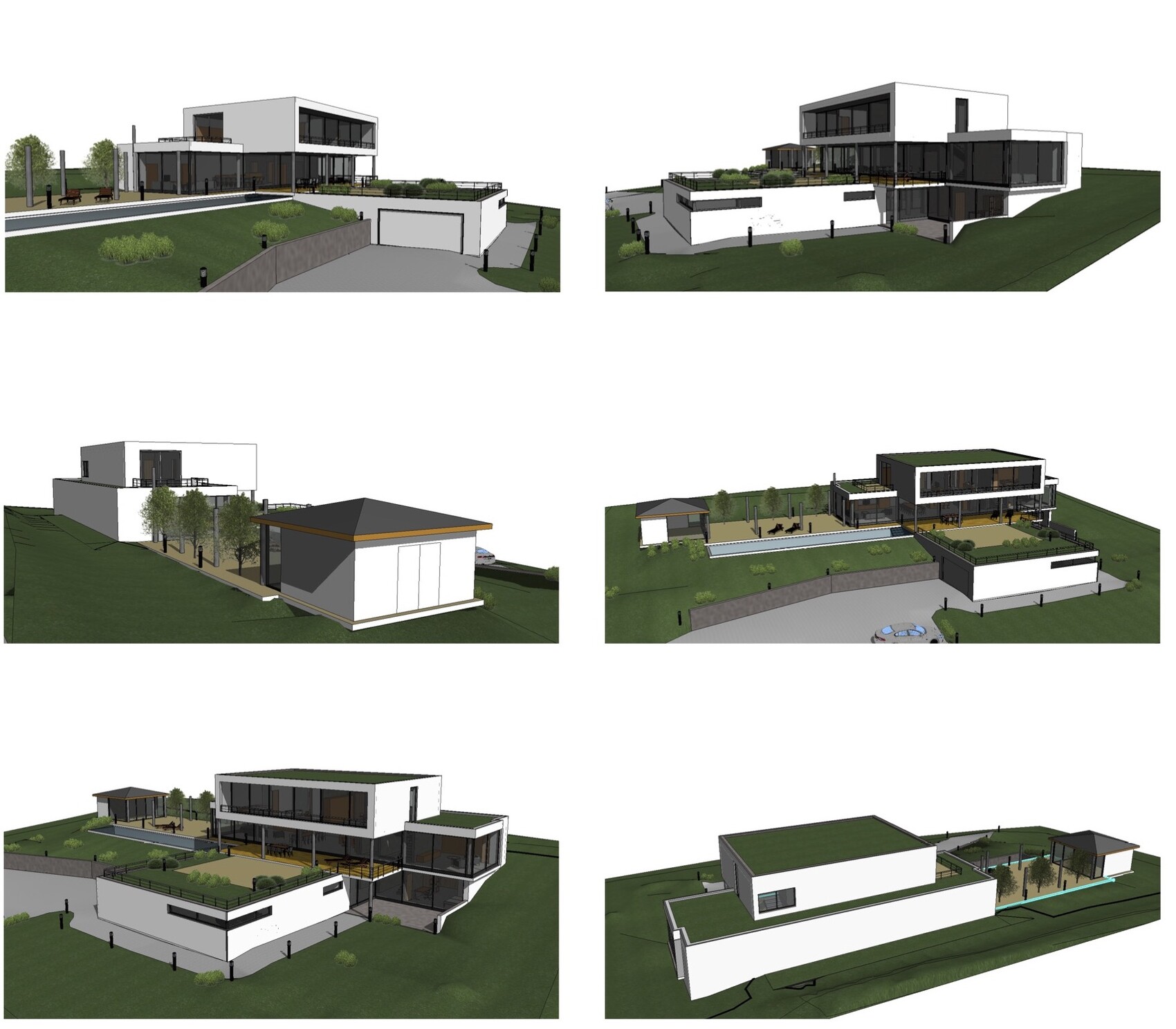
I just wanted to briefly introduce myself and say thank you.
For about a year and a half, I have been a silent reader here to gather inspiration and especially to gain more knowledge about construction technology.
Now a bit about me:
After more than a year of searching for a plot of land, I was able to purchase one from a developer who couldn’t move forward quickly with his plans.
So we found our dream plot (good location, 2500 m² (0.62 acres), slight slope, underground private spring that we have to preserve and are allowed to use).
There was an old house on the property, which we have since demolished.
There is no zoning plan, so §34 applies. During an initial informal inquiry at the building authority, almost everything we planned was rejected.
So we submitted an official preliminary building inquiry, involved the right people, and had lengthy discussions. In the end, we received a positive decision.
Therefore, there is nothing standing in the way of the building permit. The building permit should be granted within the next few weeks as there are no changes from the preliminary inquiry.
My wife (37) and I (36) want to build a Bauhaus-style villa in southern Baden-Württemberg.
It will be constructed from concrete (with core insulation) or in combination with insulated precast elements.
A lot of glass (full-glass system), textile shading, KNX, fast network both wired and wireless, strong mechanical ventilation with additional cooling coils, stainless steel pool, large cistern, and more.
The electrical planning must be 100% spot on since it’s almost impossible to make changes afterward.
Since I am friends with an architect from a larger firm, it was clear which route we would take. Such a house can basically only be realized with an architect.
I also personally know the electrician and KNX system integrator, as well as the owners and work approach of the heating, plumbing, and ventilation companies involved.
Some trades have already been contracted, and part of the equipment has already been ordered.
I’m really looking forward to getting started and to the final result. The goal is to move in by the end of 2019.
Once again, many thanks for the information I have received from you so far.
If you have any questions, just let me know.
Attached is the design, though not the final version. There have been a few minor changes.
Greetings from Swabia
S
Steffen807 Jul 2019 22:29rick2018 schrieb:
Because we wanted it cool everywhere. For a building this size, a central system also makes more sense.Same temperature in the bathroom and bedroom? In summer, we keep the bedroom constantly at 22°C (72°F), while the bathroom is usually over 25°C (77°F). The living room is 23–24°C (73–75°F), and the office is also 23°C (73°F). There is a lot of heat generated there (computers, 6 monitors, etc.). It needs significantly more cooling capacity than the rest. Sorry, but I still only see disadvantages in your solution. Mechanical ventilation with heat recovery is for fresh air, while air conditioning/heating is for cooling and heating. To me, these systems should be separate.

S
Steffen807 Jul 2019 23:26rick2018 schrieb:
Different cooling capacities are ensured by varying the air exchange rates. This also allows for different temperatures. For our house size, this is the most practical solution, although there are always several solutions that can achieve the desired result.Can you adjust the airflow volume per room? I would really like that... unfortunately, none of the known manufacturers of controlled residential ventilation systems (single-family homes) have offered this.
This is something we can do (within certain limits). It is absolutely uncommon in single-family houses. In such houses, you usually have a relatively small ventilation unit, rooms where air is extracted, and rooms where air is supplied. The rest is balanced by airflow through door gaps. That is the draft you feel at your doors.
To achieve different airflow rates, you need a significantly larger ventilation unit, much more ductwork, valves...
But most importantly, separate supply and exhaust air in all areas. Few to no zones balanced by airflow through gaps.
For example, our technical room with servers (where most of the waste heat is generated) has twice as many supply and exhaust outlets as the adjacent fitness area, even though the fitness area is 2.5 times larger.
The door in between has an all-around seal, mainly for sound insulation. Since both supply and exhaust air are within the same room, no pressure differences arise with the adjacent room.
The design of the separate supply and exhaust valves determines the overall airflow rates. The volume can still be adjusted using valves in the ducts, ceiling diffusers, and the ventilation unit itself.
What is not possible is, for example, increasing the airflow in the fitness area to match that of the technical room (relative to room size). There simply are not enough supply and exhaust outlets.
Now I also understand why you were critical of the air conditioning solution. Using a “standard” heat recovery ventilation design would make little sense for several reasons.
To achieve different airflow rates, you need a significantly larger ventilation unit, much more ductwork, valves...
But most importantly, separate supply and exhaust air in all areas. Few to no zones balanced by airflow through gaps.
For example, our technical room with servers (where most of the waste heat is generated) has twice as many supply and exhaust outlets as the adjacent fitness area, even though the fitness area is 2.5 times larger.
The door in between has an all-around seal, mainly for sound insulation. Since both supply and exhaust air are within the same room, no pressure differences arise with the adjacent room.
The design of the separate supply and exhaust valves determines the overall airflow rates. The volume can still be adjusted using valves in the ducts, ceiling diffusers, and the ventilation unit itself.
What is not possible is, for example, increasing the airflow in the fitness area to match that of the technical room (relative to room size). There simply are not enough supply and exhaust outlets.
Now I also understand why you were critical of the air conditioning solution. Using a “standard” heat recovery ventilation design would make little sense for several reasons.
S
sichtbeton828 Jul 2019 08:51Incredible and huge! Wishing you continued hard-working builders! The little touches, like with the ice for example, really make a big difference. Keep it up!
I can already see the house on NTV's "The 5 Most Gigantic Single-Family Homes in Germany"
I can already see the house on NTV's "The 5 Most Gigantic Single-Family Homes in Germany"
Similar topics