
ᐅ Modernist Concrete Villa with Cavity Wall Insulation – Experiences
Created on: 11 Sep 2018 07:32
R
rick2018
Hello everyone,
I just wanted to briefly introduce myself and say thank you.
For about a year and a half, I have been a silent reader here to gather inspiration and especially to gain more knowledge about construction technology.
Now a bit about me:
After more than a year of searching for a plot of land, I was able to purchase one from a developer who couldn’t move forward quickly with his plans.
So we found our dream plot (good location, 2500 m² (0.62 acres), slight slope, underground private spring that we have to preserve and are allowed to use).
There was an old house on the property, which we have since demolished.
There is no zoning plan, so §34 applies. During an initial informal inquiry at the building authority, almost everything we planned was rejected.
So we submitted an official preliminary building inquiry, involved the right people, and had lengthy discussions. In the end, we received a positive decision.
Therefore, there is nothing standing in the way of the building permit. The building permit should be granted within the next few weeks as there are no changes from the preliminary inquiry.
My wife (37) and I (36) want to build a Bauhaus-style villa in southern Baden-Württemberg.
It will be constructed from concrete (with core insulation) or in combination with insulated precast elements.
A lot of glass (full-glass system), textile shading, KNX, fast network both wired and wireless, strong mechanical ventilation with additional cooling coils, stainless steel pool, large cistern, and more.
The electrical planning must be 100% spot on since it’s almost impossible to make changes afterward.
Since I am friends with an architect from a larger firm, it was clear which route we would take. Such a house can basically only be realized with an architect.
I also personally know the electrician and KNX system integrator, as well as the owners and work approach of the heating, plumbing, and ventilation companies involved.
Some trades have already been contracted, and part of the equipment has already been ordered.
I’m really looking forward to getting started and to the final result. The goal is to move in by the end of 2019.
Once again, many thanks for the information I have received from you so far.
If you have any questions, just let me know.
Attached is the design, though not the final version. There have been a few minor changes.
Greetings from Swabia
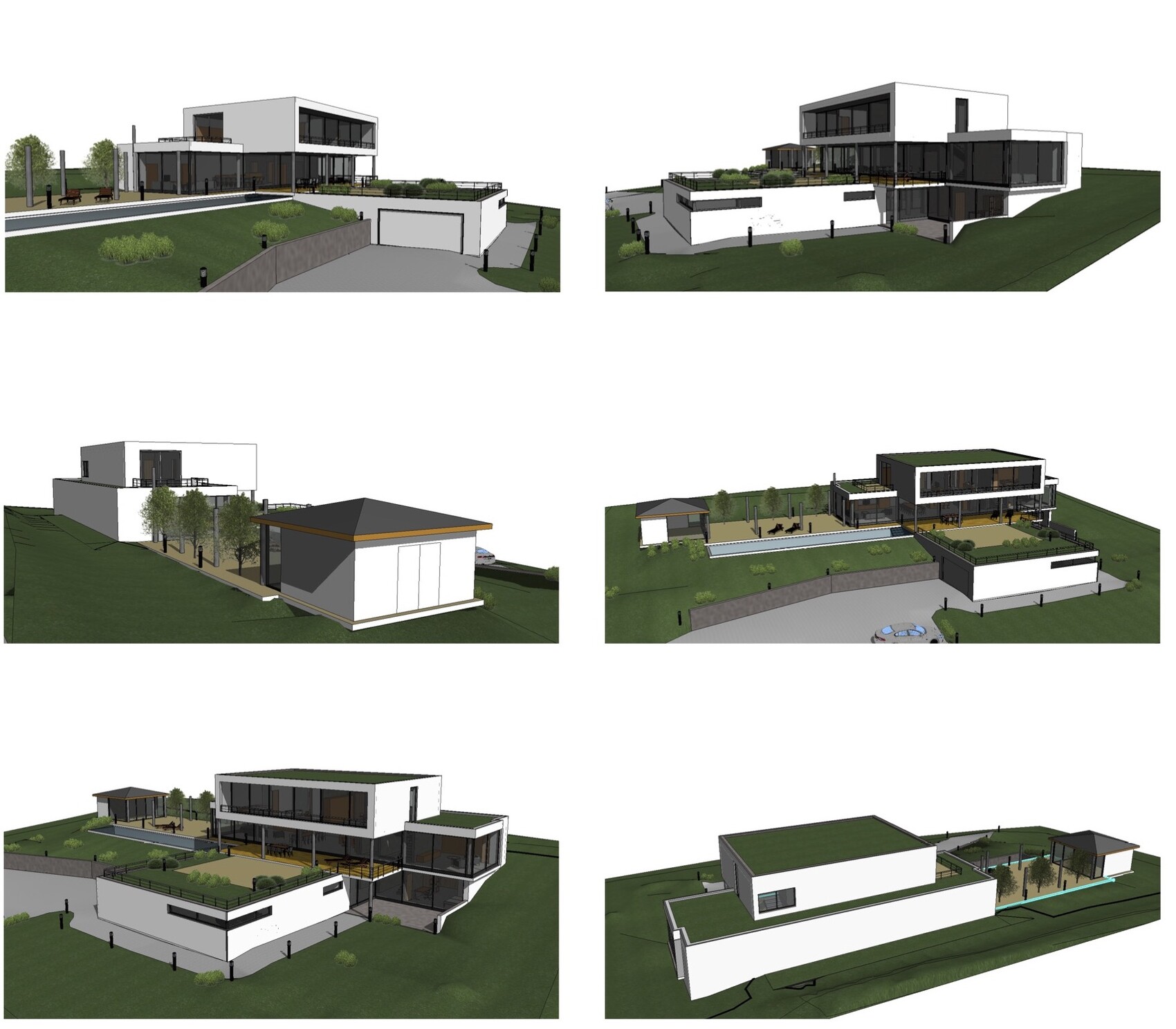
I just wanted to briefly introduce myself and say thank you.
For about a year and a half, I have been a silent reader here to gather inspiration and especially to gain more knowledge about construction technology.
Now a bit about me:
After more than a year of searching for a plot of land, I was able to purchase one from a developer who couldn’t move forward quickly with his plans.
So we found our dream plot (good location, 2500 m² (0.62 acres), slight slope, underground private spring that we have to preserve and are allowed to use).
There was an old house on the property, which we have since demolished.
There is no zoning plan, so §34 applies. During an initial informal inquiry at the building authority, almost everything we planned was rejected.
So we submitted an official preliminary building inquiry, involved the right people, and had lengthy discussions. In the end, we received a positive decision.
Therefore, there is nothing standing in the way of the building permit. The building permit should be granted within the next few weeks as there are no changes from the preliminary inquiry.
My wife (37) and I (36) want to build a Bauhaus-style villa in southern Baden-Württemberg.
It will be constructed from concrete (with core insulation) or in combination with insulated precast elements.
A lot of glass (full-glass system), textile shading, KNX, fast network both wired and wireless, strong mechanical ventilation with additional cooling coils, stainless steel pool, large cistern, and more.
The electrical planning must be 100% spot on since it’s almost impossible to make changes afterward.
Since I am friends with an architect from a larger firm, it was clear which route we would take. Such a house can basically only be realized with an architect.
I also personally know the electrician and KNX system integrator, as well as the owners and work approach of the heating, plumbing, and ventilation companies involved.
Some trades have already been contracted, and part of the equipment has already been ordered.
I’m really looking forward to getting started and to the final result. The goal is to move in by the end of 2019.
Once again, many thanks for the information I have received from you so far.
If you have any questions, just let me know.
Attached is the design, though not the final version. There have been a few minor changes.
Greetings from Swabia
S
Steffen8021 Jun 2019 09:17rick2018 schrieb:
18 meters long and 76,000 liters (20,066 gallons). We switched to a smaller one because it fits better in the available space in front of the pool. Originally, we wanted 90 m³ (3,180 ft³).
This way, we have more options for designing the garden to the left of the pool.Why so large? We have 15 m² (161 ft²), and that size is already completely uneconomical. For that money, we probably could have paid for garden water for 20 years..

Last year, there was already a ban on using fresh water for irrigation. With a cistern like this, it’s not a problem.
Depending on your garden and the establishment phase, you can easily use 10m³ (350 cubic feet) of water per irrigation session.
To operate larger sprinklers or irrigation zones, you need a suitable pump with sufficient volume and pressure. Otherwise, it would be impossible to complete an irrigation cycle, for example, in one night.
You wouldn’t be able to manage this from the mains supply alone, nor keep up with refilling afterwards. Our pump would empty your cistern in half an hour.
This way, we can store enough water temporarily (from rain and well water).
The cost increases are not as drastic once the cistern reaches a certain size.
Our goal was to bridge at least 4 to 6 weeks.
From an economic standpoint, a single-family home is not cost-efficient anyway. We didn’t install this cistern to save money but to ensure good irrigation.
For what the pool costs, we could go to a public swimming pool for life. But that’s not what we want.
Depending on your garden and the establishment phase, you can easily use 10m³ (350 cubic feet) of water per irrigation session.
To operate larger sprinklers or irrigation zones, you need a suitable pump with sufficient volume and pressure. Otherwise, it would be impossible to complete an irrigation cycle, for example, in one night.
You wouldn’t be able to manage this from the mains supply alone, nor keep up with refilling afterwards. Our pump would empty your cistern in half an hour.
This way, we can store enough water temporarily (from rain and well water).
The cost increases are not as drastic once the cistern reaches a certain size.
Our goal was to bridge at least 4 to 6 weeks.
From an economic standpoint, a single-family home is not cost-efficient anyway. We didn’t install this cistern to save money but to ensure good irrigation.
For what the pool costs, we could go to a public swimming pool for life. But that’s not what we want.
M
Mottenhausen21 Jun 2019 09:33Look up the annual rainfall per square meter in your region. Then multiply that by the square meters of roof area you direct into the rainwater tank and by about 4 €/m³ (4 USD/yd³) for freshwater plus wastewater costs. I estimate the rainwater tank would pay for itself in at least 30 years, assuming water prices continue to rise.
This comes at the expense of the environment and freshwater quality, because if everyone collects their own infiltration water, nitrate levels in groundwater will continue to increase.
A watering ban using freshwater? That’s surprising—I haven’t heard of that before.
This comes at the expense of the environment and freshwater quality, because if everyone collects their own infiltration water, nitrate levels in groundwater will continue to increase.
A watering ban using freshwater? That’s surprising—I haven’t heard of that before.
Mottenhausen, in some regions, cisterns are part of the concept to prevent flooding caused by heavy rain. And heavy rain events are becoming more frequent.
How cisterns will affect groundwater remains to be seen. Basements flooded with water are also far from ideal. I wouldn’t want to imagine what kind of pollutants could be washed into streams and rivers.
How cisterns will affect groundwater remains to be seen. Basements flooded with water are also far from ideal. I wouldn’t want to imagine what kind of pollutants could be washed into streams and rivers.
As haydee mentioned, retention cisterns are required in new housing developments to manage heavy rainfall by providing temporary storage.
We didn’t actually need a cistern but chose to have one anyway.
In our case, the water drains back into the ground quite quickly. Most of it will probably return to the groundwater source.
Last year’s watering restrictions, I believe, were only active for about 4-6 weeks. Still, it’s frustrating when you’ve invested a lot of money and effort in landscaping and then end up with a brown, dry yard.
We didn’t actually need a cistern but chose to have one anyway.
In our case, the water drains back into the ground quite quickly. Most of it will probably return to the groundwater source.
Last year’s watering restrictions, I believe, were only active for about 4-6 weeks. Still, it’s frustrating when you’ve invested a lot of money and effort in landscaping and then end up with a brown, dry yard.
Last year, I was in OWL as well as in (Middle) Franconia, where there is generally little rainfall, and during summer this also happens more often.
(Fresh water watering ban for lawn sprinklers).
I find it annoying anyway; you can manage lawns and perennials again, but bushes and trees may occasionally need watering assistance.
(Fresh water watering ban for lawn sprinklers).
I find it annoying anyway; you can manage lawns and perennials again, but bushes and trees may occasionally need watering assistance.
Similar topics