
L
landhausbauer2 Jun 2019 21:45Hello everyone,
I am planning a solid construction house with the following details:
Main house with two full floors and a pitched roof on top, an attached secondary building connected with a T-joint, featuring a garage on the ground floor and a pitched roof above.
The ground floor slab of the main house is intended to be higher than the garage floor, so I am considering pouring the foundation slab at two different levels.
This means the main house entrance would be accessible via two or three steps.
Now I have two questions:
1.) Is it common practice to pour a two-level concrete slab, and how is this done in practice?
2.) The brick facade will run continuously on the foundation slab but should also start at the very bottom of the main house (otherwise the exposed foundation slab above the ground would be visible). How can this be achieved?
Answers like “Ask the architect/structural engineer” are not helpful to me. I have made it my goal to plan the house from the ground up and acquire the necessary knowledge myself.
Thank you very much for your help!
I am planning a solid construction house with the following details:
Main house with two full floors and a pitched roof on top, an attached secondary building connected with a T-joint, featuring a garage on the ground floor and a pitched roof above.
The ground floor slab of the main house is intended to be higher than the garage floor, so I am considering pouring the foundation slab at two different levels.
This means the main house entrance would be accessible via two or three steps.
Now I have two questions:
1.) Is it common practice to pour a two-level concrete slab, and how is this done in practice?
2.) The brick facade will run continuously on the foundation slab but should also start at the very bottom of the main house (otherwise the exposed foundation slab above the ground would be visible). How can this be achieved?
Answers like “Ask the architect/structural engineer” are not helpful to me. I have made it my goal to plan the house from the ground up and acquire the necessary knowledge myself.
Thank you very much for your help!

Hello country house builders,
we are currently constructing a semi-detached house with three different heights, meaning three separate slabs. This is probably not very common, but definitely feasible. It will depend on finding a skilled structural engineer or concrete contractor. What foundation recommendation do you have in your soil report? In our case, a floating slab foundation was laid on an 80 cm (31 inch) gravel base.
The different levels were established when preparing the subgrade and gravel layer. First, the lowest slab was poured, then the ground floor walls were built up. On the side adjacent to the other two slabs, thorough waterproofing and insulation were applied. Then, the second slab was poured “against” it, along with an additional strip footing on the first and deepest slab for the third and highest slab. After formwork removal, there was another round of waterproofing and insulation. Finally, the third slab was poured together with the stair steps connecting the last two slabs (split level).
Honestly, I would advise against planning this on your own. Our architect provided very detailed execution plans, and I witnessed extensive coordination with the concrete contractor. There were occasional moments of confusion and questions on site. It’s not straightforward by any means.
Regarding your question about brick veneer, I can’t help since I’m not familiar with that. With varying heights, you need to carefully consider how to shape the plinth/sockel so it doesn’t look awkward. Maybe you could upload a sketch showing your idea.
we are currently constructing a semi-detached house with three different heights, meaning three separate slabs. This is probably not very common, but definitely feasible. It will depend on finding a skilled structural engineer or concrete contractor. What foundation recommendation do you have in your soil report? In our case, a floating slab foundation was laid on an 80 cm (31 inch) gravel base.
The different levels were established when preparing the subgrade and gravel layer. First, the lowest slab was poured, then the ground floor walls were built up. On the side adjacent to the other two slabs, thorough waterproofing and insulation were applied. Then, the second slab was poured “against” it, along with an additional strip footing on the first and deepest slab for the third and highest slab. After formwork removal, there was another round of waterproofing and insulation. Finally, the third slab was poured together with the stair steps connecting the last two slabs (split level).
Honestly, I would advise against planning this on your own. Our architect provided very detailed execution plans, and I witnessed extensive coordination with the concrete contractor. There were occasional moments of confusion and questions on site. It’s not straightforward by any means.
Regarding your question about brick veneer, I can’t help since I’m not familiar with that. With varying heights, you need to carefully consider how to shape the plinth/sockel so it doesn’t look awkward. Maybe you could upload a sketch showing your idea.
L
landhausbauer3 Jun 2019 18:36Thank you very much for the help and the detailed insights! Of course, an architect or structural engineer will have to review everything in the end, but I hope my designs are mature enough to avoid major changes later on. As an addition, below is a model of the base slab as I currently envision it. It shows that the slab is only raised in the inner area of the main house. The bricks of the exterior wall are also indicated. For completing the cavity wall construction (which is the current plan), insulation and facing brick will be applied on the lower ledge (at the same height as the garage). This means there is no step for the insulation and facing brick, and the height will be consistent all around the house—avoiding visual issues. What I see as problematic is that the ledge of the base slab must be exactly the same height as one brick.
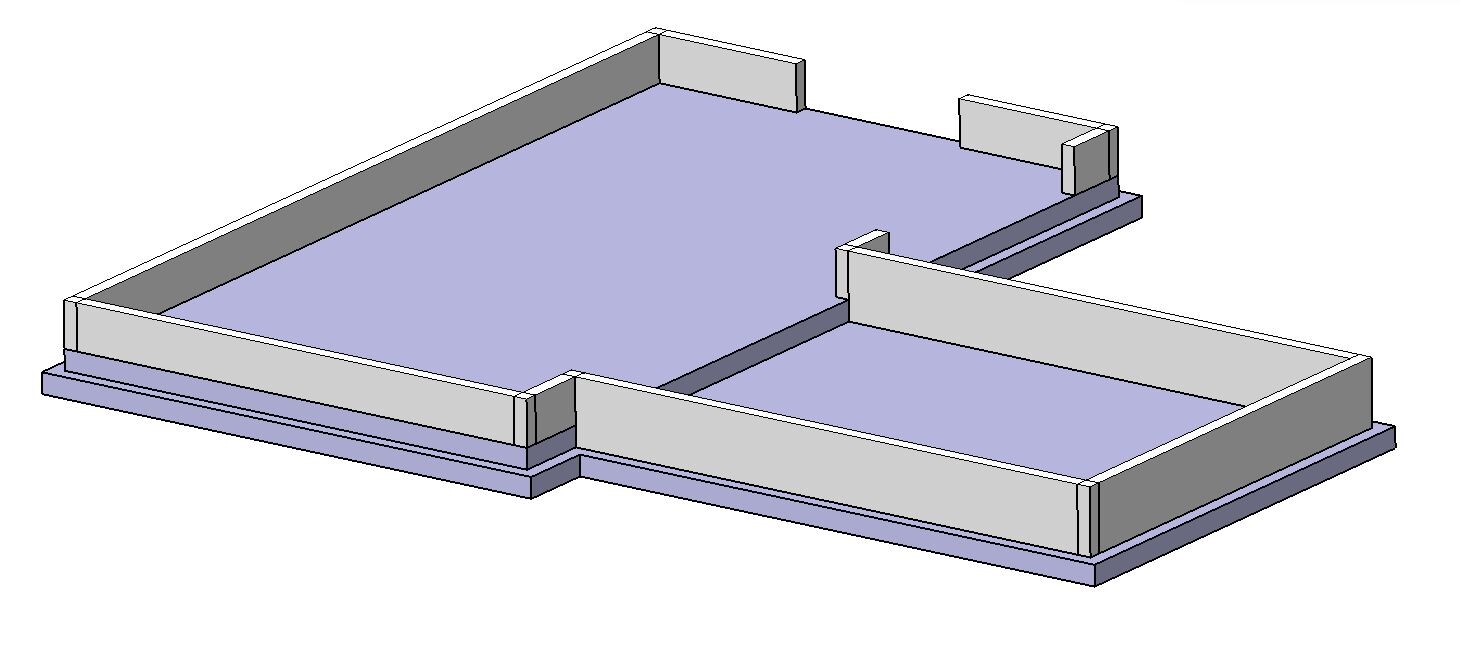
Best regards
Best regards
N
nordanney3 Jun 2019 18:53landhausbauer schrieb:
exactlyThat is an unpronounceable word in construction...Don’t bother trying to figure it out on your own. You’re too much of a non-professional and don’t have the necessary expertise. It’s better to plan together with the architect and use your time for other things if you really want to get deeply involved in the building process. After all, an architect has studied for this, which you are trying to learn on the side.
Planning and execution are two completely different fields. You can do well planning on your own, but the architect and the tradespeople need to professionally turn your plans into a house.

landhausbauer schrieb:
This means the main house entrance should be accessible by two or three steps. At first, this sounded like a bigger difference than the drawing actually shows. Different thicknesses or heights of floor slabs are quite common—especially since it is typical not to have underfloor heating in the garage.
I usually keep track of threads and link related discussions well, but in this case, I can only say without links that the issue of a terrain-following brick cladding boundary is not unusual and is discussed several times a year—mostly in relation to houses built on sloping terrain.
Would the slab, as you imagine it, be seamless? And in general: is there a plot of land where your building design has already been checked for buildability?
https://www.instagram.com/11antgmxde/
https://www.linkedin.com/company/bauen-jetzt/
Similar topics