
ᐅ Planning a Single-Family Home on a Sloped Site – Making Optimal Use of the Land
Created on: 24 May 2019 22:20
F
Fuchsbauer
Hello dear forum,
we currently live in Vienna and have purchased a beautiful (and unfortunately very expensive) sloped plot west of Vienna. We already had an approved building permit plan (!) prepared by an architect, but in February we decided to stop the process. Through discussions with builders as well as other trades (window manufacturers, plumbers, electricians), we realized that this plan would exceed our initially agreed budget by approximately 30-40% in execution costs. Hence, we put on the brakes and started over: this time with an independent planner recommended to us by a builder who – in our opinion – is doing a good job and has developed the current plan together with us.
However, before we proceed towards the building permit plan, we would like to have your feedback to “challenge” the plan. As you can imagine, we have already invested a lot of time and nerves in this process with the architect, the restart, and back and forth, and if possible, we want to start building still in 2019… especially since one of the future residents of the two children’s bedrooms has already been born, and we want to move out of our small apartment as soon as possible.
Here is our questionnaire, which we hope gives you a good overview of our project:
Development plan / Restrictions
Plot size: 690 m² (19.5 m x 35.4 m) (7,432 sq ft (64 ft x 116 ft))
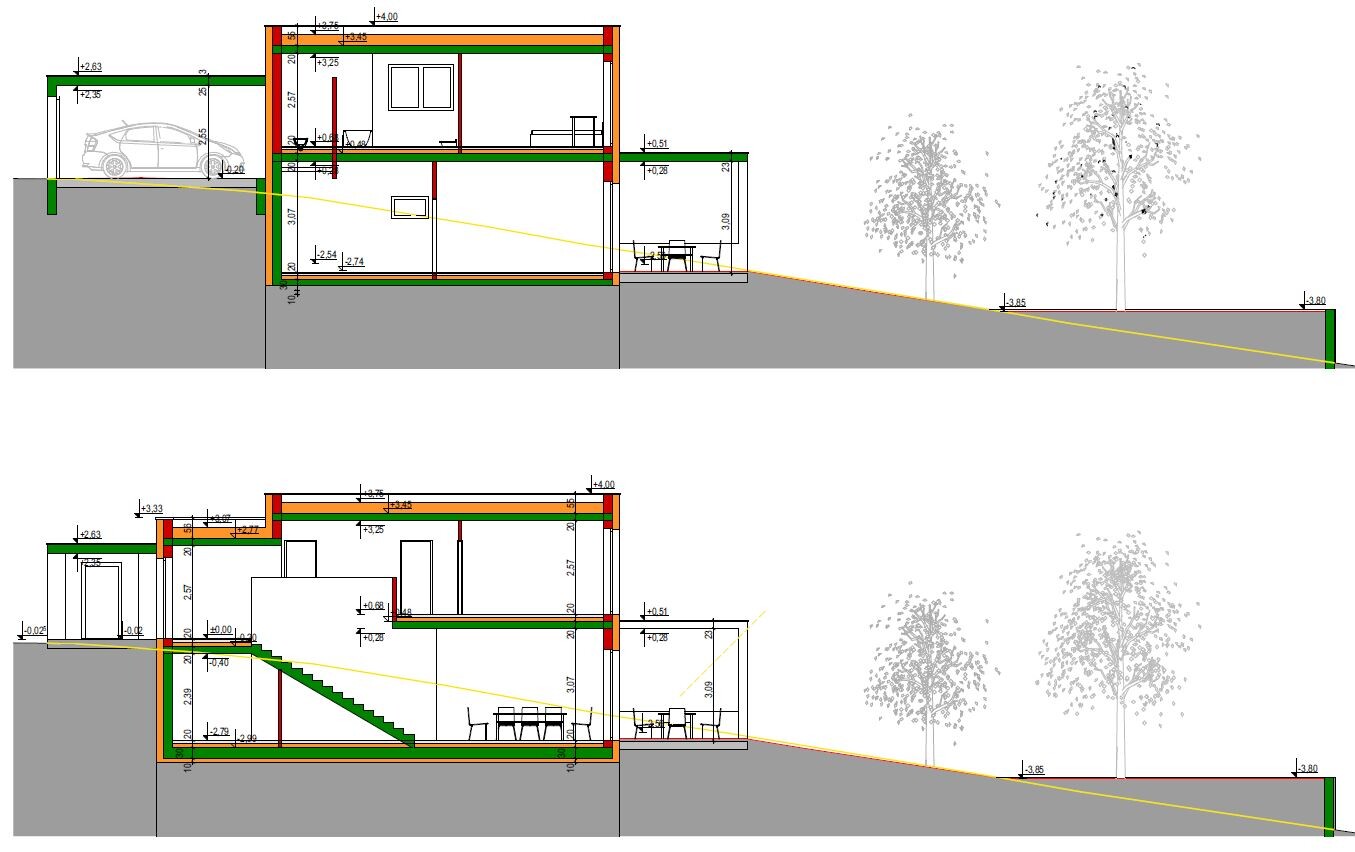
Slope: yes, approx. 5 m (16 ft) gradient over 35 m (115 ft) length
Site coverage ratio: not applicable in Austria, buildable area is 199 m² (2,141 sq ft)
Floor area ratio: not applicable in Austria
Building setback lines and boundaries: front and side setbacks each 3 m (10 ft) or half the eaves height of the adjacent house front, whichever is greater; rear setback 3 m (10 ft)
Edge construction: within the setback area up to a max height of 3 m (10 ft); higher height downhill allowed following terrain
Number of parking spaces: 1 unenclosed parking space required
Number of storeys: no restrictions in the development plan; currently 2 floors planned
Roof type: flat roof
Architectural style: Bauhaus
Orientation: southeast
Maximum heights / limits: 6.5 m (21 ft) on slope side / 8.5 m (28 ft) on valley side
Additional regulations:
Owners’ requirements
Architectural style, roof type, building type: Bauhaus, flat roof, single-family house
Basement, floors: 2 floors (for cost reasons), with the upper floor at street level and the ground floor partially built into the slope
Number of occupants, ages: 4, two adults (mid/late 30s) and two small children; medium-term expectation of adding an elderly person (grandmother)
Room requirements on ground floor and upper floor:
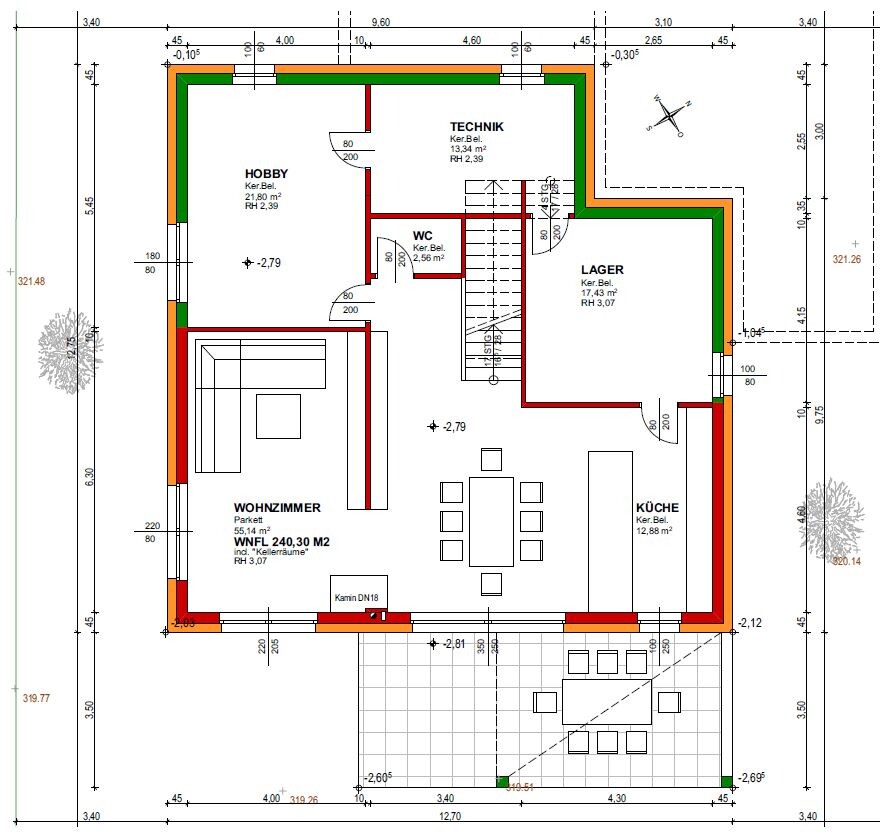
Ground floor (essentially basement level): large living area with living room, dining area and spacious kitchen, guest WC with hand basin, hobby room and storage rooms as well as technical room
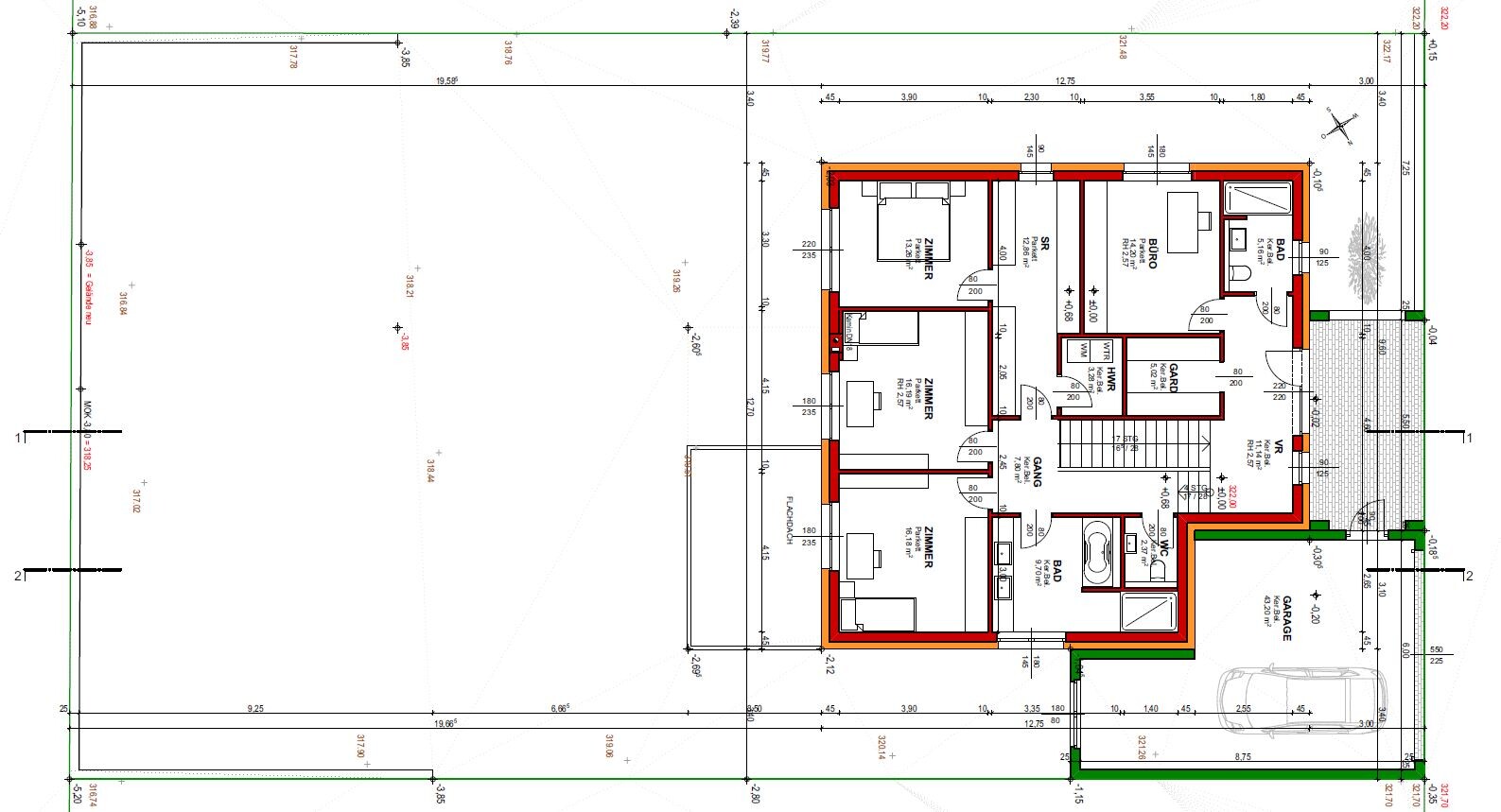
Upper floor (at street level): office/guest room, guest bathroom, wardrobe, large bathroom, walk-in closet (spatially separated from master bedroom), utility room plus 3 bedrooms (master bedroom, 2 children's rooms)
Office: family use or home office? Both
Number of guest stays per year: currently about 6 weekends per year, but potential for permanent guest room use
Open or closed architecture: open but focused on reducing noise transfer from the living area to the bedrooms
Conservative or modern construction: modern but timeless
Open kitchen, kitchen island: open kitchen with large kitchen island (peninsula) and direct view contact to dining table
Number of dining seats: regularly 6 with possibility to expand to 10 for occasions
Fireplace: yes, on the ground floor in the living area – also to serve as room divider
Music / stereo wall: wall for large TV and floor-standing speakers
Balcony, roof terrace: no
Garage, carport: garage
Utility garden, greenhouse: raised beds for vegetables, preferably flat area for children’s play area (sandbox, swing, …), shrubs such as elderberry bush and butterfly bush along the property boundary
It is planned to raise the original ground level by up to 1.5 m (5 ft) to create a level area, which means a retaining wall will be necessary in the lower garden area.
Additional wishes / special features / daily routine, including reasons why some things should or should not be included:
Controlled ventilation system, thermal building activation for cooling, heating via geothermal energy (horizontal trench collector)
The walk-in closet should be spatially separated (at least by a door) from the master bedroom (since one of us gets up earlier than the other and the second person should not be disturbed).
The bedroom windows are oriented directly to the garden to prevent views from neighbors.
Guest room / office and guest bathroom should be on the same level so guests can easily find their way at night.
Large, open space combining living room, dining room, and kitchen, with the area around the sofa and TV somewhat separated (niche).
House design
Origin of the planning:
We initially worked with an architect and already had an approved building permit plan. Unfortunately, based on quotes from builders, it became clear that the architect’s cost estimates were far too low and would have significantly exceeded our budget. Therefore, we have now created a new design together with a planner, which has also been roughly discussed with a builder and should be within our budget.
- Planner affiliated with a construction company: yes
- Architect: no
- Do-it-yourself: no
What do you like most? Why?
The large open living area on the ground floor with direct access to the garden.
What do you dislike? Why?
Basically, we like the layout on the ground floor very much and it fits our needs. However, we are concerned about the long staircase (17 steps) – we fear it might be too dark there. We are also worried about noise transmission from the large living area to the bedrooms. Skylights would be possible, but we’d prefer to avoid them to keep the roof design as simple as possible.
@Regarding darkness: The positioning and size of windows is not yet final – we welcome feedback here. As mentioned, we are concerned that the hallway areas, and perhaps also the large living room on the ground floor, could be too dark. Please share your ideas.
Also, there is a lot of hallway space in front of the toilet on the ground floor (along the stairs) – perhaps there is a better layout with less circulation space required?
Location and size of the utility room on the upper floor – it is located away from the bathroom and is too small to fit a drying rack.
Estimated cost according to architect/planner:
Shell construction approx. 300,000 EUR
Personal maximum budget for the house, including fittings:
600,000 EUR
Preferred heating technology:
Geothermal energy (horizontal trench collector)
If you had to give up something, which details or expansions
- can you do without: garage (can be built later), garden fence, full build-out of the retaining wall, interior finishing of some rooms (guest bathroom, one children’s room, storage rooms), fireplace (can be built later)
- cannot do without: covered terrace, storage rooms and technical room
Why is the design the way it is?
Standard design from the planner?
Which wishes were implemented by the architect?
A mixture of many examples from various magazines...
What do you think is particularly good or bad about it?
The plot resulted from subdividing a large meadow. Neighboring plots are currently undeveloped (no buyers yet), so future development can only be guessed at. Therefore, we orient the bedrooms towards the garden. The plot southwest of ours is only 17 m (56 ft) wide. It is therefore likely that a future house there will be oriented roughly northeast-southwest (meaning it will extend further downslope than ours) and will potentially use the 8.5 m max building height.
Basically, the current plan is based on our experience with the architect’s design and the insights gained from many conversations with different trades to balance costs with our ideas.
What is the most important / fundamental question about the floor plan in 130 characters
How can I optimally use the sloped site to implement the spatial concept and keep costs under control? What could be improved?

we currently live in Vienna and have purchased a beautiful (and unfortunately very expensive) sloped plot west of Vienna. We already had an approved building permit plan (!) prepared by an architect, but in February we decided to stop the process. Through discussions with builders as well as other trades (window manufacturers, plumbers, electricians), we realized that this plan would exceed our initially agreed budget by approximately 30-40% in execution costs. Hence, we put on the brakes and started over: this time with an independent planner recommended to us by a builder who – in our opinion – is doing a good job and has developed the current plan together with us.
However, before we proceed towards the building permit plan, we would like to have your feedback to “challenge” the plan. As you can imagine, we have already invested a lot of time and nerves in this process with the architect, the restart, and back and forth, and if possible, we want to start building still in 2019… especially since one of the future residents of the two children’s bedrooms has already been born, and we want to move out of our small apartment as soon as possible.
Here is our questionnaire, which we hope gives you a good overview of our project:
Development plan / Restrictions
Plot size: 690 m² (19.5 m x 35.4 m) (7,432 sq ft (64 ft x 116 ft))
Slope: yes, approx. 5 m (16 ft) gradient over 35 m (115 ft) length
Site coverage ratio: not applicable in Austria, buildable area is 199 m² (2,141 sq ft)
Floor area ratio: not applicable in Austria
Building setback lines and boundaries: front and side setbacks each 3 m (10 ft) or half the eaves height of the adjacent house front, whichever is greater; rear setback 3 m (10 ft)
Edge construction: within the setback area up to a max height of 3 m (10 ft); higher height downhill allowed following terrain
Number of parking spaces: 1 unenclosed parking space required
Number of storeys: no restrictions in the development plan; currently 2 floors planned
Roof type: flat roof
Architectural style: Bauhaus
Orientation: southeast
Maximum heights / limits: 6.5 m (21 ft) on slope side / 8.5 m (28 ft) on valley side
Additional regulations:
Owners’ requirements
Architectural style, roof type, building type: Bauhaus, flat roof, single-family house
Basement, floors: 2 floors (for cost reasons), with the upper floor at street level and the ground floor partially built into the slope
Number of occupants, ages: 4, two adults (mid/late 30s) and two small children; medium-term expectation of adding an elderly person (grandmother)
Room requirements on ground floor and upper floor:
Ground floor (essentially basement level): large living area with living room, dining area and spacious kitchen, guest WC with hand basin, hobby room and storage rooms as well as technical room
Upper floor (at street level): office/guest room, guest bathroom, wardrobe, large bathroom, walk-in closet (spatially separated from master bedroom), utility room plus 3 bedrooms (master bedroom, 2 children's rooms)
Office: family use or home office? Both
Number of guest stays per year: currently about 6 weekends per year, but potential for permanent guest room use
Open or closed architecture: open but focused on reducing noise transfer from the living area to the bedrooms
Conservative or modern construction: modern but timeless
Open kitchen, kitchen island: open kitchen with large kitchen island (peninsula) and direct view contact to dining table
Number of dining seats: regularly 6 with possibility to expand to 10 for occasions
Fireplace: yes, on the ground floor in the living area – also to serve as room divider
Music / stereo wall: wall for large TV and floor-standing speakers
Balcony, roof terrace: no
Garage, carport: garage
Utility garden, greenhouse: raised beds for vegetables, preferably flat area for children’s play area (sandbox, swing, …), shrubs such as elderberry bush and butterfly bush along the property boundary
It is planned to raise the original ground level by up to 1.5 m (5 ft) to create a level area, which means a retaining wall will be necessary in the lower garden area.
Additional wishes / special features / daily routine, including reasons why some things should or should not be included:
Controlled ventilation system, thermal building activation for cooling, heating via geothermal energy (horizontal trench collector)
The walk-in closet should be spatially separated (at least by a door) from the master bedroom (since one of us gets up earlier than the other and the second person should not be disturbed).
The bedroom windows are oriented directly to the garden to prevent views from neighbors.
Guest room / office and guest bathroom should be on the same level so guests can easily find their way at night.
Large, open space combining living room, dining room, and kitchen, with the area around the sofa and TV somewhat separated (niche).
House design
Origin of the planning:
We initially worked with an architect and already had an approved building permit plan. Unfortunately, based on quotes from builders, it became clear that the architect’s cost estimates were far too low and would have significantly exceeded our budget. Therefore, we have now created a new design together with a planner, which has also been roughly discussed with a builder and should be within our budget.
- Planner affiliated with a construction company: yes
- Architect: no
- Do-it-yourself: no
What do you like most? Why?
The large open living area on the ground floor with direct access to the garden.
What do you dislike? Why?
Basically, we like the layout on the ground floor very much and it fits our needs. However, we are concerned about the long staircase (17 steps) – we fear it might be too dark there. We are also worried about noise transmission from the large living area to the bedrooms. Skylights would be possible, but we’d prefer to avoid them to keep the roof design as simple as possible.
@Regarding darkness: The positioning and size of windows is not yet final – we welcome feedback here. As mentioned, we are concerned that the hallway areas, and perhaps also the large living room on the ground floor, could be too dark. Please share your ideas.
Also, there is a lot of hallway space in front of the toilet on the ground floor (along the stairs) – perhaps there is a better layout with less circulation space required?
Location and size of the utility room on the upper floor – it is located away from the bathroom and is too small to fit a drying rack.
Estimated cost according to architect/planner:
Shell construction approx. 300,000 EUR
Personal maximum budget for the house, including fittings:
600,000 EUR
Preferred heating technology:
Geothermal energy (horizontal trench collector)
If you had to give up something, which details or expansions
- can you do without: garage (can be built later), garden fence, full build-out of the retaining wall, interior finishing of some rooms (guest bathroom, one children’s room, storage rooms), fireplace (can be built later)
- cannot do without: covered terrace, storage rooms and technical room
Why is the design the way it is?
Standard design from the planner?
Which wishes were implemented by the architect?
A mixture of many examples from various magazines...
What do you think is particularly good or bad about it?
The plot resulted from subdividing a large meadow. Neighboring plots are currently undeveloped (no buyers yet), so future development can only be guessed at. Therefore, we orient the bedrooms towards the garden. The plot southwest of ours is only 17 m (56 ft) wide. It is therefore likely that a future house there will be oriented roughly northeast-southwest (meaning it will extend further downslope than ours) and will potentially use the 8.5 m max building height.
Basically, the current plan is based on our experience with the architect’s design and the insights gained from many conversations with different trades to balance costs with our ideas.
What is the most important / fundamental question about the floor plan in 130 characters
How can I optimally use the sloped site to implement the spatial concept and keep costs under control? What could be improved?
Where should grandma live?
What if grandma cannot manage stairs or needs a walker?
I find separate toilets more than suboptimal when there are small children, especially since there is a second full bathroom on the upper floor.
The utility room is very small. A sink for handwashing is missing.
The closet space is not usable as designed.
The upper floor feels like a game of Tetris.
The staircase should be bright enough.
What if grandma cannot manage stairs or needs a walker?
I find separate toilets more than suboptimal when there are small children, especially since there is a second full bathroom on the upper floor.
The utility room is very small. A sink for handwashing is missing.
The closet space is not usable as designed.
The upper floor feels like a game of Tetris.
The staircase should be bright enough.
haydee schrieb:
Closet space not usable like this.I’m quite surprised ... why not, haydee?
kbt09 schrieb:
I’m quite surprised… why not, haydee?Two rows of cabinets make the passage very narrow. Especially the entrance area, which is frequently used with laundry baskets. There is only 90 cm (35 inches) of space left — just enough for the door to open. Or am I missing something in the layout?

haydee schrieb:
Two rows of cabinets, and then the passage becomes very narrow.The tight passage between the rows of cabinets should indeed be made more elegant.https://www.instagram.com/11antgmxde/
https://www.linkedin.com/company/bauen-jetzt/

Hello,
I would now identify the office upstairs and its adjoining bathroom as the "grandmother’s area."
There are no steps to the entrance, and it has its own bathroom...
The three steps leading to the private area (bedroom/children’s rooms) are probably meant as a "protection" for grandma in this area, or at least to provide some spatial separation. If the separation between the office/guest room and private rooms is an important criterion, I actually think this solution is quite good.
I would now identify the office upstairs and its adjoining bathroom as the "grandmother’s area."
There are no steps to the entrance, and it has its own bathroom...
The three steps leading to the private area (bedroom/children’s rooms) are probably meant as a "protection" for grandma in this area, or at least to provide some spatial separation. If the separation between the office/guest room and private rooms is an important criterion, I actually think this solution is quite good.
Well, room width is 230 cm (90 inches) ... maybe 220 cm (87 inches) if the walls are adjusted. I would place the 4 m (13 ft) long cabinets with a depth of 60 cm (24 inches) along the top of the plan, and the 2 m (6.5 ft) cabinets to the left of the bedroom door. With the doors closed, there will actually be just over 90 cm (35 inches) of space remaining.
In the entrance area, almost 3 m (10 ft) of dressers with a depth of 40 cm (16 inches) would fit. That should provide enough room and storage space.
In the entrance area, almost 3 m (10 ft) of dressers with a depth of 40 cm (16 inches) would fit. That should provide enough room and storage space.