
G
Guido19801 May 2019 10:44I have a question regarding the definition of a dormer versus a gable:
The development plan requires a minimum distance of 1 meter (3.3 feet) from the lower roof edge and the ridge for roof extensions. Additionally, the eaves height must not exceed 3.50 meters (11.5 feet).
Is the attached construction method considered a gable or a roof extension, and would the building authority approve such a design?
Does the upper eave of the dormer/gable also count towards the 3.50-meter (11.5 feet) height limit? Should the minimum distance be measured from the ridge height of the dormer/gable or from their eave? And how is the distance measured—vertically in a cross-section or along the roof surface?
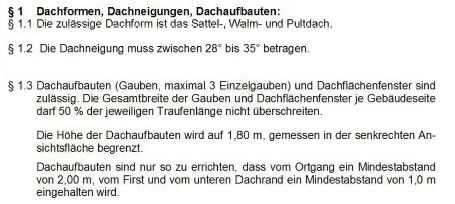
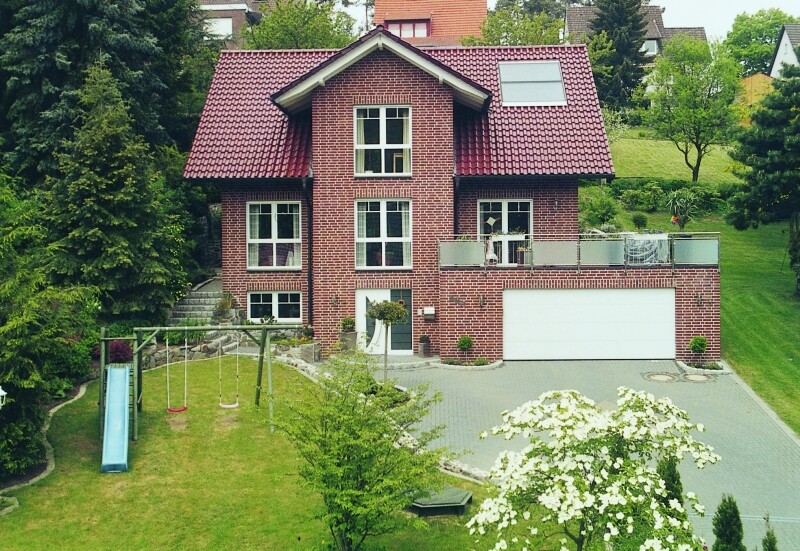
The development plan requires a minimum distance of 1 meter (3.3 feet) from the lower roof edge and the ridge for roof extensions. Additionally, the eaves height must not exceed 3.50 meters (11.5 feet).
Is the attached construction method considered a gable or a roof extension, and would the building authority approve such a design?
Does the upper eave of the dormer/gable also count towards the 3.50-meter (11.5 feet) height limit? Should the minimum distance be measured from the ridge height of the dormer/gable or from their eave? And how is the distance measured—vertically in a cross-section or along the roof surface?
H
hampshire1 May 2019 12:29I understand this to mean that the 1 m (3 ft) minimum distance between the dormer and the gable of the house is measured so that the dormer’s gable must be at least 1 m (3 ft) below the main gable. Therefore, the house shown in the illustration would not comply with the building regulations.
Whether it can still be approved is something you can check with the building authority before submitting the building application. Sometimes you get a response that way. In our case, the building code specifies a maximum house width, which we exceeded by 1.5 m (5 ft). This was allowed through a special permit, as was moving the building boundary (building line / setback line) one meter (3 ft) back and constructing a carport outside the building boundary.
Sometimes it helps to ask politely and present your concept.
Whether it can still be approved is something you can check with the building authority before submitting the building application. Sometimes you get a response that way. In our case, the building code specifies a maximum house width, which we exceeded by 1.5 m (5 ft). This was allowed through a special permit, as was moving the building boundary (building line / setback line) one meter (3 ft) back and constructing a carport outside the building boundary.
Sometimes it helps to ask politely and present your concept.
Guido1980 schrieb:
Is the attached construction a gable or a dormer A gable
Guido1980 schrieb:
Would the building authority approve such a construction? Ask them. Your development plan does not allow it as is.
Guido1980 schrieb:
Does the upper eave of the dormer/gable also count towards the 3.50 m (11.5 ft) regulation? Yes.
Guido1980 schrieb:
Or is the minimum distance measured from the ridge height of the dormer or gable, or from their eaves? The minimum distance does not apply since this is not a roof extension.
Guido1980 schrieb:
And how is the distance measured (as a vertical offset in section or along the roof surface)? Your roof structure is not allowed if any part of it is less than the minimum distance to any point on the verge, ridge, or lower edge of the roof. Since further explanations are missing, unlike the height of roof constructions, the true three-dimensional distance is meant.
G
Guido19802 May 2019 07:59Escroda schrieb:
Your roof construction is not permitted if any part of the roof structure is closer than the minimum required distance to any point of the verge, ridge, or lower roof edge. Since no further explanations are provided, unlike the height of roof structures, the actual distance in three-dimensional space is meant. So, it’s not the vertical offset but the distance measured along the slope, right?
G
Guido19802 May 2019 18:18ypg schrieb:
Did your architect actually plan it this way? The zoning plan was known to them, right?Yes, it comes from the architect… but they also said that "not all details have been taken into account yet and that this will be done during the building permit / planning permission process."
Similar topics