
ᐅ Floor plan for a house on a hillside (ground floor and basement living area) with a maximum of 150 m²
Created on: 2 Feb 2019 14:27
P
Pamiko
Hello,
we are currently working on the floor plan for our house. We already have the plot, which is on a sloping site.
We have decided to build a two-story house, with the upper floor (sleeping area) providing access to the street and the lower floor serving as the living area with garden access.
We want a manageable house size, but due to the requirements for the living floor, a minimum of about 140m² (1505 sq ft) is necessary. However, it definitely should not exceed 150m² (1615 sq ft).
We want a modern touch or something distinctive. For example, because of the great view, we considered a window seat. Ultimately, we decided on a small open space with a large window facing the backyard.
We really like the lower floor; the ground floor is not yet one hundred percent right.
Since I have been a long-time forum reader, I want to mention upfront that optimizing every last bit of available space is not a must for me. I am aware that, for example, a lot of space is used for corridors. Given the house’s orientation (there are no alternatives here), I think this is necessary to avoid a cramped feeling.
I would appreciate any feedback or suggestions.
And here is the questionnaire:
Development plan/restrictions
Plot size: 700m² (7,535 sq ft), width 20m (66 ft)
Slope: yes, sloping
Floor area ratio: 0.4
Building envelope, building line, and boundary: standard 3m (10 ft) setback
Number of parking spaces: 2
Number of floors: 2
Roof type: hip roof or gable roof
Style: modern
Orientation: northeast
Client requirements
Style, roof form, building type: city villa style with the special feature that, due to the slope, the entrance is on the upper of the two floors. The lower floor is fully embedded at the street side and opens to the back.
Basement, floors: ground floor and living basement
Number of occupants, ages: 4 (35, 35, 3, 1)
Room requirements on ground floor, upper floor: living floor must have at least one (small) room. Living, dining, kitchen combined approx. 45m² (480 sq ft), guest toilet with shower
Guests per year: none
Open or closed layout: open
Traditional or modern construction: modern
Open kitchen, kitchen island: open without island
Number of dining seats: 6-8
Fireplace: no
Music/stereo wall: no
Balcony, roof terrace: no
Garage, carport: double-level single garage (with basement storage space below)
Additional wishes/features/daily routine, including reasons why something should or should not be included: living floor must be on the lower level for direct garden access
House design
Who created the plan:
- Planner from a construction company
- Offer for the house (including painter, flooring, and preliminary material selection): approx. 320,000 EUR
What do you particularly like? Why?: like the lower floor; open space, room sizes fit well
What do you dislike? Why?: children’s room next to the garage
Preferred heating technology: air-to-water heat pump
If you have to give up anything, which details/extensions:
- can give up: –
- cannot give up: room sizes of lower floor; open space
Why is the design as it is now?: proposal from the general contractor (a similar house was recently built) with small changes. Also limited by the set budget.
Which wishes from the architect were implemented? The open space was added
What is the most important/fundamental question about the floor plan in 130 characters?
How can the ground floor be changed so that the children’s room is not next to the garage? I can’t find a suitable solution with the current plan. The staircase cannot be moved due to the basement (the guest toilet and utility room would otherwise become too small).
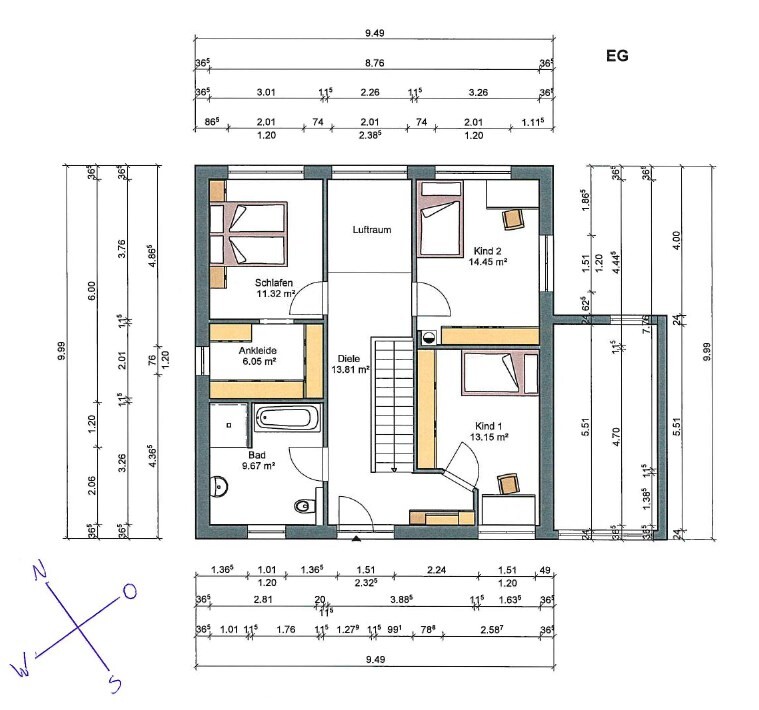
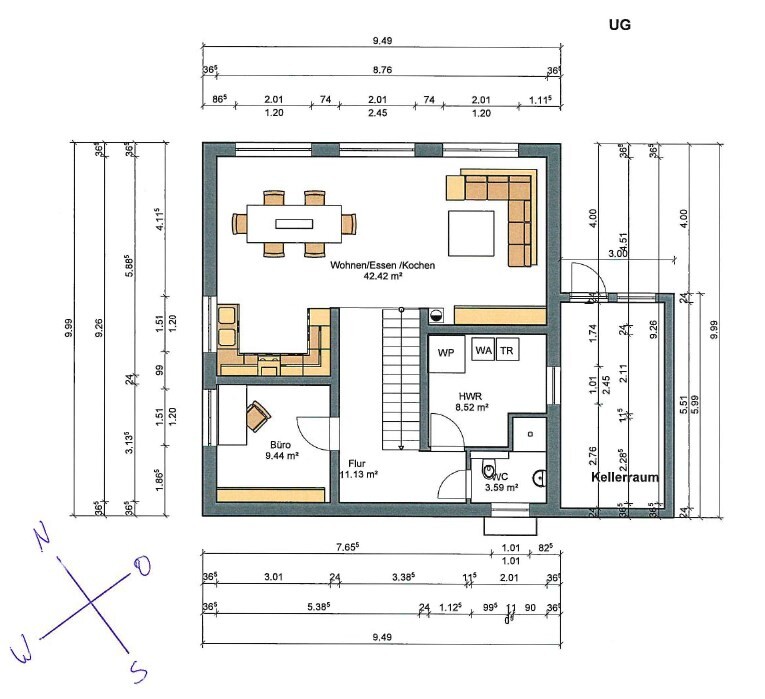
we are currently working on the floor plan for our house. We already have the plot, which is on a sloping site.
We have decided to build a two-story house, with the upper floor (sleeping area) providing access to the street and the lower floor serving as the living area with garden access.
We want a manageable house size, but due to the requirements for the living floor, a minimum of about 140m² (1505 sq ft) is necessary. However, it definitely should not exceed 150m² (1615 sq ft).
We want a modern touch or something distinctive. For example, because of the great view, we considered a window seat. Ultimately, we decided on a small open space with a large window facing the backyard.
We really like the lower floor; the ground floor is not yet one hundred percent right.
Since I have been a long-time forum reader, I want to mention upfront that optimizing every last bit of available space is not a must for me. I am aware that, for example, a lot of space is used for corridors. Given the house’s orientation (there are no alternatives here), I think this is necessary to avoid a cramped feeling.
I would appreciate any feedback or suggestions.
And here is the questionnaire:
Development plan/restrictions
Plot size: 700m² (7,535 sq ft), width 20m (66 ft)
Slope: yes, sloping
Floor area ratio: 0.4
Building envelope, building line, and boundary: standard 3m (10 ft) setback
Number of parking spaces: 2
Number of floors: 2
Roof type: hip roof or gable roof
Style: modern
Orientation: northeast
Client requirements
Style, roof form, building type: city villa style with the special feature that, due to the slope, the entrance is on the upper of the two floors. The lower floor is fully embedded at the street side and opens to the back.
Basement, floors: ground floor and living basement
Number of occupants, ages: 4 (35, 35, 3, 1)
Room requirements on ground floor, upper floor: living floor must have at least one (small) room. Living, dining, kitchen combined approx. 45m² (480 sq ft), guest toilet with shower
Guests per year: none
Open or closed layout: open
Traditional or modern construction: modern
Open kitchen, kitchen island: open without island
Number of dining seats: 6-8
Fireplace: no
Music/stereo wall: no
Balcony, roof terrace: no
Garage, carport: double-level single garage (with basement storage space below)
Additional wishes/features/daily routine, including reasons why something should or should not be included: living floor must be on the lower level for direct garden access
House design
Who created the plan:
- Planner from a construction company
- Offer for the house (including painter, flooring, and preliminary material selection): approx. 320,000 EUR
What do you particularly like? Why?: like the lower floor; open space, room sizes fit well
What do you dislike? Why?: children’s room next to the garage
Preferred heating technology: air-to-water heat pump
If you have to give up anything, which details/extensions:
- can give up: –
- cannot give up: room sizes of lower floor; open space
Why is the design as it is now?: proposal from the general contractor (a similar house was recently built) with small changes. Also limited by the set budget.
Which wishes from the architect were implemented? The open space was added
What is the most important/fundamental question about the floor plan in 130 characters?
How can the ground floor be changed so that the children’s room is not next to the garage? I can’t find a suitable solution with the current plan. The staircase cannot be moved due to the basement (the guest toilet and utility room would otherwise become too small).
Still, it’s a winding path past the table, an uncomfortable sofa spot in the middle of the room, and the kitchen is completely unergonomic, especially with the open space above.

How about placing the sofa/TV area in the kitchen zone, and the cooking/dining area towards the terrace?
Unfortunately, a site plan is still missing, and I found Katja’s design from post 31 more successful.
It is also a fact that when a floor is partially built into a slope, a square house shape is not necessarily ideal. The slightly more rectangular shape from Katja’s (@kaho674) design is better suited in this case.
How about placing the sofa/TV area in the kitchen zone, and the cooking/dining area towards the terrace?
Unfortunately, a site plan is still missing, and I found Katja’s design from post 31 more successful.
It is also a fact that when a floor is partially built into a slope, a square house shape is not necessarily ideal. The slightly more rectangular shape from Katja’s (@kaho674) design is better suited in this case.
Thank you for your input.
I have also considered swapping the living area with the kitchen, but in the end, I always find myself at a dead end and like it less than before.
What I like about the design, in addition to the points already mentioned, is that it’s not so "off-the-shelf." Almost all hillside houses with a living area on the basement level and bedrooms on the upper floor that I have seen more or less followed the original layout.
Who doesn’t like the feeling of having something special?
I have also considered swapping the living area with the kitchen, but in the end, I always find myself at a dead end and like it less than before.
What I like about the design, in addition to the points already mentioned, is that it’s not so "off-the-shelf." Almost all hillside houses with a living area on the basement level and bedrooms on the upper floor that I have seen more or less followed the original layout.
Who doesn’t like the feeling of having something special?
Pamiko schrieb:
Who doesn’t like the feeling of having something special? However, something special also needs to work well to be truly good.Katja placed a lot of emphasis on functionality, which I can fully understand. However, for me, a “mix” is more important.
The only thing that doesn’t work there is the upstairs hallway. Although daylight spots are planned, it will be a tent roof or gable roof. Therefore, this is not possible. As a result, the hallway will be too dark.
The only thing that doesn’t work there is the upstairs hallway. Although daylight spots are planned, it will be a tent roof or gable roof. Therefore, this is not possible. As a result, the hallway will be too dark.
Similar topics