
Hello everyone,
we plan to start building our house within the next 2-3 years.
The location is about 20km (12 miles) west of Innsbruck in Tyrol. The plot is on a gentle slope. The house is planned for 2 adults and 2 children.
I apologize in advance. This is the very first step towards building our house. Of course, we have already researched and have some ideas, but we are not professionals. Our thoughts are still in the early stages and certainly have room for improvement, which is exactly why I’m here: I want to receive both positive and negative feedback as early as possible to design the best possible home for us.
A brief explanation of the attached image: Based on the initial information about the room layout and legal requirements, the sketch below is a first draft of the initial ideas. It was drawn with the limited tools I have available. The street side is north and the garden faces south. Due to the slope, the garage is accessed by car through the basement level, which is at the same height as the street.
The house will mainly be constructed using prefabricated steel segments. The east, south, and west walls of the basement will serve as retaining walls appropriate for the slope. The steel frame should already be in place on the north side. The entire house should be well insulated, although we are still unsure about the exact level or “class” of insulation.
A decentralized ventilation system should be installed in the basement, living/dining area, restroom, bathrooms, and bedrooms. The reason for a decentralized system is the desire to control the temperature in each room individually, as well as to accommodate different daily routines, etc.
The bathrooms will be heated with electric underfloor heating directly beneath the tiles, so the screed does not need to be heated. All other rooms will be heated with infrared heaters.
Regarding flooring: All rooms will have “warm” floor coverings, such as hardwood floors, linoleum, or cork. Naturally, the bathrooms will be tiled, which is why underfloor heating will be installed there.
Shading is planned for the living/dining area and bedrooms.
The entire building will have home automation (heating, shading, lighting, security system, etc.). Before anyone objects: I will try to do as much of this myself as possible. I have experience from my training with home automation and am a certified KNX installer. However, I plan to use Z-Wave as the standard in the house. The idea is to only heat rooms that are in occasional use minimally, for example, the multi-purpose/hobby room. Bathrooms will only be heated in the morning or evening, and only when someone is at home, etc., thereby saving energy.
Because a planned electric car and the heating system will result in significant electricity consumption, a 15kWp photovoltaic system is planned. The energy consumption will also benefit from a lighting concept using 100% LEDs. The current electricity price is about 14 cents/kWh, which is relatively low. For higher energy demands, there are alternative providers offering a higher fixed fee but a lower price per kWh. The plan is to switch providers if needed.
Please be patient with me. I’m not inventing these ideas myself; I have picked them up somewhere and they seemed logical and useful to me. In our region, these topics are quite unusual, so there is little local experience. That’s why I’m turning to the forum.
I hope you will help me develop our ideas.
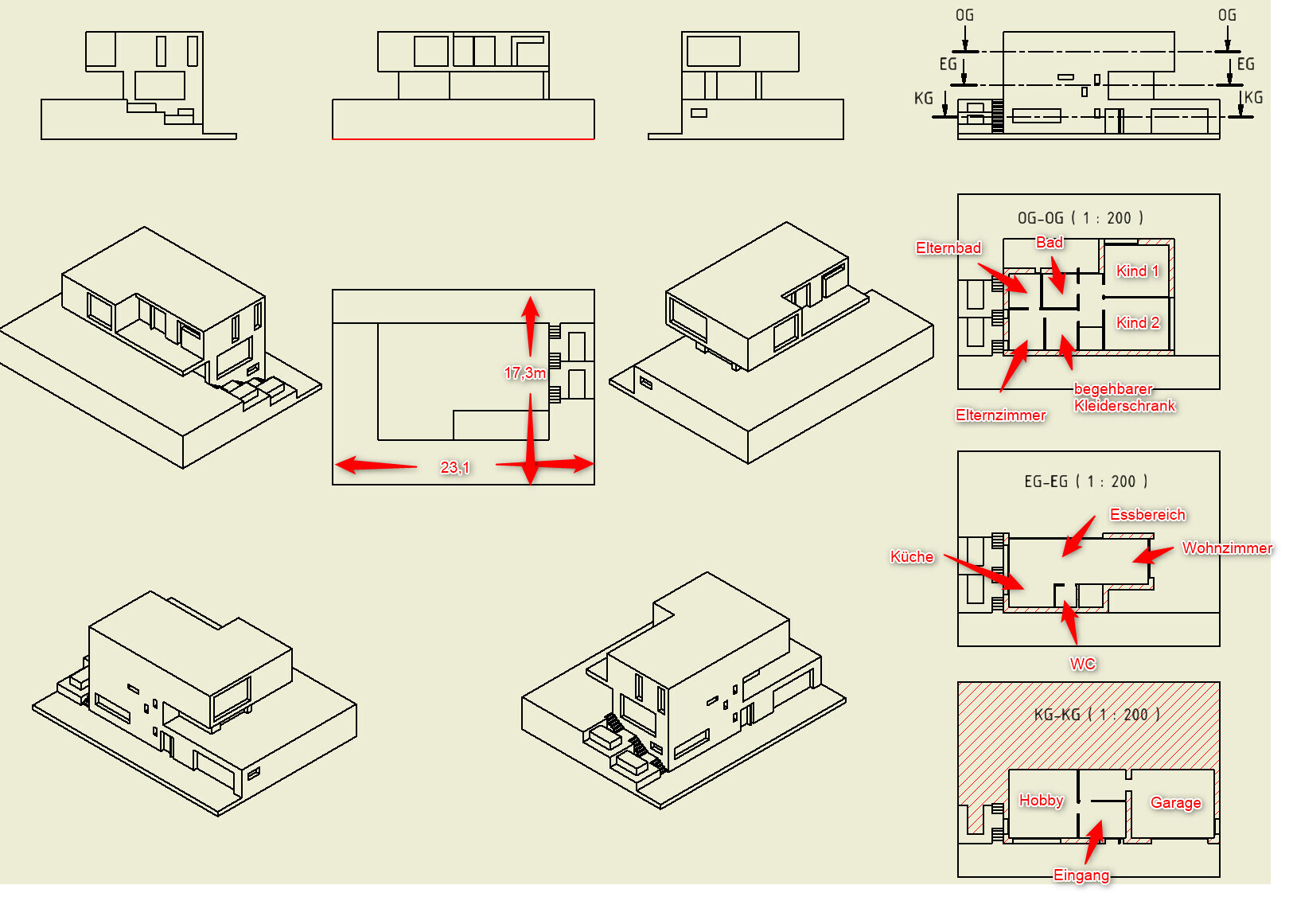
we plan to start building our house within the next 2-3 years.
The location is about 20km (12 miles) west of Innsbruck in Tyrol. The plot is on a gentle slope. The house is planned for 2 adults and 2 children.
I apologize in advance. This is the very first step towards building our house. Of course, we have already researched and have some ideas, but we are not professionals. Our thoughts are still in the early stages and certainly have room for improvement, which is exactly why I’m here: I want to receive both positive and negative feedback as early as possible to design the best possible home for us.
A brief explanation of the attached image: Based on the initial information about the room layout and legal requirements, the sketch below is a first draft of the initial ideas. It was drawn with the limited tools I have available. The street side is north and the garden faces south. Due to the slope, the garage is accessed by car through the basement level, which is at the same height as the street.
The house will mainly be constructed using prefabricated steel segments. The east, south, and west walls of the basement will serve as retaining walls appropriate for the slope. The steel frame should already be in place on the north side. The entire house should be well insulated, although we are still unsure about the exact level or “class” of insulation.
A decentralized ventilation system should be installed in the basement, living/dining area, restroom, bathrooms, and bedrooms. The reason for a decentralized system is the desire to control the temperature in each room individually, as well as to accommodate different daily routines, etc.
The bathrooms will be heated with electric underfloor heating directly beneath the tiles, so the screed does not need to be heated. All other rooms will be heated with infrared heaters.
Regarding flooring: All rooms will have “warm” floor coverings, such as hardwood floors, linoleum, or cork. Naturally, the bathrooms will be tiled, which is why underfloor heating will be installed there.
Shading is planned for the living/dining area and bedrooms.
The entire building will have home automation (heating, shading, lighting, security system, etc.). Before anyone objects: I will try to do as much of this myself as possible. I have experience from my training with home automation and am a certified KNX installer. However, I plan to use Z-Wave as the standard in the house. The idea is to only heat rooms that are in occasional use minimally, for example, the multi-purpose/hobby room. Bathrooms will only be heated in the morning or evening, and only when someone is at home, etc., thereby saving energy.
Because a planned electric car and the heating system will result in significant electricity consumption, a 15kWp photovoltaic system is planned. The energy consumption will also benefit from a lighting concept using 100% LEDs. The current electricity price is about 14 cents/kWh, which is relatively low. For higher energy demands, there are alternative providers offering a higher fixed fee but a lower price per kWh. The plan is to switch providers if needed.
Please be patient with me. I’m not inventing these ideas myself; I have picked them up somewhere and they seemed logical and useful to me. In our region, these topics are quite unusual, so there is little local experience. That’s why I’m turning to the forum.
I hope you will help me develop our ideas.
M
MuHaha20218 Apr 2019 09:56Thanks for the feedback.
About these pipe dreams:
It was really a concept that I knew wouldn’t be feasible for me as it was. And likely, filing cabinet P will get quite full.
What surprises me is the price estimate. As I said, I was aware that it wouldn’t be achievable at that price. But the estimate of 1.5 million was unexpected for me. I will have to double-check my sources and acquaintances to see if they might have misjudged or been overly optimistic with their assessment.
Thanks for pointing out the major error!
Regarding heating, here are my considerations so far:
First, the heating demand:
From what I could find, the heating demand for a passive house is about 15 kWh/m² per year. To be conservative, let’s simply double that to 30 kWh/m² per year.
One question: Is this a realistic figure in practice?
Calculating with 160 m² (1700 sq ft) of heated living space, that results in 4800 kWh of heating energy per year.
Costs for purchase and installation of infrared heating: €8,000 (approx. $8,900)
Costs for purchase and installation of air-to-water heat pump: €12,500 (approx. $13,900)
Operating costs for air-to-water heat pump per year: €150-200 (approx. $170-220), based on experience with a comparable single-family home in the family.
Regarding operating costs of the infrared heating panels:
The key word here is "electricity costs."
Concerning electricity - Tiwag:
Cost per kWh: 7.376 cents/kWh
However, additional charges from Tinetz bring the final price per kWh to about 14 cents/kWh.
That results in ongoing infrared heating costs of about €670 (approx. $745).
This suggests a cost crossover point of about 8 to 9 years, if my calculations are correct.
Now, adding a photovoltaic system combined with good insulation (minimizing heat loss), a decentralized ventilation system (low energy loss during ventilation), and home automation that raises the room temperature according to certain rules when there is excess photovoltaic power—allowing a degree of "overheating" above the normal room temperature—I hope to push that crossover point further.
Good insulation will be done regardless of the heating system. Home automation is also desired, and achieving room temperature adjustments is feasible without Z-Wave or KNX, and with relatively little effort.
Yes, the green represents the staircase (sorry, I forgot to mention that).
The floor plan measures 2 m by 2.135 m (6.6 ft by 7 ft).
I found little useful staircase design guidelines online. What I did find mentioned these dimensions.
Too small?
There is room for a wardrobe in the basement entrance area of the stairwell. The width between the stairwell and the wall is 1.8 m (5.9 ft). A wardrobe usually requires 40 cm to 60 cm (16 to 24 inches) depth, depending on how coats and shoes are stored. This leaves a passage of 1.2 to 1.4 m (47 to 55 inches).
That should be sufficient, right?
A further note: Some shoes and coats will also be stored in the utility room, as the entrance from the garage leads through that space.
Both, actually.
Meaning, space for hobbies is needed, but about 15 m² (160 sq ft) would probably be enough. However, since there is no attic or other storage areas planned, the room should be slightly larger to allow for some storage.
Christmas decorations have to go somewhere if there’s no Christmas tree in the house.
Great statement.
Hits the nail on the head.
I looked it up on Google.
It looks interesting, though I haven’t studied it much—but I can definitely see some similarities.
Did I understand you correctly that you mean the “integration” with the neighbor?
There are already discussions with neighbors. For example, the garage should be adjacent to the neighbor’s garage.
Earthworks and adjustments to the exterior will likely also be coordinated together.
kaho674 schrieb:
Nice that you joined here. I think there are still many unrealistic pipe dreams that will end up in filing cabinet P before the first shovel hits the ground.
About these pipe dreams:
It was really a concept that I knew wouldn’t be feasible for me as it was. And likely, filing cabinet P will get quite full.
What surprises me is the price estimate. As I said, I was aware that it wouldn’t be achievable at that price. But the estimate of 1.5 million was unexpected for me. I will have to double-check my sources and acquaintances to see if they might have misjudged or been overly optimistic with their assessment.
Thanks for pointing out the major error!
Regarding heating, here are my considerations so far:
First, the heating demand:
From what I could find, the heating demand for a passive house is about 15 kWh/m² per year. To be conservative, let’s simply double that to 30 kWh/m² per year.
One question: Is this a realistic figure in practice?
Calculating with 160 m² (1700 sq ft) of heated living space, that results in 4800 kWh of heating energy per year.
Costs for purchase and installation of infrared heating: €8,000 (approx. $8,900)
Costs for purchase and installation of air-to-water heat pump: €12,500 (approx. $13,900)
Operating costs for air-to-water heat pump per year: €150-200 (approx. $170-220), based on experience with a comparable single-family home in the family.
Regarding operating costs of the infrared heating panels:
The key word here is "electricity costs."
Concerning electricity - Tiwag:
Cost per kWh: 7.376 cents/kWh
However, additional charges from Tinetz bring the final price per kWh to about 14 cents/kWh.
That results in ongoing infrared heating costs of about €670 (approx. $745).
This suggests a cost crossover point of about 8 to 9 years, if my calculations are correct.
Now, adding a photovoltaic system combined with good insulation (minimizing heat loss), a decentralized ventilation system (low energy loss during ventilation), and home automation that raises the room temperature according to certain rules when there is excess photovoltaic power—allowing a degree of "overheating" above the normal room temperature—I hope to push that crossover point further.
Good insulation will be done regardless of the heating system. Home automation is also desired, and achieving room temperature adjustments is feasible without Z-Wave or KNX, and with relatively little effort.
haydee schrieb:
Is the green area supposed to be the staircase? It seems too small to me.
Yes, the green represents the staircase (sorry, I forgot to mention that).
The floor plan measures 2 m by 2.135 m (6.6 ft by 7 ft).
I found little useful staircase design guidelines online. What I did find mentioned these dimensions.
Too small?
haydee schrieb:
Where will coats, shoes, and bags go? No space for a wardrobe.
There is room for a wardrobe in the basement entrance area of the stairwell. The width between the stairwell and the wall is 1.8 m (5.9 ft). A wardrobe usually requires 40 cm to 60 cm (16 to 24 inches) depth, depending on how coats and shoes are stored. This leaves a passage of 1.2 to 1.4 m (47 to 55 inches).
That should be sufficient, right?
A further note: Some shoes and coats will also be stored in the utility room, as the entrance from the garage leads through that space.
haydee schrieb:
What about the hobby room? Placeholder or really necessary?
Both, actually.
Meaning, space for hobbies is needed, but about 15 m² (160 sq ft) would probably be enough. However, since there is no attic or other storage areas planned, the room should be slightly larger to allow for some storage.
Christmas decorations have to go somewhere if there’s no Christmas tree in the house.
hampshire schrieb:
A house is a shelter for the lives of its occupants. Habits, desires, attitudes, tasks, social integration, aesthetic sense, body awareness, and health.
Great statement.
Hits the nail on the head.
11ant schrieb:
Avant-gardists of the international architecture scene around 1930
I looked it up on Google.
It looks interesting, though I haven’t studied it much—but I can definitely see some similarities.
11ant schrieb:
What about the neighboring context of this building?
Did I understand you correctly that you mean the “integration” with the neighbor?
There are already discussions with neighbors. For example, the garage should be adjacent to the neighbor’s garage.
Earthworks and adjustments to the exterior will likely also be coordinated together.
Cross photovoltaic power off your heating cost calculation. Photovoltaic systems only generate significant electricity in summer when you don’t need heating. Therefore, your calculated "breakeven point" of 8 years remains, after which infrared heating results in higher overall costs. Are the additional costs for the passive house also included in the calculations?
If the house exceeds your budget so much, what do you expect to gain from this entire discussion?
If the house exceeds your budget so much, what do you expect to gain from this entire discussion?

I keep wondering who can supply electricity for 7 cents per kWh. We pay over 20. Is this some kind of "Germans are crazy" thing? Or is Tiwag some sort of joint venture with special pricing?
Is this going to be a passive house now?
With your 30 kW, you are also at the lower end of the energy consumption scale:
Heating energy demand per square meter and consumption year:
A building from the year 2000 to today requires about 25 to 90 kilowatt-hours per square meter per year
What if it ends up being 70 or 80?
Is this going to be a passive house now?
With your 30 kW, you are also at the lower end of the energy consumption scale:
Heating energy demand per square meter and consumption year:
A building from the year 2000 to today requires about 25 to 90 kilowatt-hours per square meter per year
What if it ends up being 70 or 80?
Budget
I believe the costs in Austria will be similar:
2,000 Euro per square meter
+ higher energy standard
+ upgraded features (e.g., rain shower, many floor-to-ceiling windows, lift-and-slide doors, fireplace, etc.)
+ costs for a more complex floor plan (projections, recesses, etc.; for example, a bay window almost costs the same as extending the exterior wall and thus increasing the floor area by that depth)
+ earthworks are significantly higher on a slope
+ landscaping costs are much higher on sloping lots compared to flat sites
+ additional construction costs such as utility connections, construction electricity, etc.
The cloakroom is too small.
The staircase should be a few centimeters larger.
The heating concept is uneconomical and uncomfortable.
What speaks against an air-to-water heat pump with central controlled residential ventilation with heat recovery?
The more heating energy you need, the less power your photovoltaic system provides.
Who plans to overheat the rooms?
You cannot compare a passive house or similar with older houses from the pre-energy-saving era.
I live in a passive house; the infrared reflector is nice, but continuous heating is out of the question, especially since it can only switch on and off.
The difference between a comfortable temperature and too warm is 0.5 degrees with us. All three of us feel this the same way, and our guests start rolling up their sleeves at about that point.
Does your zoning plan even allow such a house?
I assume Austria also has regulations on building envelopes, building height, roof style, etc., or the house must, as YPG mentioned, visually fit in with the existing development.
In other words, your house does not fit into a neighborhood with one-and-a-half-story buildings with gable roofs.
I believe the costs in Austria will be similar:
2,000 Euro per square meter
+ higher energy standard
+ upgraded features (e.g., rain shower, many floor-to-ceiling windows, lift-and-slide doors, fireplace, etc.)
+ costs for a more complex floor plan (projections, recesses, etc.; for example, a bay window almost costs the same as extending the exterior wall and thus increasing the floor area by that depth)
+ earthworks are significantly higher on a slope
+ landscaping costs are much higher on sloping lots compared to flat sites
+ additional construction costs such as utility connections, construction electricity, etc.
The cloakroom is too small.
The staircase should be a few centimeters larger.
The heating concept is uneconomical and uncomfortable.
What speaks against an air-to-water heat pump with central controlled residential ventilation with heat recovery?
The more heating energy you need, the less power your photovoltaic system provides.
Who plans to overheat the rooms?
You cannot compare a passive house or similar with older houses from the pre-energy-saving era.
I live in a passive house; the infrared reflector is nice, but continuous heating is out of the question, especially since it can only switch on and off.
The difference between a comfortable temperature and too warm is 0.5 degrees with us. All three of us feel this the same way, and our guests start rolling up their sleeves at about that point.
Does your zoning plan even allow such a house?
I assume Austria also has regulations on building envelopes, building height, roof style, etc., or the house must, as YPG mentioned, visually fit in with the existing development.
In other words, your house does not fit into a neighborhood with one-and-a-half-story buildings with gable roofs.
Similar topics