
Hello everyone,
we plan to start building our house within the next 2-3 years.
The location is about 20km (12 miles) west of Innsbruck in Tyrol. The plot is on a gentle slope. The house is planned for 2 adults and 2 children.
I apologize in advance. This is the very first step towards building our house. Of course, we have already researched and have some ideas, but we are not professionals. Our thoughts are still in the early stages and certainly have room for improvement, which is exactly why I’m here: I want to receive both positive and negative feedback as early as possible to design the best possible home for us.
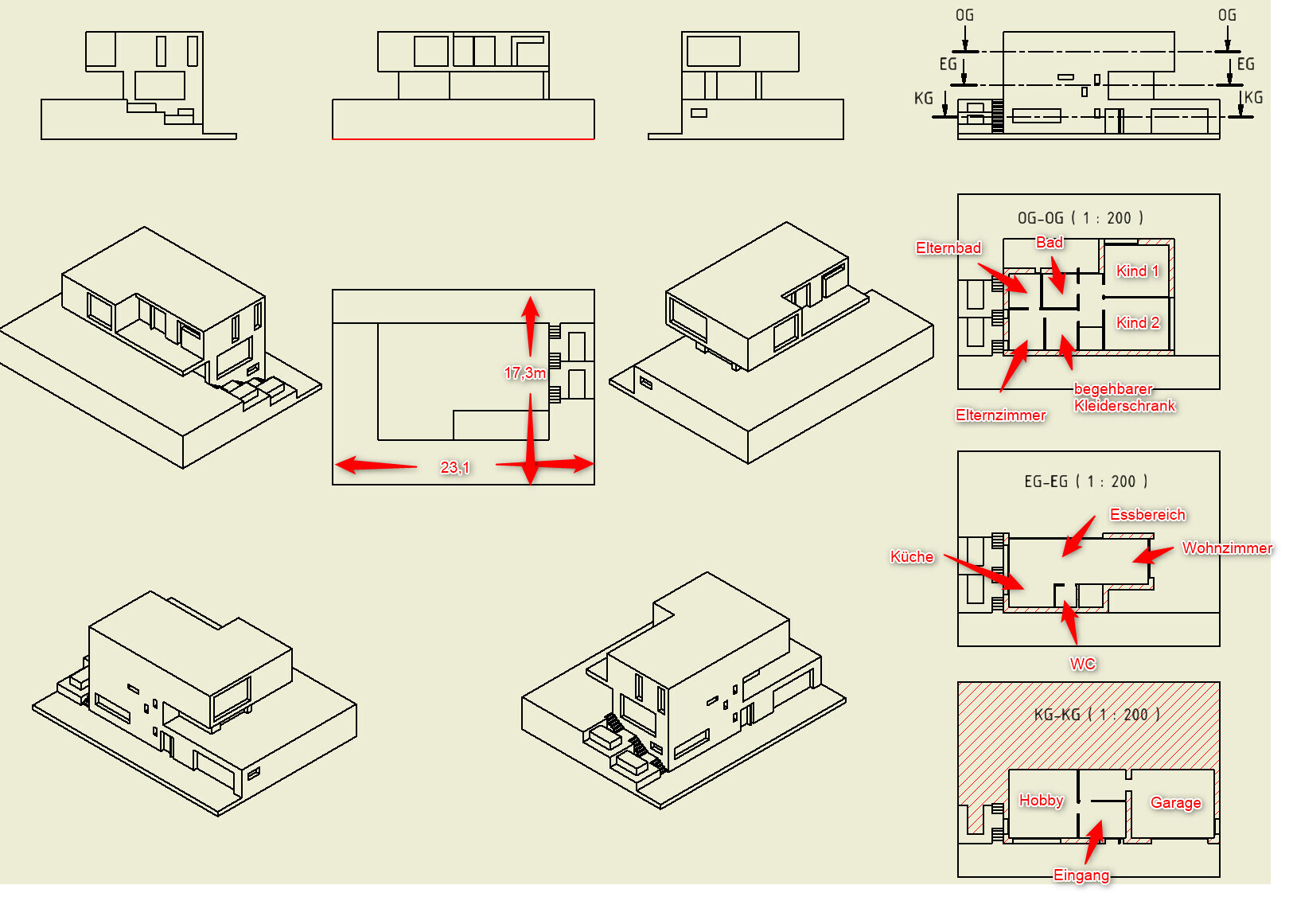
A brief explanation of the attached image: Based on the initial information about the room layout and legal requirements, the sketch below is a first draft of the initial ideas. It was drawn with the limited tools I have available. The street side is north and the garden faces south. Due to the slope, the garage is accessed by car through the basement level, which is at the same height as the street.
The house will mainly be constructed using prefabricated steel segments. The east, south, and west walls of the basement will serve as retaining walls appropriate for the slope. The steel frame should already be in place on the north side. The entire house should be well insulated, although we are still unsure about the exact level or “class” of insulation.
A decentralized ventilation system should be installed in the basement, living/dining area, restroom, bathrooms, and bedrooms. The reason for a decentralized system is the desire to control the temperature in each room individually, as well as to accommodate different daily routines, etc.
The bathrooms will be heated with electric underfloor heating directly beneath the tiles, so the screed does not need to be heated. All other rooms will be heated with infrared heaters.
Regarding flooring: All rooms will have “warm” floor coverings, such as hardwood floors, linoleum, or cork. Naturally, the bathrooms will be tiled, which is why underfloor heating will be installed there.
Shading is planned for the living/dining area and bedrooms.
The entire building will have home automation (heating, shading, lighting, security system, etc.). Before anyone objects: I will try to do as much of this myself as possible. I have experience from my training with home automation and am a certified KNX installer. However, I plan to use Z-Wave as the standard in the house. The idea is to only heat rooms that are in occasional use minimally, for example, the multi-purpose/hobby room. Bathrooms will only be heated in the morning or evening, and only when someone is at home, etc., thereby saving energy.
Because a planned electric car and the heating system will result in significant electricity consumption, a 15kWp photovoltaic system is planned. The energy consumption will also benefit from a lighting concept using 100% LEDs. The current electricity price is about 14 cents/kWh, which is relatively low. For higher energy demands, there are alternative providers offering a higher fixed fee but a lower price per kWh. The plan is to switch providers if needed.
Please be patient with me. I’m not inventing these ideas myself; I have picked them up somewhere and they seemed logical and useful to me. In our region, these topics are quite unusual, so there is little local experience. That’s why I’m turning to the forum.
I hope you will help me develop our ideas.
we plan to start building our house within the next 2-3 years.
The location is about 20km (12 miles) west of Innsbruck in Tyrol. The plot is on a gentle slope. The house is planned for 2 adults and 2 children.
I apologize in advance. This is the very first step towards building our house. Of course, we have already researched and have some ideas, but we are not professionals. Our thoughts are still in the early stages and certainly have room for improvement, which is exactly why I’m here: I want to receive both positive and negative feedback as early as possible to design the best possible home for us.
A brief explanation of the attached image: Based on the initial information about the room layout and legal requirements, the sketch below is a first draft of the initial ideas. It was drawn with the limited tools I have available. The street side is north and the garden faces south. Due to the slope, the garage is accessed by car through the basement level, which is at the same height as the street.
The house will mainly be constructed using prefabricated steel segments. The east, south, and west walls of the basement will serve as retaining walls appropriate for the slope. The steel frame should already be in place on the north side. The entire house should be well insulated, although we are still unsure about the exact level or “class” of insulation.
A decentralized ventilation system should be installed in the basement, living/dining area, restroom, bathrooms, and bedrooms. The reason for a decentralized system is the desire to control the temperature in each room individually, as well as to accommodate different daily routines, etc.
The bathrooms will be heated with electric underfloor heating directly beneath the tiles, so the screed does not need to be heated. All other rooms will be heated with infrared heaters.
Regarding flooring: All rooms will have “warm” floor coverings, such as hardwood floors, linoleum, or cork. Naturally, the bathrooms will be tiled, which is why underfloor heating will be installed there.
Shading is planned for the living/dining area and bedrooms.
The entire building will have home automation (heating, shading, lighting, security system, etc.). Before anyone objects: I will try to do as much of this myself as possible. I have experience from my training with home automation and am a certified KNX installer. However, I plan to use Z-Wave as the standard in the house. The idea is to only heat rooms that are in occasional use minimally, for example, the multi-purpose/hobby room. Bathrooms will only be heated in the morning or evening, and only when someone is at home, etc., thereby saving energy.
Because a planned electric car and the heating system will result in significant electricity consumption, a 15kWp photovoltaic system is planned. The energy consumption will also benefit from a lighting concept using 100% LEDs. The current electricity price is about 14 cents/kWh, which is relatively low. For higher energy demands, there are alternative providers offering a higher fixed fee but a lower price per kWh. The plan is to switch providers if needed.
Please be patient with me. I’m not inventing these ideas myself; I have picked them up somewhere and they seemed logical and useful to me. In our region, these topics are quite unusual, so there is little local experience. That’s why I’m turning to the forum.
I hope you will help me develop our ideas.
MuHaha202 schrieb:
Hello everyone
Thanks for all the feedback.
Attached are some sketches with dimensions. Without a basement, this should be about 170m² (1,830 sq ft).
The upper floor extends slightly forward. This is the maximum allowed by the legal setback requirements. The overhang will then be adjusted to the technically possible limits. From what I found online, one of the advantages of steel construction is that such designs are easier to implement. If necessary, a support column is also possible.Expensive and uncommon in single-family home constructionMuHaha202 schrieb:
The current budget is around 320,000€ with up to 380,000€ possible. The goal, however, is to spend less rather than more.I hope that budget is just for the house, excluding additional costs and the land. For what you are planning, it’s completely unrealistic. Construction prices in Austria, as far as I know, are still slightly higher than in Bavaria. With 320,000€, you’d typically get a standard house of that size, without a basement.MuHaha202 schrieb:
The desire is to have an affordable heating system for 20 years and to be able to heat rooms individually as needed.The basic idea is flawed. An underfloor heating system combined with a heat pump is the cost-effective solution.MuHaha202 schrieb:
We currently have infrared heating on the ceiling in the bedroom. The room temperature is about 2-3°C (4-5°F) lower than in the other rooms, but due to the infrared radiation, it feels somewhat warmer compared to the rest of the house.But you will still be paying a fortune for the electricity.
One can only agree with that, both regarding the heating concept and the budget.
Smart home systems can be affordable, but I would not switch to Z-Wave unless necessary, especially if I am knowledgeable and don’t need to rely on external experience, when I can use KNX.
Z-Wave is great for apartments and retrofitting, among other things.
Smart home systems can be affordable, but I would not switch to Z-Wave unless necessary, especially if I am knowledgeable and don’t need to rely on external experience, when I can use KNX.
Z-Wave is great for apartments and retrofitting, among other things.

Glad you signed up here. I think there are still many unrealistic pipe dreams that will end up shelved before the first ground breaking.
The gap between your budget and your design is so large that you might want to first get a rough estimate from a general contractor so you can believe us and we can continue discussing with you.
For a 300+k (dollar/pound/euro) budget, it will almost certainly be just two floors of the simplest construction. With a bit of luck, maybe a garage. Overhangs or other fancy features are unrealistic. And that doesn’t even take into account any terrain landscaping yet.
The heating concept has already been questioned several times. I also think infrared heating will be much more expensive than conventional underfloor heating or radiators. Underfloor heating can also be regulated, and constant heating and cooling of rooms saves exactly nothing compared to maintaining a steady temperature with good insulation.
The gap between your budget and your design is so large that you might want to first get a rough estimate from a general contractor so you can believe us and we can continue discussing with you.
For a 300+k (dollar/pound/euro) budget, it will almost certainly be just two floors of the simplest construction. With a bit of luck, maybe a garage. Overhangs or other fancy features are unrealistic. And that doesn’t even take into account any terrain landscaping yet.
The heating concept has already been questioned several times. I also think infrared heating will be much more expensive than conventional underfloor heating or radiators. Underfloor heating can also be regulated, and constant heating and cooling of rooms saves exactly nothing compared to maintaining a steady temperature with good insulation.
For the budget, you can get 150 sqm (1,615 sqft) on a flat plot plus a carport if the house is equipped cost-effectively. You will need to plan your house smaller and increase your budget.
Heating system
It doesn’t get more expensive than this. According to the energy consultant, we had to install a 900-watt mirror heater in the bathroom for 18 sqm (194 sqft) as an additional heat source. That corresponds to 8.5 kWh scaled to your house size. Let these run for 20 hours in winter and 10 hours during the transitional seasons.
Underfloor heating with gas or air-to-water heat pump.
Washing laundry in the bathroom is common in rental apartments. In your own house, it’s absolutely not recommended.
Regarding the floor plan
Is the green area supposed to be the staircase? It seems too small to me. Please check.
Where will coats, shoes, and bags be stored? There is no space allocated for a wardrobe.
What is the purpose of the hobby room?
Is it a placeholder or truly necessary?
Ground floor
Definitely try furnishing it. It will not work well as it is.
There’s no way around it.
Rethink the heating system.
KNX is not feasible with this budget.
The house needs to be smaller and simpler. No projections or recesses.
Remove the kids’ bathroom; the washing machine could be placed there instead.
Remove the photovoltaic system.
Remove the hobby room and garage. In your case, convert living rooms into bedrooms in the basement.
Heating system
It doesn’t get more expensive than this. According to the energy consultant, we had to install a 900-watt mirror heater in the bathroom for 18 sqm (194 sqft) as an additional heat source. That corresponds to 8.5 kWh scaled to your house size. Let these run for 20 hours in winter and 10 hours during the transitional seasons.
Underfloor heating with gas or air-to-water heat pump.
Washing laundry in the bathroom is common in rental apartments. In your own house, it’s absolutely not recommended.
Regarding the floor plan
Is the green area supposed to be the staircase? It seems too small to me. Please check.
Where will coats, shoes, and bags be stored? There is no space allocated for a wardrobe.
What is the purpose of the hobby room?
Is it a placeholder or truly necessary?
Ground floor
Definitely try furnishing it. It will not work well as it is.
There’s no way around it.
Rethink the heating system.
KNX is not feasible with this budget.
The house needs to be smaller and simpler. No projections or recesses.
Remove the kids’ bathroom; the washing machine could be placed there instead.
Remove the photovoltaic system.
Remove the hobby room and garage. In your case, convert living rooms into bedrooms in the basement.
H
hampshire17 Apr 2019 21:44Hello and welcome. You have a lot of ideas and like to think unconventionally. I like that. Your design looks exciting. I really like these "stacked bungalows." How you can realize this within your budget remains to be seen. Since I prefer to focus on solutions rather than problems, take a look at innovation labs or design studios at universities for new construction methods. Sometimes it’s possible to develop a reference project where the homeowners invest as designers. With conventional providers, your design will almost certainly be significantly more expensive.
The heating concept does not correspond to the commonly recommended standards. Electric infrared panels are affordable to purchase and provide a very pleasant warmth. However, they need to be well positioned, because sitting too close to them (e.g., directly underneath) is uncomfortable, and if placed opposite windows, energy is lost.
Potentially, energy costs with these electric heaters can be higher. Therefore, it is extremely worthwhile to invest in insulation and to use walls that have energy-storing properties on the interior, such as clay plaster. The downside is that this eats up the savings from the purchase costs more than it compensates for.
Please note that this advice comes from someone whose future heating system also deviates from normal standards and who cannot yet prove that the concept will actually work.
In Austria, there are excellent, innovative, and very reputable companies specializing in heating technology. Just take a look at the different concepts.
From my experience, most homeowners intensely ask themselves the question, "What kind of home do I want to live in?" The much more important question, however, is: "How do I want to live?" A house is a container for the lives of its occupants. Habits, desires, attitudes, tasks, social connections, aesthetic sense, body awareness, and health—these aspects should guide the architecture. Building styles are suitable to support these aspects. Don’t squeeze your life into a design idea. Design creatively for your life.
The heating concept does not correspond to the commonly recommended standards. Electric infrared panels are affordable to purchase and provide a very pleasant warmth. However, they need to be well positioned, because sitting too close to them (e.g., directly underneath) is uncomfortable, and if placed opposite windows, energy is lost.
Potentially, energy costs with these electric heaters can be higher. Therefore, it is extremely worthwhile to invest in insulation and to use walls that have energy-storing properties on the interior, such as clay plaster. The downside is that this eats up the savings from the purchase costs more than it compensates for.
Please note that this advice comes from someone whose future heating system also deviates from normal standards and who cannot yet prove that the concept will actually work.
In Austria, there are excellent, innovative, and very reputable companies specializing in heating technology. Just take a look at the different concepts.
From my experience, most homeowners intensely ask themselves the question, "What kind of home do I want to live in?" The much more important question, however, is: "How do I want to live?" A house is a container for the lives of its occupants. Habits, desires, attitudes, tasks, social connections, aesthetic sense, body awareness, and health—these aspects should guide the architecture. Building styles are suitable to support these aspects. Don’t squeeze your life into a design idea. Design creatively for your life.
Similar topics