
Hello everyone,
We urgently need some help.
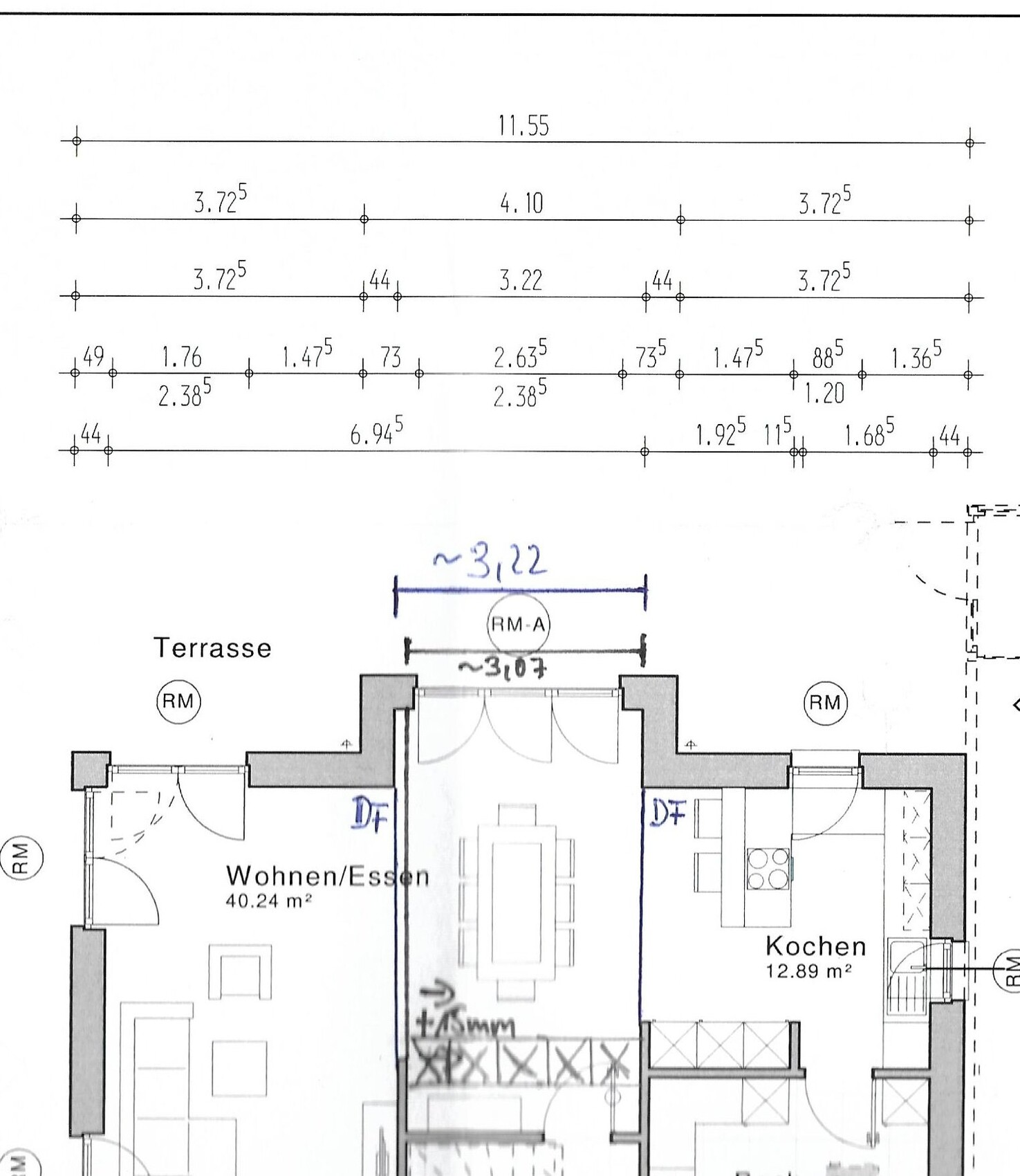
We have a question about the placement of the expansion joint.
Since we are not experts in construction, we wanted to ask here.
As the saying goes, a picture is worth a thousand words, so we have attached a sketch.
We hope this makes the situation clearer.
The expansion joints are marked with blue lines, showing how the screed installer would like to proceed.
However, with this setup, the distance between expansion joints would be about 3.22m (10 ft 7 in), and we would have to cut the sixth full 60x60cm (24x24 inch) tile.
Aesthetically, we think this looks completely wrong.
Therefore, we would like to move the expansion joint forward by 15mm (0.6 inch) (see the second black line).
This would reduce the distance to about 3.07m (10 ft 1 in), allowing us to fit five full tiles. That is our current idea.
Now for the main question: Are there any strict rules regarding the placement of expansion joints that would oppose this approach?
We are not talking about practical issues like the joint becoming longer, but about valid technical reasons why we should not do it this way.
Thank you very much for your help.
Best regards,
Nicole & Marcel
P.S. For cost reasons, we would like to avoid using uncoupling mats, and cutting an expansion joint into the screed later on is probably not possible due to the underfloor heating (pipe layout), right?
We urgently need some help.
We have a question about the placement of the expansion joint.
Since we are not experts in construction, we wanted to ask here.
As the saying goes, a picture is worth a thousand words, so we have attached a sketch.
We hope this makes the situation clearer.
The expansion joints are marked with blue lines, showing how the screed installer would like to proceed.
However, with this setup, the distance between expansion joints would be about 3.22m (10 ft 7 in), and we would have to cut the sixth full 60x60cm (24x24 inch) tile.
Aesthetically, we think this looks completely wrong.
Therefore, we would like to move the expansion joint forward by 15mm (0.6 inch) (see the second black line).
This would reduce the distance to about 3.07m (10 ft 1 in), allowing us to fit five full tiles. That is our current idea.
Now for the main question: Are there any strict rules regarding the placement of expansion joints that would oppose this approach?
We are not talking about practical issues like the joint becoming longer, but about valid technical reasons why we should not do it this way.
Thank you very much for your help.
Best regards,
Nicole & Marcel
P.S. For cost reasons, we would like to avoid using uncoupling mats, and cutting an expansion joint into the screed later on is probably not possible due to the underfloor heating (pipe layout), right?
H
hampshire6 Apr 2019 18:56marcel83 schrieb:
P.S. We would like to avoid using decoupling mats for cost reasonsThat’s a pity, as that is the professional and proper solution. Alternatively, with the floor plan you could consider arranging the tiles in three diagonal sections with a border. This way, the expansion joints are less noticeable – that was our solution in the terraced house from 2001.
However, there is surely a reason for your choice of uniform 60cm x 60cm (24in x 24in) tiles.
H
hemali20037 Apr 2019 00:37marcel83 schrieb:
Hello everyone,
We urgently need some help.
We have a question regarding the placement of the expansion joint.
Since we are not experts in construction, we wanted to ask here.
As the saying goes, a picture is worth a thousand words, so we have attached a sketch.
We hope it makes the situation clearer.
The blue lines show the expansion joints as the screed installer would like to place them.
However, with this layout, the distance between the joints would be about 3.22m (10.6 ft), and for 60x60 cm (24x24 inch) tiles, the sixth full tile would need to be cut.
We find that visually very unappealing.
Therefore, we would like to move the expansion joint 15mm (0.6 inch) forward (see the second black line).
That would give us a distance of about 3.07m (10.1 ft) and allow for five full tiles. That’s our idea, at least.
Now for the actual question: Are there strict rules for the positioning of expansion joints that would contradict this approach?
We are not talking about practical reasons like the joint becoming longer, but rather solid technical reasons why we should not proceed this way.
Many thanks for your help.
Best regards,
Nicole & Marcel
P.S. To save costs, we would prefer to avoid uncoupling mats, and cutting an expansion joint into the screed afterwards will probably not be possible due to the underfloor heating (pipe installation), right?! The option you marked will not work because this 15 cm (6 inch) piece will break off.
We discussed the joints with the screed contractor, and a variation of plus or minus 1 meter (yard) is usually not a problem (assuming the overall lengths are not already borderline). However, the joint must be placed so that no small leftover piece remains, as it is prone to breaking.
We extended the expansion joint into the tiles and I was really worried it would be noticeable (wood-look tiles), as I’m very particular. But thanks to a skilled tiler and good color matching, it doesn’t bother me at all now!
The screed hasn’t been done yet, right? So where’s the problem now? Just install it and that’s it. That’s what I would do.
If the screed has actually already been done, you could consider moving the expansion joint in the top floor covering at 15mm (0.6 inches). Not entirely without risk, but I think it’s doable.
If the screed has actually already been done, you could consider moving the expansion joint in the top floor covering at 15mm (0.6 inches). Not entirely without risk, but I think it’s doable.
H
hemali20037 Apr 2019 10:28Bookstar schrieb:
The screed hasn’t been done yet, right? So where’s the problem now? They can just install it and that’s it. That’s what I would do.
If the screed is already done, you could consider shifting the expansion joint in the top layer by 15mm (0.6 inches). Not without some risk, but I think it’s doable.I’m sure it’s about 15cm (6 inches)!
And simply moving the joint is definitely not possible, because on the surface it would create a narrow strip about 15cm (6 inches) wide. That will inevitably crack, since the individual panels are floating and that strip won’t have any support. Step on it once and it will break.
Similar topics