
ᐅ Floor plan for a 160 sqm urban villa – Requesting advice!
Created on: 28 Jan 2019 09:23
B
Bauherrin92
Hello everyone,
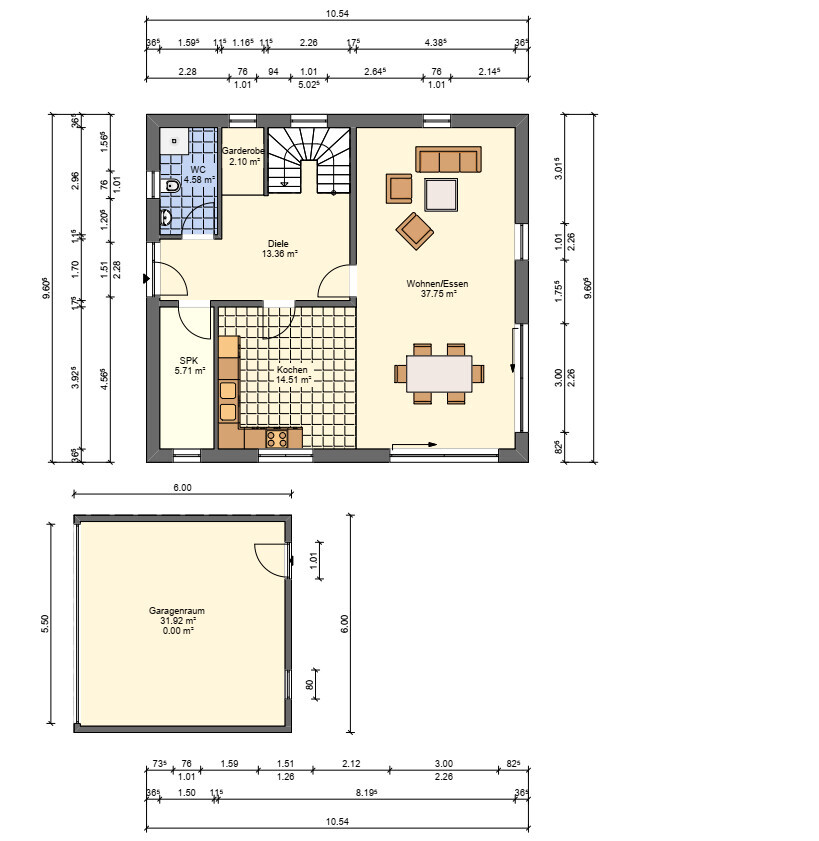
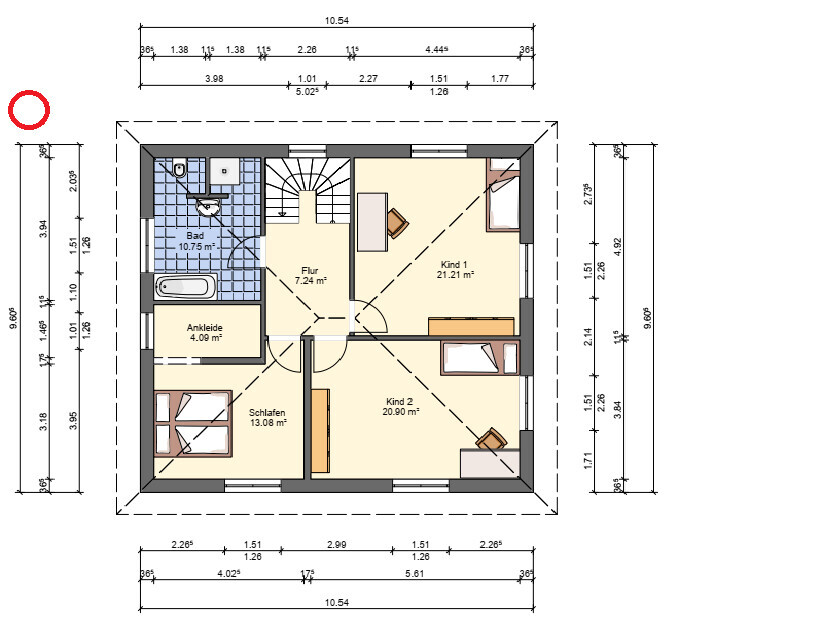
we are planning to build an urban villa with 160 sqm (1720 sq ft) plus a basement in rural Bavaria. Since we are now in the crucial phase of floor plan design, we would really appreciate your opinions and suggestions for improvements.
The following issues concern us the most:
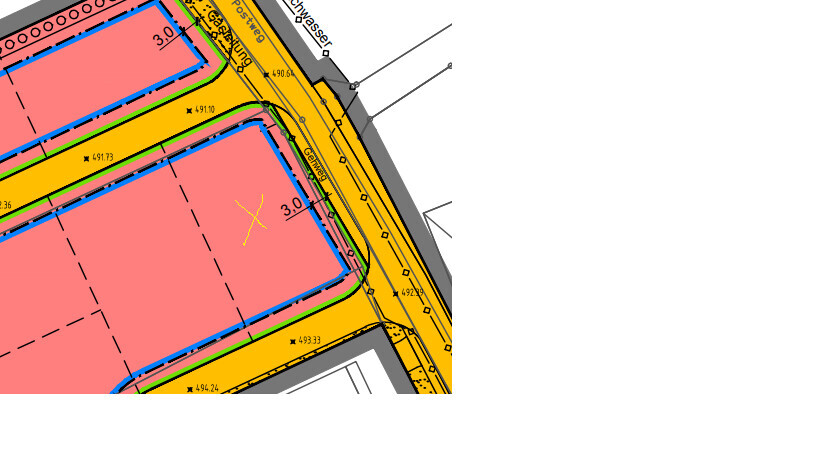
1. Arrangement of the house and garage on the plot: The garage has been deliberately placed on the west side to create distance from the neighbor. To catch the evening sun, the house has been set back. However, I wonder if this looks "good," as I have never seen such an arrangement before. We are also undecided whether the garage should be detached or attached to the house (possibly with access through the pantry?). On the plans, the garage is at the neighbor’s boundary. There is currently no house there.
2. The cloakroom and dressing room seem too small to comfortably place proper wardrobes and move around freely.
3. In general, I feel the overall design could still be improved, including the arrangement of windows.
Here is the questionnaire:
Development plan / restrictions
Plot size: 800 sqm (8,600 sq ft)
Slope: no
Floor area ratio: 0.35
Floor space index: 0.7
Building window, building line and boundary: 3 m (10 ft) to the street
Edge development: garage yes
Number of parking spaces: 2
Number of storeys: 2
Roof style: open construction
Homeowners’ requirements
Style, roof type, building type: urban villa, 2 full storeys, hipped roof
Basement, storeys: basement, ground floor, first floor
Number of people, age: two adults, schoolchild, expecting a baby
Space requirements ground floor, upper floor: three bedrooms, spacious living-dining area, separate cloakroom, shower toilet on the ground floor
Office: none
Guest bedrooms per year: none
Open or closed architecture: open
Conservative or modern construction: modern
Open kitchen, kitchen island: yes
Number of dining seats: 4–10 (when guests visit)
Fireplace: yes
Garage, carport: prefabricated double garage
Other wishes / special features / daily routine, also reasons why this or that should or should not be included:
- Cloakroom in a niche
- Shower toilet on the ground floor, later for the teenage daughter
- Large children’s rooms with floor-to-ceiling windows facing the garden
- Dressing room in the master bedroom
- Pantry for yellow bags (recycling waste bags), vacuum cleaner, cleaning supplies, pasta stock, etc.
House design
Who made the plan: planner from a construction company
What do you particularly like? Why?
- Basement: fine as is
- Ground floor: large pantry, L-shaped kitchen/living/dining area
- Upper floor: large children’s rooms
What don’t you like? Why?
- Ground floor: layout of toilet and cloakroom
- Upper floor: dressing room and bathroom possibly too small
- detached garage
Preferred heating technology: undecided so far
If you had to give up something, which details/upgrades would you skip?
- Could give up: access from garage into the house
- Could not do without: pantry, dressing room, cloakroom
Why has the design turned out as it is now? Our wishes were implemented by the planner
We look forward to your advice!!!
P.S.: The red circle is supposed to indicate north, sorry, it couldn’t be done otherwise!
we are planning to build an urban villa with 160 sqm (1720 sq ft) plus a basement in rural Bavaria. Since we are now in the crucial phase of floor plan design, we would really appreciate your opinions and suggestions for improvements.
The following issues concern us the most:
1. Arrangement of the house and garage on the plot: The garage has been deliberately placed on the west side to create distance from the neighbor. To catch the evening sun, the house has been set back. However, I wonder if this looks "good," as I have never seen such an arrangement before. We are also undecided whether the garage should be detached or attached to the house (possibly with access through the pantry?). On the plans, the garage is at the neighbor’s boundary. There is currently no house there.
2. The cloakroom and dressing room seem too small to comfortably place proper wardrobes and move around freely.
3. In general, I feel the overall design could still be improved, including the arrangement of windows.
Here is the questionnaire:
Development plan / restrictions
Plot size: 800 sqm (8,600 sq ft)
Slope: no
Floor area ratio: 0.35
Floor space index: 0.7
Building window, building line and boundary: 3 m (10 ft) to the street
Edge development: garage yes
Number of parking spaces: 2
Number of storeys: 2
Roof style: open construction
Homeowners’ requirements
Style, roof type, building type: urban villa, 2 full storeys, hipped roof
Basement, storeys: basement, ground floor, first floor
Number of people, age: two adults, schoolchild, expecting a baby
Space requirements ground floor, upper floor: three bedrooms, spacious living-dining area, separate cloakroom, shower toilet on the ground floor
Office: none
Guest bedrooms per year: none
Open or closed architecture: open
Conservative or modern construction: modern
Open kitchen, kitchen island: yes
Number of dining seats: 4–10 (when guests visit)
Fireplace: yes
Garage, carport: prefabricated double garage
Other wishes / special features / daily routine, also reasons why this or that should or should not be included:
- Cloakroom in a niche
- Shower toilet on the ground floor, later for the teenage daughter
- Large children’s rooms with floor-to-ceiling windows facing the garden
- Dressing room in the master bedroom
- Pantry for yellow bags (recycling waste bags), vacuum cleaner, cleaning supplies, pasta stock, etc.
House design
Who made the plan: planner from a construction company
What do you particularly like? Why?
- Basement: fine as is
- Ground floor: large pantry, L-shaped kitchen/living/dining area
- Upper floor: large children’s rooms
What don’t you like? Why?
- Ground floor: layout of toilet and cloakroom
- Upper floor: dressing room and bathroom possibly too small
- detached garage
Preferred heating technology: undecided so far
If you had to give up something, which details/upgrades would you skip?
- Could give up: access from garage into the house
- Could not do without: pantry, dressing room, cloakroom
Why has the design turned out as it is now? Our wishes were implemented by the planner
We look forward to your advice!!!
P.S.: The red circle is supposed to indicate north, sorry, it couldn’t be done otherwise!
B
Bauherrin925 Apr 2019 12:21kaho674 schrieb:
It would just be funny if the concrete ceiling ended up invalidating the 40 pages of floor plan puzzles because of the structural engineering. Let's hope not.

I'll respond "in cumulo" to the interim posts to avoid an overly confusing number of "@" and quotes:
The "statistics" provided by the original poster are flawed not so much because of the small total sample (2) or the small size of each test group (just 1 each), but because the fundamental conditions were not considered: if the concrete supporters have insulation on the ceiling and the wood supporters have none or only under the roof covering, then the observed phenomenon cannot be any different – but without the suspected causality (and therefore not suitable to indicate a decision in favor of a concrete ceiling!). Scientifically unsound assumptions lead to decisions that are no more meaningful than random guessing (all other oracles would then be comparatively more accurate).
Choosing between a concrete or wood ceiling for attic storage spaces has nothing to do with sound insulation. I can say little about the different preferences between red-brick and white-brick states. However, I am referring here specifically to pure attic storage spaces, which typically do not have knee walls. In "urban villas," the roof shape is mostly a matter of style.
So, it’s not primarily about the roof itself. Rather, the point is that interior walls built with drywall cost less in labor. To apply this consistently—to all interior walls of the level—this is only possible on the uppermost (or in the case of a bungalow, the only) floor, and provided that, thanks to a truss roof, the roof structure does not rest anywhere on the floor slab. In a truss roof, the roof structure and the attic floor act as a single "triangle" unit. That means there is actually no ceiling of the upper floor here, but a floor of the attic. For insulation related to heat, this makes no difference, but for sound it does: impact sound insulation is heavier (and depending on the setup does not even partially replace thermal insulation, so it adds extra weight).
Having a wood ceiling "above" basically means deciding against the option of living space conversion: attic storage, a truss roof, and "drywall only" go hand in hand in a way. More "residential use" than having a treehouse-style detective office up there with your rubber band buddy is not possible. A 25° (degree) pitched roof visually serving as a "roof" does not allow it anyway.
The question "what if attic conversion" for the modern "urban villa" is therefore purely hypothetical. I’m giving the answer on sound insulation here in the thread where it was asked for simplicity’s sake: laypeople tend to put two different things under "sound" in the same pot—namely airborne sound (noise) and impact sound (vibration).
Max and Moritz may both be equally annoying, but behave differently: only the second-best vibration soundproofing is mass, in which the vibration "dies out"—more important is avoiding a rigid connection with other components because these vibrations do not care how many times they need to bend.
Even for airborne sound, mass contributes only secondarily to damping, as stiffness is actually decisive. A hollow profile with many webs can have better stiffness than a solid profile. Only when the solid profile is made of significantly denser material can it be considered "better" at damping. That’s why it always makes my toes curl when I read in stone debates that sand-lime brick is portrayed as the heavyweight Buddha that simply blocks sound with its mass like the long-time chancellor of Oggersheim.
The real sound blocker in sand-lime brick is the oval hollow cavity, which it only has as a small-format brick (NF, 2DF) with standard interior wall thickness*. "Solid" is better in gypsum board, just as a note regarding the topic "understanding physics is more helpful than devouring comparison tables like a teenager consumes soft porn" (if nobody feels addressed, all the better).
*Yes, you read that right: it insulates best where it is thinnest. Sounds strange, but it’s true.
https://www.instagram.com/11antgmxde/
https://www.linkedin.com/company/bauen-jetzt/
The "statistics" provided by the original poster are flawed not so much because of the small total sample (2) or the small size of each test group (just 1 each), but because the fundamental conditions were not considered: if the concrete supporters have insulation on the ceiling and the wood supporters have none or only under the roof covering, then the observed phenomenon cannot be any different – but without the suspected causality (and therefore not suitable to indicate a decision in favor of a concrete ceiling!). Scientifically unsound assumptions lead to decisions that are no more meaningful than random guessing (all other oracles would then be comparatively more accurate).
Choosing between a concrete or wood ceiling for attic storage spaces has nothing to do with sound insulation. I can say little about the different preferences between red-brick and white-brick states. However, I am referring here specifically to pure attic storage spaces, which typically do not have knee walls. In "urban villas," the roof shape is mostly a matter of style.
So, it’s not primarily about the roof itself. Rather, the point is that interior walls built with drywall cost less in labor. To apply this consistently—to all interior walls of the level—this is only possible on the uppermost (or in the case of a bungalow, the only) floor, and provided that, thanks to a truss roof, the roof structure does not rest anywhere on the floor slab. In a truss roof, the roof structure and the attic floor act as a single "triangle" unit. That means there is actually no ceiling of the upper floor here, but a floor of the attic. For insulation related to heat, this makes no difference, but for sound it does: impact sound insulation is heavier (and depending on the setup does not even partially replace thermal insulation, so it adds extra weight).
Having a wood ceiling "above" basically means deciding against the option of living space conversion: attic storage, a truss roof, and "drywall only" go hand in hand in a way. More "residential use" than having a treehouse-style detective office up there with your rubber band buddy is not possible. A 25° (degree) pitched roof visually serving as a "roof" does not allow it anyway.
The question "what if attic conversion" for the modern "urban villa" is therefore purely hypothetical. I’m giving the answer on sound insulation here in the thread where it was asked for simplicity’s sake: laypeople tend to put two different things under "sound" in the same pot—namely airborne sound (noise) and impact sound (vibration).
Max and Moritz may both be equally annoying, but behave differently: only the second-best vibration soundproofing is mass, in which the vibration "dies out"—more important is avoiding a rigid connection with other components because these vibrations do not care how many times they need to bend.
Even for airborne sound, mass contributes only secondarily to damping, as stiffness is actually decisive. A hollow profile with many webs can have better stiffness than a solid profile. Only when the solid profile is made of significantly denser material can it be considered "better" at damping. That’s why it always makes my toes curl when I read in stone debates that sand-lime brick is portrayed as the heavyweight Buddha that simply blocks sound with its mass like the long-time chancellor of Oggersheim.
The real sound blocker in sand-lime brick is the oval hollow cavity, which it only has as a small-format brick (NF, 2DF) with standard interior wall thickness*. "Solid" is better in gypsum board, just as a note regarding the topic "understanding physics is more helpful than devouring comparison tables like a teenager consumes soft porn" (if nobody feels addressed, all the better).
*Yes, you read that right: it insulates best where it is thinnest. Sounds strange, but it’s true.
https://www.instagram.com/11antgmxde/
https://www.linkedin.com/company/bauen-jetzt/
11ant schrieb:
I’ll respond here collectively to the recent posts to avoid cluttering with too many "@" tags and quotes:
The “statistics” from the original poster are hardly valid—not so much because of the small total sample size (2) or the small size of each test group (only 1), but because the basic conditions were not properly considered: if the concrete supporters have insulation on the ceiling and the wood supporters have none or insulation beneath the roof covering, the observed phenomenon can only appear as it did—but without the assumed causality (and is therefore not suitable to justify a decision in favor of a concrete ceiling!). Scientifically flawed assumptions lead to decisions no better than pure guesswork (any other oracle would be relatively more precise).
Choosing between a concrete or wooden ceiling for storage attic spaces has nothing to do with sound insulation. I cannot comment much on the different preferences between brick regions ("rotmauer") and white brick regions ("weißmauer"). Here, I am referring strictly to storage attics, which typically do not have knee walls. For modern urban villas, the roof shape is basically purely a fashion choice.
The roof itself is not the main issue here. It’s about the fact that interior walls made from drywall reduce labor costs. To apply this consistently—all interior walls on a floor—you can only do this on the top floor (or the only floor in the case of a bungalow), and only if, thanks to a truss roof, the roof structure does not rest on the floor slab of the story below. In a truss roof, the roof framework and attic floor form a “triangle” as one unit. This means there is actually no first-floor ceiling here, but rather a floor of the attic. For insulation regarding thermal protection, this makes no difference, but for sound insulation it does: impact sound insulation is heavier (and in some constructions does not even partially replace thermal insulation, so weight-wise it is additional).
So, choosing a wooden ceiling "on top" essentially means opting against the possibility of finishing the attic for living space: storage attics, truss roofs, and “drywall only” tend to go together. More “living use” than having a treehouse detective agency up there with your elastic band buddy is generally not possible. A 25° pitch roof with a flat appearance (“DN Optikdeckel”) doesn’t allow it anyway.
The “what if the attic were finished” question in the case of a modern urban villa is purely hypothetical. However, for simplicity, here is my answer to the sound insulation question in this thread: laypeople tend to lump two very different things under the term “sound”—airborne sound (noise) and impact sound (vibration).
Max and Moritz may both be equally annoying, but behave differently: impact sound insulation is best achieved with mass, in which vibrations “die out” — more important, however, is preventing rigid connections to other components because these vibrations don’t care how often they are deflected.
For airborne sound, mass only plays a secondary role in attenuation because stiffness is what actually matters. A hollow core profile with many webs is actually stiffer than a solid profile. Only when the solid profile is made of significantly denser material can it be “better.” That’s why it makes me cringe whenever I read in stone debates that sand-lime brick is the heavy Buddha who simply sits out the sound with its mass like the chancellor of Oggersheim once did.
The real sound barrier in sand-lime brick is the oval cavity it has—however, only as a thin-format masonry unit (NF, 2DF) in an interior wall thickness*. The gypsum board is better in terms of “solidness,” just to note on the topic of “understanding physics helps more than devouring comparison tables like a teenager binge-watching soft porn” (if nobody feels addressed—good for you).
* Yes, you read that right: it insulates best where it is thinnest. Sounds strange, but that’s how it is. Novels should be written
This week, my signature
is being overlooked again more than usual :-(
https://www.instagram.com/11antgmxde/
https://www.linkedin.com/company/bauen-jetzt/
11ant schrieb:
A full quote is not necessary
is being overlooked again more than usual :-(
https://www.instagram.com/11antgmxde/
https://www.linkedin.com/company/bauen-jetzt/

11ant schrieb:
The "statistics" provided by the original poster are poorly valid, not so much due to the small overall sample size (2), or the small size of each individual test group (just 1 each), but because the fundamental factors were not taken into account: Well, this wouldn’t be the first survey where the approach is unsuitable to establish causality. Ultimately, it comes down to the simple question of what insulates best against heat – in this case, about 20cm (8 inches) of concrete or some type of insulation material. Accordingly, I would probably start by studying insulation materials.Considering climate change and the repeatedly expressed concern about heat in other threads, I wonder if it might finally be appropriate to cover roofs in white instead of the usual anthracite gray.
kaho674 schrieb:
Considering climate change and the recurring concerns about heat mentioned in other threads, I wonder if it might be time to start using white roofing instead of the usual anthracite gray.Even though this is somewhat off-topic: I still find protection against cold more important than heat protection. That’s why our roof is deliberately anthracite, but you have to be clear: insulation is what really matters.
For us, the heat comes through the windows!
Similar topics