
ᐅ Single-family home with a basement apartment on a hillside, designed for flexible use
Created on: 26 Mar 2019 15:02
K
kinderpingui
Hello everyone,
I have been mostly a silent reader here for several years and have gained many ideas and suggestions. I have followed many projects here since we started planning our own house build and have benefited greatly, incorporating many considerations into our planning. After purchasing a plot about 2 years ago, our own house construction is now getting closer, with the goal to start next year.
So far, we have worked with 2 different general contractors (GCs), who provided similar concepts but different designs due to the placement of the stairs. We have made some independent changes to the design we preferred.
Due to professional priorities, the project did not have top priority since the beginning of this year. This will change from April, and we will consult several more GCs. Since we have an upcoming appointment with a GC soon, I would like to hear your critical and honest opinions about our concept and design beforehand.
Thank you in advance for your help.
Zoning Plan / Restrictions
Plot size: 600 m² (22 m wide x 27 m deep) (72 ft x 89 ft)
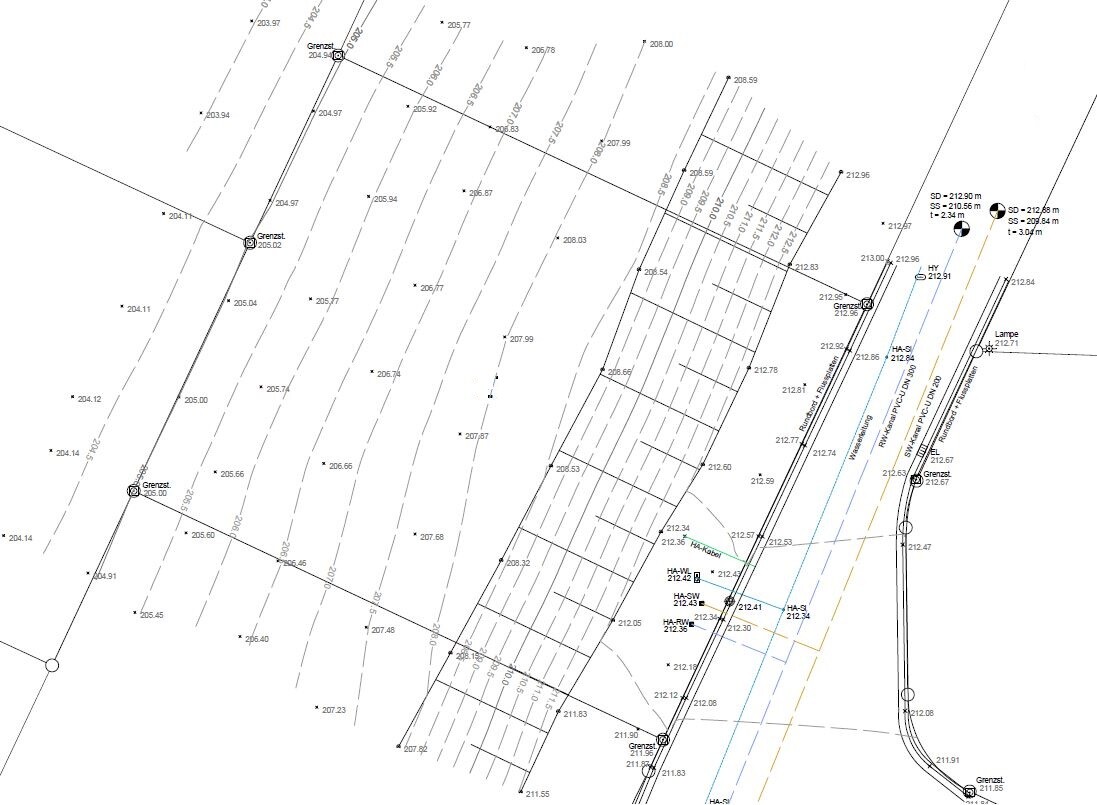
Slope: yes, steep slope (approx. 8 m on the north side and 7 m on the south side; see attached leveling plan)
Site coverage ratio: 0.4
Floor area ratio: 1
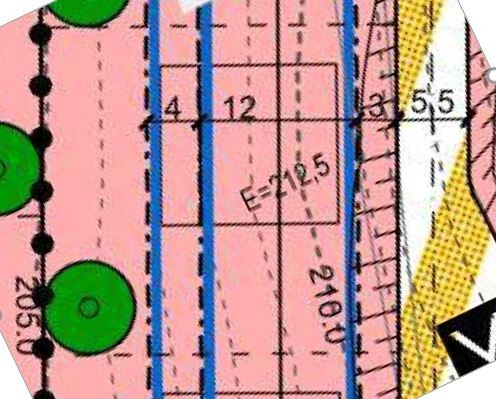
Building envelope, building line and boundary: see zoning plan excerpt
Edge development: no, 3 m setback; garage allowed; 5 m setback required from the street side
Number of parking spaces: 2 per housing unit, one of which must be covered
Number of floors: max. 2 full stories + half / stepped floor
Roof type: no restriction
Architectural style: no restriction, except no log houses
Orientation: west
Maximum heights / limits: eaves height max., parapet top max. 4 m (13 ft) on street side; eaves height max., parapet top max. 7 m (23 ft) above ground height on garden side
Other requirements:
Owners’ Requirements
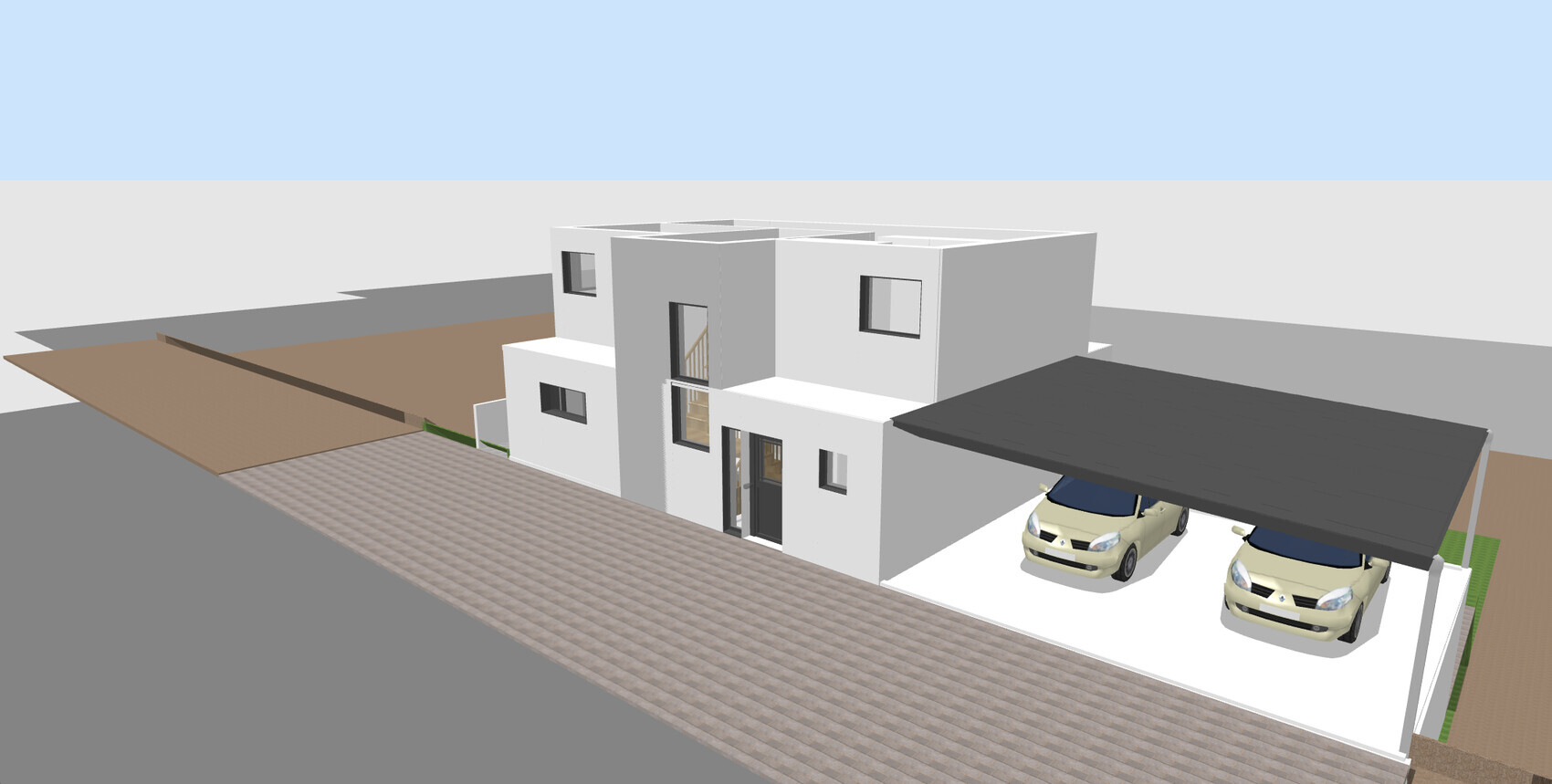
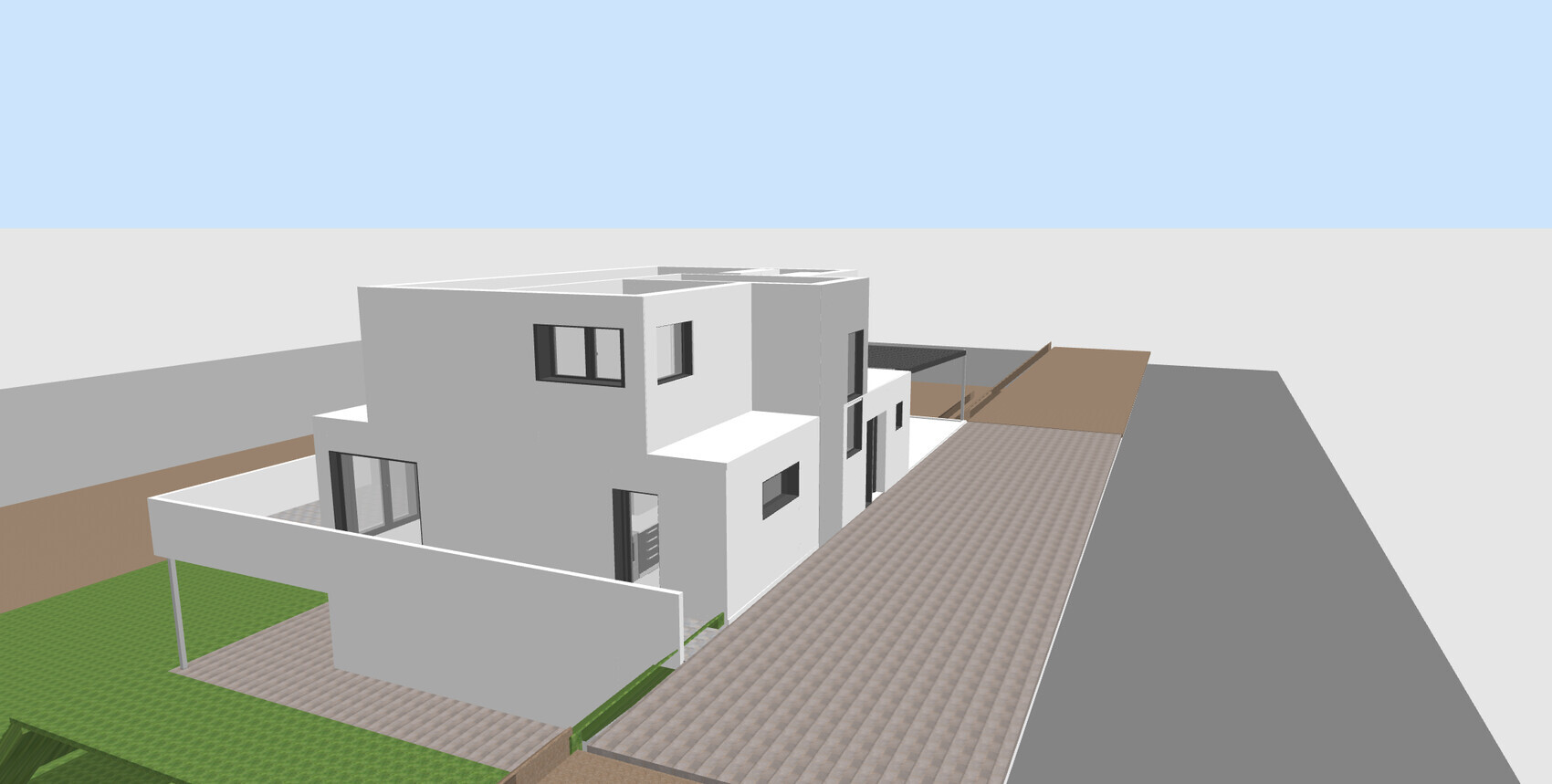
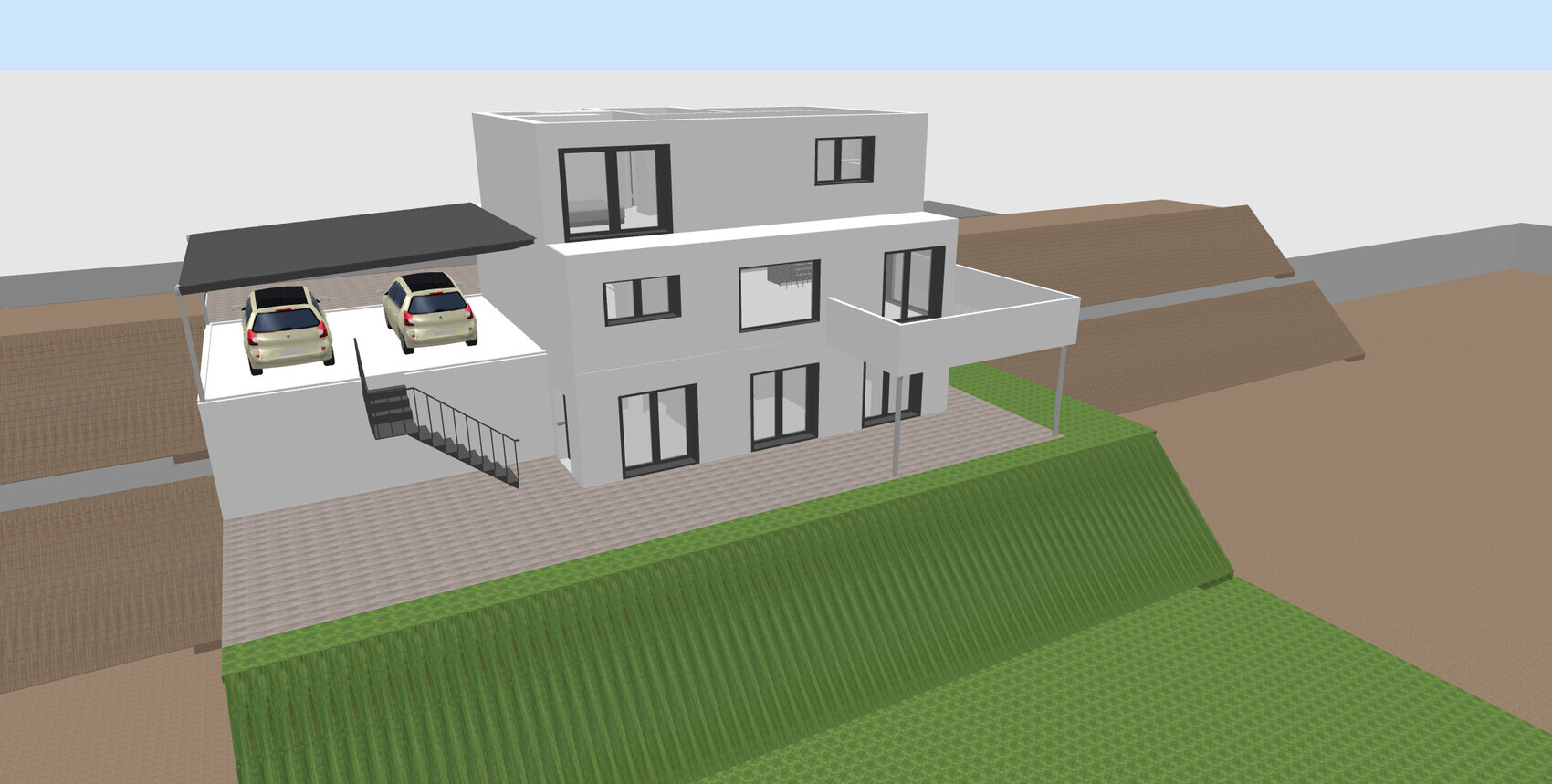
Style, roof form, building type: Bauhaus, flat roof, solid construction, single-family house with a granny flat
Basement, stories: total 2.5 stories: basement: living cellar/granny flat + utility room; ground floor: living area + office; upper floor (stepped floor): sleeping area
Number and age of people: 28 (female), 30 (male); planning for 2-3 children in about 3-4 years
Office: home office for wife
Overnight guests per year: 3–5
Open kitchen, kitchen island: open plan, preferably kitchen island (if budget allows)
Number of dining seats: 6
Balcony, roof terrace: yes, large balcony on supports connected to ground floor with garden access (depending on budget)
Garage, carport: basement carport; due to zoning plan and granny flat, 2 vehicles must fit under carport
Utility garden, greenhouse: undecided yet
House Design
Designer:
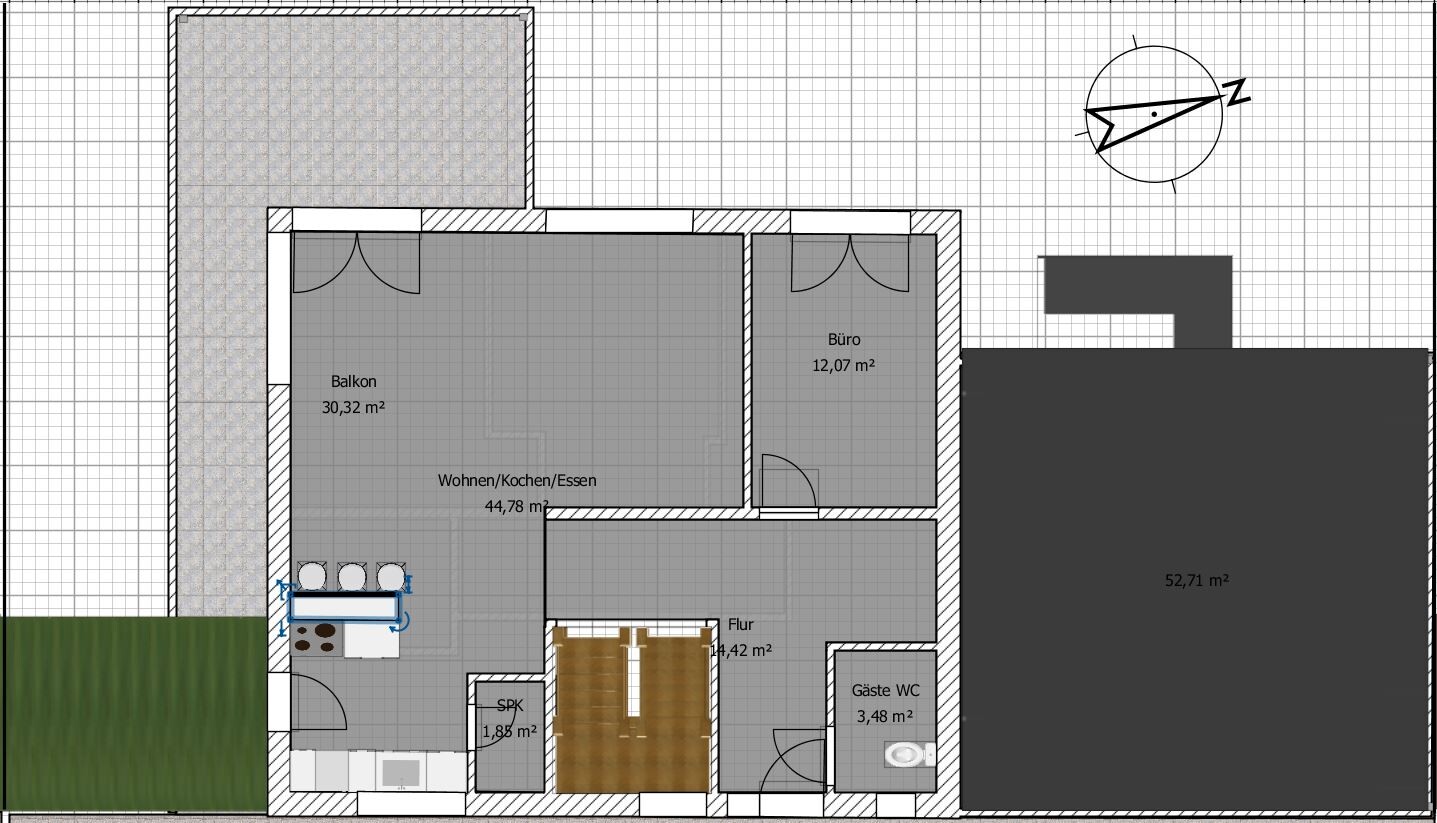
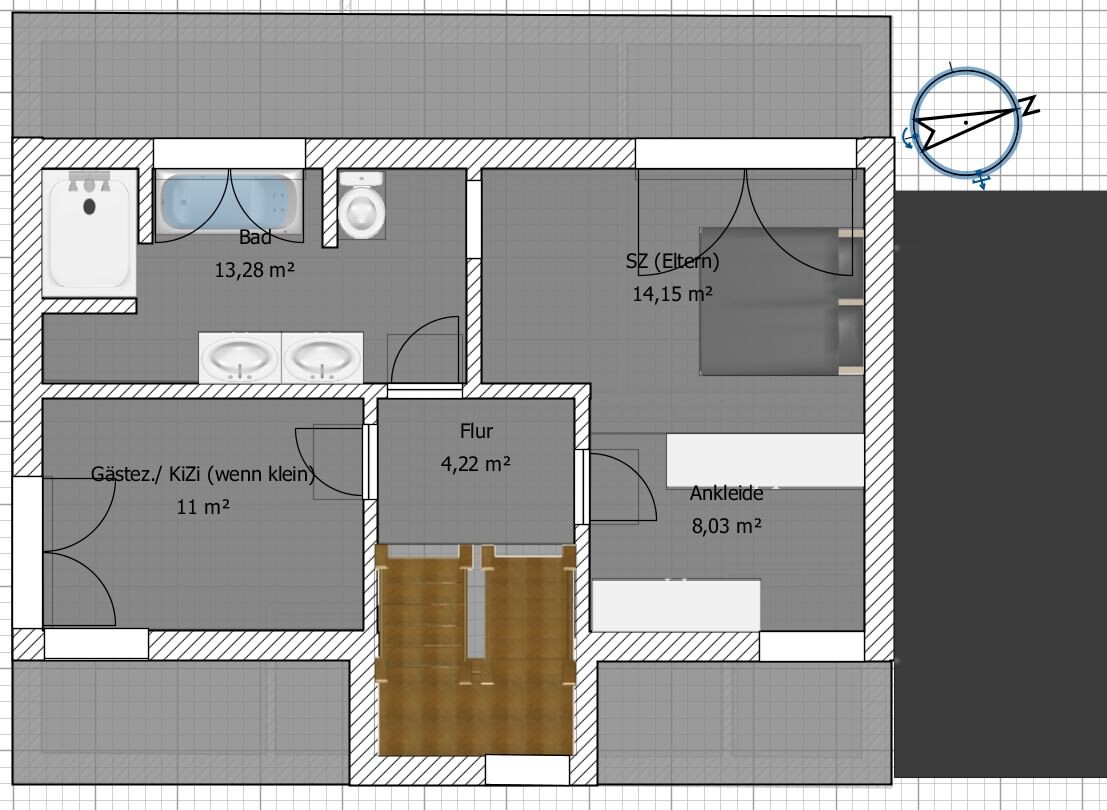
Basic design by planner from a construction company, but revised by us. Hence, the less polished own design created by me using Sweet Home 3D.
Please initially disregard the arrangement of windows, furniture, and bathroom fittings. Our main focus is on the layout and distribution of rooms across the various floors, as well as the overall concept.
About our concept:
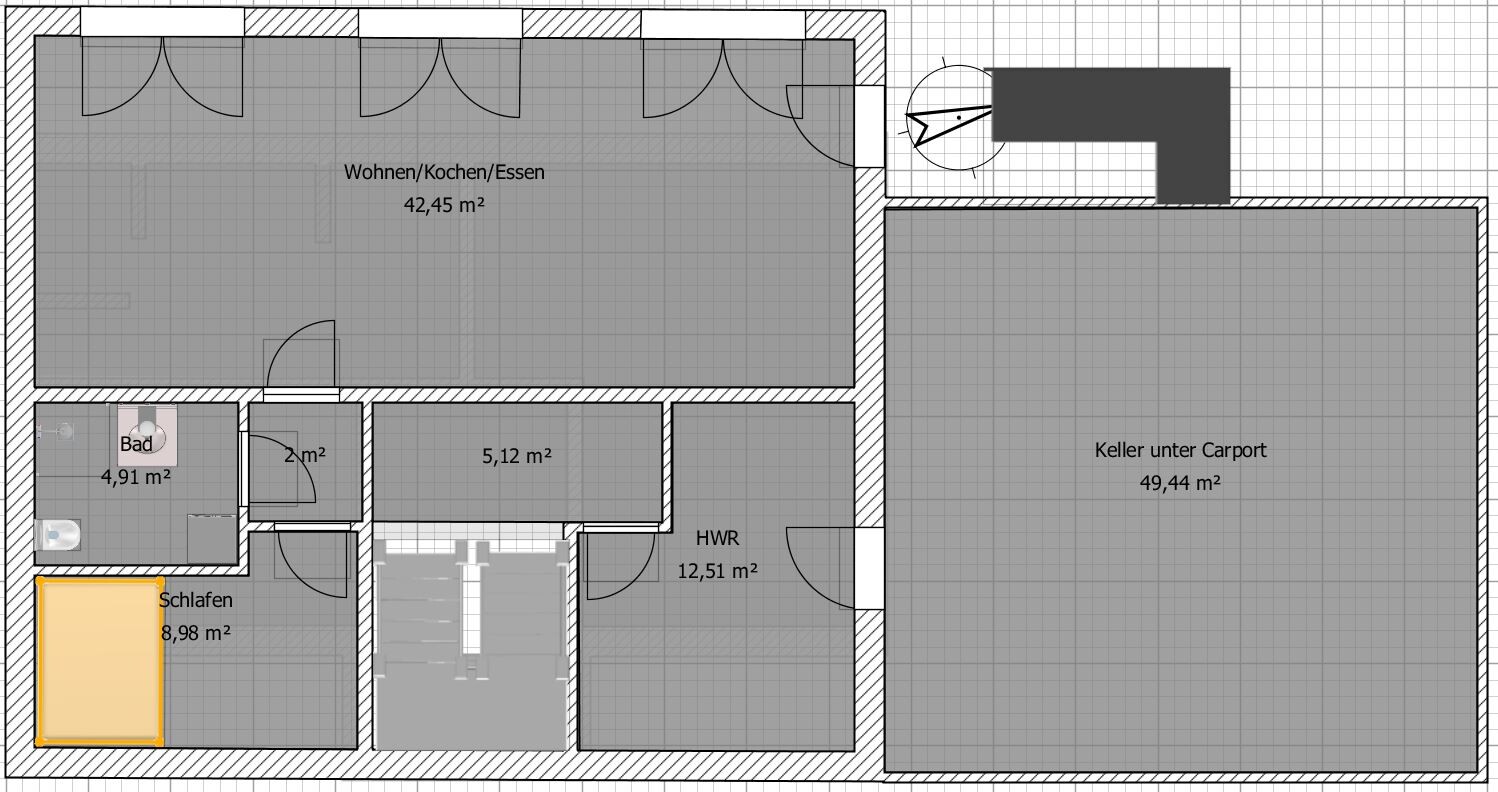
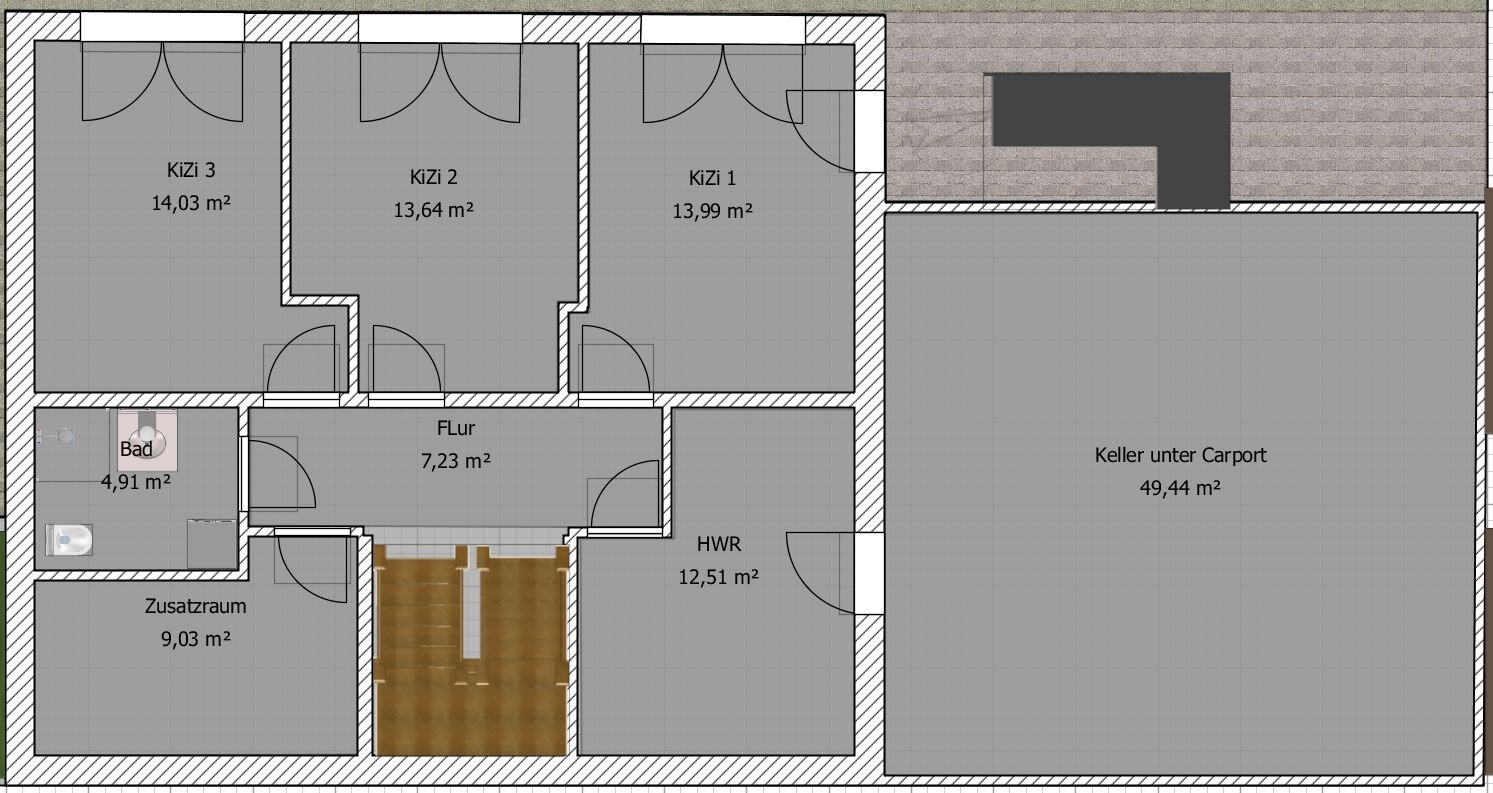
Flexibility is one of the most important aspects of our plan. We want to use the basement initially as a granny flat and later convert it into living space for the children (hence 2 versions of the basement plan). The granny flat would be used for about 10 years before the kids move down there. When the children later leave the house and we no longer need a house of this size, it should revert back into a granny flat. Possibly later, we may also live in the granny flat ourselves and rent the upper area, but that is far in the future. The idea behind this is to alleviate the mortgage payments especially during the first 10 years, when the children are still small and one of us may not be working full-time.
What do you particularly like? Why?
The stepped floor as the parents’ area, or initially a room also for children while they are small. The layout and orientation of the kitchen/living/dining area (maybe a bit small?) facing the sun.
What do you dislike? Why?
Basement: the layout in the rear area of the granny flat (basement version 1): bathroom and bedroom are too small... Any ideas on how to gain space or redesign the granny flat so that the effort to convert to basement version 2 stays minimal.
Cost Estimate according to Architect/Planner:
440k for the house (without fittings) + 20k for balcony,
62k for garage (which was a proper garage, basemented and connected to the house on the lower ground floor)
30k for earthworks (excluding removal of excavated material)
Personal Price Limit for House including Fittings:
450k for house + fittings + ?? balcony (what more affordable options are possible for execution)
+ 30k for basement carport (self-build possible)
+ 30k earthworks (+? removal)
+ 15k landscaping
Preferred heating system: geothermal (ideally combined with photovoltaic system but probably not feasible within budget)
Why is the design as it is now? / If you had to give up, on which details or extensions
Can give up: living area size, currently approx. 195 m² (2100 sq ft). We want to reduce this somewhat to save costs. Staircase from balcony to garden.
Cannot give up: Basically, this is our dream house. If the budget isn’t enough, we will have to build significantly smaller, especially without a granny flat. The question I ask myself: How much smaller can I go with the wish for rather 3 than 2 children? Does a much smaller house justify leaving out the granny flat (granny flat = relief in the beginning when salaries are lower)? We will still need the rooms from the granny flat for the future children…
What is your most important / fundamental question about the floor plan in 130 characters?
Does our project make sense in terms of flexibility or is it nonsense and difficult to plan due to many unknowns? Did we miss fundamental things in our concept?
Thank you very much for your help

I have been mostly a silent reader here for several years and have gained many ideas and suggestions. I have followed many projects here since we started planning our own house build and have benefited greatly, incorporating many considerations into our planning. After purchasing a plot about 2 years ago, our own house construction is now getting closer, with the goal to start next year.
So far, we have worked with 2 different general contractors (GCs), who provided similar concepts but different designs due to the placement of the stairs. We have made some independent changes to the design we preferred.
Due to professional priorities, the project did not have top priority since the beginning of this year. This will change from April, and we will consult several more GCs. Since we have an upcoming appointment with a GC soon, I would like to hear your critical and honest opinions about our concept and design beforehand.
Thank you in advance for your help.
Zoning Plan / Restrictions
Plot size: 600 m² (22 m wide x 27 m deep) (72 ft x 89 ft)
Slope: yes, steep slope (approx. 8 m on the north side and 7 m on the south side; see attached leveling plan)
Site coverage ratio: 0.4
Floor area ratio: 1
Building envelope, building line and boundary: see zoning plan excerpt
Edge development: no, 3 m setback; garage allowed; 5 m setback required from the street side
Number of parking spaces: 2 per housing unit, one of which must be covered
Number of floors: max. 2 full stories + half / stepped floor
Roof type: no restriction
Architectural style: no restriction, except no log houses
Orientation: west
Maximum heights / limits: eaves height max., parapet top max. 4 m (13 ft) on street side; eaves height max., parapet top max. 7 m (23 ft) above ground height on garden side
Other requirements:
Owners’ Requirements
Style, roof form, building type: Bauhaus, flat roof, solid construction, single-family house with a granny flat
Basement, stories: total 2.5 stories: basement: living cellar/granny flat + utility room; ground floor: living area + office; upper floor (stepped floor): sleeping area
Number and age of people: 28 (female), 30 (male); planning for 2-3 children in about 3-4 years
Office: home office for wife
Overnight guests per year: 3–5
Open kitchen, kitchen island: open plan, preferably kitchen island (if budget allows)
Number of dining seats: 6
Balcony, roof terrace: yes, large balcony on supports connected to ground floor with garden access (depending on budget)
Garage, carport: basement carport; due to zoning plan and granny flat, 2 vehicles must fit under carport
Utility garden, greenhouse: undecided yet
House Design
Designer:
Basic design by planner from a construction company, but revised by us. Hence, the less polished own design created by me using Sweet Home 3D.
Please initially disregard the arrangement of windows, furniture, and bathroom fittings. Our main focus is on the layout and distribution of rooms across the various floors, as well as the overall concept.
About our concept:
Flexibility is one of the most important aspects of our plan. We want to use the basement initially as a granny flat and later convert it into living space for the children (hence 2 versions of the basement plan). The granny flat would be used for about 10 years before the kids move down there. When the children later leave the house and we no longer need a house of this size, it should revert back into a granny flat. Possibly later, we may also live in the granny flat ourselves and rent the upper area, but that is far in the future. The idea behind this is to alleviate the mortgage payments especially during the first 10 years, when the children are still small and one of us may not be working full-time.
What do you particularly like? Why?
The stepped floor as the parents’ area, or initially a room also for children while they are small. The layout and orientation of the kitchen/living/dining area (maybe a bit small?) facing the sun.
What do you dislike? Why?
Basement: the layout in the rear area of the granny flat (basement version 1): bathroom and bedroom are too small... Any ideas on how to gain space or redesign the granny flat so that the effort to convert to basement version 2 stays minimal.
Cost Estimate according to Architect/Planner:
440k for the house (without fittings) + 20k for balcony,
62k for garage (which was a proper garage, basemented and connected to the house on the lower ground floor)
30k for earthworks (excluding removal of excavated material)
Personal Price Limit for House including Fittings:
450k for house + fittings + ?? balcony (what more affordable options are possible for execution)
+ 30k for basement carport (self-build possible)
+ 30k earthworks (+? removal)
+ 15k landscaping
Preferred heating system: geothermal (ideally combined with photovoltaic system but probably not feasible within budget)
Why is the design as it is now? / If you had to give up, on which details or extensions
Can give up: living area size, currently approx. 195 m² (2100 sq ft). We want to reduce this somewhat to save costs. Staircase from balcony to garden.
Cannot give up: Basically, this is our dream house. If the budget isn’t enough, we will have to build significantly smaller, especially without a granny flat. The question I ask myself: How much smaller can I go with the wish for rather 3 than 2 children? Does a much smaller house justify leaving out the granny flat (granny flat = relief in the beginning when salaries are lower)? We will still need the rooms from the granny flat for the future children…
What is your most important / fundamental question about the floor plan in 130 characters?
Does our project make sense in terms of flexibility or is it nonsense and difficult to plan due to many unknowns? Did we miss fundamental things in our concept?
Thank you very much for your help
As I understand it, the financing only works if there is additional rental income once you work less due to having children. That doesn’t sound good to me.
What is the rental apartment situation like where you are? Are there any potential tenants? Do you want strangers in your house and garden? What happens in case of vacancies or problem tenants?
What is the rental apartment situation like where you are? Are there any potential tenants? Do you want strangers in your house and garden? What happens in case of vacancies or problem tenants?
T
thewoodmaker27 Mar 2019 18:12We are building on a sloped plot with a similar gradient and do not want to live in the basement, but rather on the ground floor with a nice view from the balcony. We plan to have the bedrooms on the upper floor, with the idea that later the children can use the living space in the basement. We can’t imagine sleeping in the “basement.” But everyone has to decide that for themselves, and I think the forum, just like with many other topics, gives a somewhat distorted picture of reality. I don’t believe your thoughts are that far off.
kinderpingui schrieb:
440k house (without fittings) + 20 balcony,
62k garage (which was a real garage, with a basement and connected to the house on the lower ground floor)
30k earthworks (excluding removal of excavated soil)Is it possible in this case to separate house costs, carport, and features like the balcony? Wouldn’t it be considered one unit?
kinderpingui schrieb:
My future partner dreams of enjoying the view from the bathtub. Where exactly does she want to look?
This post I copied was in response to the earlier comments, then later the discussion about the living room in the lower ground floor came up.
Let me take away the illusion that you consciously look outside while in the bathtub. Usually, you want to relax, close your eyes, and/or it’s dark outside and/or the blinds are down while bathing.
How is that supposed to work? Lying or sitting in the tub with your head tilted? And when you get out of the tub, do you discreetly cover yourself due to modesty?
And about using the balcony: the commercial-like illusion is that you open the balcony door, breathe in fresh air, and relax the rest of the day at the table with tea or coffee while the kids sit next to you with their Nesquik?
Nope, you have to water the garden nearly every day. You’re pulling leaves here and there. You walk around the house, take care of things, maintain it. What you do with the kids was extensively commented on by @haydee.
kinderpingui schrieb:
Also, we don’t need a house this size at the beginning, when there are no or only small children, nor in old age when we’re alone again.I don’t believe all homebuilders who didn’t build a separate dwelling unit are foolish; many genuinely built just for themselves and their family. Later, you can sell and downsize.
kinderpingui schrieb:
Are our thoughts really that exclusive or unrealistic? Isn’t it reasonable to only meet those needs at different life stages that truly have to be fulfilled? I don’t find them exclusive, rather naïve.
kinderpingui schrieb:
Are there people here who built like this and say they would do it the same way again?
Do supporters of living in the lower ground floor actually have hillside plots and can speak from their own experience?Here in our flat countryside, there are also hills, even very hilly villages and communities. Usually, these are the more expensive areas. Houses stand on slopes—beautiful ones, mostly architect-designed, well thought out with garden access from their preferred living spaces, like the living or dining room.
As I said before: overall, I don’t find your thought process mature yet.
This “basement thinking” seems to be ingrained with many who just replicate standard model houses with one or two floors from general contractors, instead of investing money and letting architects design specifically for the plot.
Nobody would call the impressive hillside houses I mentioned “basements,” but simply “downstairs” and “upstairs.”
RomeoZwo schrieb:
A newer idea was an "eat-in kitchen" on the lower ground floor with garden access and a smaller, separate living room on the ground floor with a view and evening sun.
But I haven’t developed this idea any further—there is no sketch yet.Our neighbor has the eat-in kitchen, utility room, bathroom, and two children’s rooms on the ground floor of their flat plot.
The living room and parents’ suite are on the upper floor.

I’m currently short on time to find more examples for you, but the threads from the forum members I mentioned (you can find their “own topics” in their profiles, which lead to posts about their houses) represent only about half of the comparable building projects I have come across here in the last two years. One ongoing hot topic has been the discussion about the routes between the everyday living area and the terrace or garden access.
I also agree with Yvonne that for such plots, you have to move away from traditional floor designations like “basement.” Instead, there are street level, garden level, and so on.
Living preferences, secondary apartments, and building on a slope form a complex combination.
The answer to needing less space after the children leave the nest is often to build again closer to retirement — at least for homeowners where both partners are under 40 years old at the start of construction, this is a trend that is becoming more common.
https://www.instagram.com/11antgmxde/
https://www.linkedin.com/company/bauen-jetzt/
I also agree with Yvonne that for such plots, you have to move away from traditional floor designations like “basement.” Instead, there are street level, garden level, and so on.
Living preferences, secondary apartments, and building on a slope form a complex combination.
The answer to needing less space after the children leave the nest is often to build again closer to retirement — at least for homeowners where both partners are under 40 years old at the start of construction, this is a trend that is becoming more common.
https://www.instagram.com/11antgmxde/
https://www.linkedin.com/company/bauen-jetzt/
11ant schrieb:
Living concepts, granny flat, and sloped site form a tricky triangle ...while it might make sense to place a granny flat on the upper level, where a roof terrace would be useful. However, personally, I don’t see the point in planning a granny flat at all if you can’t really afford such a house otherwise.
P.S.
I took another look at the floor plan and still don’t find it great. The tiny pantry is annoying, the corner in the bedroom as well, only a complicated layout is possible in the dressing room, and so on.
K
kinderpingui28 Mar 2019 17:57matte1987 schrieb:
What are the disadvantages you mentioned about having the living level in the basement?
One disadvantage might be that you have to carry all groceries down a full flight of stairs. I consider that negligible.
We have to carry groceries up half a flight of stairs, which was an absolute no-go for us at the planning stage. Eventually, I realized that with a sloped lot you have to accept compromises.
After almost 1.5 years in the house, it feels so normal that I don’t even see it as a disadvantage anymore.
On the other hand, I can go straight from the kitchen onto the terrace and into the garden.- Exactly, the groceries (for us it’s a whole floor, not half).
- The basement is partly built into the slope and partly in front of the hill (less natural light in the basement).
- The neighboring lot on the left is slightly lower than ours. The house there will likely be built as close to our boundary as possible given the sun exposure in the garden (more light upstairs than in the basement).
- Every time the doorbell rings, you have to walk up the stairs. (I know there are intercoms with video and electric door openers, but there are always unknown visitors, delivery people, etc., whom I still want to receive at the door.)
- Every time you enter or leave the house (mainly spending time in the living area), you have to use the stairs. (Of course, if you buy a sloped lot, you should be aware that stairs are involved, but you can try to minimize them.)
- Buying an elevated plot but not using the full potential? That makes no sense to me.
- Eating outside is nice, but then you have a balcony that is even higher (and therefore with a better view) than the garden level.
- Direct garden access convinces us only partially. We have it via the stairs to the balcony. (Of course, it’s not the same as direct access because you always have to take the stairs down to the garden. You have to accept compromises.)
- The children argument from @haydee as well. How often does that actually happen and over what period in life? Five years, and in our climate only about half the year? How long would I live in the basement with at least the feeling of less light, no street access, and more stairs (40 to 50 years)? That doesn’t seem proportional to me.
We will definitely also look at houses with both options (the first ones in our development will be finished soon). Maybe seeing them in person will change our view. But for now, it doesn’t.
bortel schrieb:
We live on a slope in the basement.
My brother has the setup you’re planning, and during parties or events many people run through the house to get to the garden. That would annoy me.
We haven’t regretted it so far; I was worried about carrying groceries at first but you get used to the peace of being at the front/upper levels.Okay, but would it be any different with the floors reversed? When you enter the house, you always have to go through the house and down the stairs. The alternative for me would be the external stairs, which we already have.
RomeoZwo schrieb:
A newer idea was an open-plan kitchen/dining room in the basement with garden access and a separate, smaller living room on the ground floor with a view and evening sun.Interesting approach, we will definitely discuss that.
haydee schrieb:
No, you have to water the garden almost every day. You pick leaves here and there. You take care of the surroundings, look after it. What you do with children, @haydee has explained thoroughly.No objections, but that doesn’t prevent you from going from the living floor to the garden—you just have to take the stairs.
haydee schrieb:
You have a large cellar under the carport (which should remain) that could get daylight from the front.
If you use the cellar as living space and discard the granny flat, you could save the top floor and the complex drainage planning Matte mentioned. kaho674 schrieb:
Do you really want someone to live in your house? They would be constantly running around your garden. And for a very questionable cost-benefit ratio.I don’t really have an issue with that, especially as it would be only for 10 years. We would separate the garden anyway. As mentioned, we find it unsatisfactory that rooms remain unused for so long. If it provides an opportunity to save money, I’m happy to accept that.
kaho674 schrieb:
I understand that someone wants 3 kids. We also built two children’s rooms but have none. Do you think now we will sell the house or let someone move in? Absurd.I’m sorry for you.
I can imagine using the granny flat for that. But these are things you can’t really plan. I might also have a severe car accident shortly after building and end up in a wheelchair. In my opinion, these are things you deal with if they happen, not beforehand. And if you can’t have children or it doesn’t work by other means, that might be a reason to sell and downsize the house (according to @11ant this is even a trend when kids leave home, equivalent to having none in terms of space requirements). But everyone is different and decisions have to be made individually.
thewoodmaker schrieb:
We are building on a sloped lot with a similar gradient and prefer not to live in the basement but on the main floor with a nice view from the balcony. We will sleep on the upper floor, thinking that the children can later use the basement living space. We couldn’t imagine sleeping in the “basement”. But everyone has to decide that for themselves. I think the forum, like many others, gives a slightly distorted picture of reality on this topic. I don’t think your thoughts are far off.Okay. That could be true. The users who reply most often here on this topic tend to be the same due to their extensive expertise or moderator role. Whether that’s biased, I can’t say. It’s at least their opinion, which they apply to their own building projects.
I’m glad they prompted us to reconsider, as it made me think a lot more.
ypg schrieb:
Can house costs, carport, and features like the balcony be separated? They seem like a unit to me.The general contractor did separate them—maybe to highlight how expensive these things are alone and to encourage us to rethink.
ypg schrieb:
Where would she want to look out to?Thanks for the support. There are some nice solutions. But it’s all just speculation and doesn’t need further discussion here. I wrote that this is not about window layout or bathroom fixtures yet.
kaho674 schrieb:
How is the financing planned? What happens when the first child arrives? Will you manage everything alone? Or do you have cash stashed under your pillow? Niloa schrieb:
As I understand it, financing only works if there is additional rental income once working hours are reduced due to children. That doesn’t sound good to me.
What’s the rental market like for you? Are there tenants looking? What happens during vacancy or with bad tenants?The rental market currently favors landlords. Right now, only one apartment is listed online. Also, there is a massive commercial area nearby with demand for weekday-only housing. Thanks for the tip about bad tenants; we hadn’t considered that. However, financing does not necessarily depend on rental income, but it would definitely help ease the loan repayment.
ypg schrieb:
I don’t think people who didn’t build a granny flat are dumb, but that they simply want to build only for themselves and family. Later, they can sell and downsize.In my opinion, this isn’t about stupidity (neither option). It’s about whether you want that and can live with it temporarily, and if you’re willing to accept it for financial benefit.
As mentioned twice, we probably wouldn’t be able to build significantly smaller to reduce costs considerably (but maybe I’m wrong).
I’d also prefer to have half a million somewhere and not worry so much about financing. But since we are relatively young, funds aren’t abundant yet, and salaries won’t be as high as in 10 years (even with reduced hours), the rental income would be a nice and welcome financial relief (both civil servants, so income is quite predictable).
But we will definitely have a calculation done without the granny flat, too. We already were considering that but prefer the version discussed here. In the end, costs will likely be one of the main deciding factors.
ypg schrieb:
P.s.
I took another look at the floor plan and don’t like it much either. The tiny pantry annoys me, the corner in the bedroom as well, only a complicated layout possible in the dressing room, etc.I agree. I’m not happy with the pantry either and would remove it given its size. I reduced the bedroom corner at the expense of the hallway and don’t think it’s too bad. Thanks. We also see the dressing room the same way.
Does anyone have ideas for arranging the basement rooms? Preferably only 3 rooms plus bathroom plus utility room.
Similar topics