
Hello everyone,
After a long search, we have finally found a plot of land that we want (and can afford). Now the question is how to build.
To explain briefly, it is a slight slope parallel to the street. In front of the plot, there are two parking spaces, so the driveway can only be on the upper left side.
A soil report states that the soil is clayey. Building is allowed at 200 meters (656 feet) above sea level ± 0.50 meters (1.6 feet). The total height for shed roofs must not exceed 7.50 meters (25 feet). The shed roof must have a pitch between 10° and 15°, the orientation does not matter (preferably facing south due to a planned photovoltaic system). We would like to build two full stories.
The construction will be solid masonry, but we are still undecided between aerated concrete, clay blocks, or Neopor concrete.
Now the question is whether it makes sense to plan a basement, which would only be used as storage and for the building’s technical equipment. Possibly, depending on the size, also for a hobby room.
On the topic of basements, you find very different cost estimates ranging from €15,000 to €70,000. Since the basement will be finished by ourselves, I am mainly interested in the cost of the basement shell itself, not the complete finish.
Is a basement even possible with the maximum building height and two full stories?
What are the additional costs compared to building without a basement? Because of the slight slope, quite a bit of excavation would be required to create the foundation for the slab.
To give you a rough idea of our plans, I have attached two images.
The red numbers indicate the elevation in meters above sea level at the corners.
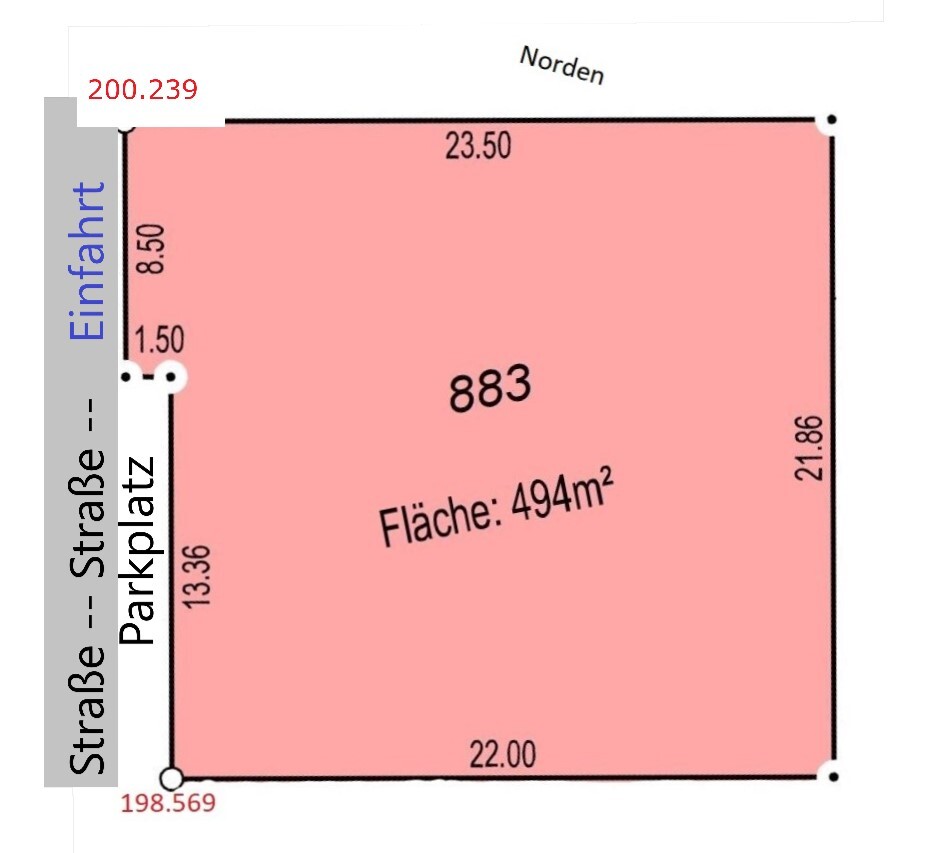
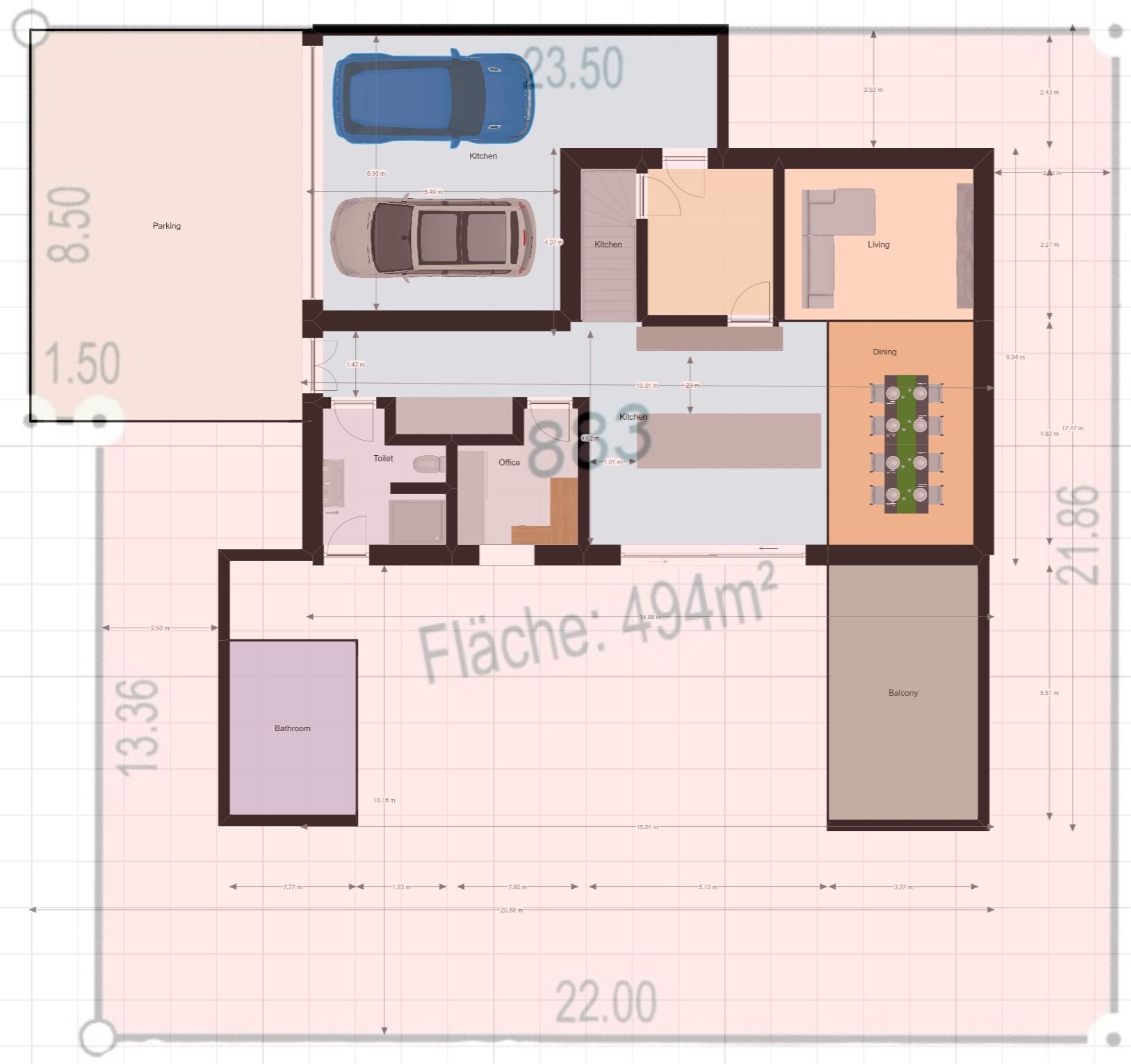
What do you think about the basement? We find it hard to design a floor plan where there is enough space on the ground floor for both the technical and storage rooms. But we also don’t want to “bury” unnecessary money.
PS: I’m happy to receive suggestions for the floor plan as well, but the main focus should be on the basement question.
After a long search, we have finally found a plot of land that we want (and can afford). Now the question is how to build.
To explain briefly, it is a slight slope parallel to the street. In front of the plot, there are two parking spaces, so the driveway can only be on the upper left side.
A soil report states that the soil is clayey. Building is allowed at 200 meters (656 feet) above sea level ± 0.50 meters (1.6 feet). The total height for shed roofs must not exceed 7.50 meters (25 feet). The shed roof must have a pitch between 10° and 15°, the orientation does not matter (preferably facing south due to a planned photovoltaic system). We would like to build two full stories.
The construction will be solid masonry, but we are still undecided between aerated concrete, clay blocks, or Neopor concrete.
Now the question is whether it makes sense to plan a basement, which would only be used as storage and for the building’s technical equipment. Possibly, depending on the size, also for a hobby room.
On the topic of basements, you find very different cost estimates ranging from €15,000 to €70,000. Since the basement will be finished by ourselves, I am mainly interested in the cost of the basement shell itself, not the complete finish.
Is a basement even possible with the maximum building height and two full stories?
What are the additional costs compared to building without a basement? Because of the slight slope, quite a bit of excavation would be required to create the foundation for the slab.
To give you a rough idea of our plans, I have attached two images.
The red numbers indicate the elevation in meters above sea level at the corners.
What do you think about the basement? We find it hard to design a floor plan where there is enough space on the ground floor for both the technical and storage rooms. But we also don’t want to “bury” unnecessary money.
PS: I’m happy to receive suggestions for the floor plan as well, but the main focus should be on the basement question.
Thanks for your answers.
Since I am building with individual contracts, I don’t have a general contractor who plans this for me. The architect did include it in the design, but I’m not sure if it really makes sense that way.
I thought a second or third opinion couldn’t hurt. Roughly, the riser shaft will be at the bottom left, and the water pipes will run at the top right.
Maybe someone else wants to give it a try.
Best regards
Since I am building with individual contracts, I don’t have a general contractor who plans this for me. The architect did include it in the design, but I’m not sure if it really makes sense that way.
I thought a second or third opinion couldn’t hurt. Roughly, the riser shaft will be at the bottom left, and the water pipes will run at the top right.
Maybe someone else wants to give it a try.
Best regards

red-ed schrieb:
The architect included that in the drawings, ... which we cannot see.red-ed schrieb:
Since I am managing the individual contracts myself, I don’t have a structural engineer to plan that for me. The architect is the one doing the planning anyway.https://www.instagram.com/11antgmxde/
https://www.linkedin.com/company/bauen-jetzt/
11ant schrieb:
... what we cannot see.
The architect is responsible for planning.Thank you for reminding me repeatedly. However, in my case, the architect does not handle that; they only prepare the drawings up to the building permit / planning permission stage. I would appreciate if this thread included more helpful responses instead of comments implying that I have chosen the wrong construction method, according to your opinion.
If you don’t have an architect or site manager and feel inexperienced, I recommend the following approach. First, take your plan to the electrician, as there are strict regulations regarding the placement of the circuit breaker panel and the required clear space in front of it to ensure safety in case someone gets an electric shock and falls backward. Then, go to the plumber or heating engineer to have their equipment and installations added to the plan. After that, you can check whether the space is sufficient. My experience may not be very helpful; our utility room is 12 sqm (130 sq ft) and we have a gas boiler, which takes up much less space than an air-to-water heat pump. So, our setup feels quite spacious. K.
Nordlys schrieb:
If you don’t have an architect or construction manager and feel inexperienced, I recommend the following approach. First, take your plan to the electrician — there are very strict regulations about how a fuse box must be mounted and how much clearance is required in front of it, in case someone gets shocked and falls backward. Then go to the plumber or heating engineer, who can add their equipment to the plan. After that, you can see if the space is sufficient. My own experience doesn’t help much: our utility room is 12 sqm (130 sq ft), and we have a gas boiler, which takes up much less space than an air-to-water heat pump. So we have quite a bit of free space. K.Thank you, that’s pretty much how I imagined it. I was told that 10 sqm (108 sq ft) is enough space to fit everything, including a washing machine. We have a separate room for this, so I think everything should fit comfortably. I was hoping someone could help.What do you think? What I don’t like here is that all the power and KNX cables have to run across the whole room to the riser shaft. Maybe you can suggest a better layout. The riser shaft is marked in red.
red-ed schrieb:
What I don't like here is that all the electrical and KNX wiring has to run across the whole room to the riser shaft.That’s why you have a professional plan these things (house and technical systems), so everything makes sense.
Why would someone risk telling you something and then the expert implements it differently?
Similar topics