
ᐅ Omitting individual room control? Mechanical ventilation with heat recovery + gas heating, new build
Created on: 15 Mar 2019 08:16
K
Kabelmodem87
Hello,
I am currently planning the electrical and technical installations for our new build.
We are constructing with 42.5 Poroton bricks without insulation and have planned a gas heating system as well as a central controlled ventilation system with heat recovery. Almost the entire house will be tiled, except for the children’s room and bedroom.
Now the question about the usefulness of 10 room thermostats, which would cost me €1500 gross without any self-labor, including valves and wiring, and which I find not very attractive on the wall. Additionally, there is continuous power consumption per radiator.
What I have read so far is that a hydraulic balancing is important, a well-adjusted heating curve depending on the outside temperature, and a system with a low flow temperature; then the individual rooms can be perfectly adjusted through the flow in the radiators. Due to door gaps and the ventilation system, it will anyway be difficult to maintain significant temperature differences.
I do not see what comfort the electronic radiator regulators (ERR) would bring, since the system is slow to respond anyway and would only react hours later when there is solar heat gain.
With modern gas boilers, there should also be the option to control the flow temperature externally via smartphone, for example from vacation, and thus lower or raise the whole house temperature by 1-2 degrees before arriving home.
I know that ERR is initially mandatory and you have to apply for an exemption. Do you see a chance that this will be approved? Is the architect together with the heating installer the right contact for the application? I think our installer always installs the room thermostats without considering whether they make sense.
Has anyone experienced a similar situation or has any tips or advice?
Please refrain from comments like “new build costs €500,000 but no €1500 for room thermostats,” this is about the principle of not buying something unnecessary and unattractive.
I am currently planning the electrical and technical installations for our new build.
We are constructing with 42.5 Poroton bricks without insulation and have planned a gas heating system as well as a central controlled ventilation system with heat recovery. Almost the entire house will be tiled, except for the children’s room and bedroom.
Now the question about the usefulness of 10 room thermostats, which would cost me €1500 gross without any self-labor, including valves and wiring, and which I find not very attractive on the wall. Additionally, there is continuous power consumption per radiator.
What I have read so far is that a hydraulic balancing is important, a well-adjusted heating curve depending on the outside temperature, and a system with a low flow temperature; then the individual rooms can be perfectly adjusted through the flow in the radiators. Due to door gaps and the ventilation system, it will anyway be difficult to maintain significant temperature differences.
I do not see what comfort the electronic radiator regulators (ERR) would bring, since the system is slow to respond anyway and would only react hours later when there is solar heat gain.
With modern gas boilers, there should also be the option to control the flow temperature externally via smartphone, for example from vacation, and thus lower or raise the whole house temperature by 1-2 degrees before arriving home.
I know that ERR is initially mandatory and you have to apply for an exemption. Do you see a chance that this will be approved? Is the architect together with the heating installer the right contact for the application? I think our installer always installs the room thermostats without considering whether they make sense.
Has anyone experienced a similar situation or has any tips or advice?
Please refrain from comments like “new build costs €500,000 but no €1500 for room thermostats,” this is about the principle of not buying something unnecessary and unattractive.

Obstlerbaum schrieb:
an empty houseAnyone who leaves for work in the morning has usually spent somewhere between 8-12 hours inside beforehand. If airing out the house thoroughly isn’t part of your morning routine (a bit of chilly east wind at the breakfast table is actually better than coffee), you will inevitably return after work to that same old stale air.
Does this cause any lasting damage? Probably not to people, but if I imagine a family of four showering in the morning and then leaving the house without ventilating… well.
Everyone can do as they please, but trying to convince an owner of a mechanical ventilation system that it’s not “worth it” is about as sensible as reminding a homeowner that their student accommodation was also warm and dry.

I thought it was just hot air.
The refrigerator comparison is completely misleading. A heat source inside a cooling unit drastically reduces efficiency. In contrast, a running mechanical ventilation system with heat recovery during absence serves its original purpose. You probably never entered a ventilated detached house after a longer absence. The difference compared to a house without ventilation is huge.
@wurmwichtel
Your argument still misses the personnel needed for ventilation in the morning/noon/evening; otherwise, it falls short here as well.
See, that’s how a mechanical ventilation system with heat recovery pays off after just a few years.
Modern plastic-sealed houses, as required by energy-saving regulations, simply need air exchange, which many homeowners find difficult to manage. Nowadays, you can tell upon the first step inside the house whether proper ventilation has taken place or not. In my experience (if no mechanical ventilation system with heat recovery is installed): hardly any ventilation is done, which is bad for both allergy sufferers and those without allergies.
The refrigerator comparison is completely misleading. A heat source inside a cooling unit drastically reduces efficiency. In contrast, a running mechanical ventilation system with heat recovery during absence serves its original purpose. You probably never entered a ventilated detached house after a longer absence. The difference compared to a house without ventilation is huge.
@wurmwichtel
Your argument still misses the personnel needed for ventilation in the morning/noon/evening; otherwise, it falls short here as well.
See, that’s how a mechanical ventilation system with heat recovery pays off after just a few years.
Modern plastic-sealed houses, as required by energy-saving regulations, simply need air exchange, which many homeowners find difficult to manage. Nowadays, you can tell upon the first step inside the house whether proper ventilation has taken place or not. In my experience (if no mechanical ventilation system with heat recovery is installed): hardly any ventilation is done, which is bad for both allergy sufferers and those without allergies.
Yes, if you don’t mind getting up at 3 a.m. to thoroughly air out the bedroom and children’s room, and you find time to do this in the morning, at midday, and in the evening, then you don’t need a mechanical ventilation system.
To be fair, however, it should be mentioned that there are also cost-effective methods to reduce manual airing to just one or two times a day. Examples include window rebate ventilation, decentralized supply and exhaust air systems, and so on.
To be fair, however, it should be mentioned that there are also cost-effective methods to reduce manual airing to just one or two times a day. Examples include window rebate ventilation, decentralized supply and exhaust air systems, and so on.
To be fair, a mechanical ventilation system with heat recovery does not cost more than 10,000.
Installation and commissioning then add another 2,000, plus say about 1,000 for additional valves, pipes, etc. (generously estimated). You are still looking at a maximum of around 8,000.
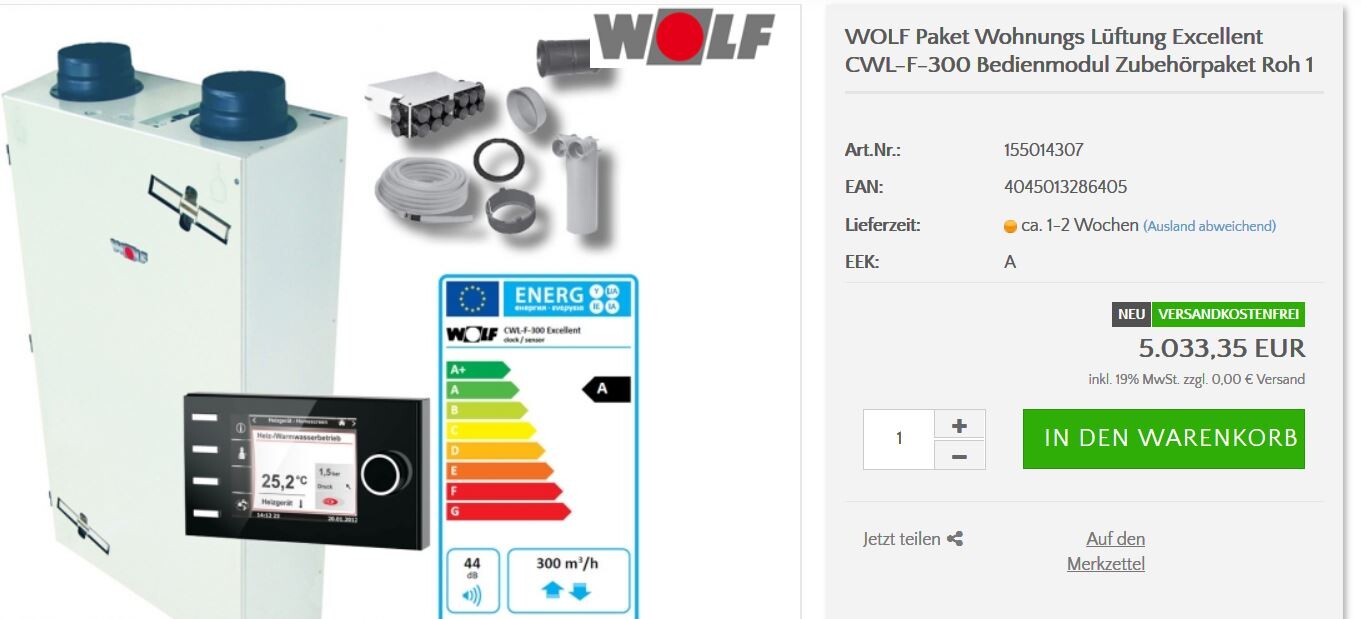
Installation and commissioning then add another 2,000, plus say about 1,000 for additional valves, pipes, etc. (generously estimated). You are still looking at a maximum of around 8,000.
O
Obstlerbaum16 Mar 2019 10:17Mycraft schrieb:
I thought it would just be hot air.
The comparison to a refrigerator is completely off. A heat source inside a cooling unit drastically reduces its efficiency. In contrast, a running mechanical ventilation system with heat recovery during absence serves its original purpose. Apparently, you have never entered a forced-ventilated single-family home after a longer absence. The difference compared to a house without ventilation is huge. Spare me the generalizations and explain who raises the CO2 levels or brings in that much moisture during absence. I’m happy for your enthusiasm about mechanical ventilation, but the lectures are out of place.Instruction or advice is by no means out of place, as there clearly is a lack of basic knowledge.
CO2 levels are only the tip of the iceberg and do not necessarily have to be elevated. There are many other particles in a house that can thrive in the absence of occupants and without sufficient ventilation.
Energy exchange processes are continuously taking place inside a house, even when it is unoccupied. These processes produce what people perceive as odors, which can sometimes be unpleasant.
Sunlight also enters and heats everything it touches, causing plastics, adhesives, paints in windows, doors, walls, furniture, televisions, and other electronics to off-gas.
The shower and other sanitary fixtures release moisture into the bathroom long after a short morning ventilation. Unless the surfaces are thoroughly dried—something hardly anyone does.
And so on... The list can be extended endlessly. Even the range hood emits odors once it is turned off, unless the filters are cleaned immediately, which again, rarely happens.
Everything inside a house produces odors and waste products during periods of absence without sufficient air exchange. These are then inhaled upon re-entering the house (until the next air exchange).
CO2 levels are only the tip of the iceberg and do not necessarily have to be elevated. There are many other particles in a house that can thrive in the absence of occupants and without sufficient ventilation.
Energy exchange processes are continuously taking place inside a house, even when it is unoccupied. These processes produce what people perceive as odors, which can sometimes be unpleasant.
Sunlight also enters and heats everything it touches, causing plastics, adhesives, paints in windows, doors, walls, furniture, televisions, and other electronics to off-gas.
The shower and other sanitary fixtures release moisture into the bathroom long after a short morning ventilation. Unless the surfaces are thoroughly dried—something hardly anyone does.
And so on... The list can be extended endlessly. Even the range hood emits odors once it is turned off, unless the filters are cleaned immediately, which again, rarely happens.
Everything inside a house produces odors and waste products during periods of absence without sufficient air exchange. These are then inhaled upon re-entering the house (until the next air exchange).
Similar topics