
ᐅ Mechanical Ventilation with Heat Recovery (MVHR) System – Maximum Duct Lengths – What Are the Consequences?
Created on: 11 Feb 2019 10:33
R
Reini1234R
Reini123411 Feb 2019 10:33I just came back from my construction site and have the feeling that the installation of my mechanical ventilation with heat recovery is going completely off track.
Initial situation:
I actually wanted to subcontract the entire ventilation system without getting too involved. The plumbing subcontractor ordered a Wolf CWL 400 with 50x140cm (20x6 inches) rectangular duct. The company installed the vents for the basement rooms in the precast concrete ceiling during the basement construction and left a few meters of duct hanging up. These ducts were supposed to be routed further through the installation level of the timber frame house up to the attic.
Recently, I was offered to install the remaining ducts myself on a time-and-materials basis, which we accepted.
The unit is mounted in the attic on the gable wall above the bathroom. The two air distributors are located directly in front of it. All supply and exhaust vents in the house are controlled from there. All rectangular ducts are connected, but the exhaust and fresh air ducts to the outside are not yet installed.
The installer came by a few times, briefly checked if everything was okay, and left. I increasingly felt that everything was done roughly by eye and wondered that apparently no guidelines or standards were used. I recently received the ventilation plan, which I have now studied more closely.
It mentions a minimum and maximum duct length of 5–15m (16–49 feet). I have met the minimum of 5m, but the maximum length is clearly exceeded in the basement rooms:
Basement Room Exhaust 12.50m (41 feet)
Basement Room Supply 20.00m (66 feet)
Basement Utility Room Exhaust 17.00m (56 feet)
Basement Hall Supply 15.80m (52 feet)
Basement Supply Exhaust 13.30m (44 feet)
Basement Toilet Exhaust 8.50m (28 feet)
What exactly happens when the duct run is too long? Can the fan no longer handle this? I might be able to reroute the long 20m (66 feet) run via floor routing to save a few meters, but I won’t be able to meet the 15m (49 feet) limit. There are four bends just on this run. Would it help to swap the much shorter exhaust duct with the supply duct?
Other issues I noticed:
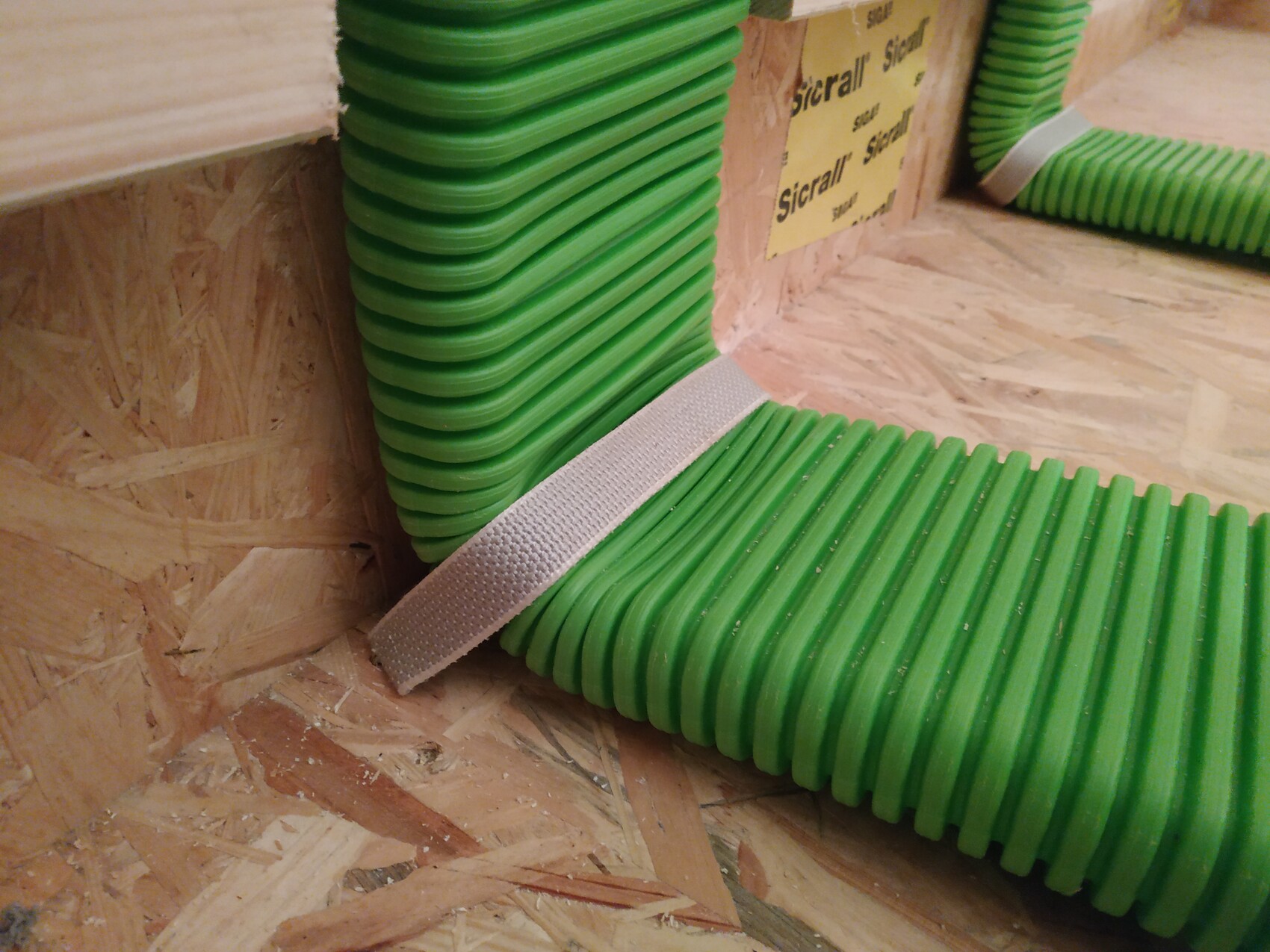
- We were not provided with rigid bends, so we bent everything ourselves. Especially the 90-degree transition from floor to wall looks like in the pictures. Due to the kink, the duct is somewhat pinched—what kind of problems could this cause?
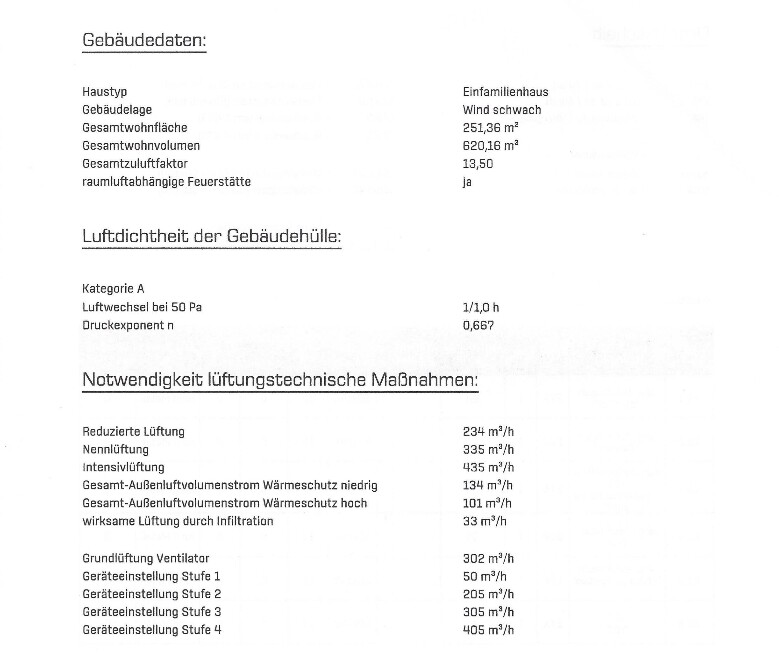
Attached is also my ventilation plan.
Initial situation:
I actually wanted to subcontract the entire ventilation system without getting too involved. The plumbing subcontractor ordered a Wolf CWL 400 with 50x140cm (20x6 inches) rectangular duct. The company installed the vents for the basement rooms in the precast concrete ceiling during the basement construction and left a few meters of duct hanging up. These ducts were supposed to be routed further through the installation level of the timber frame house up to the attic.
Recently, I was offered to install the remaining ducts myself on a time-and-materials basis, which we accepted.
The unit is mounted in the attic on the gable wall above the bathroom. The two air distributors are located directly in front of it. All supply and exhaust vents in the house are controlled from there. All rectangular ducts are connected, but the exhaust and fresh air ducts to the outside are not yet installed.
The installer came by a few times, briefly checked if everything was okay, and left. I increasingly felt that everything was done roughly by eye and wondered that apparently no guidelines or standards were used. I recently received the ventilation plan, which I have now studied more closely.
It mentions a minimum and maximum duct length of 5–15m (16–49 feet). I have met the minimum of 5m, but the maximum length is clearly exceeded in the basement rooms:
Basement Room Exhaust 12.50m (41 feet)
Basement Room Supply 20.00m (66 feet)
Basement Utility Room Exhaust 17.00m (56 feet)
Basement Hall Supply 15.80m (52 feet)
Basement Supply Exhaust 13.30m (44 feet)
Basement Toilet Exhaust 8.50m (28 feet)
What exactly happens when the duct run is too long? Can the fan no longer handle this? I might be able to reroute the long 20m (66 feet) run via floor routing to save a few meters, but I won’t be able to meet the 15m (49 feet) limit. There are four bends just on this run. Would it help to swap the much shorter exhaust duct with the supply duct?
Other issues I noticed:
- We were not provided with rigid bends, so we bent everything ourselves. Especially the 90-degree transition from floor to wall looks like in the pictures. Due to the kink, the duct is somewhat pinched—what kind of problems could this cause?
Attached is also my ventilation plan.
Quite messed up...
The pressure losses for each individual pipe need to be calculated precisely, especially taking into account sharp bends like the ones in your photo. With 20 m (65.6 ft) of piping including such bends (which is not standard practice), no air will reach the end. Instead, all the air will escape from a valve on the upper floor, which is only 5 m (16.4 ft) away. This then needs to be adjusted or balanced, but most likely it will have to be turned down so much that nothing comes out anywhere. Cleaning won’t be possible either if that ever becomes necessary.
Have a proper plan made and then redo it accordingly; otherwise, you might as well save your money.
The pressure losses for each individual pipe need to be calculated precisely, especially taking into account sharp bends like the ones in your photo. With 20 m (65.6 ft) of piping including such bends (which is not standard practice), no air will reach the end. Instead, all the air will escape from a valve on the upper floor, which is only 5 m (16.4 ft) away. This then needs to be adjusted or balanced, but most likely it will have to be turned down so much that nothing comes out anywhere. Cleaning won’t be possible either if that ever becomes necessary.
Have a proper plan made and then redo it accordingly; otherwise, you might as well save your money.
R
Reini123411 Feb 2019 22:10Starting over is no longer an option since the material is already installed and paid for.
I visited the site again today and found that by rerouting, the 20m (65.6 ft) run could actually be shortened to about 15–16m (49.2–52.5 ft). The bends can also be replaced with angled fittings, which I will probably do. I need to provide the planner with the details of the curves again so that the throttle plates can be calculated.
Another noticeable point is the high air volume according to the ventilation concept. It was calculated based on the living area rather than the number of occupants. I have also shared this document in other forums, where there are different opinions:
- The air volume and flow rates are too high, causing more noise propagation in the ducts.
- The high air volumes allow the system to operate at a low setting, which in turn reduces noise and energy costs.
What do you think?
I visited the site again today and found that by rerouting, the 20m (65.6 ft) run could actually be shortened to about 15–16m (49.2–52.5 ft). The bends can also be replaced with angled fittings, which I will probably do. I need to provide the planner with the details of the curves again so that the throttle plates can be calculated.
Another noticeable point is the high air volume according to the ventilation concept. It was calculated based on the living area rather than the number of occupants. I have also shared this document in other forums, where there are different opinions:
- The air volume and flow rates are too high, causing more noise propagation in the ducts.
- The high air volumes allow the system to operate at a low setting, which in turn reduces noise and energy costs.
What do you think?

You have several "problems":
1) (Too) long duct runs
2) Ducts are flat-duct type
3) Bends in the ductwork
4) From what you describe, there is only one duct per valve
5) The ducts have very different lengths
This means that on one hand, you have very high pressure losses in the system and will need to push (too) much air through these ducts depending on the room. This results in a very high load on your central unit, causing increased noise levels, and on the other hand, you will almost certainly have clearly audible airflow noise at some of the valves.
Additionally, I believe the unit is undersized for the required airflow volumes. Even at nominal ventilation, the unit is running at 84% capacity. It definitely will not be sufficient for the airflow rates during intensive ventilation.
Regarding your comments from other forums: I would agree with the first one, but the second, as stated, is nonsense. Did you misunderstand or misquote it?
A system can be operated at a lower level if it has potential performance reserves. That is why, in controlled mechanical ventilation systems, it usually makes sense to size the unit larger than what is strictly required on paper.
1) (Too) long duct runs
2) Ducts are flat-duct type
3) Bends in the ductwork
4) From what you describe, there is only one duct per valve
5) The ducts have very different lengths
This means that on one hand, you have very high pressure losses in the system and will need to push (too) much air through these ducts depending on the room. This results in a very high load on your central unit, causing increased noise levels, and on the other hand, you will almost certainly have clearly audible airflow noise at some of the valves.
Additionally, I believe the unit is undersized for the required airflow volumes. Even at nominal ventilation, the unit is running at 84% capacity. It definitely will not be sufficient for the airflow rates during intensive ventilation.
Regarding your comments from other forums: I would agree with the first one, but the second, as stated, is nonsense. Did you misunderstand or misquote it?
A system can be operated at a lower level if it has potential performance reserves. That is why, in controlled mechanical ventilation systems, it usually makes sense to size the unit larger than what is strictly required on paper.
R
Reini123412 Feb 2019 10:241. The long ducts have mostly been resolved, except for minimal overruns.
2. A flat duct was necessary because it is a timber frame house with an installation level.
3. These are also unavoidable with ceiling-mounted valves.
4. This is how the manufacturer specified it. It would have been impossible to fit two ducts per valve inside the walls.
5. Yes, that’s true. However, I wonder what the alternative would have been for a three-story house? The air distributor should be located as close as possible to the unit, and the unit itself can only be installed in the utility room in the basement or in the attic.
The unit itself is already the largest model that Wolf offers for private households; there is nothing bigger. I share your opinion that the system will have quite a workload. The question, however, is whether the calculated air volumes are really needed? Per person (later 4, for now 2.5), this is over 80 m³/h (47 cfm).
This is also the basis for the second comment from another forum, which suggested that the system could actually run at a lower setting with less volume, especially since the basement includes secondary rooms (party room, guest WC, utility room, and laundry room).
2. A flat duct was necessary because it is a timber frame house with an installation level.
3. These are also unavoidable with ceiling-mounted valves.
4. This is how the manufacturer specified it. It would have been impossible to fit two ducts per valve inside the walls.
5. Yes, that’s true. However, I wonder what the alternative would have been for a three-story house? The air distributor should be located as close as possible to the unit, and the unit itself can only be installed in the utility room in the basement or in the attic.
The unit itself is already the largest model that Wolf offers for private households; there is nothing bigger. I share your opinion that the system will have quite a workload. The question, however, is whether the calculated air volumes are really needed? Per person (later 4, for now 2.5), this is over 80 m³/h (47 cfm).
This is also the basis for the second comment from another forum, which suggested that the system could actually run at a lower setting with less volume, especially since the basement includes secondary rooms (party room, guest WC, utility room, and laundry room).

Similar topics