
Good morning everyone,
after the great advice on the topic of "terrace house" in the general forum, we have now purchased the small plot and will soon have the first more detailed discussions with general contractors (and possibly architects), from whom we would like to have the house built "turnkey."
Since I would like to be well prepared for the discussions and ask the right questions straight away, I would really appreciate any feedback, suggestions, or criticism on the first amateur floor plan draft.
The design and interior layout are not meant to be exact to the centimeter but rather to show what is basically possible within the building envelope. Since it is a terrace house, no windows are allowed on the east-facing wall. We are initially planning with a basement. Compared to many other examples here, this is probably a fairly classic or rather plain design for most, but I’m afraid not much else is possible.
Many thanks in advance!
Development Plan / Restrictions
Plot size – 240 sqm (2,583 sq ft)
Slope – none
Floor area ratio 0.4
Building envelope, building line, and boundary – 8.5 x 11 m (28 x 36 ft)
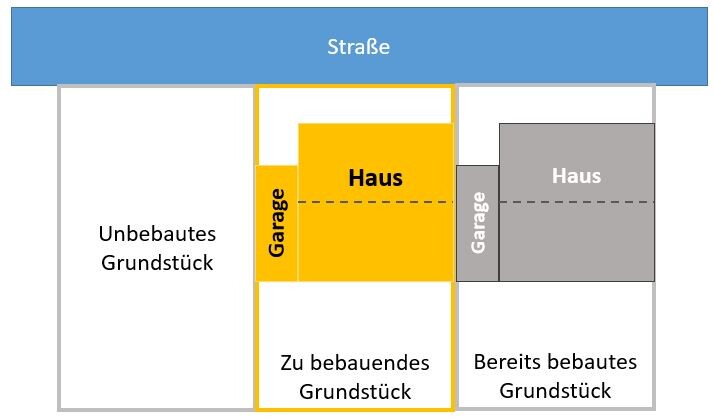
Border development – terrace house, meaning direct boundary development on the left (still vacant) and right (already developed)
Roof type – gable roof 35°-40°
Maximum heights / limits – ridge height max. 9.5 m (31 ft); eaves height max. 6.0 m (20 ft)
Client Requirements
Basement, floors – basement yes, 2 full floors, attic as potential conversion space
Number of people, ages – 3 persons (32, 34, 4)
House design
Planning source: do-it-yourself
Personal budget for the house: €300,000 + €50,000 basement + €50,000 ancillary building costs
What is the most important/basic question about the floor plan summarized in 130 characters?
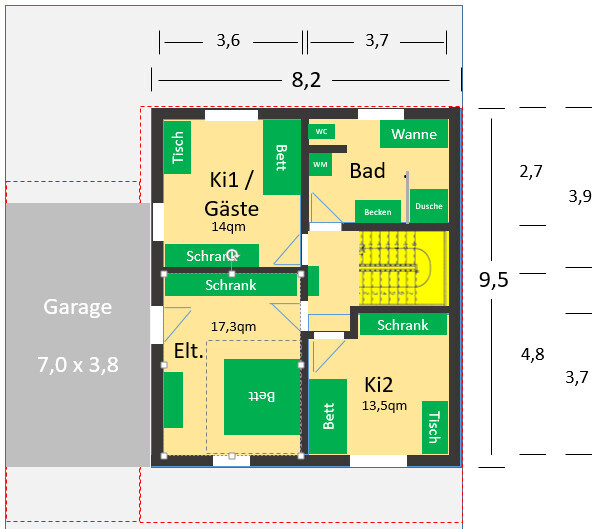
Does the floor plan make sense as is, or could a small separate office be included through a smarter layout? Should certain rooms be bigger or smaller?
after the great advice on the topic of "terrace house" in the general forum, we have now purchased the small plot and will soon have the first more detailed discussions with general contractors (and possibly architects), from whom we would like to have the house built "turnkey."
Since I would like to be well prepared for the discussions and ask the right questions straight away, I would really appreciate any feedback, suggestions, or criticism on the first amateur floor plan draft.
The design and interior layout are not meant to be exact to the centimeter but rather to show what is basically possible within the building envelope. Since it is a terrace house, no windows are allowed on the east-facing wall. We are initially planning with a basement. Compared to many other examples here, this is probably a fairly classic or rather plain design for most, but I’m afraid not much else is possible.
Many thanks in advance!
Development Plan / Restrictions
Plot size – 240 sqm (2,583 sq ft)
Slope – none
Floor area ratio 0.4
Building envelope, building line, and boundary – 8.5 x 11 m (28 x 36 ft)
Border development – terrace house, meaning direct boundary development on the left (still vacant) and right (already developed)
Roof type – gable roof 35°-40°
Maximum heights / limits – ridge height max. 9.5 m (31 ft); eaves height max. 6.0 m (20 ft)
Client Requirements
Basement, floors – basement yes, 2 full floors, attic as potential conversion space
Number of people, ages – 3 persons (32, 34, 4)
House design
Planning source: do-it-yourself
Personal budget for the house: €300,000 + €50,000 basement + €50,000 ancillary building costs
What is the most important/basic question about the floor plan summarized in 130 characters?
Does the floor plan make sense as is, or could a small separate office be included through a smarter layout? Should certain rooms be bigger or smaller?
Mbk84 schrieb:
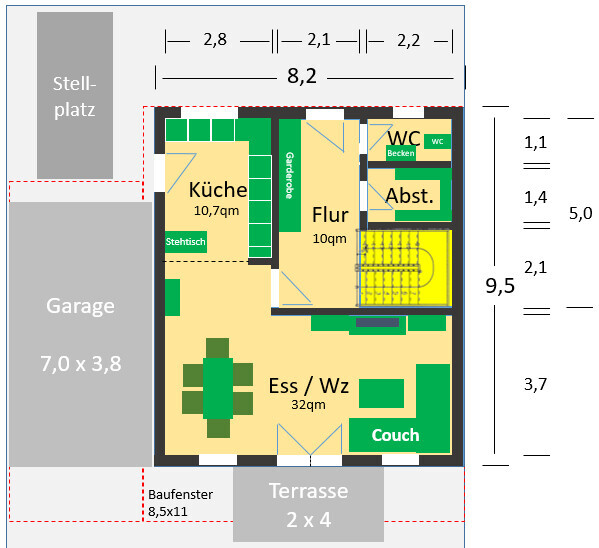
Shower on the ground floor with full depth makes more sense I can imagine a large shower works well, but how do you plan to enter it?
The position of the toilet is a bit misleading. Take the measurements from the upper floor toilet and see how much space remains there.
My plumber advised me not to go below 25 cm (10 inches) for the distance between the toilet and the wall, and if possible, to allow 35 cm (14 inches).
Mbk84 schrieb:
What exactly do you mean? An (additional) door on the right side of the kitchen leading to the hallway? And then the living room door would basically lead straight from the hallway into the living room?I would probably place the kitchen door right at the front by the main entrance: keep the kitchen units on the north side, and opposite the kitchen’s patio door, have a door. Then arrange a double-row kitchen layout. Use the remaining width for a wardrobe or integrate it with the kitchen area.
This way, a glass door can lead directly from a straight wall into the living room.
I would design it so that a family member resting on the sofa (napping, sick, or reading—seeking quiet—not necessarily hiding upstairs during the day) is not immediately disturbed by someone entering the house and going into the kitchen, without disturbing those active in the living room.
We experience this situation quite often, and despite the open layout, the person on the sofa feels protected because you don’t immediately face the seating area upon entering.
Regarding older children later on, who want to make a pizza at 10 PM without disturbing parents watching TV, this setup almost plans itself.

Slava_S schrieb:
I think a large shower sounds good, but how do you plan to get in there?
The position of the toilet is a bit of an illusion. Take the measurements of the upstairs toilet and see how much space is actually left.
My plumber advised not to go below 25 cm (10 inches) distance between the toilet and the wall, and if space allows, 35 cm (14 inches) is better.Thanks for the hint, I actually measured it at home just now: 30 cm (12 inches), although 25 cm (10 inches) would still work, but definitely not less. So 25 + 40 = 65 cm (26 inches), leaving about 65–70 cm (26–28 inches) of remaining width for walking through—I think that’s still acceptable. The shower isn’t meant for daily use anyway. Otherwise, the guest bathroom could be widened a bit, which would still be possible if needed.
I was busy working on this again.
However, my doubts about the landing staircase were confirmed: far from an optimal stair size, I had to adjust the dimensions three times just to fit it into the niche. Simply shortening the landing by 20 cm (8 inches) wasn’t enough... the staircase ended up steeper than our emergency stairway at work.
Similarly, I had to make the kitchen a bit narrower because the space between the work areas was much too large.
Now: I’m not sure which image appears first. I had in mind that the kitchen door is directly opposite the terrace door. But then I moved the kitchen door again to create a small work L-shape and to add a wall in the hallway for an impromptu coat rack. The main wardrobe is opposite the staircase, which is a two-flight switchback type. There are nice options available here, and it doesn’t have to be a yellowish beech wood finish.
The guest WC size has been adjusted... unfortunately, the doors cannot be customized in one of the versions.
@ypg .. Yvonne
Exactly my point... when it comes to a double-row kitchen, a room width of 280 cm (110 inches) is actually too much.
I like it. And for the “spontaneous cloakroom,” you could simply consider accessing the storage room through the bathroom. I wouldn’t see that as a big issue.
Also, the door between the hallway and kitchen could be made as a sliding door running along the hallway towards the bottom of the plan.
Possibly make the kitchen window narrow enough to fit a tall cabinet on each side, so about 70 cm (28 inches) of wall on the right and left—on the right side, this is already the case.
Then, in the kitchen, you could plan from left to right on the upper level: tall cabinet with oven, secondary storage area, and next to the chimney shaft a tall cabinet with reduced depth for standard kitchen supplies. In the recess below, place a freestanding refrigerator that blends into the sink area, and along the right side towards the exterior wall, the cooking zone. This could potentially allow for good exhaust ventilation.
That would be my spontaneous kitchen layout, with a more open lower section without tall cabinets.
ypg schrieb:
I had to design the kitchen a bit narrower because the space between the work areas turned out to be far too large.
Exactly my point... when it comes to a double-row kitchen, a room width of 280 cm (110 inches) is actually too much.
I like it. And for the “spontaneous cloakroom,” you could simply consider accessing the storage room through the bathroom. I wouldn’t see that as a big issue.
Also, the door between the hallway and kitchen could be made as a sliding door running along the hallway towards the bottom of the plan.
Possibly make the kitchen window narrow enough to fit a tall cabinet on each side, so about 70 cm (28 inches) of wall on the right and left—on the right side, this is already the case.
Then, in the kitchen, you could plan from left to right on the upper level: tall cabinet with oven, secondary storage area, and next to the chimney shaft a tall cabinet with reduced depth for standard kitchen supplies. In the recess below, place a freestanding refrigerator that blends into the sink area, and along the right side towards the exterior wall, the cooking zone. This could potentially allow for good exhaust ventilation.
That would be my spontaneous kitchen layout, with a more open lower section without tall cabinets.
Similar topics