
Good morning everyone,
after the great advice on the topic of "terrace house" in the general forum, we have now purchased the small plot and will soon have the first more detailed discussions with general contractors (and possibly architects), from whom we would like to have the house built "turnkey."
Since I would like to be well prepared for the discussions and ask the right questions straight away, I would really appreciate any feedback, suggestions, or criticism on the first amateur floor plan draft.
The design and interior layout are not meant to be exact to the centimeter but rather to show what is basically possible within the building envelope. Since it is a terrace house, no windows are allowed on the east-facing wall. We are initially planning with a basement. Compared to many other examples here, this is probably a fairly classic or rather plain design for most, but I’m afraid not much else is possible.
Many thanks in advance!
Development Plan / Restrictions
Plot size – 240 sqm (2,583 sq ft)
Slope – none
Floor area ratio 0.4
Building envelope, building line, and boundary – 8.5 x 11 m (28 x 36 ft)
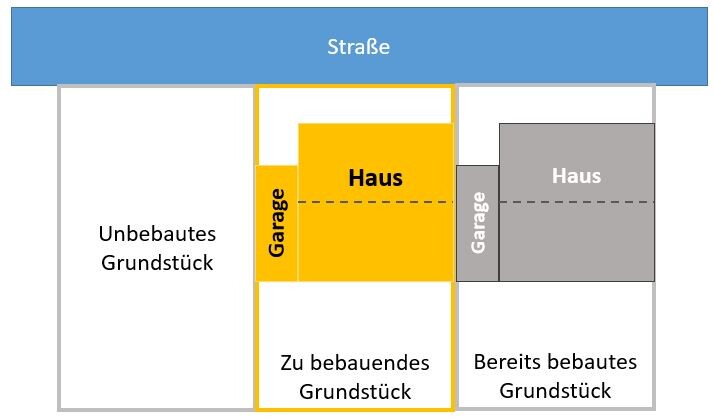
Border development – terrace house, meaning direct boundary development on the left (still vacant) and right (already developed)
Roof type – gable roof 35°-40°
Maximum heights / limits – ridge height max. 9.5 m (31 ft); eaves height max. 6.0 m (20 ft)
Client Requirements
Basement, floors – basement yes, 2 full floors, attic as potential conversion space
Number of people, ages – 3 persons (32, 34, 4)
House design
Planning source: do-it-yourself
Personal budget for the house: €300,000 + €50,000 basement + €50,000 ancillary building costs
What is the most important/basic question about the floor plan summarized in 130 characters?
Does the floor plan make sense as is, or could a small separate office be included through a smarter layout? Should certain rooms be bigger or smaller?
after the great advice on the topic of "terrace house" in the general forum, we have now purchased the small plot and will soon have the first more detailed discussions with general contractors (and possibly architects), from whom we would like to have the house built "turnkey."
Since I would like to be well prepared for the discussions and ask the right questions straight away, I would really appreciate any feedback, suggestions, or criticism on the first amateur floor plan draft.
The design and interior layout are not meant to be exact to the centimeter but rather to show what is basically possible within the building envelope. Since it is a terrace house, no windows are allowed on the east-facing wall. We are initially planning with a basement. Compared to many other examples here, this is probably a fairly classic or rather plain design for most, but I’m afraid not much else is possible.
Many thanks in advance!
Development Plan / Restrictions
Plot size – 240 sqm (2,583 sq ft)
Slope – none
Floor area ratio 0.4
Building envelope, building line, and boundary – 8.5 x 11 m (28 x 36 ft)
Border development – terrace house, meaning direct boundary development on the left (still vacant) and right (already developed)
Roof type – gable roof 35°-40°
Maximum heights / limits – ridge height max. 9.5 m (31 ft); eaves height max. 6.0 m (20 ft)
Client Requirements
Basement, floors – basement yes, 2 full floors, attic as potential conversion space
Number of people, ages – 3 persons (32, 34, 4)
House design
Planning source: do-it-yourself
Personal budget for the house: €300,000 + €50,000 basement + €50,000 ancillary building costs
What is the most important/basic question about the floor plan summarized in 130 characters?
Does the floor plan make sense as is, or could a small separate office be included through a smarter layout? Should certain rooms be bigger or smaller?

I would do many things the way you’ve already marked them in red.
Except for:
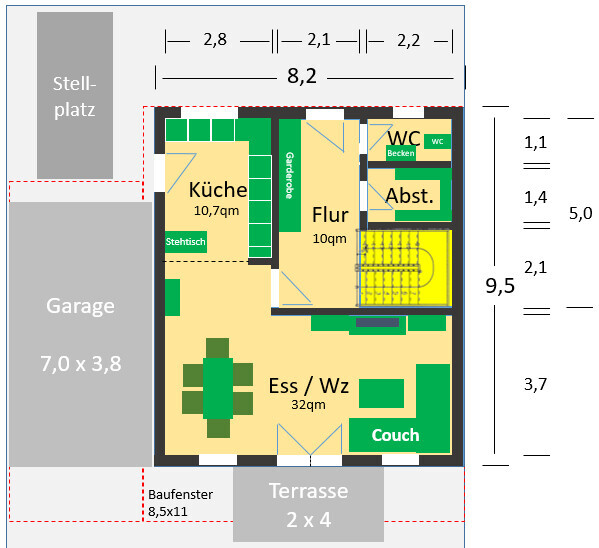
I would move the window in the living room further to the left and make it larger—fully opened!
Is the washing machine supposed to be in the bathroom even though you have a basement? I wouldn’t do that. I think I would redesign the bathroom. Making the door bigger is obvious. But does the toilet have to be directly straight ahead? Try shifting things around a bit if possible.
Does the staircase have a tread depth of 23cm (9 inches) or am I mistaken? I wouldn’t go below 25cm (10 inches).
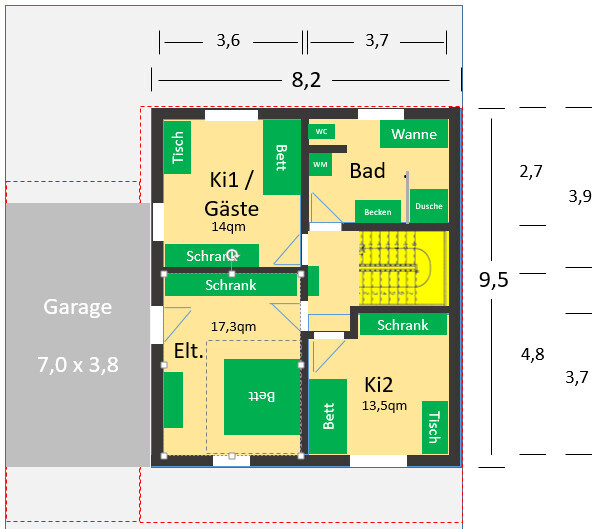
I would make the wall between the master bedroom and child’s room 2 thicker.
Except for:
I would move the window in the living room further to the left and make it larger—fully opened!
Is the washing machine supposed to be in the bathroom even though you have a basement? I wouldn’t do that. I think I would redesign the bathroom. Making the door bigger is obvious. But does the toilet have to be directly straight ahead? Try shifting things around a bit if possible.
Does the staircase have a tread depth of 23cm (9 inches) or am I mistaken? I wouldn’t go below 25cm (10 inches).
I would make the wall between the master bedroom and child’s room 2 thicker.

Thanks in advance!
Yes, we need to calculate more precisely how much window space we actually need for the room size or what makes sense. I think I read somewhere that there is a rule of thumb, like x square meters of living area = x square meters of window area.
Yes, it’s shown there in the plan, but no washing machine will actually go there.
That was just an initial idea. That’s why there’s a question mark — I thought it might be practical if someone is showering and someone else needs to use the toilet at the same time, so these two spots would be as far apart as possible. But yes, I still need to redo the bathroom layout; there are better options, especially for the tub and shower, which I would probably place more along the longer wall. Placing the toilet on the opposite side probably makes more sense as well, then it would be located “above” the guest toilet on the ground floor.
kaho674 schrieb:
I would move the window in the living room further to the left
Yes, we need to calculate more precisely how much window space we actually need for the room size or what makes sense. I think I read somewhere that there is a rule of thumb, like x square meters of living area = x square meters of window area.
kaho674 schrieb:
Is the washing machine supposed to be in the bathroom even though you have a basement?
Yes, it’s shown there in the plan, but no washing machine will actually go there.
kaho674 schrieb:
But does the toilet have to be straight ahead?
That was just an initial idea. That’s why there’s a question mark — I thought it might be practical if someone is showering and someone else needs to use the toilet at the same time, so these two spots would be as far apart as possible. But yes, I still need to redo the bathroom layout; there are better options, especially for the tub and shower, which I would probably place more along the longer wall. Placing the toilet on the opposite side probably makes more sense as well, then it would be located “above” the guest toilet on the ground floor.
I designed the bathroom differently in post 15.
Kitchen… is the plan for a floor-to-ceiling window on the left side? I find 280 cm (110 inches) almost too wide, especially if it could be a two-row layout. In that case, 250 cm (98 inches) would be sufficient. Also, as drawn, there is 160 cm (63 inches) of space between the tall cabinet block on the left (with the fridge?) and the kitchen run.
I would also avoid moving the living room window further to the right.
A stair with only a 23 cm (9 inches) tread depth on the landing… try to find a staircase like that and walk on it.
I would also divide the master bedroom more like in post 15. The headboard right next to the door with no side table… no.
And in general, check the door widths on the upper floor and how much usable depth remains behind the door. In the master bedroom, there should definitely be at least 70 cm (28 inches) behind the door to comfortably use the entire wall for a wardrobe.
Why does the bathroom on the ground floor need to have a shower?
Kitchen… is the plan for a floor-to-ceiling window on the left side? I find 280 cm (110 inches) almost too wide, especially if it could be a two-row layout. In that case, 250 cm (98 inches) would be sufficient. Also, as drawn, there is 160 cm (63 inches) of space between the tall cabinet block on the left (with the fridge?) and the kitchen run.
I would also avoid moving the living room window further to the right.
A stair with only a 23 cm (9 inches) tread depth on the landing… try to find a staircase like that and walk on it.
I would also divide the master bedroom more like in post 15. The headboard right next to the door with no side table… no.
And in general, check the door widths on the upper floor and how much usable depth remains behind the door. In the master bedroom, there should definitely be at least 70 cm (28 inches) behind the door to comfortably use the entire wall for a wardrobe.
Why does the bathroom on the ground floor need to have a shower?
Mbk84 schrieb:
Does the lack of feedback mean it’s more or less okay and there isn’t much left to optimize, or is it more of a "hopeless case"?I consider the half-landing staircase to be the wrong choice.
Also, the angled wall between the kitchen and living room stretches the space (kitchen) to its disadvantage.
For the kitchen, I would choose either one or the other width. I would segment the kitchen area slightly with a door. I would genuinely ensure that the living room corner also serves as a retreat area. Otherwise, constant presence can make you feel quite uncomfortable in your own home.
I would fully extend the shower on the ground floor and use the niche as well.
Swap the master bedroom with child’s room 1 (pay attention to the wardrobe wall, which must be swapped too).
Similar topics