
ᐅ Urban-style villa 160–170 m², issue with connecting the entrance foyer to the garage
Created on: 30 Jan 2019 22:08
H
Hemingway84H
Hemingway8430 Jan 2019 22:08Development Plan / Restrictions:
Plot size: 20.0 m x 30.0 m (600 m²)
Slope: none
Site coverage ratio: 0.4
Floor area ratio: 0.8
Building envelope, building line, and boundary: only the standard setbacks
Edge development: permitted for garages according to § 6 Abs. 8 Nr. 1 BbgBO
Number of parking spaces: 3 (required)
Number of floors: 2
Roof style: none
Architectural style: none
Orientation: none
Maximum heights / limits: eaves height max. 7.0 m (23 ft)
Additional requirements: roof pitch 25° to 45°
Client Requirements:
Architectural style, roof type, building type: Modern, hipped roof, urban villa
Basement, floors: no basement, 2 full floors
Number of occupants, age: 2 (34, 31), planning for future children
Space requirements on ground floor and upper floor: see layout in separate floor plans, approx. 160 - 170 m² (1722 - 1829 sq ft)
Office: home office with 2 fully equipped workstations (shared use)
Guest bedrooms per year: max. 2 at the same time, 4 to 6 times per year
Open or closed layout: closed
Conservative or modern construction: modern?
Open kitchen, kitchen island: closed (to contain odors), possibly a kitchen island, undecided
Number of dining seats: 6 in the dining room, 4 in the kitchen (high chair option)
Fireplace: rather no
Music / stereo wall: rather no
Balcony, roof terrace: definitely no
Garage, carport: garage connected to the house via a vestibule
Utility garden, greenhouse: no
Additional wishes / special features / daily routine, including reasons for preferences or exclusions: cat flap in vestibule from the house (location of cat litter box)
House Design:
Who designed it: DIY, compiled from sample floor plans
What do you like most? Why? The vestibule as a "buffer zone" and transition to the garage
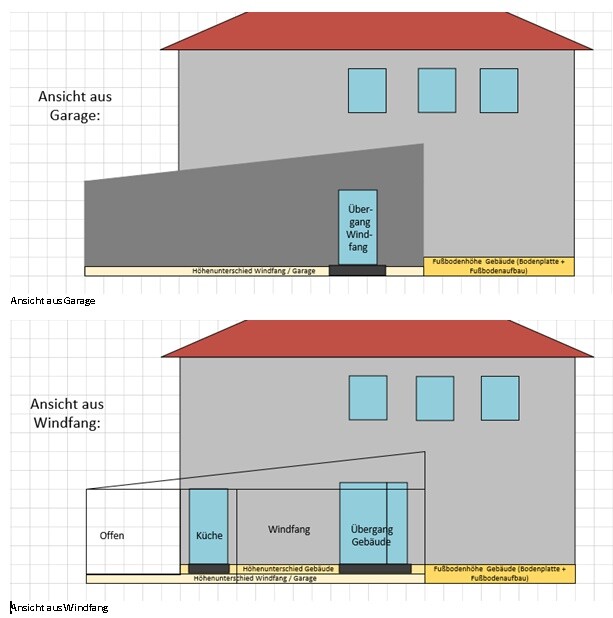
What do you not like? Why? The vestibule with garage can only be realized as edge development due to the plot width according to (§ 6 Abs. 8 Nr. 1 BbgBO). Difficulty managing height differences between garage and vestibule to house (floor slab height with floor build-up) due to maximum allowable average room height for garage with vestibule of 3.0 m (10 ft) (§ 6 Abs. 8 Nr. 1 BbgBO)
Price estimate according to architect/planner: pending; preliminary estimates put the house with special features (ventilation system, clear ceiling height 2.7 m (9 ft), BUS system, etc.) around 350,000 EUR, garage with vestibule about 50,000 EUR
Personal price limit for the house, including fittings: 350,000 EUR
Preferred heating system: heat pump, possibly gas if significantly cheaper and with the option for later conversion to heat pump
If you have to give up certain details/extensions
- What can you do without: BUS system, masonry garage (possibly similar solution with prefabricated garage if feasible)
- What you cannot do without: vestibule
Why is the design the way it is now?
Reviewed countless brochures, show homes, a felt optimum for the planned living area
What do you think is particularly good or bad about it?
If we knew. Apparently bad is the garage/vestibule planning, because it is complicated due to edge development and height differences to the house (the plot itself is flat, previously farmland), also expensive (50,000 EUR)
What is the essential question about the floor plan in 130 characters?
How can the garage with vestibule be realized cheaper, easier, or more smoothly (e.g., vestibule as bay window and prefab garage)?
By the way: street side is NW, garage NE, garden SE
Ideas, suggestions, criticism — everything welcome, especially regarding vestibule with garage!
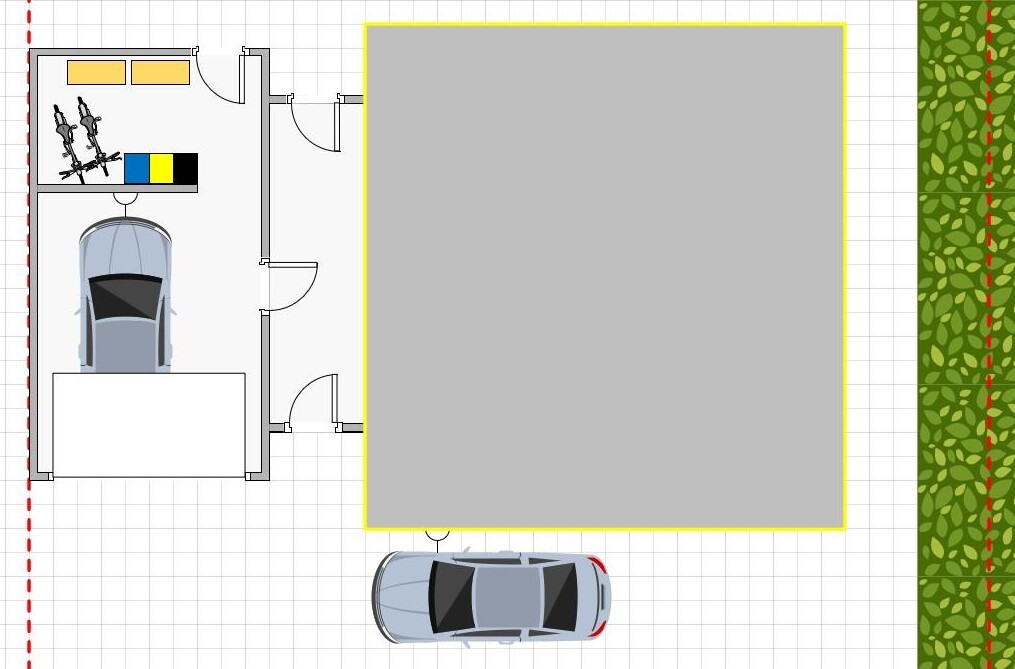
We want both to be simple but well built. Dry and sealed, uninsulated and unheated. During the first consultation, the preferred builder proposed instead a vestibule attached to the building envelope (extended bay window), mainly because of the height difference between building (floor slab height with floor buildup) and garage with vestibule. We would therefore opt for a flat roof with a height gradient from 3.5 m (11.5 ft) on the street side to 2.5 m (8 ft) on the garden side, with a compliant average wall height of 3.0 m (10 ft) (§ 6 Abs. 8 Nr. 1 BbgBO). A sketch of the side view can be found in the "Garage side" illustration, and a corresponding top view in the "Garage top" illustration.
At first glance, with such a roof gradient, it should be possible to compensate for the height differences from the garage area to the vestibule and from the vestibule into the building without the flat roof feeling oppressive at the transition to the building. The chosen flat roof variant is designed for internal roof drainage, avoiding any roof overhangs. We can only guess what the standard clear floor height (floor slab plus floor build-up) over finished ground level usually is. For simplicity in our sketches, we assumed 50 cm (20 inches). From this, we derived 25 cm (10 inches) for the vestibule and 0 cm (0 inches) for the garage. Realistically, 50 cm (20 inches) is probably the upper limit, with more typical heights between 30 and 40 cm (12 and 16 inches).
Plot size: 20.0 m x 30.0 m (600 m²)
Slope: none
Site coverage ratio: 0.4
Floor area ratio: 0.8
Building envelope, building line, and boundary: only the standard setbacks
Edge development: permitted for garages according to § 6 Abs. 8 Nr. 1 BbgBO
Number of parking spaces: 3 (required)
Number of floors: 2
Roof style: none
Architectural style: none
Orientation: none
Maximum heights / limits: eaves height max. 7.0 m (23 ft)
Additional requirements: roof pitch 25° to 45°
Client Requirements:
Architectural style, roof type, building type: Modern, hipped roof, urban villa
Basement, floors: no basement, 2 full floors
Number of occupants, age: 2 (34, 31), planning for future children
Space requirements on ground floor and upper floor: see layout in separate floor plans, approx. 160 - 170 m² (1722 - 1829 sq ft)
Office: home office with 2 fully equipped workstations (shared use)
Guest bedrooms per year: max. 2 at the same time, 4 to 6 times per year
Open or closed layout: closed
Conservative or modern construction: modern?
Open kitchen, kitchen island: closed (to contain odors), possibly a kitchen island, undecided
Number of dining seats: 6 in the dining room, 4 in the kitchen (high chair option)
Fireplace: rather no
Music / stereo wall: rather no
Balcony, roof terrace: definitely no
Garage, carport: garage connected to the house via a vestibule
Utility garden, greenhouse: no
Additional wishes / special features / daily routine, including reasons for preferences or exclusions: cat flap in vestibule from the house (location of cat litter box)
House Design:
Who designed it: DIY, compiled from sample floor plans
What do you like most? Why? The vestibule as a "buffer zone" and transition to the garage
What do you not like? Why? The vestibule with garage can only be realized as edge development due to the plot width according to (§ 6 Abs. 8 Nr. 1 BbgBO). Difficulty managing height differences between garage and vestibule to house (floor slab height with floor build-up) due to maximum allowable average room height for garage with vestibule of 3.0 m (10 ft) (§ 6 Abs. 8 Nr. 1 BbgBO)
Price estimate according to architect/planner: pending; preliminary estimates put the house with special features (ventilation system, clear ceiling height 2.7 m (9 ft), BUS system, etc.) around 350,000 EUR, garage with vestibule about 50,000 EUR
Personal price limit for the house, including fittings: 350,000 EUR
Preferred heating system: heat pump, possibly gas if significantly cheaper and with the option for later conversion to heat pump
If you have to give up certain details/extensions
- What can you do without: BUS system, masonry garage (possibly similar solution with prefabricated garage if feasible)
- What you cannot do without: vestibule
Why is the design the way it is now?
Reviewed countless brochures, show homes, a felt optimum for the planned living area
What do you think is particularly good or bad about it?
If we knew. Apparently bad is the garage/vestibule planning, because it is complicated due to edge development and height differences to the house (the plot itself is flat, previously farmland), also expensive (50,000 EUR)
What is the essential question about the floor plan in 130 characters?
How can the garage with vestibule be realized cheaper, easier, or more smoothly (e.g., vestibule as bay window and prefab garage)?
By the way: street side is NW, garage NE, garden SE
Ideas, suggestions, criticism — everything welcome, especially regarding vestibule with garage!
We want both to be simple but well built. Dry and sealed, uninsulated and unheated. During the first consultation, the preferred builder proposed instead a vestibule attached to the building envelope (extended bay window), mainly because of the height difference between building (floor slab height with floor buildup) and garage with vestibule. We would therefore opt for a flat roof with a height gradient from 3.5 m (11.5 ft) on the street side to 2.5 m (8 ft) on the garden side, with a compliant average wall height of 3.0 m (10 ft) (§ 6 Abs. 8 Nr. 1 BbgBO). A sketch of the side view can be found in the "Garage side" illustration, and a corresponding top view in the "Garage top" illustration.
At first glance, with such a roof gradient, it should be possible to compensate for the height differences from the garage area to the vestibule and from the vestibule into the building without the flat roof feeling oppressive at the transition to the building. The chosen flat roof variant is designed for internal roof drainage, avoiding any roof overhangs. We can only guess what the standard clear floor height (floor slab plus floor build-up) over finished ground level usually is. For simplicity in our sketches, we assumed 50 cm (20 inches). From this, we derived 25 cm (10 inches) for the vestibule and 0 cm (0 inches) for the garage. Realistically, 50 cm (20 inches) is probably the upper limit, with more typical heights between 30 and 40 cm (12 and 16 inches).

A lot of text – little substance.
So, what is it? A slope or no slope? If yes, how steep is the gradient in the building plot? If not, where is the problem? It can’t really be the 20cm (8 inches) height difference between the garage and the house’s concrete slab, or is it? If that really is an issue for the garage roof, then I’d just raise one row of blocks higher. Problem solved.
It’s best to sketch the building plot. I probably didn’t understand something there.
By the way: a requirement for 3 parking spaces on a 600m² (6458 sq ft) lot – I’d sue the city planners! What if someone doesn’t have or want a car? All that ground is compacted unnecessarily. They must be crazy.
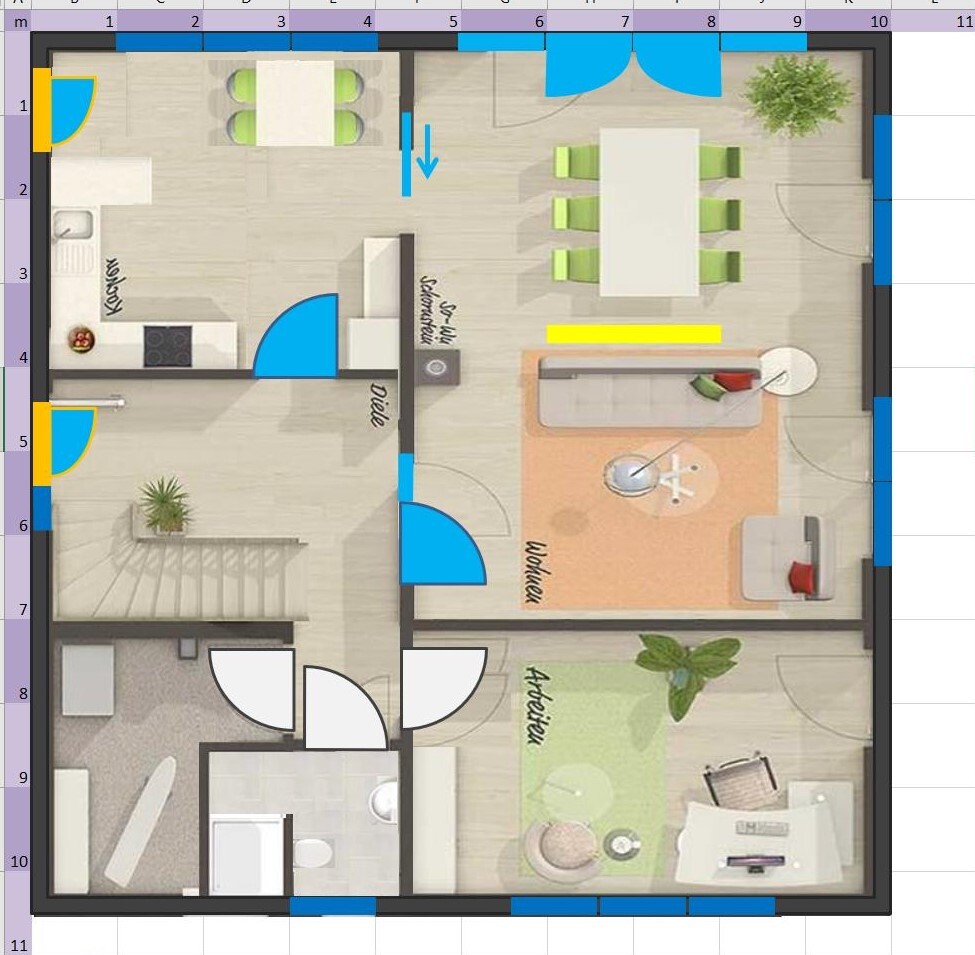
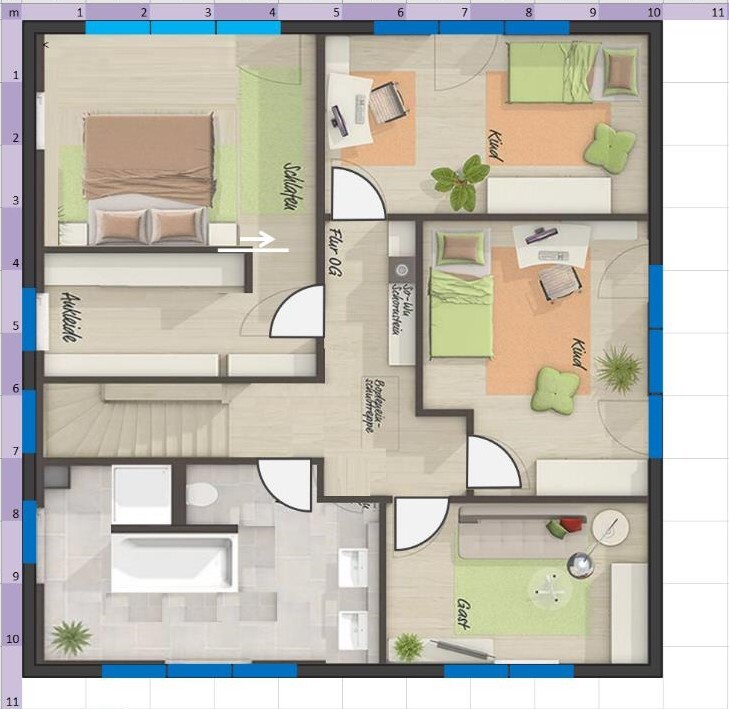
Regarding the floor plan: Town & Country greetings. The guest room upstairs is probably intended to become the utility room? Otherwise, I can’t imagine where the washing machine would go. The tiny technical room downstairs is already barely big enough to fit everything. Apart from that – the standard design is fine. Whether all those wall angles upstairs are really necessary to make the bathroom bigger is hard to judge without measurements.
By the way, we also have a cat flap in the house. Welcome to the club.
So, what is it? A slope or no slope? If yes, how steep is the gradient in the building plot? If not, where is the problem? It can’t really be the 20cm (8 inches) height difference between the garage and the house’s concrete slab, or is it? If that really is an issue for the garage roof, then I’d just raise one row of blocks higher. Problem solved.
It’s best to sketch the building plot. I probably didn’t understand something there.
By the way: a requirement for 3 parking spaces on a 600m² (6458 sq ft) lot – I’d sue the city planners! What if someone doesn’t have or want a car? All that ground is compacted unnecessarily. They must be crazy.
Regarding the floor plan: Town & Country greetings. The guest room upstairs is probably intended to become the utility room? Otherwise, I can’t imagine where the washing machine would go. The tiny technical room downstairs is already barely big enough to fit everything. Apart from that – the standard design is fine. Whether all those wall angles upstairs are really necessary to make the bathroom bigger is hard to judge without measurements.
By the way, we also have a cat flap in the house. Welcome to the club.
kaho674 schrieb:
Whether all those wall jogs at the top are really necessary just to make the bathroom bigger is hard to judge without dimensions.Correct me if I’m wrong, but I would say "NO."Since Child 1 has grown taller now, you could reconsider moving the wall between the children's rooms until the square meters are equal again.
Oh, and the toilet has swapped places with the shower.
M
Mottenhausen31 Jan 2019 14:31I would save the extra costs for floor plan changes with Town & Country. Either build as designed or plan freely.
On one hand, the staircase seems much shorter than it should be. On the other hand, the walls appear very thin to me.
Is Town & Country supposed to be the general contractor? They still build with ultra-thin walls – I don’t even know how they fit the insulation in.
Still, the living room, with a depth of three meters (10 feet), isn’t exactly spacious... A 6-room house on a 10 x 10 meter (33 x 33 feet) footprint... this is the first time I’ve seen that.
Dimensions, and not just approximate ones but for every wall, would be helpful. That way, you can also see where there are tight spots.
The entrance area feels a bit like a mistake.
Is Town & Country supposed to be the general contractor? They still build with ultra-thin walls – I don’t even know how they fit the insulation in.
Still, the living room, with a depth of three meters (10 feet), isn’t exactly spacious... A 6-room house on a 10 x 10 meter (33 x 33 feet) footprint... this is the first time I’ve seen that.
Dimensions, and not just approximate ones but for every wall, would be helpful. That way, you can also see where there are tight spots.
The entrance area feels a bit like a mistake.