
ᐅ Architect’s Responsibilities Regarding KfW Funding Interest and Additional Matters
Created on: 13 Jul 2018 11:44
R
Ruhrgebiet23
Hello everyone,
We purchased a house in February this year. It’s a semi-detached house from the 1950s, generally in good, old condition. It quickly became clear to us that we wanted and were able to invest a significant amount of money (up to around 300,000,000 Euros) to have everything done “properly.” We found an architect through a distant acquaintance who accompanied us for the inspection in December.
The purchase was completed in February, and we hoped for a quick submission of the building permit / planning permission application — we intended to renovate everything (new heating system, pipes, insulation, windows, etc.) and extend the back. We already had a draft design, which was roughly adopted and, of course, detailed further. The architect informed us at the second meeting that he had a new employee who would be responsible for our project. We were a bit surprised but accepted it. Some mistakes have been made by him (e.g., compass directions on the building permit incorrectly shown — my husband noticed this before submission; errors concerning the development boundaries, which, however, were never acknowledged), but that is not the main point here.
The original architect quickly made it clear that he was rather skeptical about insulation. As a result, we also assumed that achieving low-energy house standards or similar would not be possible. However, we stated early on that we were very interested in a photovoltaic system for hot water.
The building permit / planning permission was submitted three months ago, and since then we have been waiting — no one is responsible for the delay (at least not the architect). Meanwhile, we have been constantly trying to discuss KfW (government) funding programs with the architects. Both say that adapting the house to be age-appropriate is easier to implement than energy-efficient renovation. Because we persistently asked, they have now admitted that funding measures for energy-efficient renovation are also possible. Regarding further information, they consistently refer us to a financial advisor, who can only tell us that loan terms there are generally better than at our regular bank. We have now brought in an energy consultant to assess what really makes sense for our property. She believes that insulation according to the Energy Saving Ordinance is quite reasonable and not much more expensive. She met with the architects earlier this week.
We have already asked the architects several times to prepare a detailed cost breakdown — so far, we only have a rough estimate from 02/2018. But in order to decide what kind of funding might be suitable FOR US, we need comparable figures. Is that really too much to ask? What can we reasonably expect from the architect? He is contracted for all phases of the project.
We feel that the architects simply want to keep the planning effort as low as possible. We have to raise many issues multiple times before they are considered. For example, we asked for a drywall partition wall to the neighbor to be planned. At the last meeting, we were asked to finalize the kitchen plan as soon as possible. When we finally got the dimensions, we asked again if the drywall partition had been included. It had not. This has been repeated with many things so far, where we as laypeople have to remind them constantly. We certainly will not be able to think of everything... The new architect independently handles the exterior design of the entrance area — when we point out efflorescence in the basement, he replies that he can look into it during construction. We are laypeople, but their priorities don’t seem very logical to us...
Maybe I’m mistaken, so I would appreciate your assessments.
Best regards!
We purchased a house in February this year. It’s a semi-detached house from the 1950s, generally in good, old condition. It quickly became clear to us that we wanted and were able to invest a significant amount of money (up to around 300,000,000 Euros) to have everything done “properly.” We found an architect through a distant acquaintance who accompanied us for the inspection in December.
The purchase was completed in February, and we hoped for a quick submission of the building permit / planning permission application — we intended to renovate everything (new heating system, pipes, insulation, windows, etc.) and extend the back. We already had a draft design, which was roughly adopted and, of course, detailed further. The architect informed us at the second meeting that he had a new employee who would be responsible for our project. We were a bit surprised but accepted it. Some mistakes have been made by him (e.g., compass directions on the building permit incorrectly shown — my husband noticed this before submission; errors concerning the development boundaries, which, however, were never acknowledged), but that is not the main point here.
The original architect quickly made it clear that he was rather skeptical about insulation. As a result, we also assumed that achieving low-energy house standards or similar would not be possible. However, we stated early on that we were very interested in a photovoltaic system for hot water.
The building permit / planning permission was submitted three months ago, and since then we have been waiting — no one is responsible for the delay (at least not the architect). Meanwhile, we have been constantly trying to discuss KfW (government) funding programs with the architects. Both say that adapting the house to be age-appropriate is easier to implement than energy-efficient renovation. Because we persistently asked, they have now admitted that funding measures for energy-efficient renovation are also possible. Regarding further information, they consistently refer us to a financial advisor, who can only tell us that loan terms there are generally better than at our regular bank. We have now brought in an energy consultant to assess what really makes sense for our property. She believes that insulation according to the Energy Saving Ordinance is quite reasonable and not much more expensive. She met with the architects earlier this week.
We have already asked the architects several times to prepare a detailed cost breakdown — so far, we only have a rough estimate from 02/2018. But in order to decide what kind of funding might be suitable FOR US, we need comparable figures. Is that really too much to ask? What can we reasonably expect from the architect? He is contracted for all phases of the project.
We feel that the architects simply want to keep the planning effort as low as possible. We have to raise many issues multiple times before they are considered. For example, we asked for a drywall partition wall to the neighbor to be planned. At the last meeting, we were asked to finalize the kitchen plan as soon as possible. When we finally got the dimensions, we asked again if the drywall partition had been included. It had not. This has been repeated with many things so far, where we as laypeople have to remind them constantly. We certainly will not be able to think of everything... The new architect independently handles the exterior design of the entrance area — when we point out efflorescence in the basement, he replies that he can look into it during construction. We are laypeople, but their priorities don’t seem very logical to us...
Maybe I’m mistaken, so I would appreciate your assessments.
Best regards!
R
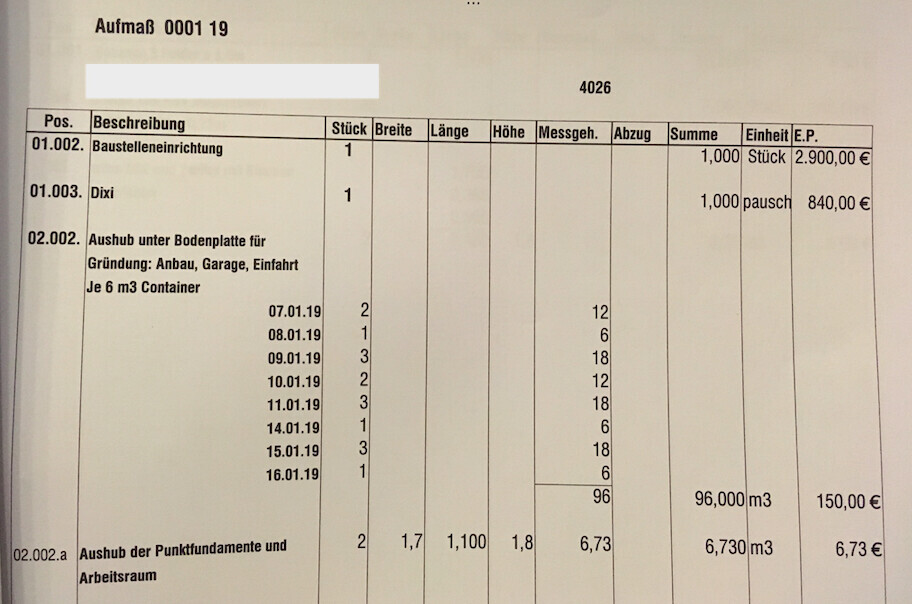
Ruhrgebiet2328 Jan 2019 19:43On Friday, we received the certificates, the invoice from the structural contractor, and the revised invoice from the architect. Included were two pages, but we are not sure whether they come from the architect or the structural contractor. These pages also list other items, including excavation work (see picture). However, the garage area has NOT been excavated yet.
Ruhrgebiet23 schrieb:
Does anyone perhaps have overviews for such inspections? Yes. The cost estimate from your architect based on DIN 276 according to HOAI service phase 4 should serve as a guideline here.
R
Ruhrgebiet2328 Jan 2019 19:44MayrCh schrieb:
Unfortunately, this doesn’t help if the scope of work / bill of quantities is poorly prepared and the listed quantities are incorrect or just rough estimates.
For example, in excavation and disposal, I’m missing details about the installation class / classification value (Z0-Z2). Just disposing of Z2 material alone costs over 50€/t (tons). Added to that are landfill acceptance fees, handling, and sampling, which quickly add a significant amount per ton. The risk of having to dispose of Z2 material at your own expense due to unclear specifications is borne by very few or no one.
In short: construction costs in individual contracts heavily depend on the quality of the tender documents. If the bill of quantities is poor or vague, high costs arise in individual items, additional costs due to increased quantities, and additional claims that are often already drafted and waiting even before the contract is confirmed.Do you have any tips on how we can avoid getting burned again? :-(
R
Ruhrgebiet2328 Jan 2019 19:46MayrCh schrieb:
Yes. The cost estimate from your architect according to DIN 276 in HOAI service phase 4 should be used as a guideline here.Unfortunately, we still don’t have it, but we have requested it. Today, we received an email: "Mr. xy [former architect] and I are currently working on an updated cost estimate."
This clearly shows a breach of duty – he still does not provide a cost quotation.
I have one more idea, maybe someone can correct me: Was the shell construction contractor hired under the VOB (German Construction Contract Procedures)? Was their offer based on the quantities specified in the tender? Is the invoicing done according to the actual quantities at the agreed unit prices?
If so, a) their performed work must also be paid for (which could be expensive for the original poster).
However, the shell contractor was obligated to immediately report any increases in quantities as soon as they became apparent. The originally offered quantities can then be billed at the agreed unit prices. Any excess quantities must be recalculated upon your request, and this recalculation must be documented and proven. Perhaps this could help recover some costs.
If so, a) their performed work must also be paid for (which could be expensive for the original poster).
However, the shell contractor was obligated to immediately report any increases in quantities as soon as they became apparent. The originally offered quantities can then be billed at the agreed unit prices. Any excess quantities must be recalculated upon your request, and this recalculation must be documented and proven. Perhaps this could help recover some costs.

MayrCh schrieb:
The cost estimate from your architect based on DIN 276 according to HOAI service phase 4 should serve as a guideline here.The cost estimate logically only exists at the tendering stage (service phase 7), and it merely reflects what the companies included in the bill of quantities (BOQ). It therefore does not protect against additional costs or incorrectly planned quantities.
At this point, the only document you could realistically request is the cost calculation (service phase 3). However, I doubt that this will be more substantial than the rough estimate provided by the architect.
My position remains: in the end, it will cost what it will cost. Savings are only possible on “non-essential” items such as external thermal insulation composite systems (ETICS), the garage, or by reducing the level of execution quality.
Of course, it is desirable to know in advance where things are headed, but in your case the train has already left the station—the loan agreement is signed, and construction has started. So why waste energy now wondering how things could or should have been?
Similar topics