
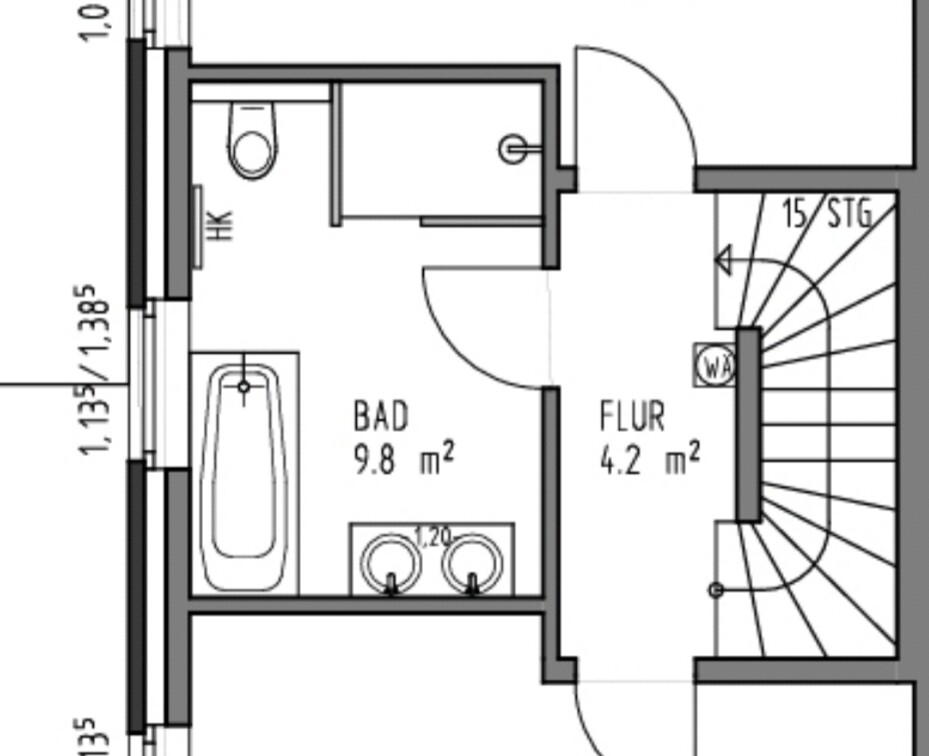
We are planning a walk-in shower: 1.5 m (5 feet) wide and 1 m (3 feet) deep.
Since the architect designed the toilet in a way that makes access somewhat awkward, I have the following questions:
1) Where and how large would you make the shower entrance?
2) Is just an opening enough, or would you partially extend the wall into the shower as shown in the drawing? Or should a glass door be installed?
3) Or do you think leaving the side facing the toilet open and entering from there is better? I find that a bit too narrow and unattractive myself.
Thank you for your ideas and tips

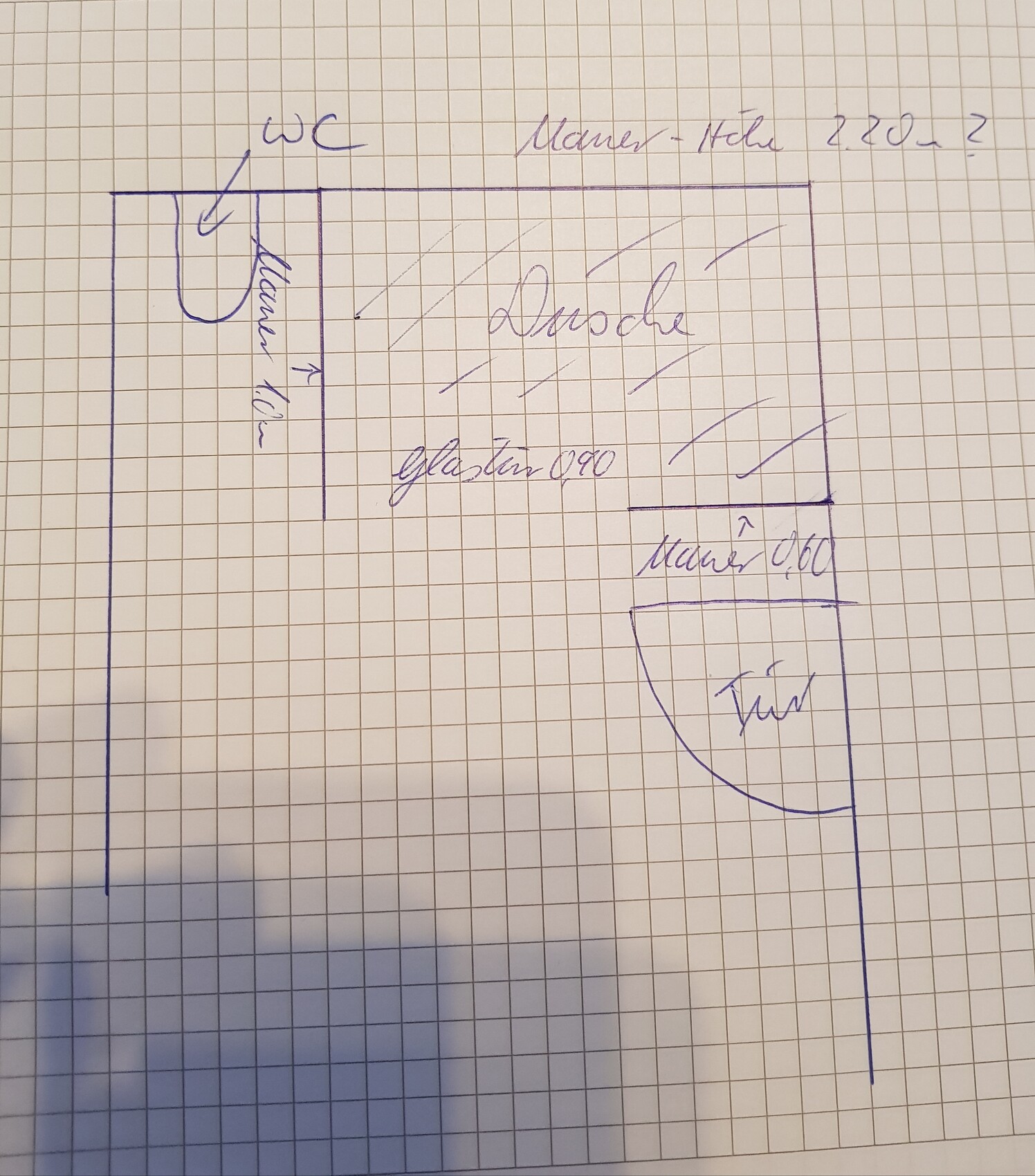
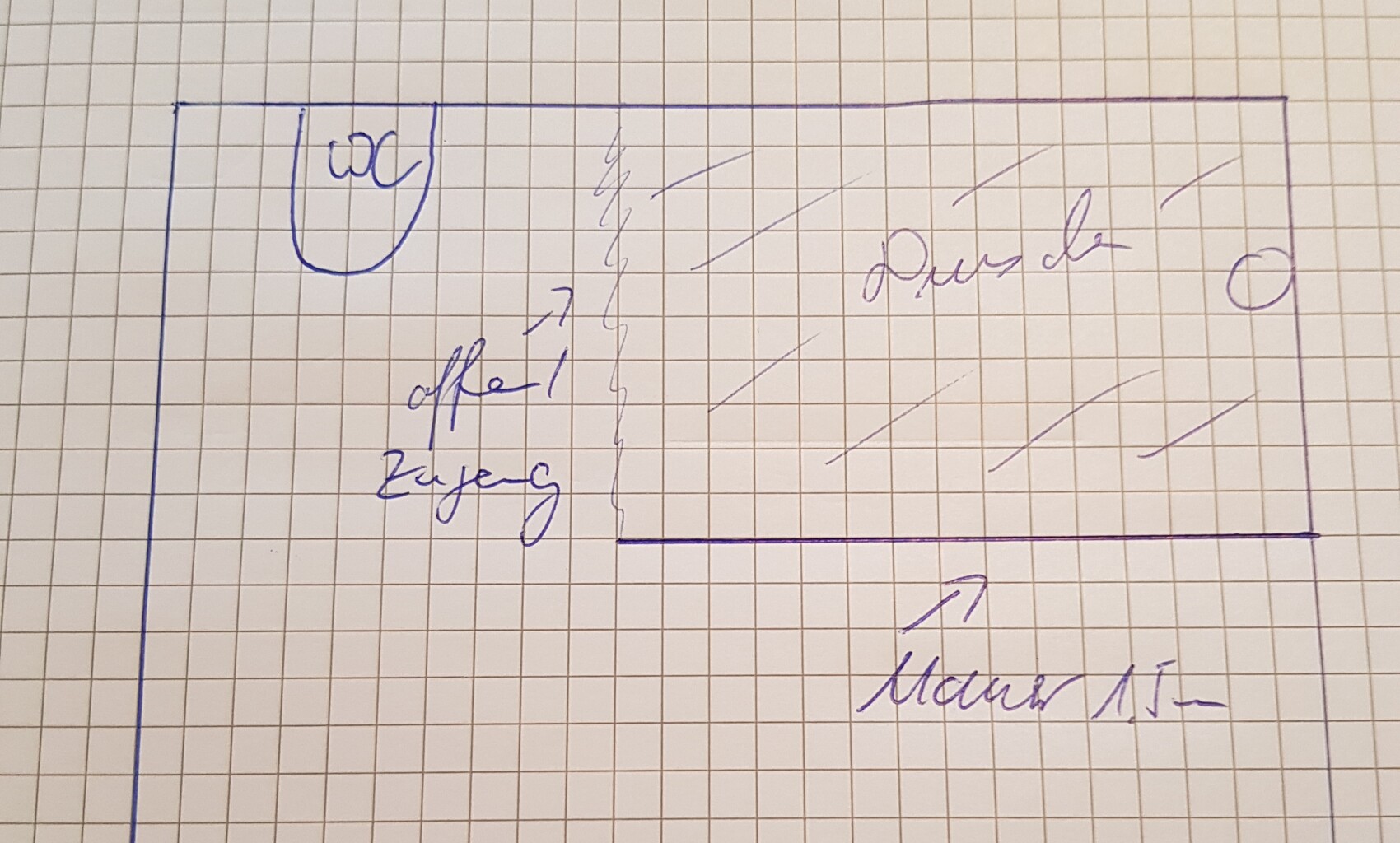
Since the architect designed the toilet in a way that makes access somewhat awkward, I have the following questions:
1) Where and how large would you make the shower entrance?
2) Is just an opening enough, or would you partially extend the wall into the shower as shown in the drawing? Or should a glass door be installed?
3) Or do you think leaving the side facing the toilet open and entering from there is better? I find that a bit too narrow and unattractive myself.
Thank you for your ideas and tips
A bit off-topic, but: what exactly makes a walk-in shower a walk-in shower? Is it the level floor, the absence of a shower tray (there are ultra-low-profile trays, and tiled showers can also have height differences), or the lack of a door? Or a combination of these? I mean, you can enter any shower, even models that could be repurposed as children’s bathtubs.
By the way, I don’t like doorless showers; I feel uncomfortable, exposed, and unprotected in them.
By the way, I don’t like doorless showers; I feel uncomfortable, exposed, and unprotected in them.
LarsRud schrieb:
Or how would you divide this bathroom? Everything is still flexible in the planning stage. The door can also be relocated to the side.
It’s possible that we are already stuck in a certain perspective.ypg schrieb:
If I were you, I would download a bathroom planner tool online (for example, from Villeroy & Boch) and optimize the bathroom layout with exact measurements. As a quick suggestion, you could move the door to create different wall spaces.
Maybe the window can be repositioned as well? It would always be best to have the shower wall at 1.50 m (4 ft 11 in), so you have minimal splashing even without a door. Ideally, even longer.
If you plan the shower as it’s currently drawn, with a 60 cm (24 in) passage, you’d end up with a partition length of 80 or 90 cm (31 or 35 in) — in that case, you might as well skip the 50 cm (20 in) and design a standard shower of 100 x 100 cm (39 x 39 in) between two walls with a shower door.
(70 cm (28 in) should be the minimum passage width, though.)
When asking here in the forum, it’s always helpful to include how many people will use the bathroom, add measurements, clarify what can still be adjusted, explain why the drain is planned where it is, and so on.
That way, the answers can be more valuable, sometimes even including sketches.Measurements and everything else... The door is already settled.
Kekse schrieb:
A bit off-topic, but: what exactly makes a walk-in shower a walk-in shower? Is it the level flooring, the absence of a shower tray (which can be very shallow anyway, and tiled showers can also have height differences), or the missing door? Or a combination of these? You can hopefully walk into any shower, even models that could be repurposed as a child’s bathtub.
By the way, I don’t like doorless showers; I feel uneasy, watched, and unprotected in them.No, a true walk-in shower has absolutely no barriers. None. No threshold, no door, nothing. It is designed to be usable even when you are old, disabled, need to shower sitting down, or require assistance with drying. That’s the whole point for us. Karsten
S
sauerland30 Jan 2019 17:24Here is what comes to mind spontaneously:
I would have the radiator installed next to the door (warm towels ) within easy reach of the sink, and then position the window more towards the toilet. That way, the window should be easier to clean than if it were partly above the bathtub.
I would have the radiator installed next to the door (warm towels ) within easy reach of the sink, and then position the window more towards the toilet. That way, the window should be easier to clean than if it were partly above the bathtub.
M
Mottenhausen31 Jan 2019 13:18Here is the excerpt from our construction plan: (the width of the toilet niche is about 1m (3.3 feet), the measurement is shown somewhere outside the plan.)
The length of the splash guard wall is therefore approximately 1.40m (4.6 feet), while the other according to the plan is 1.16m (3.8 feet). We spent a long time deliberating, measuring, and consulting. Conclusion: there will probably be minimal splashing. But making the toilet niche narrower, narrowing the shower entrance, or redesigning the entire house were not options.
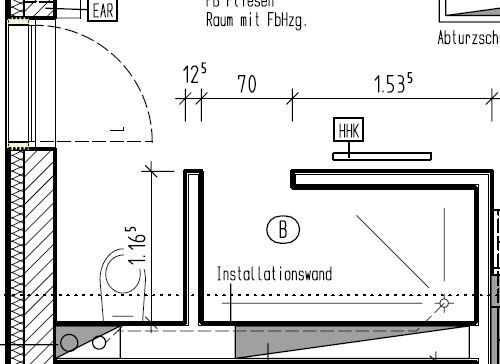
The length of the splash guard wall is therefore approximately 1.40m (4.6 feet), while the other according to the plan is 1.16m (3.8 feet). We spent a long time deliberating, measuring, and consulting. Conclusion: there will probably be minimal splashing. But making the toilet niche narrower, narrowing the shower entrance, or redesigning the entire house were not options.
H
hemali200331 Jan 2019 22:07We chose the version from your architect’s design but extended it by 10cm (4 inches). The passage is 70cm (28 inches) wide, so the wall at the bottom of the plan is 90cm (35 inches) and the wall on the left side of the plan is 100cm (39 inches) or 110cm (43 inches) to align with the other wall at the front. There is no door. The walls are 2m (6 ft 7 in) high. Installing the drywall was a bit tricky to ensure the walls stand firmly.
I think it’s perfect. The 10 drops that sometimes end up in front of the passage are quickly wiped away with the towel.
There’s no draft either! Because the entire room warms up during showering, not just the enclosed shower area. That’s really not an issue.
I think it’s perfect. The 10 drops that sometimes end up in front of the passage are quickly wiped away with the towel.
There’s no draft either! Because the entire room warms up during showering, not just the enclosed shower area. That’s really not an issue.
Similar topics