
Hello community,
with our first post, we would like to ask for help regarding our building project and would appreciate any suggestions and advice.
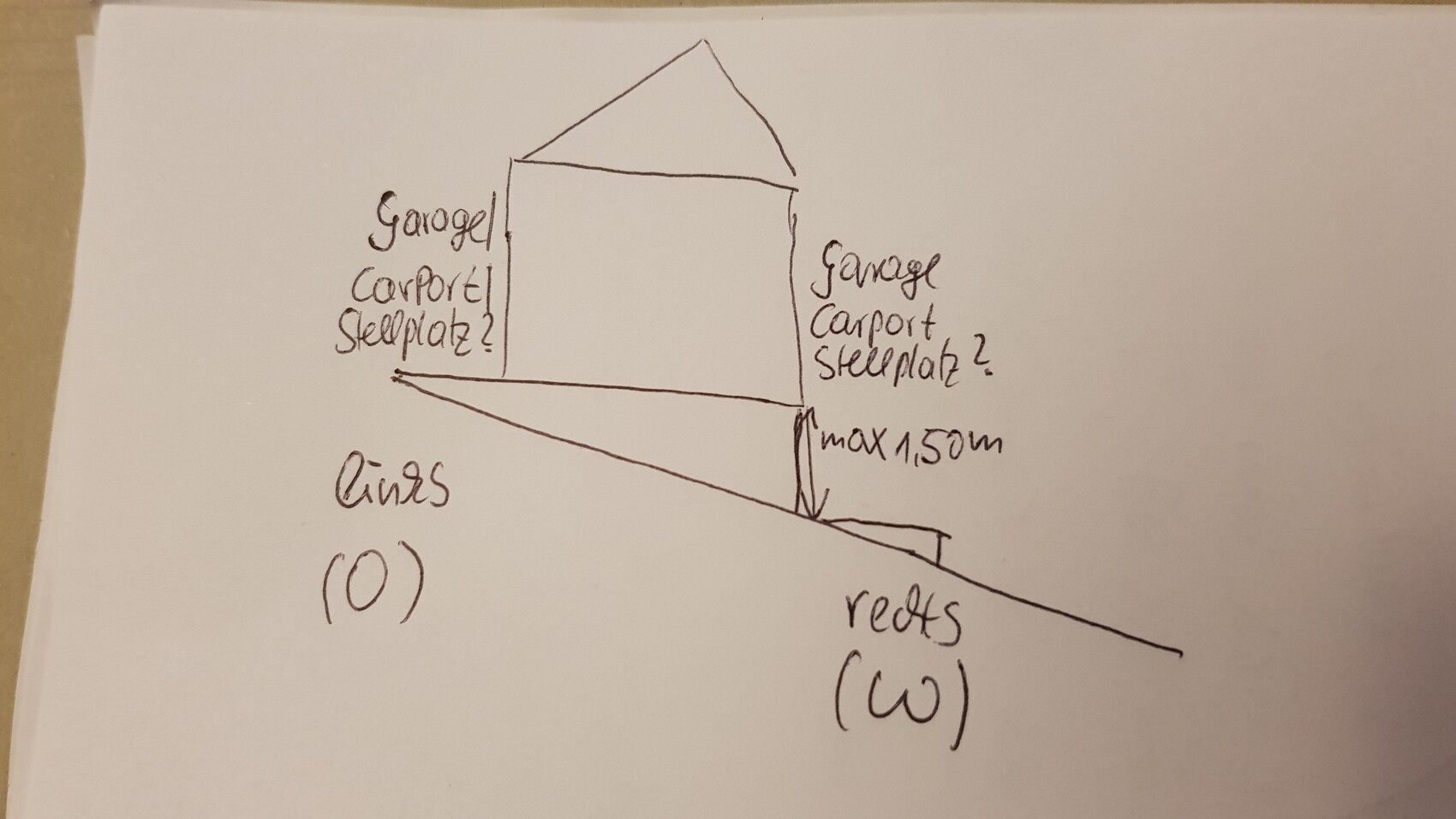
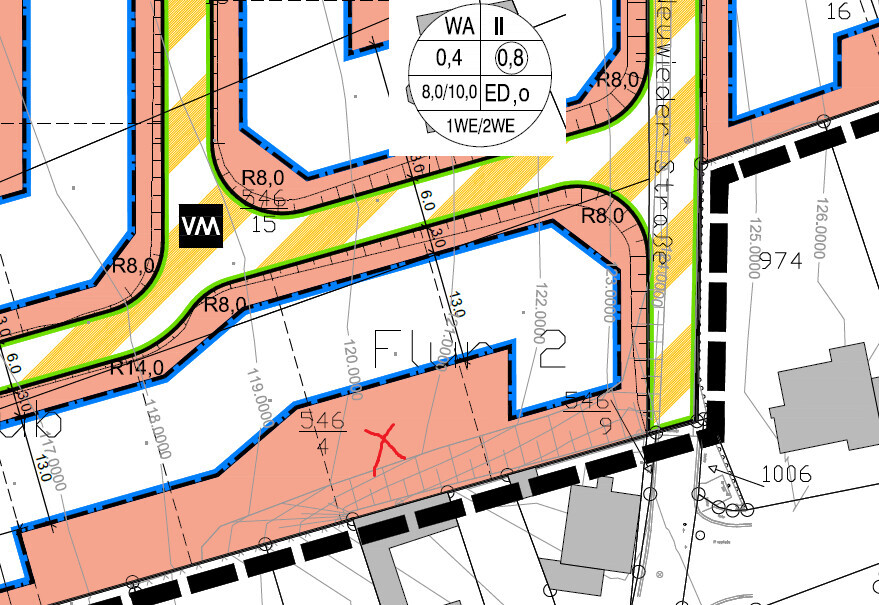
We are planning to build the house on a slight slope. The property is 18m (59 feet) wide, with a drop of about 1.5m (5 feet) along this length, which is approximately 8.3% (see sketch from east to west as well as a section of the development plan/planning permission).
To make the best use of the width, parking spaces will be created on both the left and right sides of the house in the form of at least one garage and one parking space/carport each (requirement according to the development plan/planning permission: 2 parking spaces). This way, the setback from the boundary line will be optimized and the house can theoretically be 12m (39 feet) wide. Due to the 1.5m (5 feet) fill, the parking space on the right side will inevitably be lower than the house because of the slope.
Now we are wondering if the fill can be built as shown in the sketch and also be retained flush with the house wall, and if so, how—using L-shaped retaining blocks or retaining walls—and what the approximate cost might be.
Thank you very much
with our first post, we would like to ask for help regarding our building project and would appreciate any suggestions and advice.
We are planning to build the house on a slight slope. The property is 18m (59 feet) wide, with a drop of about 1.5m (5 feet) along this length, which is approximately 8.3% (see sketch from east to west as well as a section of the development plan/planning permission).
To make the best use of the width, parking spaces will be created on both the left and right sides of the house in the form of at least one garage and one parking space/carport each (requirement according to the development plan/planning permission: 2 parking spaces). This way, the setback from the boundary line will be optimized and the house can theoretically be 12m (39 feet) wide. Due to the 1.5m (5 feet) fill, the parking space on the right side will inevitably be lower than the house because of the slope.
Now we are wondering if the fill can be built as shown in the sketch and also be retained flush with the house wall, and if so, how—using L-shaped retaining blocks or retaining walls—and what the approximate cost might be.
Thank you very much

F
fsbau20195 Jan 2019 18:29tomtom79 schrieb:
That is more than 1.5 meters (5 feet) If anything, it is less than or exactly 1.5 meters (5 feet), since the drilling points were measured.
The photos, especially those taken by hand, are just as informative as your subjective impression on site for the reasons mentioned by @11ant in post #41. To get an accurate understanding of the topography, you would need a leveled camera with known lens parameters and clearly defined reference objects, such as vertically positioned 2m (6.6 ft) survey rods. A better and easier method would be a plan with at least 8 elevation points: the four corners of the plot and the corresponding points at the base of the slope.
And where are these? Visit the local authority. They should have the road development plan with detailed, closely spaced elevation data. There should also be elevation points visible on the plot for connection purposes. Maybe they will provide you with a section copy.
Based on the contour lines, that’s plausible. As mentioned, I would rotate the house to further reduce the height difference.
Pure speculation!
fsbau2019 schrieb:
I only have the two surveyed borehole points from the soil report in relation to the road
And where are these? Visit the local authority. They should have the road development plan with detailed, closely spaced elevation data. There should also be elevation points visible on the plot for connection purposes. Maybe they will provide you with a section copy.
fsbau2019 schrieb:
I can imagine leveling, meaning cutting in 0.45m (1.5 ft) on the left and filling 0.45m (1.5 ft) on the right.
Based on the contour lines, that’s plausible. As mentioned, I would rotate the house to further reduce the height difference.
tomtom79 schrieb:
That’s more than 1.5 meters (4.9 ft)
fsbau2019 schrieb:
If anything, it’s less or exactly 1.5m (4.9 ft)
Pure speculation!
C
chand19866 Jan 2019 09:41If the exact measurements are not readily available, you can buy 30 meters (100 feet) of inexpensive transparent tubing at a hardware store and measure the site yourself with two people.
Fill it with water, and at the lower end, one person holds the tube high enough so that the water levels at both ends are the same. This should be easily done up to 2 meters (6.5 feet) without a ladder. Then use a tape measure to check the height. It doesn’t have to be accurate to the nearest centimeter. It’s still much better than the rough estimates often done here.
Fill it with water, and at the lower end, one person holds the tube high enough so that the water levels at both ends are the same. This should be easily done up to 2 meters (6.5 feet) without a ladder. Then use a tape measure to check the height. It doesn’t have to be accurate to the nearest centimeter. It’s still much better than the rough estimates often done here.
@escorda
@chand
The technical expert was on site and received tips on how to measure the layout but still didn’t do it. So, he simply doesn’t care if it costs more; he can afford it.
Regarding my statement, yes, I made an estimate, but I based it on the sale of the wall.
PS. I really don’t care whether it’s 1 meter or 2 meters (3 feet 3 inches or 6 feet 6 inches); it’s not my property.
@chand
The technical expert was on site and received tips on how to measure the layout but still didn’t do it. So, he simply doesn’t care if it costs more; he can afford it.
Regarding my statement, yes, I made an estimate, but I based it on the sale of the wall.
PS. I really don’t care whether it’s 1 meter or 2 meters (3 feet 3 inches or 6 feet 6 inches); it’s not my property.
F
fsbau20197 Jan 2019 06:13tomtom79 schrieb:
So he doesn't care if it costs more, he can afford it.Ah, so you base that on the fact that at the time I neither had a water level nor a laser pointer, and had only been able to rely on the measurement values from the soil survey so far...Thanks!