
Hello community,
with our first post, we would like to ask for help regarding our building project and would appreciate any suggestions and advice.
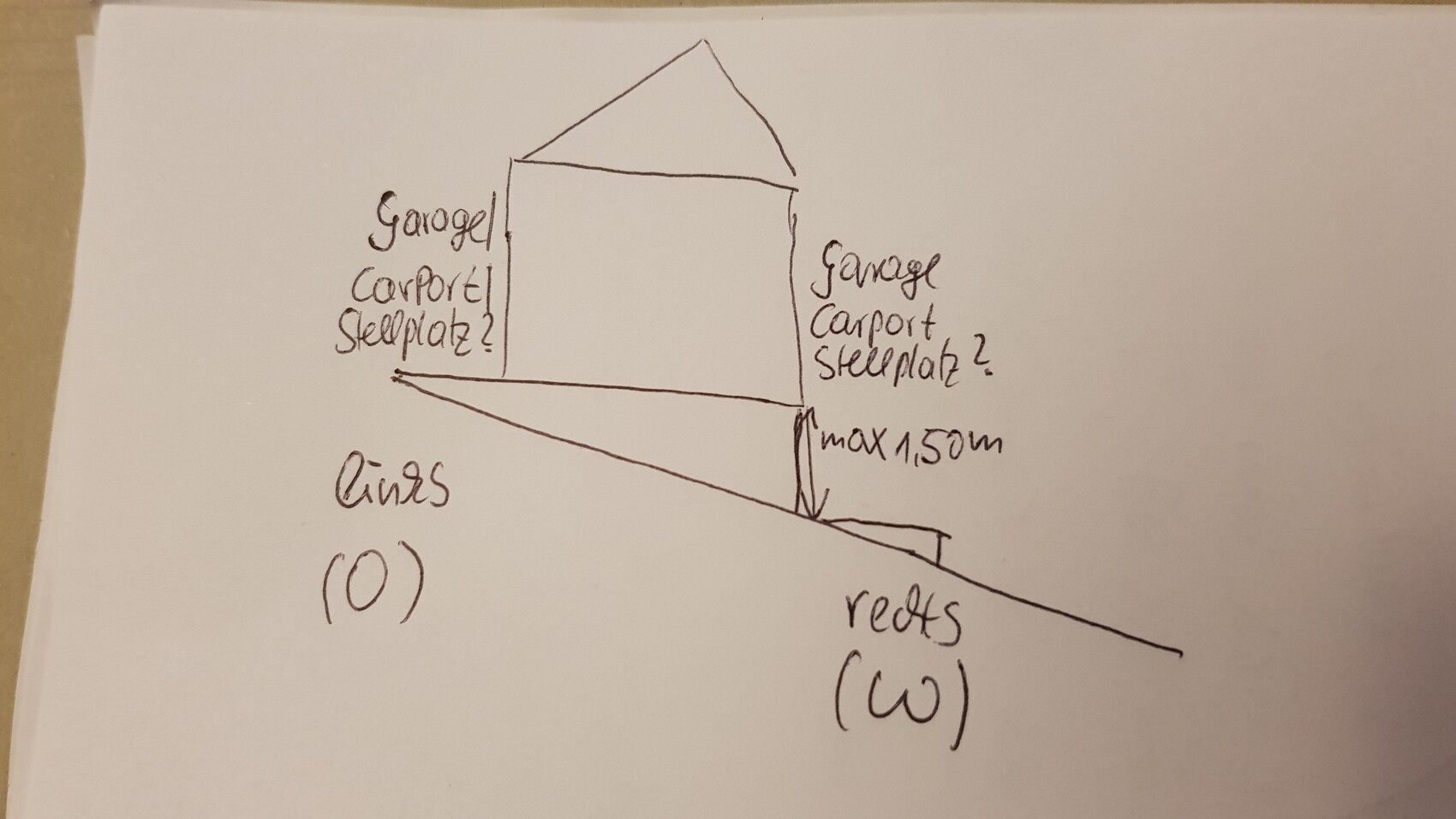
We are planning to build the house on a slight slope. The property is 18m (59 feet) wide, with a drop of about 1.5m (5 feet) along this length, which is approximately 8.3% (see sketch from east to west as well as a section of the development plan/planning permission).
To make the best use of the width, parking spaces will be created on both the left and right sides of the house in the form of at least one garage and one parking space/carport each (requirement according to the development plan/planning permission: 2 parking spaces). This way, the setback from the boundary line will be optimized and the house can theoretically be 12m (39 feet) wide. Due to the 1.5m (5 feet) fill, the parking space on the right side will inevitably be lower than the house because of the slope.
Now we are wondering if the fill can be built as shown in the sketch and also be retained flush with the house wall, and if so, how—using L-shaped retaining blocks or retaining walls—and what the approximate cost might be.
Thank you very much
with our first post, we would like to ask for help regarding our building project and would appreciate any suggestions and advice.
We are planning to build the house on a slight slope. The property is 18m (59 feet) wide, with a drop of about 1.5m (5 feet) along this length, which is approximately 8.3% (see sketch from east to west as well as a section of the development plan/planning permission).
To make the best use of the width, parking spaces will be created on both the left and right sides of the house in the form of at least one garage and one parking space/carport each (requirement according to the development plan/planning permission: 2 parking spaces). This way, the setback from the boundary line will be optimized and the house can theoretically be 12m (39 feet) wide. Due to the 1.5m (5 feet) fill, the parking space on the right side will inevitably be lower than the house because of the slope.
Now we are wondering if the fill can be built as shown in the sketch and also be retained flush with the house wall, and if so, how—using L-shaped retaining blocks or retaining walls—and what the approximate cost might be.
Thank you very much
M
Matthew034 Jan 2019 23:19You do not factor in any potential savings from reducing the size of the upper floor thanks to living space in the basement. The floor plan would actually be helpful for that, as it allows you to understand the living space layout, assess needs, and thus present alternatives...
I claim that the cost comparison between fill/groundwork and a basement with living space is more relevant than you might think.
I claim that the cost comparison between fill/groundwork and a basement with living space is more relevant than you might think.

fsbau2019 schrieb:
We are torn about whether to build there or not. Originally, the budget included 20,000 for groundworks, including a terrace, garage foundation, drainage, and trenching for utility connections. Wow. That’s quite tight.
fsbau2019 schrieb:
If it’s much more expensive, we have to skip it, as I said, an extra 50,000 for a basement is too much. A utility room and storage also need space—if not in the basement, then somewhere else that uses up floor area. Let’s say that from a 150cm (5 feet) terrain difference you could level out 30cm (1 foot), that would leave 120cm (4 feet), and by my rule of thumb that translates to about 60% of the cost of a built basement compared to not having one.
I don’t necessarily see the dream home fading because of this, but for a “flat on the ground” house, you’d need a flat plot.
https://www.instagram.com/11antgmxde/
https://www.linkedin.com/company/bauen-jetzt/
fsbau2019 schrieb:
As I said, an additional 50,000 is too much for a basementI would avoid using the word basement and instead define it as a single-story house (bungalow) with a lower ground floor—essentially a living basement. This has come up several times before, but it seems the issue hasn’t been resolved for you yet. However, you can’t just use a standard house design for this; the bedrooms might need to be on the ground floor, with living areas and utility rooms in the lower ground floor. The site plan hasn’t been shared yet, has it?
20 tons for earthworks including shoring according to the structural engineer's specifications
This will not be sufficient
Move away from the idea of a basement (dark, damp, storage room, for oil tanks)
I would spontaneously plan a carport on the east side. Use concrete blocks for shoring, with steps leading to the main entrance.
Also plan a parking space directly in front of the house entrance.
Mirror the floor plan: place the building services on the east side, kitchen on the west side
The exterior area then does not need the terrace to be raised and shored by 1.5 m (5 feet). It can be done like Nordlys did, using natural stone or planting stones
The ground floor will not be built with timber frame construction
This will not be sufficient
Move away from the idea of a basement (dark, damp, storage room, for oil tanks)
I would spontaneously plan a carport on the east side. Use concrete blocks for shoring, with steps leading to the main entrance.
Also plan a parking space directly in front of the house entrance.
Mirror the floor plan: place the building services on the east side, kitchen on the west side
The exterior area then does not need the terrace to be raised and shored by 1.5 m (5 feet). It can be done like Nordlys did, using natural stone or planting stones
The ground floor will not be built with timber frame construction

F
fsbau20195 Jan 2019 09:40Thank you for the input,
we already understand that this is not about a damp storage cellar or anything like that, but rather about simply getting the house built.
What makes me skeptical is the slope. I have been on site several times, and after 1.5 meters (5 feet), it doesn’t look like that on the building plot.
The road to the north seems to have the slope, but the building plots are significantly flatter…
Could it be that the area has already been leveled?
And if so, what does this mean for our plan to build with a slab foundation?
I can only recall the step of about 40–50 cm (16–20 inches) at the left property boundary towards the road (which runs from east to west down the slope, remember).
Furthermore, the right property boundary appears level with the road???
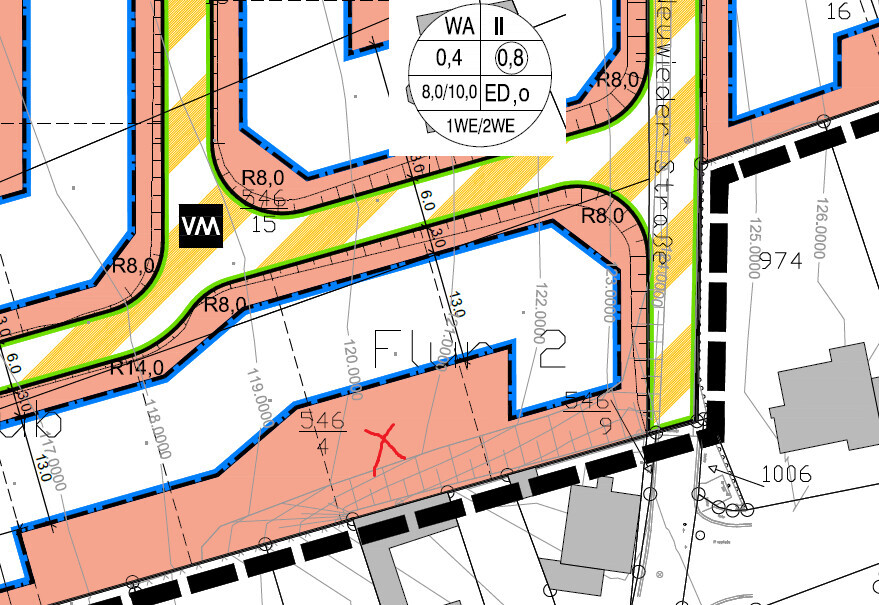
Could this be due to the cross slope? (see excerpt of the development plan). However, if that’s the case, then somewhere on the plot the 1.5 m (5 feet) slope of the road must have “disappeared”… but you cannot see it anywhere!...
As part of the soil survey, two boreholes were referenced to a benchmark on the road, and lo and behold, the 1.5 m (5 feet) slope reappears there.
Do you have any idea, and is this good or bad for us?
we already understand that this is not about a damp storage cellar or anything like that, but rather about simply getting the house built.
What makes me skeptical is the slope. I have been on site several times, and after 1.5 meters (5 feet), it doesn’t look like that on the building plot.
The road to the north seems to have the slope, but the building plots are significantly flatter…
Could it be that the area has already been leveled?
And if so, what does this mean for our plan to build with a slab foundation?
I can only recall the step of about 40–50 cm (16–20 inches) at the left property boundary towards the road (which runs from east to west down the slope, remember).
Furthermore, the right property boundary appears level with the road???
Could this be due to the cross slope? (see excerpt of the development plan). However, if that’s the case, then somewhere on the plot the 1.5 m (5 feet) slope of the road must have “disappeared”… but you cannot see it anywhere!...
As part of the soil survey, two boreholes were referenced to a benchmark on the road, and lo and behold, the 1.5 m (5 feet) slope reappears there.
Do you have any idea, and is this good or bad for us?
Similar topics