
Hello everyone,
After a long search, we have finally found a plot of land that we want (and can afford). Now the question is how to build.
To explain briefly, it is a slight slope parallel to the street. In front of the plot, there are two parking spaces, so the driveway can only be on the upper left side.
A soil report states that the soil is clayey. Building is allowed at 200 meters (656 feet) above sea level ± 0.50 meters (1.6 feet). The total height for shed roofs must not exceed 7.50 meters (25 feet). The shed roof must have a pitch between 10° and 15°, the orientation does not matter (preferably facing south due to a planned photovoltaic system). We would like to build two full stories.
The construction will be solid masonry, but we are still undecided between aerated concrete, clay blocks, or Neopor concrete.
Now the question is whether it makes sense to plan a basement, which would only be used as storage and for the building’s technical equipment. Possibly, depending on the size, also for a hobby room.
On the topic of basements, you find very different cost estimates ranging from €15,000 to €70,000. Since the basement will be finished by ourselves, I am mainly interested in the cost of the basement shell itself, not the complete finish.
Is a basement even possible with the maximum building height and two full stories?
What are the additional costs compared to building without a basement? Because of the slight slope, quite a bit of excavation would be required to create the foundation for the slab.
To give you a rough idea of our plans, I have attached two images.
The red numbers indicate the elevation in meters above sea level at the corners.
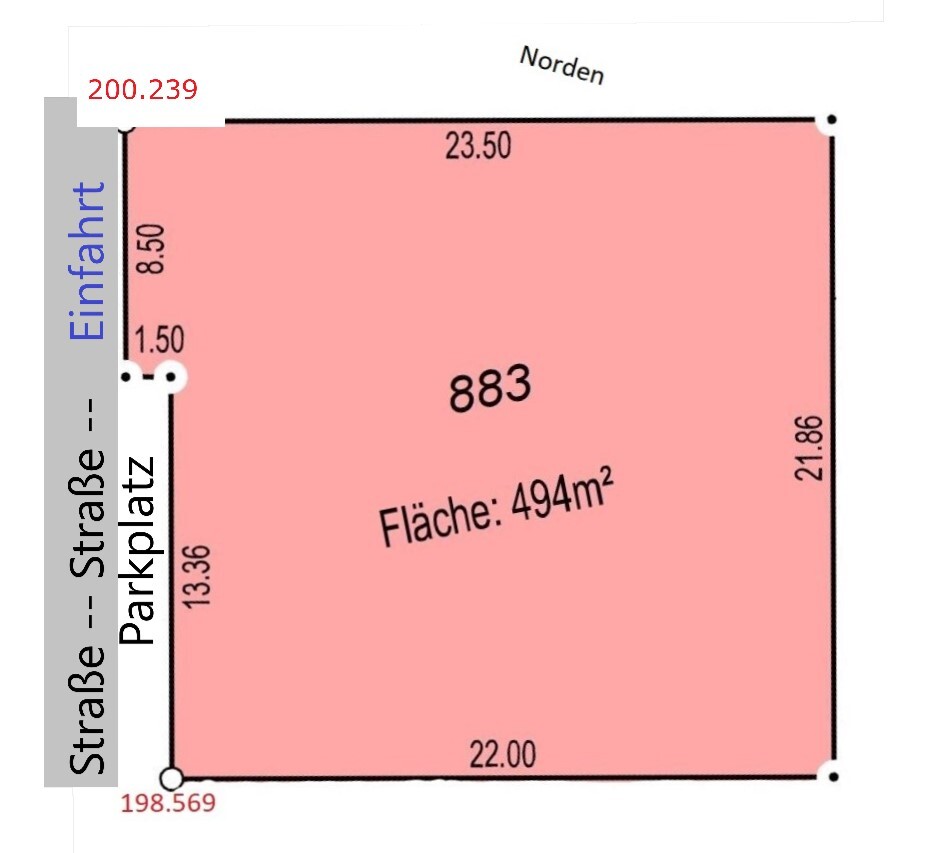
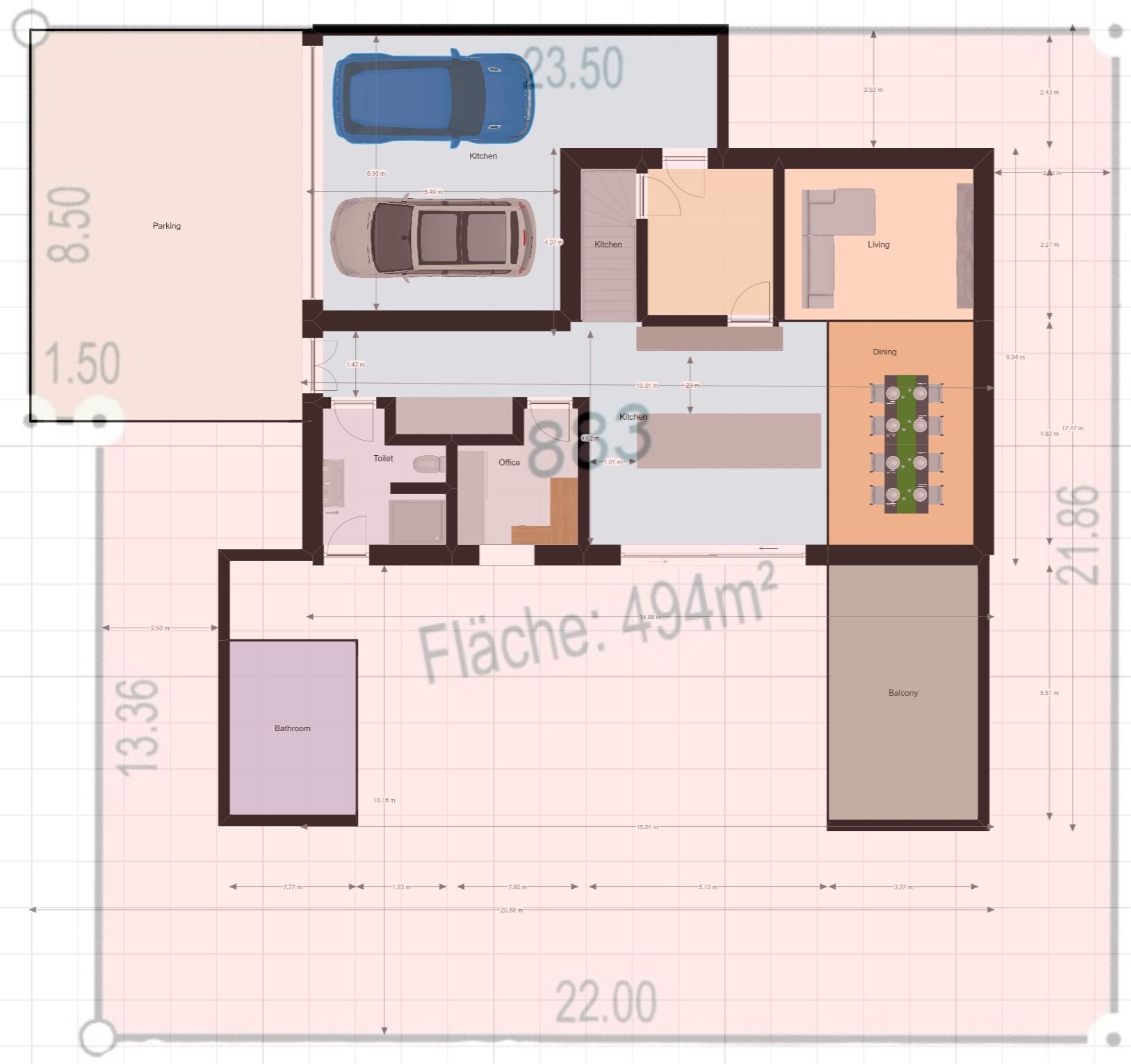
What do you think about the basement? We find it hard to design a floor plan where there is enough space on the ground floor for both the technical and storage rooms. But we also don’t want to “bury” unnecessary money.
PS: I’m happy to receive suggestions for the floor plan as well, but the main focus should be on the basement question.
After a long search, we have finally found a plot of land that we want (and can afford). Now the question is how to build.
To explain briefly, it is a slight slope parallel to the street. In front of the plot, there are two parking spaces, so the driveway can only be on the upper left side.
A soil report states that the soil is clayey. Building is allowed at 200 meters (656 feet) above sea level ± 0.50 meters (1.6 feet). The total height for shed roofs must not exceed 7.50 meters (25 feet). The shed roof must have a pitch between 10° and 15°, the orientation does not matter (preferably facing south due to a planned photovoltaic system). We would like to build two full stories.
The construction will be solid masonry, but we are still undecided between aerated concrete, clay blocks, or Neopor concrete.
Now the question is whether it makes sense to plan a basement, which would only be used as storage and for the building’s technical equipment. Possibly, depending on the size, also for a hobby room.
On the topic of basements, you find very different cost estimates ranging from €15,000 to €70,000. Since the basement will be finished by ourselves, I am mainly interested in the cost of the basement shell itself, not the complete finish.
Is a basement even possible with the maximum building height and two full stories?
What are the additional costs compared to building without a basement? Because of the slight slope, quite a bit of excavation would be required to create the foundation for the slab.
To give you a rough idea of our plans, I have attached two images.
The red numbers indicate the elevation in meters above sea level at the corners.
What do you think about the basement? We find it hard to design a floor plan where there is enough space on the ground floor for both the technical and storage rooms. But we also don’t want to “bury” unnecessary money.
PS: I’m happy to receive suggestions for the floor plan as well, but the main focus should be on the basement question.
MayrCh schrieb:
A really poor comparison. The last time we did this was over 45 years ago... Yes, you are of course right. But I think I have made my point quite clearly. Basically, the energy saving regulations are to blame.
red-ed schrieb:
If you compare 10cm (4 inches), 15cm (6 inches), and 18cm (7 inches) walls, concrete blocks come out a bit better. Would you agree with that? Maybe – if I could follow your reasoning (?)
red-ed schrieb:
A formwork block can be many things. Whether it’s the Kaiser blocks, wooden blocks, or Neopor blocks.
Since they can’t really be compared to each other, I usually just call them Neopor. I think even fewer homebuilders compare formwork blocks among themselves than those who compare formwork blocks to other wall materials; therefore, I tend to group all formwork block enthusiasts (some of whom then become actual users) together in terms of a) their general interest in this building method, and b) how deeply they get involved or even move from being curious observers to actual buyers. It is never a mainstream product.
red-ed schrieb:
Basically, the Energy Saving Ordinance is to blame The only thing to blame was Bossa Nova
https://www.instagram.com/11antgmxde/
https://www.linkedin.com/company/bauen-jetzt/
I wanted to say that when you compare the U-value of a wall structure with
35cm (14 inches) Poroton + 10cm (4 inches) external thermal insulation composite system (ETICS) with a 45cm (18 inches) Neopor insulated concrete form (ICF) block, the Neopor block performs better.
However, if you compare
15cm (6 inches) concrete + 10cm (4 inches) ETICS and
35cm (14 inches) Poroton + 10cm (4 inches) ETICS, then of course the Poroton performs better.
That’s what I meant.
Wall thickness is an important factor for many homeowners, as plot sizes are not getting any bigger.
Regards
Red
35cm (14 inches) Poroton + 10cm (4 inches) external thermal insulation composite system (ETICS) with a 45cm (18 inches) Neopor insulated concrete form (ICF) block, the Neopor block performs better.
However, if you compare
15cm (6 inches) concrete + 10cm (4 inches) ETICS and
35cm (14 inches) Poroton + 10cm (4 inches) ETICS, then of course the Poroton performs better.
That’s what I meant.
Wall thickness is an important factor for many homeowners, as plot sizes are not getting any bigger.
Regards
Red
red-ed schrieb:
I wanted to say that when you compare the U-value of a wall structure with 35cm Poroton + 10cm external thermal insulation composite system (ETICS) to a 45cm Neopor formwork block, the Neopor block performs better.. I seriously doubt that: both are combinations of a structural material and an insulation layer; in the ETICS, the insulation is applied only on the exterior side, while the formwork block is essentially an integral insulation system with insulation distributed on both sides. Regarding the total thickness of the insulation layer, the arrangement—whether you place 12cm (5 inches) on the outside or split it as 4cm (1.5 inches) inside plus 8cm (3 inches) outside with the same material—makes little difference. Thus, the concrete core can roughly be equated with a concrete wall behind an ETICS cladding. When comparing the wall construction across to that of another building material, concrete clearly performs worse than an equally thick porous brick.
https://www.instagram.com/11antgmxde/
https://www.linkedin.com/company/bauen-jetzt/
red-ed schrieb:
I hope I haven’t mixed or confused anything. But was I perhaps misunderstood?
I said: with the same type and thickness of insulation, whether applied only to the exterior or split between interior and exterior, and with the same thickness of concrete or aerated brick, the overall result is always worse for concrete than for aerated brick.
I’m not going to read through every possible apples-to-oranges comparison out there, since I’m not looking for an answer to the question “how much A + x equals the same or lower U-value at the same or thinner overall wall thickness as B + y.”
For anyone who could only afford a house under the condition of minimized wall footprint, a responsible financial advisor should actually recommend against building a house altogether.
https://www.instagram.com/11antgmxde/
https://www.linkedin.com/company/bauen-jetzt/
But who is interested in a comparison between concrete and aerated concrete blocks of the same thickness? What really matters is what I need to do to ensure structural safety and achieve my goal (energy saving regulations, KFW70-55-40-40+, etc). Then there is also the question of which building material I feel most drawn to.
Similar topics