
Hello everyone,
after spending quite some time in another forum, I hope to start fresh here (also for those who might be active in both forums).
We found a plot with a house from a builder. We really like the location (in the far west of the beautiful Ruhr area).
The plot with the standard floor plan (10x9 m, approx. 150 m² (1615 sq ft)) and a 9 m (30 ft) garage fits our budget. We don’t want it any bigger.
There was an appointment back then with the builder and architect where we discussed our wishes and special furniture pieces to be taken along.
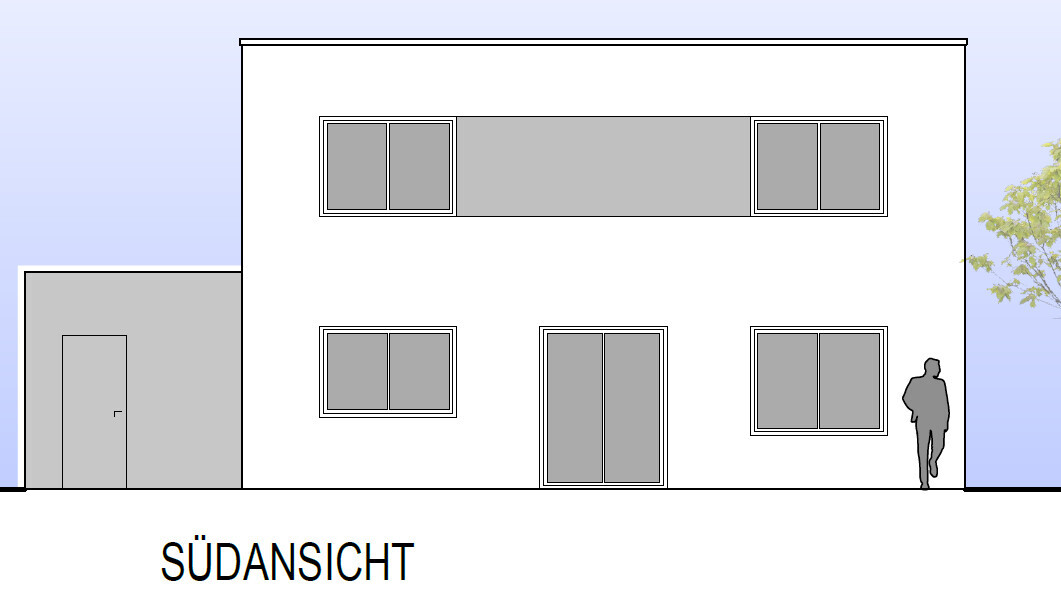
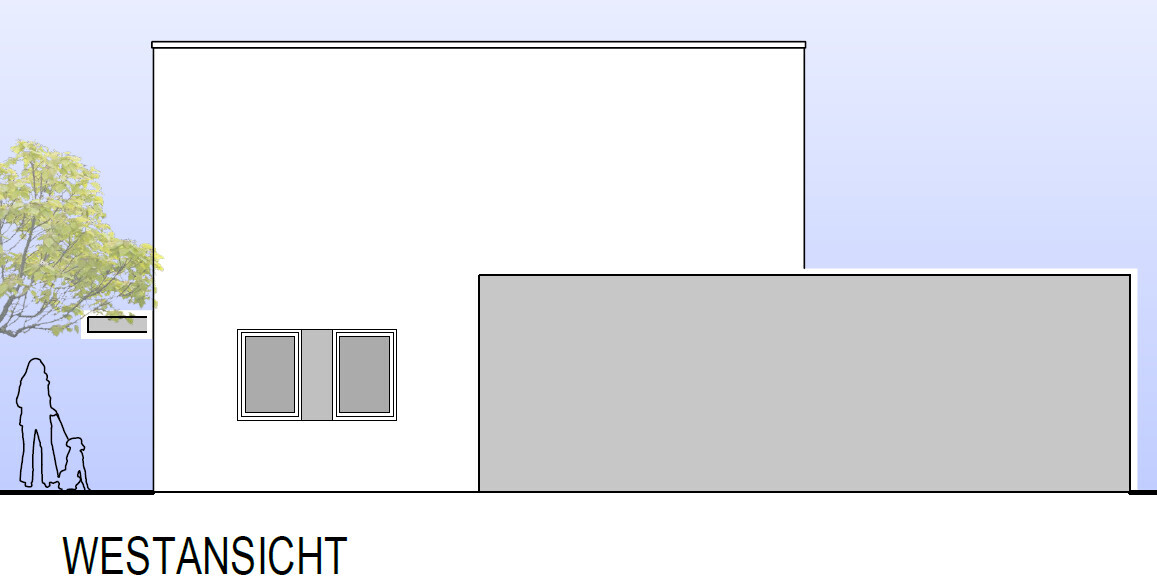
We also talked about the 9 m (30 ft) garage. The plan places it on the west side of the house for a straight driveway. However, we realized it might be better on the east side. This way, an additional source of light could be placed on the west side in the kitchen or living room area. On the other hand, due to the neighboring house to the west, this would likely be a passive light source. Would a window on the east side be as effective as on the west side? On the west side, the house is 6 m (20 ft) away, and its garage is 3 m (10 ft) away. On the east side, the window would be approximately at the terrace level of house number 11.
Since the driveway to the garage on the east side seemed quite narrow, we simulated it with our Fabia station wagon (4.25 m (14 ft) long) along a house edge and the plot boundary marked with chalk. The driveway and exit worked, even if the neighbor would build a fence right on the boundary. But we aren’t yet 100% convinced about this option.
Originally, we planned to build smaller than the offered standard floor plan (10x9 m), wanting 10x8 m (approx. 86 sq m / 920 sq ft). The architect drew something for this, but we didn’t like it at all.
Then we went for 10x8.5 m (approx. 91 sq m / 980 sq ft), with the architect basing it on the standard floor plan but with 15 steps instead of 14. The straight or quarter-turn staircase caused repeated problems during several redrawings. Mostly, the dining area was too tight and/or the hallway or entrance area too large.
At one point, we briefly sketched another floor plan ourselves (the quarter-turn staircase rotated by 90°) and had it redrawn, but we rejected it again due to what felt like too small a TV area (4.15 m (13.6 ft) depth). I should mention that in our previous homes, we always had a distance of 4.5–6 m (15 to 20 ft) for a 42-inch TV and found that comfortable.
We were nearly desperate and looked at show homes. We got some great ideas there (e.g., built-in wardrobe in the entrance hall, children’s rooms around 14–15 m² (150–160 sq ft) are sufficient) and saw living rooms with TV areas around 3.5–3.75 m (11.5–12 ft) deep and tried them out. We didn’t find them too small, especially considering the manufacturer recommendations for optimal TV viewing distance.
Hoping that a larger floor plan would solve all problems, we decided to go for 10x9 m (150 sq m/1615 sq ft) size and saw the Signus floor plan (with 14 steps) from Kern-Haus and had it redrawn accordingly (with 15 steps). In retrospect, the basic structure is similar to the builder’s standard floor plan, except the staircase and TV area were handled differently. The dining area remains tight, and there is an extra barely usable space between the entrance and dining area.
At some point, the architect drew the standard floor plan with a corner staircase. We asked him to redraw it with dimensions but we are still waiting for this version today. Instead, we recently received the Signus floor plan with a slightly modified quarter-turn staircase (one step from the straight section was moved to the landing).
Here are the key data first:
Development plan/restrictions
Homeowners’ requirements
If you had to give up on details/features
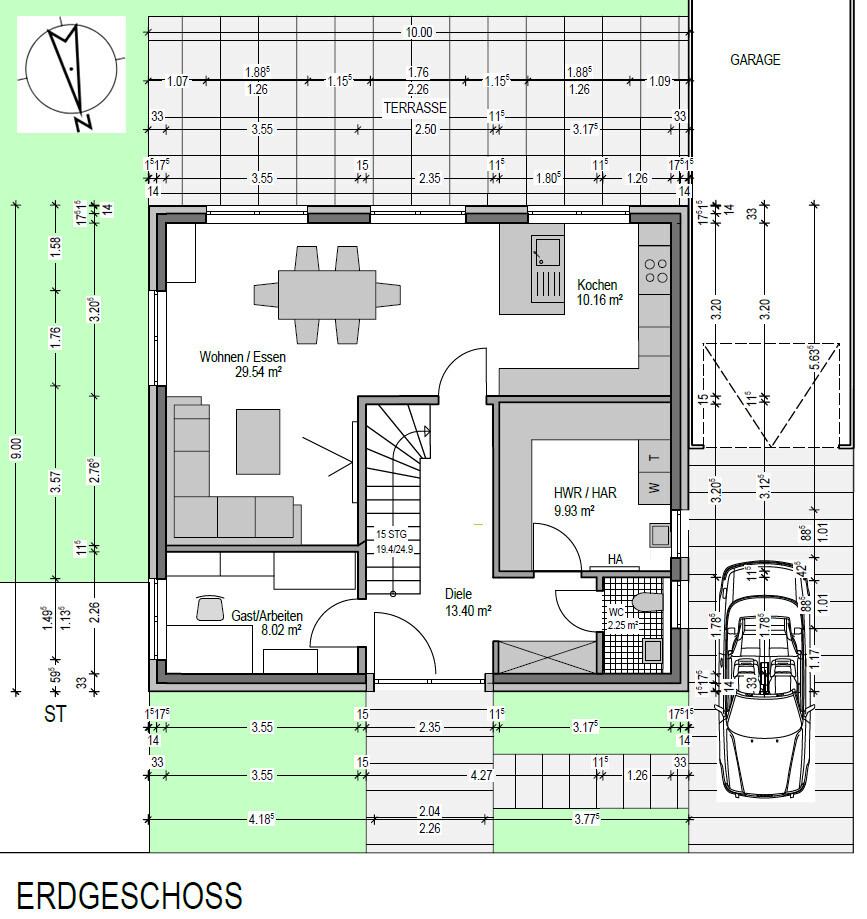
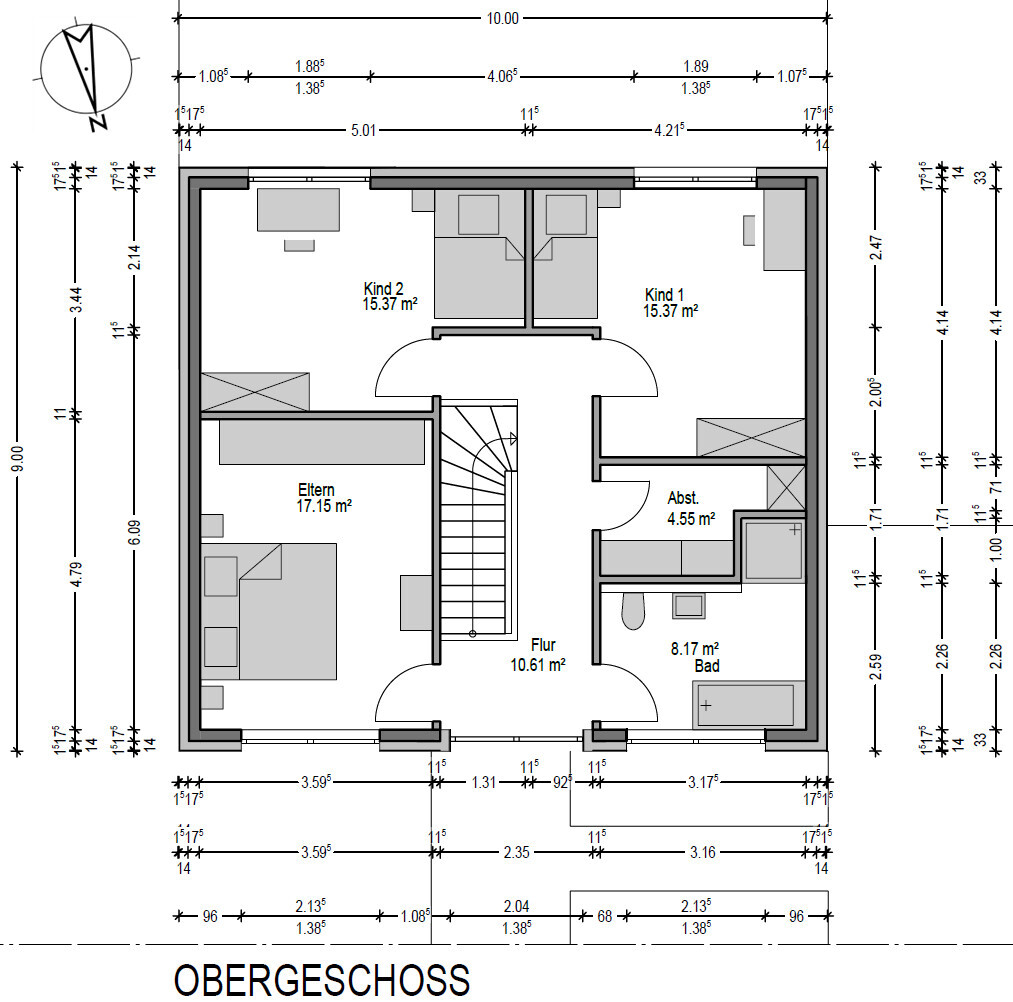
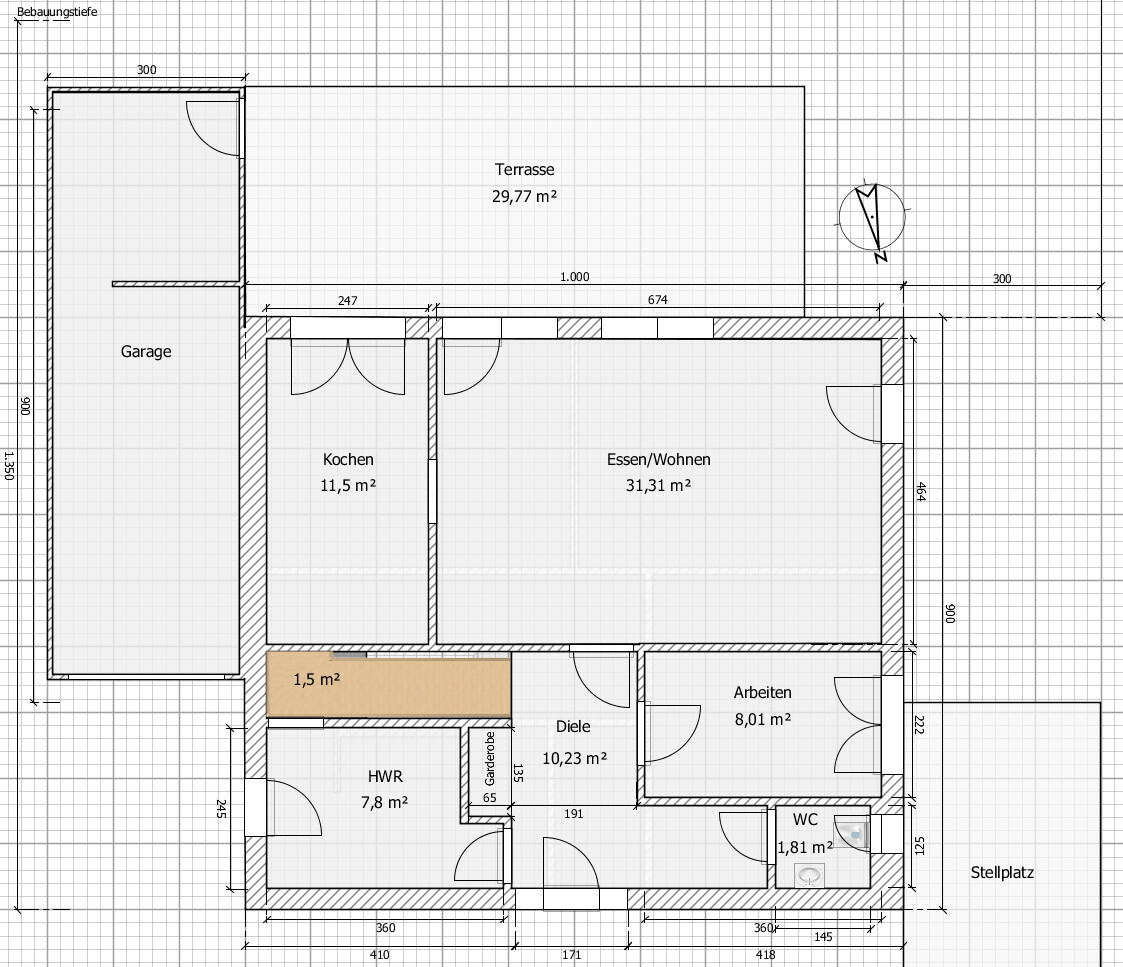
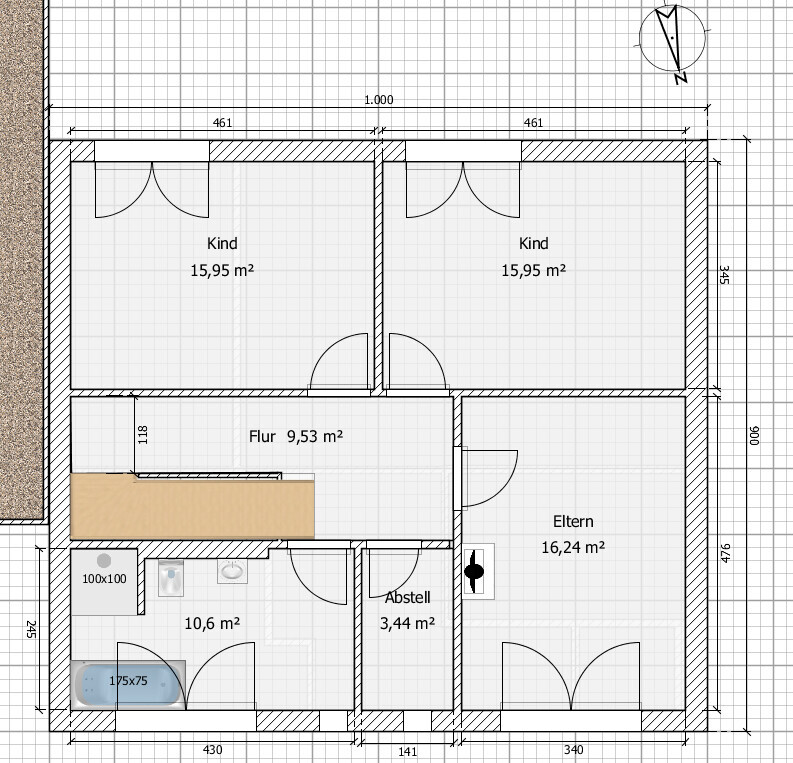
Builder’s floor plan (images ending with 295772-295772-5.png)
House design – why did the design turn out as it is?
Own Floor Plan 1 [U](images ending with 295772-6-295772-7.png)
House design – why did the design turn out as it is?[/U]
Own Floor Plan 2 [U](images ending with 295772-8-295772-9.png)
House design – why did the design turn out as it is?[/U]
What is the most important/basic question about the floor plan summarized in 130 characters?
A few more characters than 130.
So, that was a lot of text.
I hope I haven’t forgotten anything and wish us a pleasant discussion.
P.S.
We also got the suggestion to build the house narrower (7–8 m (23–26 ft) wide) and deeper instead of 10 m (33 ft) wide. This way, the garage could be on the west side and an additional light source could be positioned on the west side in the kitchen or living room area. Somehow, we have not found a fitting floor plan idea yet that makes us rethink this. Also, the idea of having a very long green strip on the east side complicates it in our minds.
Site plan:
after spending quite some time in another forum, I hope to start fresh here (also for those who might be active in both forums).
We found a plot with a house from a builder. We really like the location (in the far west of the beautiful Ruhr area).
The plot with the standard floor plan (10x9 m, approx. 150 m² (1615 sq ft)) and a 9 m (30 ft) garage fits our budget. We don’t want it any bigger.
There was an appointment back then with the builder and architect where we discussed our wishes and special furniture pieces to be taken along.
We also talked about the 9 m (30 ft) garage. The plan places it on the west side of the house for a straight driveway. However, we realized it might be better on the east side. This way, an additional source of light could be placed on the west side in the kitchen or living room area. On the other hand, due to the neighboring house to the west, this would likely be a passive light source. Would a window on the east side be as effective as on the west side? On the west side, the house is 6 m (20 ft) away, and its garage is 3 m (10 ft) away. On the east side, the window would be approximately at the terrace level of house number 11.
Since the driveway to the garage on the east side seemed quite narrow, we simulated it with our Fabia station wagon (4.25 m (14 ft) long) along a house edge and the plot boundary marked with chalk. The driveway and exit worked, even if the neighbor would build a fence right on the boundary. But we aren’t yet 100% convinced about this option.
Originally, we planned to build smaller than the offered standard floor plan (10x9 m), wanting 10x8 m (approx. 86 sq m / 920 sq ft). The architect drew something for this, but we didn’t like it at all.
Then we went for 10x8.5 m (approx. 91 sq m / 980 sq ft), with the architect basing it on the standard floor plan but with 15 steps instead of 14. The straight or quarter-turn staircase caused repeated problems during several redrawings. Mostly, the dining area was too tight and/or the hallway or entrance area too large.
At one point, we briefly sketched another floor plan ourselves (the quarter-turn staircase rotated by 90°) and had it redrawn, but we rejected it again due to what felt like too small a TV area (4.15 m (13.6 ft) depth). I should mention that in our previous homes, we always had a distance of 4.5–6 m (15 to 20 ft) for a 42-inch TV and found that comfortable.
We were nearly desperate and looked at show homes. We got some great ideas there (e.g., built-in wardrobe in the entrance hall, children’s rooms around 14–15 m² (150–160 sq ft) are sufficient) and saw living rooms with TV areas around 3.5–3.75 m (11.5–12 ft) deep and tried them out. We didn’t find them too small, especially considering the manufacturer recommendations for optimal TV viewing distance.
Hoping that a larger floor plan would solve all problems, we decided to go for 10x9 m (150 sq m/1615 sq ft) size and saw the Signus floor plan (with 14 steps) from Kern-Haus and had it redrawn accordingly (with 15 steps). In retrospect, the basic structure is similar to the builder’s standard floor plan, except the staircase and TV area were handled differently. The dining area remains tight, and there is an extra barely usable space between the entrance and dining area.
At some point, the architect drew the standard floor plan with a corner staircase. We asked him to redraw it with dimensions but we are still waiting for this version today. Instead, we recently received the Signus floor plan with a slightly modified quarter-turn staircase (one step from the straight section was moved to the landing).
Here are the key data first:
Development plan/restrictions
- Our plot and house will be number 10.
- Plot size: 370–380 m² (16 m (52.5 ft) wide, approx. 23.8 m (78 ft) deep), no slope.
- Building envelope: 10 m (33 ft) wide and 13.5 m (44 ft) deep, with a 3 m (10 ft) setback from neighbors and the private road (which will be extended to the boundary of number 11).
- Orientation: south to southeast.
- Floor area ratio (FAR): 0.4
- Total floor area ratio: 0.8
- 2 full stories
- 6° flat roof design
- Bauhaus style
- Parking: Within the development area, private demand for garages, carports, and parking spaces must be met within the plot itself due to limited access areas. Garages, carports, and parking spaces should not be distributed randomly on the plots. They are only allowed inside the building zones and designated parking areas to avoid a disorganized impression and to prevent the use of rear zones and setback areas next to the existing buildings for garages, carports, or parking spaces.
Homeowners’ requirements
- Detached
- No basement
- 2 full stories
- 2 adults (35, 40), 2 children (6)
- Kitchen, living/dining room, WC, bathroom, utility room, master bedroom, 2 children’s rooms, 1 office (exclusively for home office), additional storage room
- In the kitchen, it would be nice to have a view of the garden from the main workspace or sink.
- In the living room, it would be nice to see the garden from the sofa.
- The area between living room and entrance/hall/staircase should be closed off with a door if possible.
- In the master bedroom, the door should be visible from the bed, and there should be no window behind or above the bed.
- Children’s rooms approx. 15 m² (160 sq ft) each, both facing south (better view, more light) with appropriate windows.
- The office should be at least 8 m² (86 sq ft). This room does not necessarily need access from the hallway, it could be an adjacent room. The desk should be placed sideways to the window. Also, it should be arranged so that the desk is not directly visible from the street (reason: I find it uncomfortable to sit with my back to “the public”). The room should be designed to also hold a 1.5 m (5 ft) wide wardrobe (storage) and one or more 1 m (3.3 ft) wide highboards (ideally three).
- A window in the upstairs hallway would be nice.
- No overnight guests planned so far
- Rather closed architecture
- Prefer modern design
- Prefer a closed kitchen, but a semi-open kitchen is also possible
- 5-6 dining seats
- No fireplace
- TV wall with 5.1 sound system
- 2 parking spaces (1x 9 m (30 ft) garage), garage on the east side?
- Utility garden
- No direct access from garage to utility room
If you had to give up on details/features
- We can and want to do without a shower in the guest WC.
- The 9 m (30 ft) garage on the east side is probably best in terms of light, but placement on the west side is also possible. A 6 m (20 ft) garage with an annex (for garden furniture, lawn mower, bicycles, etc.) elsewhere is also conceivable. However, since it makes sense to have an additional parking space in front of the garage, a 6 m garage combined with a 5.0–6 m parking space would practically end at the back of the house, so we wouldn’t really gain anything.
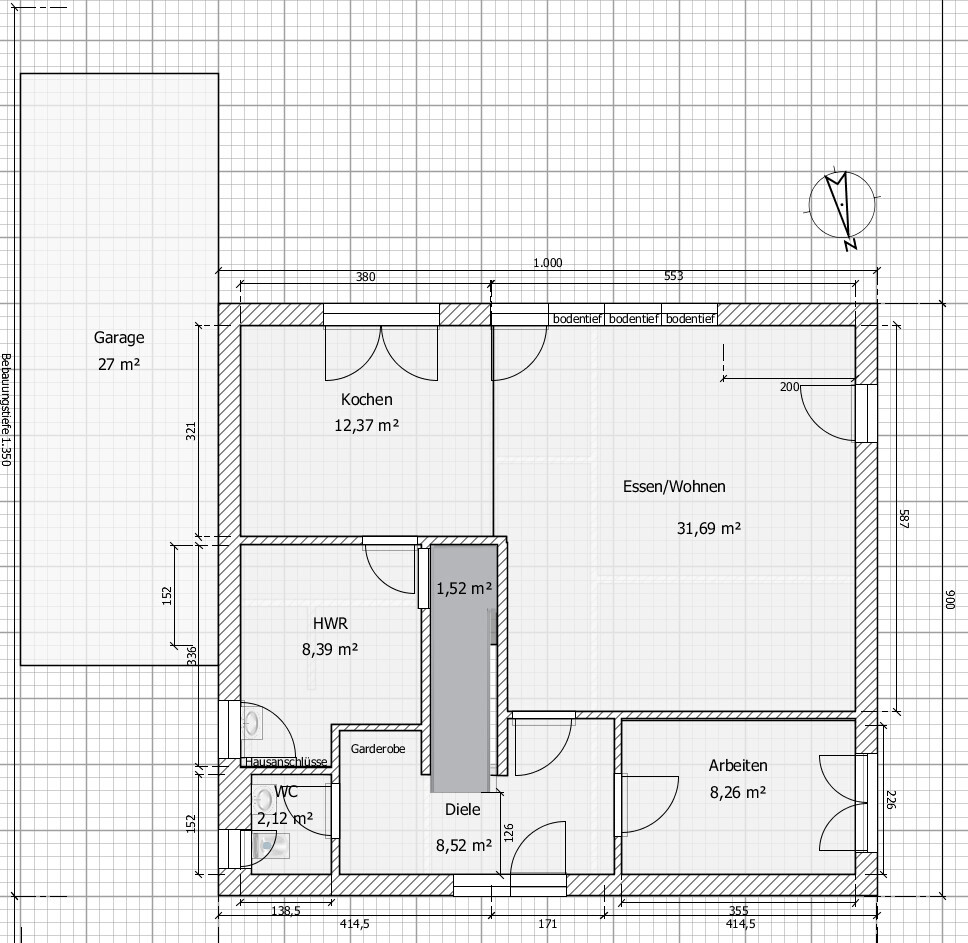
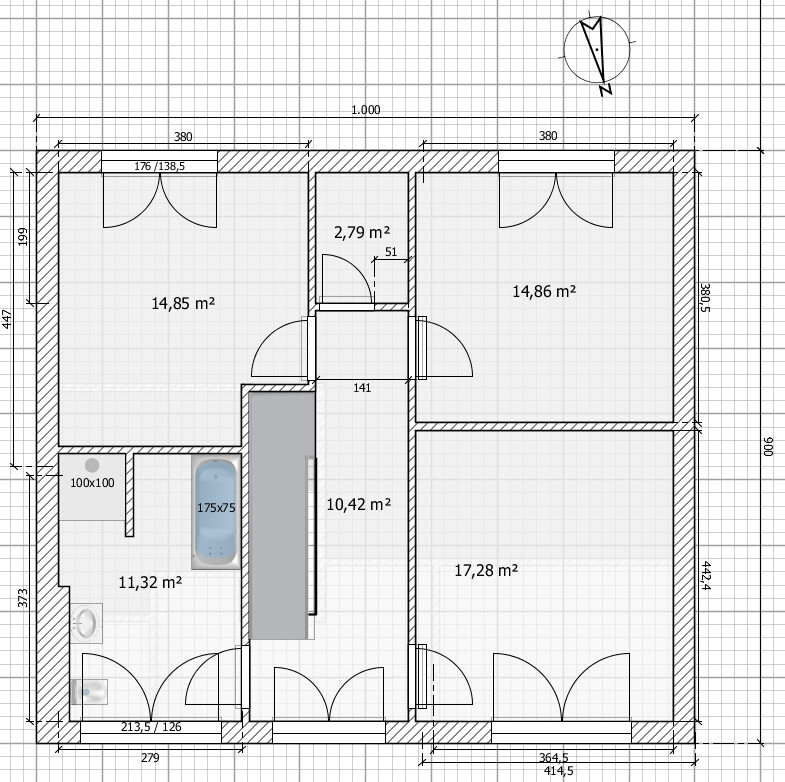
Builder’s floor plan (images ending with 295772-295772-5.png)
House design – why did the design turn out as it is?
- The builder’s architect based the floor plan on the Signus by Kern-Haus.
- We like the basic structure so far.
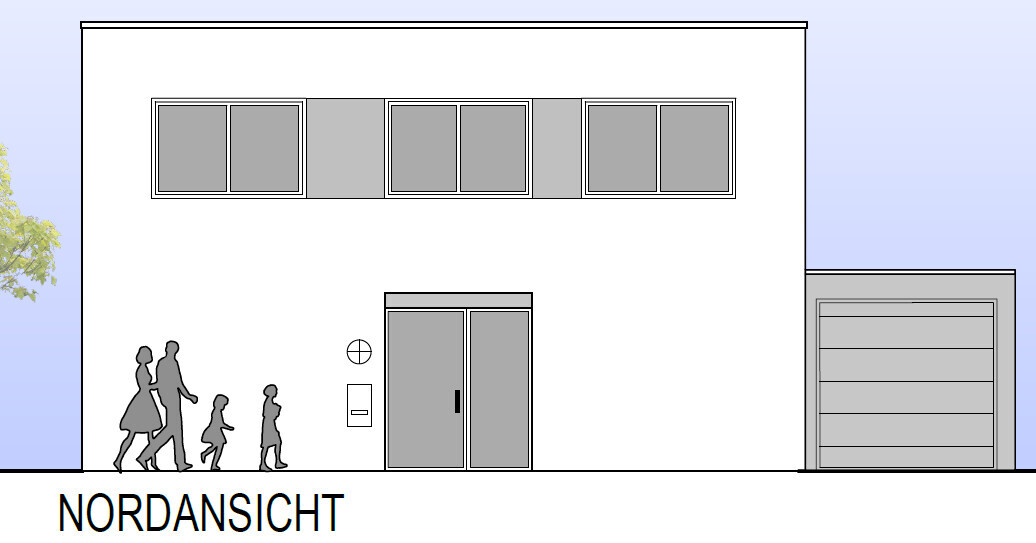
- The front entrance with the door and the windows above feels much more inviting than the standard floor plan.
- Is the front door drawn too large?
- The door to the living room is not ideal. Depending on kitchen layout, it would be in the way when open.
- Would a window sill height of 1.01 m (3.3 ft) be sufficient for the kitchen window? The left window in the dining area facing the terrace could perhaps be made floor-to-ceiling. It might not look perfectly symmetrical from the outside, but it would look the same from the inside in the dining area.
- Due to the quarter-turn staircase with one step on the exit, the entrance hall area was reduced at the expense of the TV area. Is the TV area still large enough?
- The entrance hall is quite large because of the quarter-turn staircase with the step on the exit. How could this space, especially under the stairs, be better used? Maybe with a built-in closet or storage room (with its own access)? We also once thought about rotating the staircase 180° and using the area under the stairs at the entrance as a wardrobe (built-in closet). But then what about the door to the living room? And how would it look when entering the house and seeing a cupboard right away? On the other hand, it might make sense to swap the front door with the window element.
- The utility room has a 73.5 cm (29 in) door. Is that sufficient or would an 85 cm (33.5 in) door be better?
- For the WC, we might prefer the door to open inward and swap the toilet and washbasin.
- The two bed niches in the children’s rooms don’t look optimal at first glance. On one hand, only a wider bed fits here, and the other child would have to place a bigger bed elsewhere later (unless sleeping partially under the window). On the other hand, from this niche, you can’t see who enters the room. Maybe this deep niche is better for the entrance and perhaps a wardrobe with a headboard? Or the partition wall could be shifted a bit left (centered between the two windows), so that beds fit properly in both niches and bigger beds would protrude a little.
- The storage room could perhaps be a bit narrower in favor of the bathroom. Maybe it would look better with an 85 cm (33.5 in) door here as well?
- The heating system will likely be underfloor heating with a gas condensing boiler and solar storage for hot water support.
Own Floor Plan 1 [U](images ending with 295772-6-295772-7.png)
House design – why did the design turn out as it is?[/U]
- DIY… since we can’t let go of the basic structure from the builder and Signus, I also drew a bit. Access to the utility room was moved to the kitchen and a 1.25 m (4 ft) wide built-in closet wardrobe was planned in the hallway.
- Maybe the stairs should be moved a bit further left to get a larger living/dining area. This would allow making the WC narrower and possibly longer.
- The square dining/living room looks like it might not be used optimally later. The distance between TV and sofa is quite large at 5.87 m (19 ft).
- The upstairs hallway might be a bit too wide (due to the storage room). The wall between the storage room and the left children’s room could be moved left a bit. This would mean the door to the children’s room is not aligned with the stair railing but set a bit behind the wall at the stair’s end. Or could this be solved by adding a railing to the last step facing the left children’s room (similar to the builder’s floor plan)? On the other hand, such a wide hallway offers space for 30–40 cm (12–16 in) slim sideboards.
- The layout of WC and bathroom might be done differently.
- Windows and doors are not fixed yet and could be better positioned.
- We like the entrance area better with the two outer windows above.
Own Floor Plan 2 [U](images ending with 295772-8-295772-9.png)
House design – why did the design turn out as it is?[/U]
- DIY… We reviewed all floor plans again and came across the one with the staircase rotated 90°. I extended this plan to 9 m (30 ft) depth and shifted the stairs.
- I find this layout very flexible since the central axis can be moved depending on needs. The same applies vertically for the utility room and office.
- I like that with the stair positioning upstairs you come out behind the central axis, allowing large straight rooms to the south as well as to the other side.
- I thought about using another staircase but couldn’t find a good location, and it would mean no window in the upper hallway.
- The kitchen could also be open, or alternatively as our preferred closed kitchen. The dimensions shouldn’t feel too narrow.
- The entrance area might be a bit large, especially in front of the WC. But it could fit a slim sideboard, mirror, or day coat rack.
- The children’s rooms might be a bit too large. The central axis including stairs could be moved about 20 cm (8 in) toward the garden, but that would narrow the dining/living and cooking area.
- The master bedroom might be a bit narrow if the bed is placed on the right and a sideboard with TV on the opposite wall.
- Whether the stair overhang is enough to access the bathroom from there still needs to be checked in detail.
- The layout of WC and bathroom might be done differently.
- Windows and doors are not fixed yet and could be better positioned.
- We like the entrance area better with the two outer windows above. Whether to place two slim windows beside the front door or one larger window and then likely none on the top line needs further review.
What is the most important/basic question about the floor plan summarized in 130 characters?
A few more characters than 130.
- Is one of the floor plans good enough to build upon?
- Where would you position the garage?
- How would you position the TV area? The TV wall (creating about 1.8–2 m (6–7 ft) longer wall surface) on the south side with a view from the sofa into the garden? Or the TV wall inside the house?
- Both children’s rooms facing south (view of greenery) or rather west side (view of neighbor’s house)?
So, that was a lot of text.
I hope I haven’t forgotten anything and wish us a pleasant discussion.
P.S.
We also got the suggestion to build the house narrower (7–8 m (23–26 ft) wide) and deeper instead of 10 m (33 ft) wide. This way, the garage could be on the west side and an additional light source could be positioned on the west side in the kitchen or living room area. Somehow, we have not found a fitting floor plan idea yet that makes us rethink this. Also, the idea of having a very long green strip on the east side complicates it in our minds.
Site plan:

Slava_S schrieb:
Why do we even need a pantry exactly? etc.
Only after that did we come across solutions that really met our needs. Exactly. Some things are better clarified with (especially pro/con) tables or similar methods, and hunting for Pinterest examples doesn’t really help. There are different opinions about pantries and utility rooms—what should go into which of the two and why. Or you only start thinking consciously about it when planning, for example, that in an apartment the vacuum cleaner is stored in the pantry along with the pasta, but in a newly built house you might want to organize that differently.
Slava_S schrieb:
We still don’t understand how we could have liked that first floor plan. Haha, someone should start a thread like “Show your first floor plans and tell us why you threw them in the bin.” That could become a classic, just like the house photo thread.
https://www.instagram.com/11antgmxde/
https://www.linkedin.com/company/bauen-jetzt/
11ant schrieb:
Haha, someone should start a thread called "Show Your First Floor Plans and Explain Why You Tossed Them." It could become a classic, just like the house photos thread. And it could be quite helpful to read the reasons, especially for those still in the planning phase.
@11ant
Out of the over 200 posts here, you alone have contributed more than 20.
You congratulate yourself when I misread 10.72 meters (35.18 feet).
You throw in a rotated floor plan from gerrit83, which I still haven’t found to this day.
In return, you keep suggesting that you can’t simply scale down larger floor plans. I’m showing you how Flairs handle this, and even then, you seem only somewhat willing to accept it and prefer to philosophize about the issue instead.
I correct you that Pareto is not 90/10 but 80/20. Yet you find it more important whether it’s a system or a phenomenon than admitting that you are not infallible either.
Here, I bring in the "sender-receiver model." Unfortunately, your sent messages don’t seem to reach me as the receiver. Apparently, we communicate on different levels. Your posts mostly contain impressive metaphors and overflow with great philosophical content. You and some readers seem to like this level, but factually, it helps me very little.
Where I come from, I would tell my counterpart: if you don’t want to contribute to the topic, just keep quiet (and this is the polite way to say it).
Yes, among the many posts, some are truly constructive. Unfortunately, there is also a lot of useless stuff.
The internet is both a blessing and a curse at the same time.
We do that quite well.
Some things are missing but they are not easy either. For example, the number of windows vs. usable space. Everyone talks about letting light into the house. Yet with every window, you lose the possibility to place a taller cabinet.
Another example is the placement of the TV. From the architect, we basically received two examples for a living room.
One is the first in the initial post, and then a larger room — basically my first self-drawn version in the initial post. The corner version has its charm, especially because the TV would be on a wall (regardless of which side) that doesn’t interfere with the windows facing the garden and west. However, this creates two narrower rooms. The larger room offers significantly more openness but requires either a larger space for the TV on the garden side or placing the couch in front of the window, which means you can’t look into the garden from the couch. Apart from that, the distance between the couch and TV is already quite large.
In principle, these are listed under “Homeowner Requirements” in the first post.
What frustrates me is that we keep saying the house should be 10x9 meters (33x30 feet) in size. Some recommend rotating the house, and we say no. This means we have made a decision! Instead of looking for solutions for this building shape, the attempts to rotate the house continue.
Here, I would like to explicitly thank @kaho674 for her ideas.
Out of the over 200 posts here, you alone have contributed more than 20.
You congratulate yourself when I misread 10.72 meters (35.18 feet).
You throw in a rotated floor plan from gerrit83, which I still haven’t found to this day.
In return, you keep suggesting that you can’t simply scale down larger floor plans. I’m showing you how Flairs handle this, and even then, you seem only somewhat willing to accept it and prefer to philosophize about the issue instead.
I correct you that Pareto is not 90/10 but 80/20. Yet you find it more important whether it’s a system or a phenomenon than admitting that you are not infallible either.
Here, I bring in the "sender-receiver model." Unfortunately, your sent messages don’t seem to reach me as the receiver. Apparently, we communicate on different levels. Your posts mostly contain impressive metaphors and overflow with great philosophical content. You and some readers seem to like this level, but factually, it helps me very little.
Where I come from, I would tell my counterpart: if you don’t want to contribute to the topic, just keep quiet (and this is the polite way to say it).
Slava_S schrieb:
Phew, it took me three days to read through this because it’s very interesting. Great suggestions from the forum that address and solve the obvious problems.
Yes, among the many posts, some are truly constructive. Unfortunately, there is also a lot of useless stuff.
Slava_S schrieb:
Any inspiration or suggestion for improvement leads to rethinking the whole thing.
The internet is both a blessing and a curse at the same time.
Slava_S schrieb:
Then go to an Excel sheet. Write down all wishes without any reference to a floor plan. The saying "a picture is worth a thousand words" does not apply here. Then sort these by importance, and don’t use “equally important” — create a ranking.
We do that quite well.
Some things are missing but they are not easy either. For example, the number of windows vs. usable space. Everyone talks about letting light into the house. Yet with every window, you lose the possibility to place a taller cabinet.
Another example is the placement of the TV. From the architect, we basically received two examples for a living room.
One is the first in the initial post, and then a larger room — basically my first self-drawn version in the initial post. The corner version has its charm, especially because the TV would be on a wall (regardless of which side) that doesn’t interfere with the windows facing the garden and west. However, this creates two narrower rooms. The larger room offers significantly more openness but requires either a larger space for the TV on the garden side or placing the couch in front of the window, which means you can’t look into the garden from the couch. Apart from that, the distance between the couch and TV is already quite large.
In principle, these are listed under “Homeowner Requirements” in the first post.
What frustrates me is that we keep saying the house should be 10x9 meters (33x30 feet) in size. Some recommend rotating the house, and we say no. This means we have made a decision! Instead of looking for solutions for this building shape, the attempts to rotate the house continue.
Here, I would like to explicitly thank @kaho674 for her ideas.
Your fundamental misunderstanding is that you think you want "a ten-by-nine meter house period." But in reality, you want "a ten-by-nine meter house comma, but you have wishes for an eleven-by-eight meter house." The latter, however, would not fit within your building envelope. So it’s not ignorance but logic that we recommend you "take eleven-by-eight and rotate it to eight-by-eleven; then it will fit."
I'm well aware of the Nuhr imperative (and my fallibility is almost public). I also wouldn’t be eligible as pope because of my Protestant denomination. It’s a pity that you think I caught you in a reading error. That you believe I would enjoy that is the lesser evil here.
It’s about something entirely different: reading 10.72 m as 10.07 m can happen to anyone. But building 10.72 m as 10.07 m should be avoided: the difference is 65 cm (about 26 inches) — equivalent to the depth of a wardrobe including baseboard, handle, and lock; or a person’s passage width (who is not carrying a laundry basket). You don’t just bite off such a substantial chunk from a floor plan without consequences.
The fact that a functioning floor plan can be enlarged without pain does not mean it can be reduced just as easily. From generous to adequate, yes — but going smaller than adequate causes problems. And no, "just take a bit more elsewhere" won’t help.
You don’t need to look for a longitudinal format design by gerrit83 specifically. I mentioned gerrit83 in the same breath as criminals only because you said that the designs from both were actually usable—unfortunately followed by the remark, "but mine Ilsebill, she does not want as I want." So I meant that willingness to compromise, even on what seemed to be the central question of rotating the floor plan, could solve a deadlock.
I never claimed that "Pareto is 90/10." Rather, I said: if you understood Pareto—content-wise!—then you would actually rejoice and celebrate when reaching 90% of the optimum instead of stubbornly butting your head against the wall over the "still missing" ten percent, even though you cannot square the circle.
But thank you for pointing out Sender / Receiver: you are, of course, right that if the receiver is deaf, sending makes no sense. Does this prove my patience or my fallibility in still trying? – philosophers can decide that. Meanwhile, I’ll follow Mr. Kerkeling: it’s more likely for a camel to pass through the eye of a needle than for a Stuyvesant to get to Reval.
https://www.instagram.com/11antgmxde/
https://www.linkedin.com/company/bauen-jetzt/
I'm well aware of the Nuhr imperative (and my fallibility is almost public). I also wouldn’t be eligible as pope because of my Protestant denomination. It’s a pity that you think I caught you in a reading error. That you believe I would enjoy that is the lesser evil here.
It’s about something entirely different: reading 10.72 m as 10.07 m can happen to anyone. But building 10.72 m as 10.07 m should be avoided: the difference is 65 cm (about 26 inches) — equivalent to the depth of a wardrobe including baseboard, handle, and lock; or a person’s passage width (who is not carrying a laundry basket). You don’t just bite off such a substantial chunk from a floor plan without consequences.
The fact that a functioning floor plan can be enlarged without pain does not mean it can be reduced just as easily. From generous to adequate, yes — but going smaller than adequate causes problems. And no, "just take a bit more elsewhere" won’t help.
You don’t need to look for a longitudinal format design by gerrit83 specifically. I mentioned gerrit83 in the same breath as criminals only because you said that the designs from both were actually usable—unfortunately followed by the remark, "but mine Ilsebill, she does not want as I want." So I meant that willingness to compromise, even on what seemed to be the central question of rotating the floor plan, could solve a deadlock.
I never claimed that "Pareto is 90/10." Rather, I said: if you understood Pareto—content-wise!—then you would actually rejoice and celebrate when reaching 90% of the optimum instead of stubbornly butting your head against the wall over the "still missing" ten percent, even though you cannot square the circle.
But thank you for pointing out Sender / Receiver: you are, of course, right that if the receiver is deaf, sending makes no sense. Does this prove my patience or my fallibility in still trying? – philosophers can decide that. Meanwhile, I’ll follow Mr. Kerkeling: it’s more likely for a camel to pass through the eye of a needle than for a Stuyvesant to get to Reval.
https://www.instagram.com/11antgmxde/
https://www.linkedin.com/company/bauen-jetzt/
Similar topics