
ᐅ Ground floor approximately 100 sqm, upper floor adaptable for expansion (planned bathroom, 2 children's bedrooms, 1 storage room)
Created on: 28 Mar 2018 10:32
P
pffreestyler
Hello,
Development plan / restrictions
Plot size: 879 sqm (9,458 sq ft)
Slope: no
Site occupancy index: 0.3
Floor area ratio: 0.45
Building envelope, building line and boundary: 5 m (16 ft) to the street, 3 m (10 ft) each to the orchard area and neighbors
Edge development /
Number of parking spaces: 2
Number of floors: 2
Roof type: gable roof
Construction style: solid / masonry
Maximum heights / limits: ridge height 9.0 m (30 ft), eaves height 6.0 m (20 ft)
Other requirements
Homeowners’ requirements: living room facing south, small office (initially used as a nursery), walk-in shower on ground floor, utility room on the driveway side
Style, roof type, building type
Basement, floors: no basement, 1.5 stories
Number of residents, age: 2 – under 30
Office use: family use rather than home office
Number of overnight guests per year: 2-3
Open or closed architecture: closed
Traditional or modern style: rather traditional
Open kitchen, kitchen island: no
Number of dining seats: 6
Fireplace: no
Music / stereo wall: no
Balcony, roof terrace: no
Garage, carport: carport planned later on the east side
Kitchen garden, greenhouse: no
House design
Designer: general contractor
What do you like most? Why? living room facing south, the number of rooms as desired
What do you dislike? Why? the office window 1 should be moved from south to west (otherwise the wall looks too bare); driveway and access to be on the east, not the west
Price estimate by architect/planner: available after Easter; currently mainly focused on the floor plan
Personal price limit including fixtures: expected around €1,700 per sqm (sq ft conversion not added per instruction)
Preferred heating: gas
If you have to give up, which details/features?
-can give up: bathtub
-cannot give up:
Why is the design as it is now?
The floor plan is based on a very similar layout seen during a house viewing and is our favorite among all viewings and catalog research. We only adapted it slightly to our needs (removed guest WC and enlarged living room, rotated office).
What is the most important/basic question about the floor plan in 130 characters?
The floor plan basically fits us, but I would appreciate your opinion to see if any improvements are possible. Note: as mentioned, we want to move the office window to the west so the wall doesn’t look so bare. Driveway on the east, not west. Therefore, the bare wall on the west is where the carport will go up to the utility room door. Alternatively, a window could be added to the living room there and the carport start behind the house. The plot allows this.
My main concern is that we’re not 100% happy with the roof’s east-west orientation; I would prefer a north-south alignment. Do you have ideas on rotating the floor plan 90 degrees while keeping the layout mostly unchanged? Only the kitchen and office could be swapped.
PS: The square meter figures for the hallway may be incorrect; the contractor will finalize after Easter. Correct figures will be approximately: living room 31.79 sqm (342 sq ft), kitchen 15.19 sqm (163 sq ft), utility room 9.87 sqm (106 sq ft), hallway about 19.5 sqm (210 sq ft), office/child room 1 about 8 sqm (86 sq ft), bedroom about 11.8 sqm (127 sq ft), bathroom about 8.5 sqm (91 sq ft)
Plot details: length west: 40 m (131 ft), east: 42 m (138 ft), width: 21.5 m (71 ft)
Best regards
Development plan / restrictions
Plot size: 879 sqm (9,458 sq ft)
Slope: no
Site occupancy index: 0.3
Floor area ratio: 0.45
Building envelope, building line and boundary: 5 m (16 ft) to the street, 3 m (10 ft) each to the orchard area and neighbors
Edge development /
Number of parking spaces: 2
Number of floors: 2
Roof type: gable roof
Construction style: solid / masonry
Maximum heights / limits: ridge height 9.0 m (30 ft), eaves height 6.0 m (20 ft)
Other requirements
Homeowners’ requirements: living room facing south, small office (initially used as a nursery), walk-in shower on ground floor, utility room on the driveway side
Style, roof type, building type
Basement, floors: no basement, 1.5 stories
Number of residents, age: 2 – under 30
Office use: family use rather than home office
Number of overnight guests per year: 2-3
Open or closed architecture: closed
Traditional or modern style: rather traditional
Open kitchen, kitchen island: no
Number of dining seats: 6
Fireplace: no
Music / stereo wall: no
Balcony, roof terrace: no
Garage, carport: carport planned later on the east side
Kitchen garden, greenhouse: no
House design
Designer: general contractor
What do you like most? Why? living room facing south, the number of rooms as desired
What do you dislike? Why? the office window 1 should be moved from south to west (otherwise the wall looks too bare); driveway and access to be on the east, not the west
Price estimate by architect/planner: available after Easter; currently mainly focused on the floor plan
Personal price limit including fixtures: expected around €1,700 per sqm (sq ft conversion not added per instruction)
Preferred heating: gas
If you have to give up, which details/features?
-can give up: bathtub
-cannot give up:
Why is the design as it is now?
The floor plan is based on a very similar layout seen during a house viewing and is our favorite among all viewings and catalog research. We only adapted it slightly to our needs (removed guest WC and enlarged living room, rotated office).
What is the most important/basic question about the floor plan in 130 characters?
The floor plan basically fits us, but I would appreciate your opinion to see if any improvements are possible. Note: as mentioned, we want to move the office window to the west so the wall doesn’t look so bare. Driveway on the east, not west. Therefore, the bare wall on the west is where the carport will go up to the utility room door. Alternatively, a window could be added to the living room there and the carport start behind the house. The plot allows this.
My main concern is that we’re not 100% happy with the roof’s east-west orientation; I would prefer a north-south alignment. Do you have ideas on rotating the floor plan 90 degrees while keeping the layout mostly unchanged? Only the kitchen and office could be swapped.
PS: The square meter figures for the hallway may be incorrect; the contractor will finalize after Easter. Correct figures will be approximately: living room 31.79 sqm (342 sq ft), kitchen 15.19 sqm (163 sq ft), utility room 9.87 sqm (106 sq ft), hallway about 19.5 sqm (210 sq ft), office/child room 1 about 8 sqm (86 sq ft), bedroom about 11.8 sqm (127 sq ft), bathroom about 8.5 sqm (91 sq ft)
Plot details: length west: 40 m (131 ft), east: 42 m (138 ft), width: 21.5 m (71 ft)
Best regards
kaho674 schrieb:
With this observation, you can take your place at the back of the line in this thread.
I’m afraid the original poster might give up on us if we just keep complaining. We need solutions.
Out of money?
I would also consider completing the roof insulation now. That way, you can also show the "shoddy planner" the problems clearly. Maybe they will lower the price.Is it really that simple to include the roof within the thermal envelope? If I understand the original poster correctly, the building permit / planning permission is based on the energy saving regulation calculation with the insulation of the ceiling floor. Even if he insulates the roof, the ceiling floor and its insulation must still comply with the building permit requirements, or am I missing something?
P
pffreestyler5 Dec 2018 09:3911ant schrieb:
The incorrect information you gave was about the position of the windows, and I wouldn’t call your rough calculation ignorance.
Let me slowly explain what can be seen in your picture. Namely, that an "k" is missing – you have no knee wall!
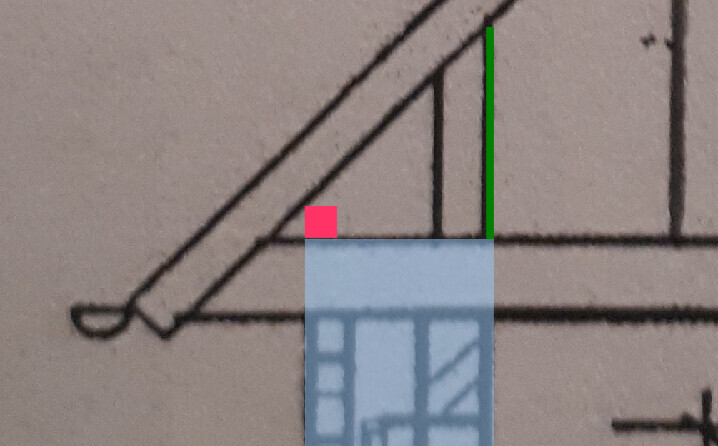
I highlighted the exterior wall in blue, mentally extending it up to the top edge of the ceiling joist. The position of the non-existent base plate here is shown in red. Its lower edge lies at "0" relative to the blue area, so the knee wall is at 0.
The difference between the length of the green line and zero is simply due to the "scissor" effect caused by the roof slope. This is not a knee wall, it is just a simple plumb line marker.
If you subtract a floor structure from the base of the green line, it will roughly still be about 12cm (5 inches) long – but that doesn’t make it sensible to claim a 1m (3.3 ft) line 88 cm (35 inches) further on.
The construction of the roof overhang is economically executed; given the current trend for boxed eaves, this is smartly designed for a laundry loft (which is a polite way of saying "the person who planned this as living space should publicly return their diploma").
If the upper floor isn’t going to become an illegal structure, the planner will have a tough job getting this thermally insulated to meet approval. Starting with the lack of an exterior wall in the attic, sealing this upper addition to the thermal envelope will not be easy.
Your idea to count a battens extension on the rafters – which is necessary only because of the insulation thickness – as the counter-battening is nonsense of the same kind as the 10cm (4 inch) floor.
I find this concept of the two-person apartment with a ‘build now, think later’ attic irresponsible. A professional should have strongly advised you against it. Do I understand correctly that, in terms of the dimensions I used, this doesn’t have much impact since the distance between floor and beam is there anyway, but it is very problematic regarding the insulation? Would a solution like this then be possible?haydee schrieb:
Since there is a full bathroom downstairs, a small shower bathroom upstairs would be sufficient.
The planning with an apartment for two on the ground floor and a normal upper floor of a family home results in:
2 master bedrooms,
2 complete bathrooms, and
small rooms.
The house is too small for that.
Why isn’t the roof insulated and included in the thermal envelope from the start? The bathroom downstairs is not fully equipped.kaho674 schrieb:
With that observation, you can take your place at the end of this thread. I’m afraid the OP might leave if all we do is complain. Solutions are needed.
Out of money? I’d also consider completing the roof insulation now. That way you can clearly show the ‘botched planner’ what’s wrong. Maybe you can get a price reduction. I’m not running away. I know it’s not optimally solved, but I’m not as pessimistic as some here. A quote for insulating the ceiling to the attic was requested on Saturday. Let’s see what it costs. 110 sqm (1184 sqft) for the ground floor ceiling is $4k plus VAT. Possibly as DIY.11ant schrieb:
I just assume it’s not the case – based on plans and photos alone, some things are unclear. Without a detailed boxed eave detail, I would actually expect the ground floor to be a closed envelope, but then with a retractable or enclosed staircase.
I fear even with a serious effort, it’s not yet solvable here. Yes, the ground floor is a separate envelope. My approach was that only the stairwell (with a fire-rated door as entrance) will be enclosed and insulated. It was only recommended to immediately position and insulate the exterior walls of the rooms so that later stair conversion won’t have to be undone, avoiding wasted money. But no final decision has been made yet; it depends on the quote. So far it’s only a plan, which might not necessarily be realized.hanse987 schrieb:
Is it really that simple to include the roof in the thermal envelope? If I understand the OP correctly, the building permit is based on the energy saving regulation calculation with insulation of the ceiling above the living space. Even if he insulates upstairs, the ceiling and underlying floor must still meet the insulation requirements according to the building permit, or am I missing something? I don’t think that’s possible. Although the construction application states 20cm (8 inches) of insulation under the slab, the energy saving regulation calculation showed it was not necessary and therefore it was not done. When I asked, I was told that is acceptable.
pffreestyler schrieb:
Would such a solution be possible? Is the position of the rising wall in your non-scaled sketch meant to represent the knee wall to be built? - if so, that should work.
pffreestyler schrieb:
Yes, the ground floor is its own envelope. My approach was also that only the stairwell (with a mezzanine door as the entrance) is enclosed and insulated. Is that exactly how it is in the approved planning, meaning an insulated ground floor with enclosure/cladding of the stairs, and otherwise an empty attic space?
https://www.instagram.com/11antgmxde/
https://www.linkedin.com/company/bauen-jetzt/
P
pffreestyler6 Dec 2018 09:4111ant schrieb:
Is the position of the rising wall in your non-scale sketch supposed to represent the knee wall to be built? – if so, that should work. Yes, that’s what it’s meant to be. Not to scale though, since it’s not my drawing. But the principle is the same.Yesterday, I spoke with the carpenter and the construction manager, and both independently suggested that during the later finishing work, the insulation should be extended down to the visible insulation shown here
and then the knee wall can be built wherever desired. If I’ve understood correctly, this also has the advantage that cables and pipes behind the knee wall have more space? Insulating only where the knee wall is makes handling pipes more difficult, right?
11ant schrieb:
Is this consistent with the permit/planning application, meaning insulated ground floor with enclosure around/along the staircase, and otherwise empty attic?Yes, I’m just not sure which type of staircase was assumed (a full staircase or the typical attic ladder), although we have always clearly communicated that we intend to install a full staircase right away.
Similar topics