ᐅ Floor Plan of a Narrow, Rectangular L-Shaped House on a Triangular Plot with an Oak Tree
Created on: 4 Nov 2018 10:54
O
Oakland
Hello everyone!
We have purchased a triangular plot of land. As if that weren’t complicated enough, there is also a large oak tree that must be considered during the planning. In our initial considerations, it quickly became clear that the floor plan will have an L-shape.
Does anyone here have experience with this type of plot and a correspondingly shaped floor plan? What additional information is needed to get meaningful advice?
Best regards
We have purchased a triangular plot of land. As if that weren’t complicated enough, there is also a large oak tree that must be considered during the planning. In our initial considerations, it quickly became clear that the floor plan will have an L-shape.
Does anyone here have experience with this type of plot and a correspondingly shaped floor plan? What additional information is needed to get meaningful advice?
Best regards
haydee schrieb:
The plum tree can be removed, right?Yes, the plum tree is not an issue.
What other measurements do you need?
M
Mottenhausen25 Nov 2018 22:36So everything remains roughly as previously estimated.
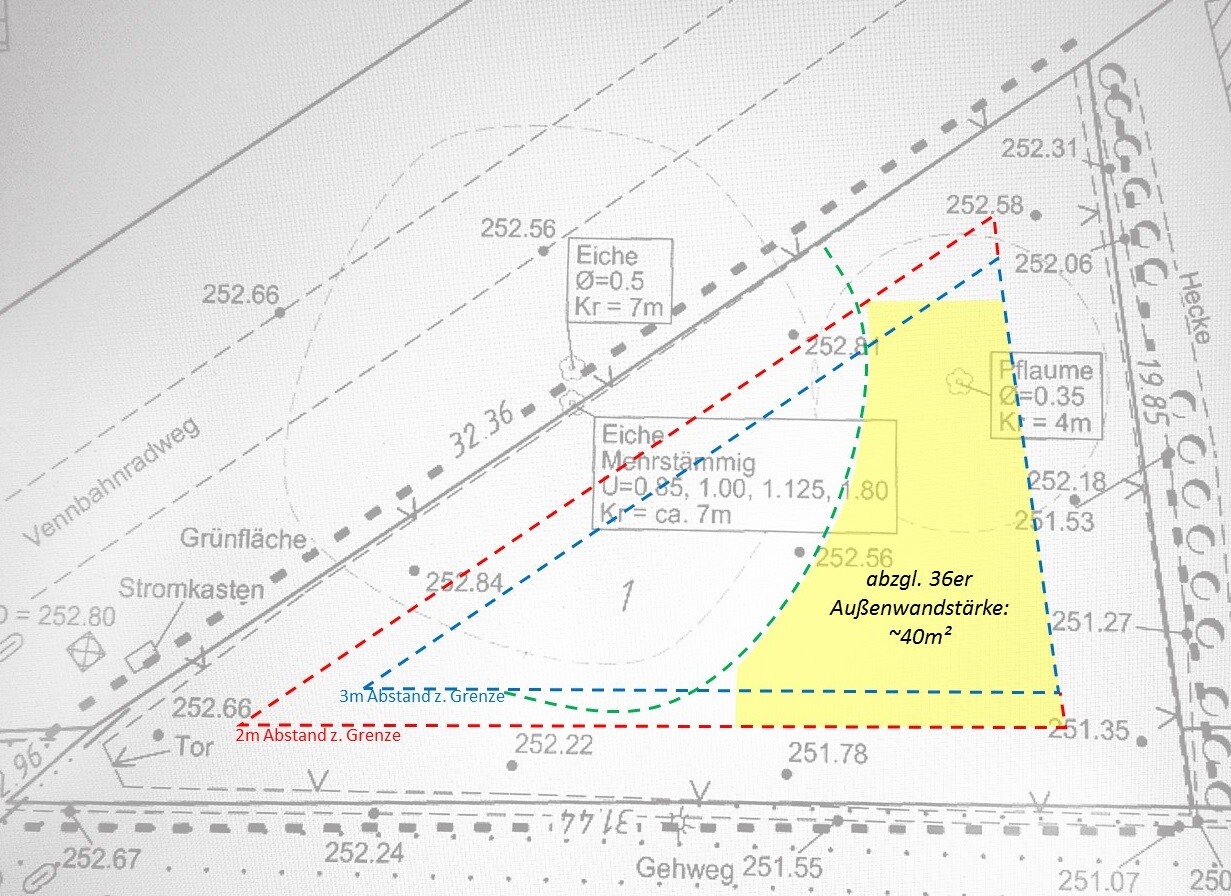
The crown circle around the plum tree has a radius of 4m (13 feet) or a diameter of 8m (26 feet) and illustrates the distance from the oak tree’s canopy to the property boundary: approximately 8.5m (28 feet). Subtracting 3m (10 feet) minimum setback to the neighbor, and 1.5m (5 feet) clearance from the canopy according to authorities leaves 4m (13 feet) of building width in the northern wing.
Has the architect commented on this yet? Is a drastic pruning of the oak tree permitted to gain 1 to 2 meters? Has the setback to the sidewalk on the south side been clarified? Is it allowed to build up to the boundary there as intended? Is the neighbor willing to approve a reduced setback, perhaps 2m (7 feet) instead of 3m (10 feet)?
All of this will ultimately determine whether the site is reasonably buildable or not. But the building plot hypothesized on the previous pages remains the same: it will either stay very small or become larger and more usable.
The crown circle around the plum tree has a radius of 4m (13 feet) or a diameter of 8m (26 feet) and illustrates the distance from the oak tree’s canopy to the property boundary: approximately 8.5m (28 feet). Subtracting 3m (10 feet) minimum setback to the neighbor, and 1.5m (5 feet) clearance from the canopy according to authorities leaves 4m (13 feet) of building width in the northern wing.
Has the architect commented on this yet? Is a drastic pruning of the oak tree permitted to gain 1 to 2 meters? Has the setback to the sidewalk on the south side been clarified? Is it allowed to build up to the boundary there as intended? Is the neighbor willing to approve a reduced setback, perhaps 2m (7 feet) instead of 3m (10 feet)?
All of this will ultimately determine whether the site is reasonably buildable or not. But the building plot hypothesized on the previous pages remains the same: it will either stay very small or become larger and more usable.

Apparently, the authority follows DIN 18920. A Mr. Brudi kindly summarized some key points, but it is only available as a PDF.
The requirements during the construction phase are quite demanding. In the root zone, excavation is only allowed by hand.
The 1.5m (5 feet) distance in the root zone is clear. But what about the upper floor? Is it permitted to build an overhang up to the canopy? After all, up to 30% of the root area may be covered with paths.
The question remains whether all of this is worth it. However, the original poster is determined. I have yet to see a property where § 4 g) of the tree protection ordinance fits better than here. The tree has an expropriating effect and prevents use beyond a reasonable extent. Has the previous owner already filed an unsuccessful lawsuit?
As a nature enthusiast, I am also against cutting down the oak. But then the land should not be designated as building land. The original poster has confirmed the land-use zoning, and there is even a positive preliminary building inquiry (although I am unclear about what exactly). So, in my opinion, the tree would have to be removed.
The requirements during the construction phase are quite demanding. In the root zone, excavation is only allowed by hand.
The 1.5m (5 feet) distance in the root zone is clear. But what about the upper floor? Is it permitted to build an overhang up to the canopy? After all, up to 30% of the root area may be covered with paths.
The question remains whether all of this is worth it. However, the original poster is determined. I have yet to see a property where § 4 g) of the tree protection ordinance fits better than here. The tree has an expropriating effect and prevents use beyond a reasonable extent. Has the previous owner already filed an unsuccessful lawsuit?
As a nature enthusiast, I am also against cutting down the oak. But then the land should not be designated as building land. The original poster has confirmed the land-use zoning, and there is even a positive preliminary building inquiry (although I am unclear about what exactly). So, in my opinion, the tree would have to be removed.
M
Mottenhausen29 Nov 2018 11:34The required 1.5m (5 feet) setback from the current crown extent remains the main issue here. If building up to the street is allowed, it will improve somewhat. What is currently left is, in any case, a joke—40m² (area of the yellow section, already minus the 36cm (14 inch) wall all around). … this still excludes interior walls and stairs.