
ᐅ Floor-to-ceiling windows – Why choose floor-to-ceiling windows? Advantages and disadvantages?
Created on: 27 Jul 2018 16:45
Y
ypg
In the past, people used to talk about their "own four walls," but nowadays it would be more accurate to say: "my own four / six / eight windows" – depending on how many floor-to-ceiling and nearly ceiling-high windows break up and interrupt the walls. Floor-to-ceiling windows have gone from being a status symbol to a matter of course; they represent a contrast to the traditional windowsill and flowerpot world that new-build residents want to leave behind. These windows can be tilted or even opened, provided they have fall protection, but the question remains: Can you really love them?
In fact, buying a floor plan can stir emotions when you see the bright, airy rooms and seemingly weightless walls in the graphical simulations provided by the real estate agent. Glass reaching to the floor was previously only known from high-rise scenes in major films and extravagant museum buildings. Just the prospect of floor-to-ceiling windows gives a sense of becoming a more open, lighter, and brighter person.
In the public perception, these windows convey something solemn, dramatic, visionary. For example, when the Handelsblatt profiles the leading conservative talk show figure Hans-Olaf Henkel, the very first paragraph notes that the vigorous AfD official looks out through floor-to-ceiling windows from his penthouse in Berlin-Mitte towards "his goal," the government district. Gerhard Schröder, on the other hand, offers a reversed perspective in his book Decisions: My Life in Politics. The former chancellor writes about the moment after Oskar Lafontaine’s resignation in 1999: "When Joschka was outside again and Heye had also said goodbye, I stood as usual—whenever faced with a confusing situation—by the floor-to-ceiling window through which a late sun sent its last rays. Early spring and a faint light green in the park of the Federal Chancellery."
However, most people who stand before floor-to-ceiling windows in confusing situations are more likely to see withering turf or a chaotic collection of ride-on toys, children's bicycles, scooters, skateboards, unicycles, and rubber boots: springtime in a new residential development in Munich-Oberföhring, Hamburg-Ottensen, or Berlin-Prenzlauer Berg. Especially where housing is built for families, floor-to-ceiling windows are now the standard design feature, and even Germany’s best-selling house model "Flair 113" features floor-to-ceiling windows beneath its pitched roof.
The rise of underfloor heating was probably the trigger: since new buildings are heated from below, radiators no longer need to be placed under the windows, and the windows can extend all the way to the floor. This results in more light inside and makes the façades appear less bulky and unwelcoming.
Planning is one thing, but the reality for residents is another. Or, in the words of Anne Zuber, editor-in-chief of the magazine Häuser: "Reality is the moment when you glance into the fridge while walking past, shove two slices of salami into your mouth, and get watched by neighbors from three different directions." Zuber’s advice to future architects and planners: "Don’t forget the salami zones."
For now, however, the pleasure belongs to pleated blind manufacturers. These blinds, which can be slid up and down within the window frame, are ideal for turning floor-to-ceiling windows back into windows you can look through only up to hip level. However, these windows then appear like strictly skirted governesses among the openings in the walls. Others use frosted adhesive film, which always raises the question: Why have floor-to-ceiling windows if you cover them up?
A walk through a new development shows that residents simply block some of their floor-to-ceiling windows over time. It looks odd because the backs of furniture are hardly decorative façades. But what else can one do when a children's room has one wall with a door, one with a wardrobe, and two walls with floor-to-ceiling windows? Anyone living with floor-to-ceiling windows quickly realizes that these windows demand things from you that you cannot always provide. Writer Anke Stelling has just released an illuminating novel about a mother's existential crisis in Prenzlauer Berg. Her book is titled Floor-to-Ceiling Windows. In it, the narrator reflects, "The new building looks from the outside exactly as you want it nowadays. But the floor-to-ceiling windows honestly make furnishing difficult—at least if you didn’t know during the initial floor plan design who would sleep where and with how many people and pieces of furniture you would move in. The windows demand a coherent overall concept."
Every move, especially if building your own home, feels like a fresh start, like the chance to finally have that "coherent overall concept," the hope to take control of your own life. But once you’re living there, the windows bring you back down to earth—right to the ground they reach. Yes, architects praise the exchange between private and public space in residential complexes, and design furniture catalogs suggest that minimalist living is possible in everyday life, but in the end, the floor-to-ceiling windows remind you: everything remains improvisation, nothing is really coherent.
My daughter is turning eight; she was just born when we moved into the new building. She only knows floor-to-ceiling windows. In her room, she has three of them. When asked before her birthday what she wished for, she said: "A windowsill." Why’s that? "So you can sit comfortably on it. Or lean on it. With a cushion or something. Or put something on it." And what would that be? "A flowerpot."
Photo: Till Raether, source: Schlafzimmer-Süddeutsche
In fact, buying a floor plan can stir emotions when you see the bright, airy rooms and seemingly weightless walls in the graphical simulations provided by the real estate agent. Glass reaching to the floor was previously only known from high-rise scenes in major films and extravagant museum buildings. Just the prospect of floor-to-ceiling windows gives a sense of becoming a more open, lighter, and brighter person.
In the public perception, these windows convey something solemn, dramatic, visionary. For example, when the Handelsblatt profiles the leading conservative talk show figure Hans-Olaf Henkel, the very first paragraph notes that the vigorous AfD official looks out through floor-to-ceiling windows from his penthouse in Berlin-Mitte towards "his goal," the government district. Gerhard Schröder, on the other hand, offers a reversed perspective in his book Decisions: My Life in Politics. The former chancellor writes about the moment after Oskar Lafontaine’s resignation in 1999: "When Joschka was outside again and Heye had also said goodbye, I stood as usual—whenever faced with a confusing situation—by the floor-to-ceiling window through which a late sun sent its last rays. Early spring and a faint light green in the park of the Federal Chancellery."
However, most people who stand before floor-to-ceiling windows in confusing situations are more likely to see withering turf or a chaotic collection of ride-on toys, children's bicycles, scooters, skateboards, unicycles, and rubber boots: springtime in a new residential development in Munich-Oberföhring, Hamburg-Ottensen, or Berlin-Prenzlauer Berg. Especially where housing is built for families, floor-to-ceiling windows are now the standard design feature, and even Germany’s best-selling house model "Flair 113" features floor-to-ceiling windows beneath its pitched roof.
The rise of underfloor heating was probably the trigger: since new buildings are heated from below, radiators no longer need to be placed under the windows, and the windows can extend all the way to the floor. This results in more light inside and makes the façades appear less bulky and unwelcoming.
Planning is one thing, but the reality for residents is another. Or, in the words of Anne Zuber, editor-in-chief of the magazine Häuser: "Reality is the moment when you glance into the fridge while walking past, shove two slices of salami into your mouth, and get watched by neighbors from three different directions." Zuber’s advice to future architects and planners: "Don’t forget the salami zones."
For now, however, the pleasure belongs to pleated blind manufacturers. These blinds, which can be slid up and down within the window frame, are ideal for turning floor-to-ceiling windows back into windows you can look through only up to hip level. However, these windows then appear like strictly skirted governesses among the openings in the walls. Others use frosted adhesive film, which always raises the question: Why have floor-to-ceiling windows if you cover them up?
A walk through a new development shows that residents simply block some of their floor-to-ceiling windows over time. It looks odd because the backs of furniture are hardly decorative façades. But what else can one do when a children's room has one wall with a door, one with a wardrobe, and two walls with floor-to-ceiling windows? Anyone living with floor-to-ceiling windows quickly realizes that these windows demand things from you that you cannot always provide. Writer Anke Stelling has just released an illuminating novel about a mother's existential crisis in Prenzlauer Berg. Her book is titled Floor-to-Ceiling Windows. In it, the narrator reflects, "The new building looks from the outside exactly as you want it nowadays. But the floor-to-ceiling windows honestly make furnishing difficult—at least if you didn’t know during the initial floor plan design who would sleep where and with how many people and pieces of furniture you would move in. The windows demand a coherent overall concept."
Every move, especially if building your own home, feels like a fresh start, like the chance to finally have that "coherent overall concept," the hope to take control of your own life. But once you’re living there, the windows bring you back down to earth—right to the ground they reach. Yes, architects praise the exchange between private and public space in residential complexes, and design furniture catalogs suggest that minimalist living is possible in everyday life, but in the end, the floor-to-ceiling windows remind you: everything remains improvisation, nothing is really coherent.
My daughter is turning eight; she was just born when we moved into the new building. She only knows floor-to-ceiling windows. In her room, she has three of them. When asked before her birthday what she wished for, she said: "A windowsill." Why’s that? "So you can sit comfortably on it. Or lean on it. With a cushion or something. Or put something on it." And what would that be? "A flowerpot."
Photo: Till Raether, source: Schlafzimmer-Süddeutsche

Traumfaenger schrieb:
We have drawn our existing furniture, including the kitchen, to scale with their surface areas, cut them out, and then placed them on the house floor plans to get an initial impression of whether it would roughly fit. In many amateur floor plans, it "fits" only in the sense of a "tight fit," either due to hardly variable furniture arrangements or a barely sufficient circulation space around the double bed.
garfunkel schrieb:
Floor-to-ceiling windows are generally incorrect as a rule. It just needs to be coherent and fit well as a whole. However, they are less popular with people who have this mindset and more with pattern home fashion enthusiasts.
https://www.instagram.com/11antgmxde/
https://www.linkedin.com/company/bauen-jetzt/
T
Traumfaenger28 Jul 2018 23:35garfunkel schrieb:
It just has to be coherent and fit well as a whole.For me, these windows are also a design element, but I’m generally more a fan of Bauhaus style. For example, I can’t imagine the Barcelona Pavilion by Ludwig Mies van der Rohe or other works without floor-to-ceiling windows.
However, in that case, the facade design must have a consistent window grid and not a chaotic mix of window sizes as has been discussed in other parts here.
Traumfaenger schrieb:
For example, I can’t imagine the Barcelona Pavilion by Ludwig Mies van der Rohe or other works without floor-to-ceiling windows. Interestingly, I just saw an ad in this forum showing the following image:
Farnsworth instead of Barcelona, but indeed also “unimaginable” with regular-sized windows.
https://www.instagram.com/11antgmxde/
https://www.linkedin.com/company/bauen-jetzt/
Tina mit K schrieb:
We will have 6 floor-to-ceiling windows in the living room, 4 of which can be opened to access the garden. We plan to put our pool table there, so I don’t mind if the neighbors can see it.Then it seems to make sense for you.
It feels like living rooms are being equipped with doors to the outside in all directions, even though these are often no longer usable afterwards. Furniture is placed in front of them inside, and outside there isn’t always a terrace, or if you step onto the terrace, you immediately stand in the furniture there. You can observe this in many new residential areas.
EinMarc schrieb:
Of course it doesn’t make sense everywhere, but since some windows now have better insulation values than solid walls, it’s not just nonsensical anymore but offers added value without major drawbacks.Where did you hear that rumor?
A very expensive “passive house window” has a Uw value of 0.7 W/(m²K), while a typical exterior wall in new construction is around U = 0.2 or even lower (KFW 55/40).
 Tina mit K29 Jul 2018 09:25
Our plot is quite large, measuring 1600 sqm (approximately 17,220 sq ft), and our garden borders a field. I am really looking forward to the view we will have.
This is how it will look later:
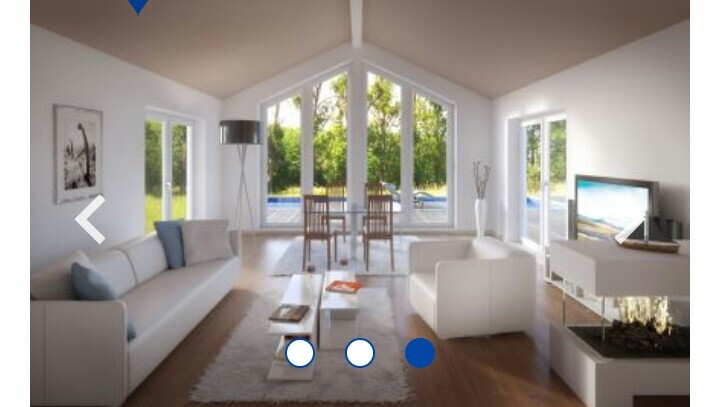
This is how it will look later:
Similar topics