
ᐅ Terrace on a Sloped Site Supported by Stilts – Which Is Better: Wood or Steel?
Created on: 3 Jun 2018 15:05
Z
Zaba12
Hello everyone,
I need your input because our eastern neighbor has disrupted our landscaping plans. We had planned to stabilize the area with two rows of 1 meter (3 feet) L-shaped retaining walls. Now, our neighbor intends to build three full stories facing the garden, meaning they will want direct access from the basement to the garden.
This makes our original plan obsolete since we intended to add fill while they plan to excavate. This would leave us with 2.5 meter (8 feet) tall L-shaped retaining walls on the side, which none of us want.
So now the question is, do you have any idea what it would cost to construct the terrace on a supporting framework, possibly including the tool shed? See the screenshot. We would need to expose the basement wall facing the garden, but then we wouldn’t need to install the L-shaped retaining walls, which would cost around €26,000.
Would wood or steel be advisable?
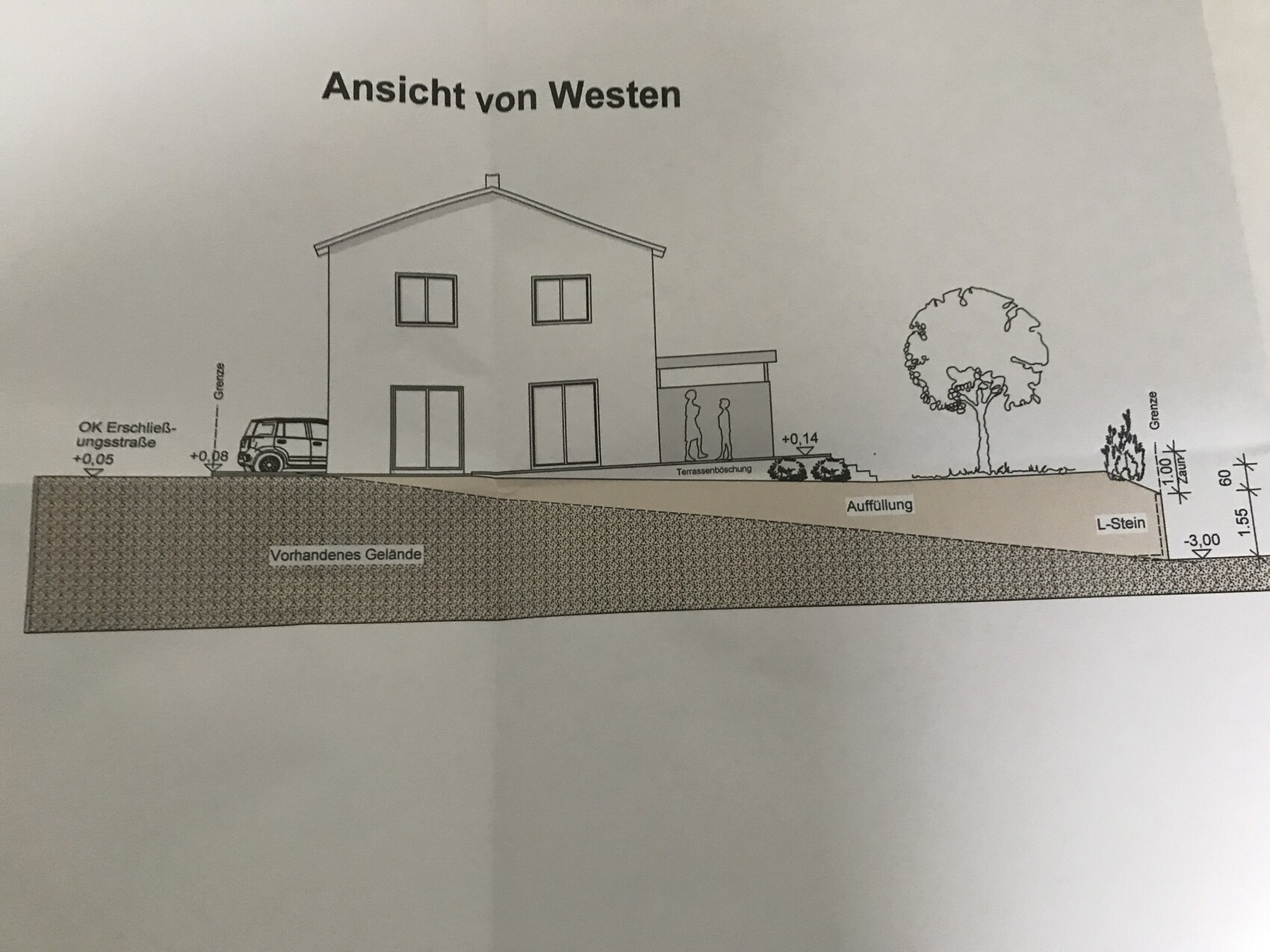
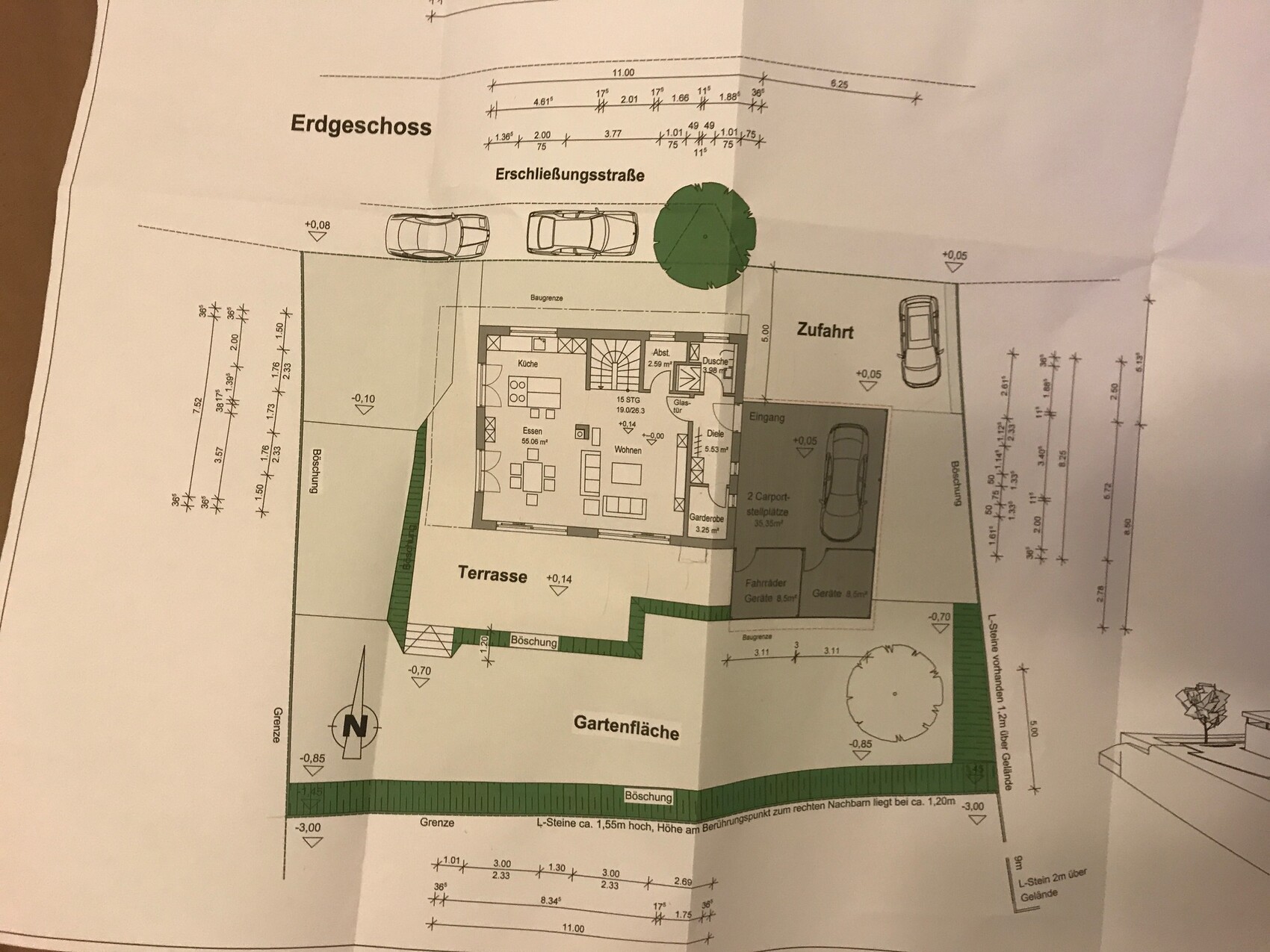
I need your input because our eastern neighbor has disrupted our landscaping plans. We had planned to stabilize the area with two rows of 1 meter (3 feet) L-shaped retaining walls. Now, our neighbor intends to build three full stories facing the garden, meaning they will want direct access from the basement to the garden.
This makes our original plan obsolete since we intended to add fill while they plan to excavate. This would leave us with 2.5 meter (8 feet) tall L-shaped retaining walls on the side, which none of us want.
So now the question is, do you have any idea what it would cost to construct the terrace on a supporting framework, possibly including the tool shed? See the screenshot. We would need to expose the basement wall facing the garden, but then we wouldn’t need to install the L-shaped retaining walls, which would cost around €26,000.
Would wood or steel be advisable?
I have now made the following proposal to my architect. What do you think?
And does it conflict with the local building regulations?
"
Balconies, Minor Projections:
Balconies, canopies, and ground-floor extensions are considered minor projections according to Article 6, paragraph 8 of the Bavarian Building Code (BayBO) and are permitted to extend up to a maximum depth of 1.5 m (5 feet) beyond the building boundary. Other projecting structural elements are not allowed, deviating from Article 6, paragraph 8 BayBO.
"

And does it conflict with the local building regulations?
"
Balconies, Minor Projections:
Balconies, canopies, and ground-floor extensions are considered minor projections according to Article 6, paragraph 8 of the Bavarian Building Code (BayBO) and are permitted to extend up to a maximum depth of 1.5 m (5 feet) beyond the building boundary. Other projecting structural elements are not allowed, deviating from Article 6, paragraph 8 BayBO.
"

Zaba12 schrieb:
And does it conflict with the building line regulation? With a depth of 1.5 m (5 feet), basically yes – however, I don’t see any projecting structure as defined by the regulation. Apart from extending a maximum of 84 cm (33 inches) compared to the adjacent slope of the terrain, the terrace does not protrude further. In my assessment, it remains below the maximum finished floor level of the ground floor, so it is considered “at ground level.” In my opinion, a stabilized ground embankment is not regarded as a projecting structure under a regulation that likely aims to restrict large porch canopies or porch vestibules.
https://www.instagram.com/11antgmxde/
https://www.linkedin.com/company/bauen-jetzt/
11ant schrieb:
With a depth of 1.5 m (5 feet) basically yes – however, I don’t see any protruding component in the sense of the regulation here. Except for (max. about 84 cm (33 inches) compared to the adjacent terrain slope) the terrace does not extend forward at all. In my assessment, it remains below the maximum top edge of the finished floor level on the ground floor, so it’s considered “level with the ground.” In my opinion, a compacted fill is not a protruding component in the sense of a regulation that is probably intended to limit large door canopies or windbreak vestibules. That already reassures me.
I have two appointments next week to estimate the costs of the steel construction. I’m curious how expensive it will be.
Compared to the old plan, I’m currently about €7,500 (+/-) ahead without steel beams, without the wooden terrace substructure and superstructure, without railings, and without the additional cost of basement plastering. The site is already excavated and the material is at the landfill, and the L-shaped retaining walls are in place. So it feels like about €18,500 in additional costs overall.
Do you see it the same way?
These extra costs will be balanced out by a savings buffer and the extra line item for the exterior landscaping (20,000 €).
If the steel structure then costs around €25,000 to €30,000, we’ll have to come up with another idea.
Hello Zaba12
I wouldn’t use a support frame there. Extend the ground slab around the terrace, build two walls from the basement under the terrace, and place a concrete slab on top. This would then be the floor of the terrace. I believe this would be the more cost-effective construction method.
Steven
I wouldn’t use a support frame there. Extend the ground slab around the terrace, build two walls from the basement under the terrace, and place a concrete slab on top. This would then be the floor of the terrace. I believe this would be the more cost-effective construction method.
Steven
Hi Steven,
Our construction coordinator also suggested that and called the structural builder while he was on vacation to ask about the cost. A cantilevered, thermally decoupled terrace from the foundation slab (6x3m (20x10 feet)) costs 6,000€ net.
The problem is that with these dimensions, we can’t reach the carport or the west terrace door.
In my opinion, the last sketch in this thread is the optimum area combined with the L-shaped concrete blocks.
The soil analysis report will arrive this week. If there is too much rubble or organic material in the soil, then the idea of handling 900m³ (1,180 cubic yards) of loose soil will quickly be off the table.
It remains exciting.
EDIT: Another idea would be to use 2.55 L-shaped blocks at least to form the supports. That means 3 L-blocks (2 outer and 1 in the middle) on the garden side at the front edge of the terrace. However, this would only form the supports. We would still need beams that have to be anchored to the house so that the terrace substructure can be mounted.
Our construction coordinator also suggested that and called the structural builder while he was on vacation to ask about the cost. A cantilevered, thermally decoupled terrace from the foundation slab (6x3m (20x10 feet)) costs 6,000€ net.
The problem is that with these dimensions, we can’t reach the carport or the west terrace door.
In my opinion, the last sketch in this thread is the optimum area combined with the L-shaped concrete blocks.
The soil analysis report will arrive this week. If there is too much rubble or organic material in the soil, then the idea of handling 900m³ (1,180 cubic yards) of loose soil will quickly be off the table.
It remains exciting.
EDIT: Another idea would be to use 2.55 L-shaped blocks at least to form the supports. That means 3 L-blocks (2 outer and 1 in the middle) on the garden side at the front edge of the terrace. However, this would only form the supports. We would still need beams that have to be anchored to the house so that the terrace substructure can be mounted.
Hello Zaba12
you are working with 255 mm L-shaped concrete blocks (about 10 inches). They are expensive and quite heavy.
As I mentioned, I would extend the foundation slab to include the terrace area (you need a foundation or slab anyway for the L-shaped blocks) and build a 300 mm (12 inch) masonry wall instead of using the L-shaped blocks. Then place a cantilevered slab on top. Taking this into account during the structural shell phase shouldn’t be very expensive. In any case, it will be more cost-effective than handling such large L-shaped blocks.
Steven
you are working with 255 mm L-shaped concrete blocks (about 10 inches). They are expensive and quite heavy.
As I mentioned, I would extend the foundation slab to include the terrace area (you need a foundation or slab anyway for the L-shaped blocks) and build a 300 mm (12 inch) masonry wall instead of using the L-shaped blocks. Then place a cantilevered slab on top. Taking this into account during the structural shell phase shouldn’t be very expensive. In any case, it will be more cost-effective than handling such large L-shaped blocks.
Steven
Similar topics