
ᐅ Cavity Wall Construction for a Basement in a Hillside Location – Any Experiences?
Created on: 5 May 2018 14:31
N
notardHello everyone,
We are currently planning the construction of an end terraced house on a sloped site and would appreciate your advice regarding the wall construction.
Our project has some specific features, namely:
Our original wall construction plan for the house was as follows:
Now, due to the sloped site, we want to include a residential basement, which creates challenges with the brick facing, as it is very difficult to align the base of the outer leaf of the brickwork with the slope of the ground while ensuring proper insulation and waterproofing.
Our architect has proposed the following solution:
However, we consciously decided against using EWI because
Therefore, we would like to gather more opinions on whether there might still be a solution for a continuous brick facade that does not become excessively expensive. Has anyone experienced how to solve this kind of issue?
Attachment: Sketch of the planned house with terrain
Thank you very much and best regards,
notard
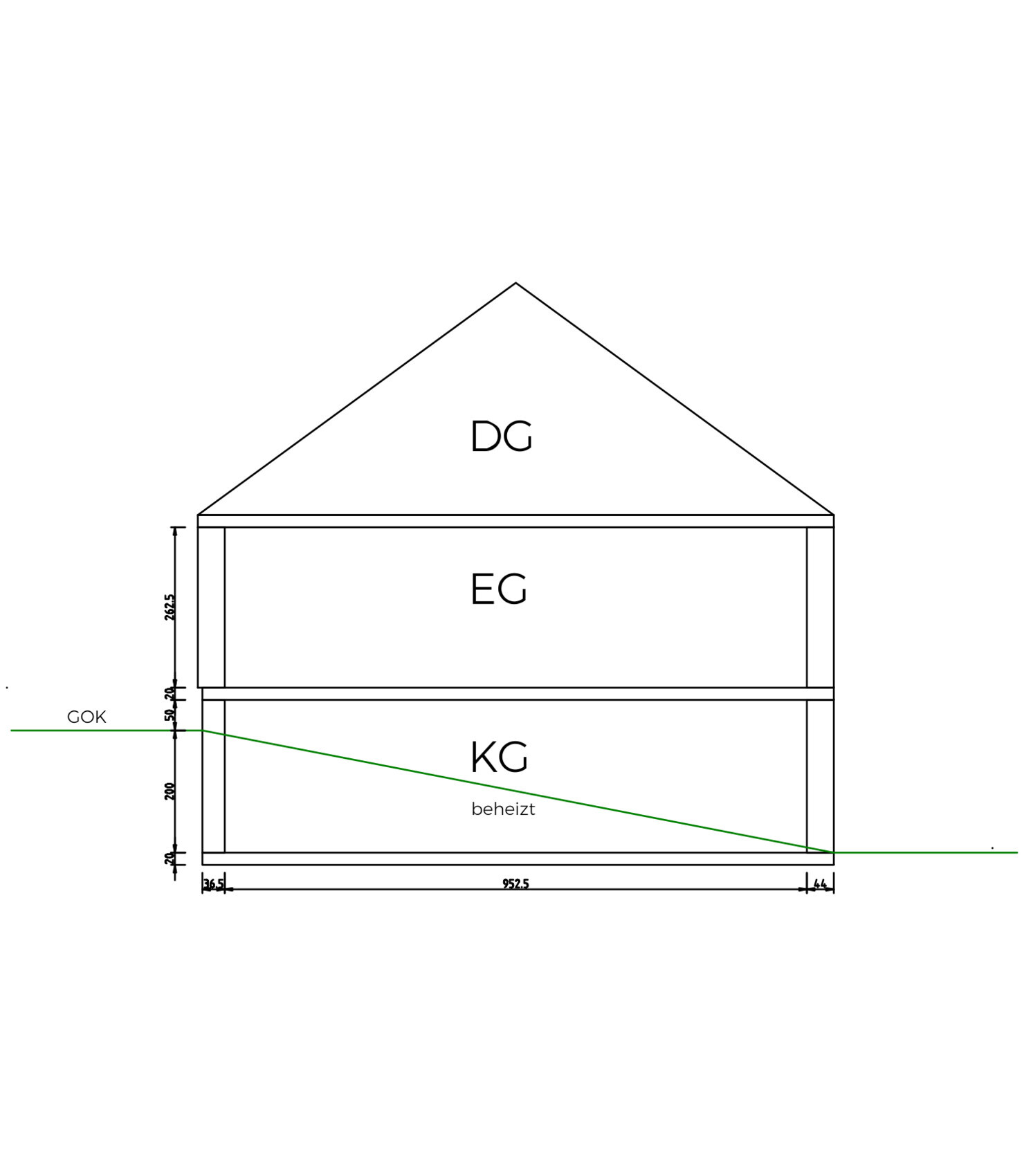
We are currently planning the construction of an end terraced house on a sloped site and would appreciate your advice regarding the wall construction.
Our project has some specific features, namely:
- Building plot on a slope (green line indicates the terrain)
- Extension attached to an existing terraced house (opposite side compared to the drawing)
- Foundation must be at the same level as the existing house
Our original wall construction plan for the house was as follows:
- 11.5cm (4.5 inches) facing brick / 15cm (6 inches) cavity insulation + cavity / 17.5cm (7 inches) calcium silicate solid blocks = 44cm (17 inches)
Now, due to the sloped site, we want to include a residential basement, which creates challenges with the brick facing, as it is very difficult to align the base of the outer leaf of the brickwork with the slope of the ground while ensuring proper insulation and waterproofing.
Our architect has proposed the following solution:
- Cladding the exposed basement exterior wall with external wall insulation system (EWI) up to the base
- From the ground floor upwards: cavity masonry
However, we consciously decided against using EWI because
- We are concerned about algae and mold issues, which we have already encountered in acquaintances’ buildings
- We value the durability and quality of a brick masonry facade
- We prefer a uniform (brick) appearance
Therefore, we would like to gather more opinions on whether there might still be a solution for a continuous brick facade that does not become excessively expensive. Has anyone experienced how to solve this kind of issue?
Attachment: Sketch of the planned house with terrain
Thank you very much and best regards,
notard

notard schrieb:
Our architect made the following suggestion: Cladding the exposed exterior basement wall with ETICS (up to the base/plinth); from the ground floor: cavity wall I would modify that to: plaster up to the base/plinth, and insulation applied on the inside of the basement wall.
https://www.instagram.com/11antgmxde/
https://www.linkedin.com/company/bauen-jetzt/
11ant schrieb:
Plaster up to the base, and insulation inside the basement walls. I often hear that interior insulation can lead to thermal bridges and that it is primarily a solution for renovating older buildings. Of course, these are probably just second-hand opinions – nevertheless, we would appreciate it if you could explain a bit more why interior insulation would be a good choice in this case. So far, this option hasn’t occurred to us at all.
notard schrieb:
We are currently planning the construction of an end terraced house on a slope and would like your advice regarding the wall construction. I haven’t addressed this point yet: how is it possible that an individual homeowner is dealing with this – a row of houses is usually planned uniformly, isn’t it?
notard schrieb:
Surely these are just opinions picked up here and there Then it’s better not to add mine to the mix. That’s why I stuck to facts:
1) Insulation is required, but the homeowner does not want it as an external thermal insulation composite system (ETICS / external wall insulation).
2) The cavity wall lining cannot be left unsupported, but stepping the support line by line would be unnecessarily complex and impractical.
From “insulation, but not outside,” it logically follows “insulation inside.”
The support is created by inserting the outer wall in the basement accordingly beneath it.
I could imagine using the same facing brick as thin brick slips in this area. I would avoid a double-wall construction extending into the soil; that seems unwise to me.
What do the neighbors in the row think about this?
https://www.instagram.com/11antgmxde/
https://www.linkedin.com/company/bauen-jetzt/
11ant schrieb:
How should one imagine that a single homeowner deals with this – isn’t a row of houses typically planned uniformly? This concerns an extension to existing houses, and the local development plan does not impose any restrictions on the facade design. So, it practically only involves the side facing away from the neighbors.
11ant schrieb:
2) The cladding cannot be suspended in mid-air, but stepping its support row by row would be extremely complicated nonsense. Ah, thank you for your comment on this! I would like to understand better. Why is stepping the support so time-consuming?
Best regards,
Notard
notard schrieb:
I would like to understand this better. Why is a stepped foundation so complicated? In the worst case, if you have trouble picturing it, drawing it yourself might help: the support had to be built and fixed like a staircase. That alone is quite a challenge, even for someone handy. On top of that, the terrain is unlikely to be so accommodating as to rise by exactly half or one and a half brick lengths per row. So, you would also have to build this awkward custom structure unevenly.
https://www.instagram.com/11antgmxde/
https://www.linkedin.com/company/bauen-jetzt/
Similar topics