
Hello!
We have owned a plot of land for some time now but haven’t been able to get a good house plan together. It’s starting to drive us a bit crazy.
The plot has a slight west-facing slope and a minimal north-facing slope, which together total about 3.5 meters (11.5 feet) diagonally. The driveway will be accessed from the south—ideally the southeast—but unfortunately, that is the highest point, which complicates things.
We want to build with a general contractor (GC), so the architect they work with is doing the planning. The first architect tried to push a standard plan on us. That would have been fine if it matched our ideas and was more affordable, but it didn’t. Also, the GC wasn’t very reliable.
The second GC has been great so far, and the chemistry with his partner architect was good right away. The first architect just wanted a long driveway with the house and garage next to each other at the north end. The second architect immediately proposed what we envisioned: a shorter driveway and a garage set apart to the southeast in front of the house with a covered walkway to the entrance. I mentioned that, given the terrain heights, it might be challenging, but he said that would be his responsibility.
Since then, things have changed quite a bit after we saw their official proposals. Three out of four versions had a driveway in front of the garage with slopes of up to 20%, and then steps from the garage to the house. The floor plans didn’t impress us either; some room sizes were about 20% smaller than what we had already planned as tight. They told us not to fuss over a few square meters. Then, in the last meeting, the bombshell: they now say the planned version is not realistically feasible on this plot. The best solution would be to put the garage next to the house, push everything as far north as possible, resulting in a long driveway (25 meters / 82 feet)! So, basically, no progress from their side. We’re quite frustrated. Why did they create three alternative plans if the agreed version wasn’t really workable? How many hours have they spent on this already?
Besides the fact that we still don’t have a final plan and building costs keep rising, we’re wondering whether to continue working with this architect. It feels like there’s a lack of creativity. Or are we expecting too much?
We’re unsure what to do now. We don’t want to switch again if possible. Another question is what costs have already been incurred and how to handle that.
We are cautious and don’t want to provoke a confrontation, especially since things are fine on a personal level. But professionally and creatively, we’re not convinced, and we wonder if this will work out at all.
What do you think? I would appreciate your advice. Many thanks in advance.
We have owned a plot of land for some time now but haven’t been able to get a good house plan together. It’s starting to drive us a bit crazy.
The plot has a slight west-facing slope and a minimal north-facing slope, which together total about 3.5 meters (11.5 feet) diagonally. The driveway will be accessed from the south—ideally the southeast—but unfortunately, that is the highest point, which complicates things.
We want to build with a general contractor (GC), so the architect they work with is doing the planning. The first architect tried to push a standard plan on us. That would have been fine if it matched our ideas and was more affordable, but it didn’t. Also, the GC wasn’t very reliable.
The second GC has been great so far, and the chemistry with his partner architect was good right away. The first architect just wanted a long driveway with the house and garage next to each other at the north end. The second architect immediately proposed what we envisioned: a shorter driveway and a garage set apart to the southeast in front of the house with a covered walkway to the entrance. I mentioned that, given the terrain heights, it might be challenging, but he said that would be his responsibility.
Since then, things have changed quite a bit after we saw their official proposals. Three out of four versions had a driveway in front of the garage with slopes of up to 20%, and then steps from the garage to the house. The floor plans didn’t impress us either; some room sizes were about 20% smaller than what we had already planned as tight. They told us not to fuss over a few square meters. Then, in the last meeting, the bombshell: they now say the planned version is not realistically feasible on this plot. The best solution would be to put the garage next to the house, push everything as far north as possible, resulting in a long driveway (25 meters / 82 feet)! So, basically, no progress from their side. We’re quite frustrated. Why did they create three alternative plans if the agreed version wasn’t really workable? How many hours have they spent on this already?
Besides the fact that we still don’t have a final plan and building costs keep rising, we’re wondering whether to continue working with this architect. It feels like there’s a lack of creativity. Or are we expecting too much?
We’re unsure what to do now. We don’t want to switch again if possible. Another question is what costs have already been incurred and how to handle that.
We are cautious and don’t want to provoke a confrontation, especially since things are fine on a personal level. But professionally and creatively, we’re not convinced, and we wonder if this will work out at all.
What do you think? I would appreciate your advice. Many thanks in advance.
Thank you for your advice. I’m already being cautious about how to proceed.
However, what I see differently is that, in my opinion, the architect is there to propose a good building design, not (just) me as a layperson. Then what do I need them for? It’s like taking my car to the workshop and they can’t fix it, while I’m paying for the labor hours. Then I’m told I should deal with the problem, suggest a solution to the workshop, and they would repair accordingly.
However, what I see differently is that, in my opinion, the architect is there to propose a good building design, not (just) me as a layperson. Then what do I need them for? It’s like taking my car to the workshop and they can’t fix it, while I’m paying for the labor hours. Then I’m told I should deal with the problem, suggest a solution to the workshop, and they would repair accordingly.

tepee schrieb:
..It’s like taking my car to the workshop and they can’t fix it, even though I’m paying for the labor hours. The car was repaired, but you just don’t like the oval wheels. It doesn’t run perfectly smoothly, but it does run.
The question is whether you really want to spend several hundred thousand euros on a compromise just because you don’t want to think it through yourself. I’m saying this because the responsibility for your project lies entirely with you. Everyone else just wants to make money. The only person who wants it to turn out well is you. You should get used to that. So go for it.

kaho674 schrieb:
The car was repaired, it’s just that you don’t like the oval wheels. It doesn’t run perfectly smoothly, but it runs. Hilarious
tepee schrieb:
What I would have seen differently is that, in my opinion, the architect is there to propose a good building design, not (only) me as a layperson. Then what do I need them for? That is architect type A. The "architect" type B has a different objective (that of their breadwinner, the contractor): not to confuse the client with alternatives before signing, but to quickly make the client’s sketches ready for signature and stamping.
kaho674 schrieb:
The only person who wants it to turn out well is you. You should get used to that. So get to it. Accordingly, my last post, read as an instruction:
Either
Become a “private client” of an architect (type A) whom you hire directly yourself
or – if you want to stick with the plan provider –
plan your house yourself. My input on this, as I said, is in #4 of your plot thread: place a nice house facing the street; leave as much west-facing garden as possible for the evening sun; give the carport what remains.
House, terrace, and garage cannot all have top priority simultaneously. It’s either one thing or the other; the flip side of the south street is usually the north garden. South street, south garden, and short utility connections form a magic triangle, of which even a star architect can only satisfy two wishes at once.
https://www.instagram.com/11antgmxde/
https://www.linkedin.com/company/bauen-jetzt/
In conversations with our architects, it came up that most private homebuilders have little interest in creative input. Usually, they come inspired by catalogs with almost finished designs. The couples have spent nights thinking it over and have already agreed among themselves that their own design is good—so how can anyone argue with that? As an architect, you are then only allowed to add final touches.
This is fine when building single-family homes for average clients. It simply isn’t a market for free spirits. The likelihood that a potential new client and architect match perfectly in style is very low (especially since the client often consciously doesn’t follow any particular style), so this is not the primary objective. Architects need to make a living as well.
They get to be more creative in multi-family homes for wealthier clients. They have also set a few accents with us (or were allowed to!). This was clear to us, because their portfolio clearly showed what they like themselves (which are also the projects they like to showcase).
This is fine when building single-family homes for average clients. It simply isn’t a market for free spirits. The likelihood that a potential new client and architect match perfectly in style is very low (especially since the client often consciously doesn’t follow any particular style), so this is not the primary objective. Architects need to make a living as well.
They get to be more creative in multi-family homes for wealthier clients. They have also set a few accents with us (or were allowed to!). This was clear to us, because their portfolio clearly showed what they like themselves (which are also the projects they like to showcase).
OK, the explanation about the different types of architects makes sense. The first one was relatively clear to me. For the second, I would have thought he falls somewhere between the two types. Although, I hadn’t really considered this classification of architects before. You always learn something new, especially when you have little experience in the industry.
Just to clarify: If I understand correctly, this means we would need a lifting station even without a basement if the house is positioned further to the northeast. But then the reference level according to the current plans would be around 412.5 meters (1353 feet). The sewer connection at the front of the street is roughly at the same elevation, just below the contour line between 413 and 412 meters (1355 and 1351 feet). See here:
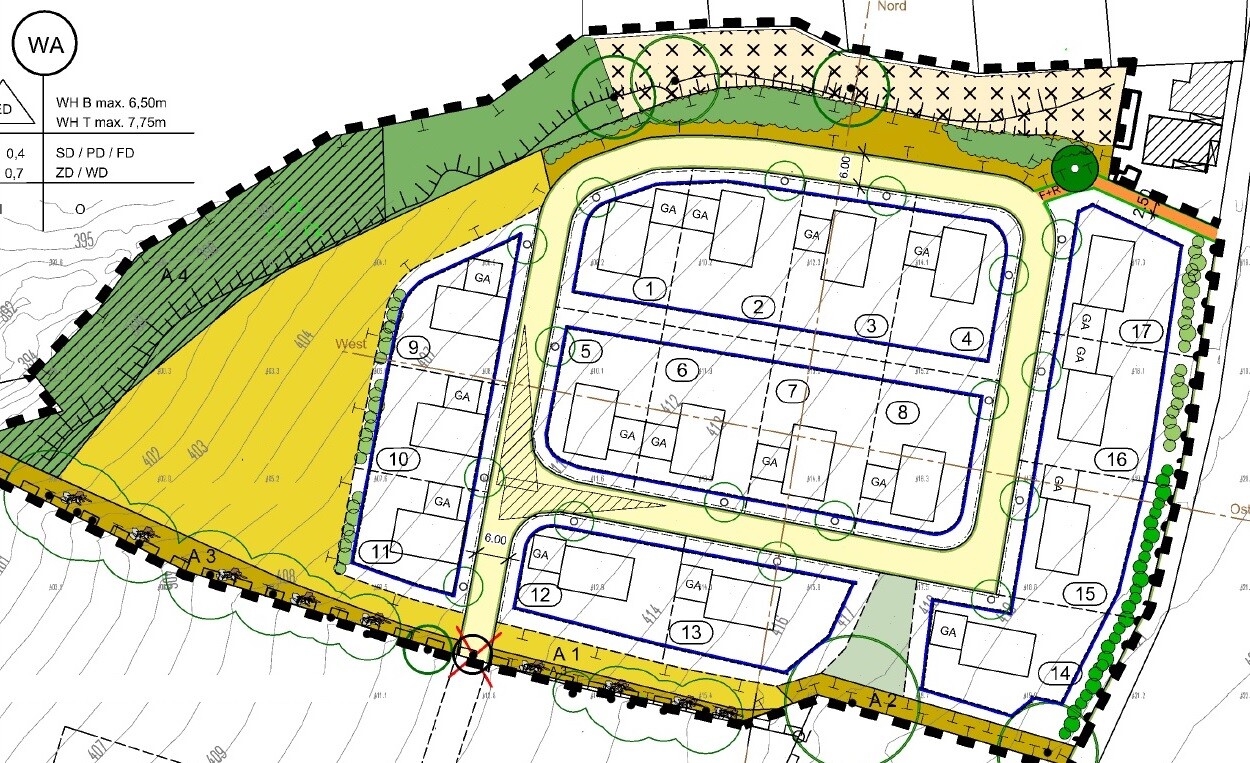
As you can see, the orientation is slightly angled towards the southwest. There are no trees on the street side, and currently, nothing on or in front of the plot.
By the way, the architect suggested another option, which seems similar to what Nordlys briefly mentioned. A garage would be located in the southeast, directly at the street front (which would be permitted), dug in 1.5 meters (5 feet) at the highest point, with the driveway running parallel to the street from below. In terms of elevation, this could be an interesting solution. However, I have some doubts about how it would look. Also, our garden to the southwest would be open due to the driveway, and we would effectively sacrifice a 6-meter (20 feet) wide strip at the street front for the garage and driveway (although it might be possible to design this in an appealing way). On the other hand, the house could be positioned towards the east or possibly southeast, with the entrance on the east side set further forward and a covered walkway to the garage. This would also help level out the plot a little.
Just to clarify: If I understand correctly, this means we would need a lifting station even without a basement if the house is positioned further to the northeast. But then the reference level according to the current plans would be around 412.5 meters (1353 feet). The sewer connection at the front of the street is roughly at the same elevation, just below the contour line between 413 and 412 meters (1355 and 1351 feet). See here:
As you can see, the orientation is slightly angled towards the southwest. There are no trees on the street side, and currently, nothing on or in front of the plot.
By the way, the architect suggested another option, which seems similar to what Nordlys briefly mentioned. A garage would be located in the southeast, directly at the street front (which would be permitted), dug in 1.5 meters (5 feet) at the highest point, with the driveway running parallel to the street from below. In terms of elevation, this could be an interesting solution. However, I have some doubts about how it would look. Also, our garden to the southwest would be open due to the driveway, and we would effectively sacrifice a 6-meter (20 feet) wide strip at the street front for the garage and driveway (although it might be possible to design this in an appealing way). On the other hand, the house could be positioned towards the east or possibly southeast, with the entrance on the east side set further forward and a covered walkway to the garage. This would also help level out the plot a little.
Similar topics