
ᐅ Stone wall made of natural stone or stone tiles? Living room / kitchen
Created on: 12 Jul 2016 23:01
L
Lile08
I really like natural stone walls in living spaces, like in these pictures of stone walls:

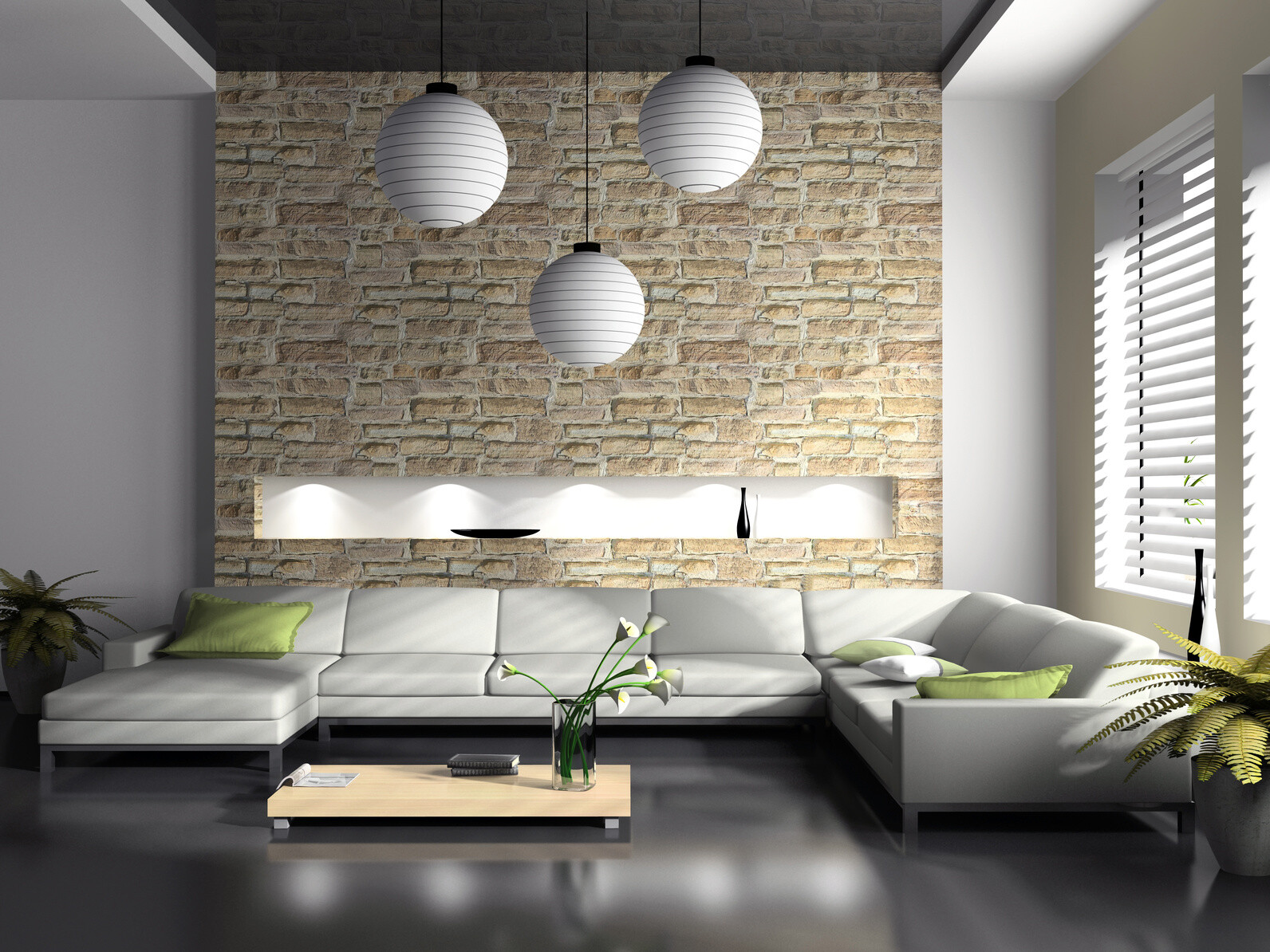
Does anyone have experience with this?
Do you use regular bricks or specially made stone veneer panels?
How do you keep something like this clean (for example, is it also suitable as a backsplash behind a cooktop in the kitchen)?
I’m also interested in the costs for these types of stone walls...
Thanks in advance!
Does anyone have experience with this?
Do you use regular bricks or specially made stone veneer panels?
How do you keep something like this clean (for example, is it also suitable as a backsplash behind a cooktop in the kitchen)?
I’m also interested in the costs for these types of stone walls...
Thanks in advance!
Hello,
while searching for wall cladding, I came across this interesting forum.
I have seen similar cladding made of polyurethane at a friend’s place. I had to knock on it to make sure it wasn’t natural stone. This wall covering looks very natural and attractive. Even people with little DIY experience should have no trouble installing it.
However, I am concerned about the isocyanates contained in polyurethane. When I asked the manufacturer, they informed me:
That sounds reasonable, but what is allowed for sale doesn’t necessarily mean it is safe or healthy, just look at glyphosate and other substances.
Is what the retailer said correct, or should I avoid using this wall cladding?
Best regards,
Madivaru
while searching for wall cladding, I came across this interesting forum.
garfunkel schrieb:
there is also plastic with a stone look
I have seen similar cladding made of polyurethane at a friend’s place. I had to knock on it to make sure it wasn’t natural stone. This wall covering looks very natural and attractive. Even people with little DIY experience should have no trouble installing it.
However, I am concerned about the isocyanates contained in polyurethane. When I asked the manufacturer, they informed me:
Polyurethane is a high-quality plastic found in almost every product. In the automotive industry alone, up to 150 different car parts per vehicle are made from polyurethane. Our panels are also made of this plastic. If toxic gases were released from the polyurethane, this product would not be allowed to be sold within the EU or Germany.
That sounds reasonable, but what is allowed for sale doesn’t necessarily mean it is safe or healthy, just look at glyphosate and other substances.
Is what the retailer said correct, or should I avoid using this wall cladding?
Best regards,
Madivaru
W
winnetou7830 Jan 2018 14:53Madivaru schrieb:
But I’m worried about the isocyanates contained in polyurethane. Seriously? Have you ever really studied chemistry?
Polyurethane does not contain isocyanates. Isocyanate is a raw material used to produce polyurethane and is no longer present as "individual" molecules in the final material. Yes, you shouldn’t eat or drink isocyanates, but you also wouldn’t lick it daily, and they have reacted to form a macromolecule. You shouldn’t eat iron, copper, or silver either, yet we use metal cutlery every day without thinking about it. As soon as something is labeled plastic, it suddenly becomes dangerous. Plastic only becomes hazardous if it decomposes or deteriorates, but even then, you have to be very precise when assessing the risk.
You’re considering using wall blocks made of polyurethane that will be painted afterwards. What could go wrong?
Do you know what kitchen wall coatings are made of?
Do you know what many food-safe seals are made of (it’s not all rubber)?
Do you know what else is made from polyurethane:
- A large part of the interior of high-end vehicles
- Foam mattresses
- All kinds of dishwashing sponges
- Many food storage containers and components for drinking bottles
- All kinds of synthetic leather (synthetic leather IS polyurethane)
- Insulation in refrigerators, freezers, air conditioning units, etc.
- Furniture sealants (veneer or foil)
- Electronic devices (smartphones, tablets, televisions, etc.)
- ...
Personally, I wouldn’t worry at all about having polyurethane on my living room wall. I’d be more cautious about inhaling the glue fumes during application (which is probably a PU-based adhesive as well).
Thank you for the quick and detailed (reassuring) response.
With a history of cytopathological issues, it certainly doesn’t hurt to be cautious.
Fortunately, the panels are screwed in place.
With a history of cytopathological issues, it certainly doesn’t hurt to be cautious.
86bibo schrieb:
Personally, I wouldn’t worry about whether there is PU on my living room wall. I would be more careful when sniffing the adhesive during application (it’s probably a PU adhesive anyway)
Fortunately, the panels are screwed in place.
I risk annoying you again with this repeated question, but just to be sure, I’m asking once more.
As long as I live, nothing will decompose.
However, this is not—as discussed a few pages back—a replacement of a tiled backsplash, but a total area of about 38 sqm (409 sq ft). Are these dimensions also considered safe?
86bibo schrieb:
Plastic only becomes dangerous if it decomposes or rots, but even then, you really have to differentiate carefully.
As long as I live, nothing will decompose.
However, this is not—as discussed a few pages back—a replacement of a tiled backsplash, but a total area of about 38 sqm (409 sq ft). Are these dimensions also considered safe?
Similar topics