
Hello,
We are starting to get really frustrated... every builder tells us something different...
We want to build a 130sqm (1,399 sq ft) KfW 70 house with the living room facing south, and we are unsure whether to choose gas or an air source heat pump. Some providers, at almost the same price level, offer us air source heat pumps and claim that the annual costs are significantly (30%) lower compared to gas, while others doubt this.
We understand that insulation with gas/solar systems is usually better because an air source heat pump boosts efficiency more towards KfW 70 standards compared to gas/solar, which might argue in favor of gas. An air source heat pump might fail somewhat sooner, and in case of problems, you can usually get quick and competent local support with gas. With air source heat pumps, there could be more difficulties. Additionally, the noise of air source heat pumps (in our case about 3 meters (10 feet) from the neighbor) is not insignificant. Some say that sooner or later, everyone ends up having issues with neighbors for this reason.
We are interested in air source heat pumps with storage tanks from these providers: Vaillant, Mitsubishi Zubadan, and Rotex.
What we are really curious about is the annual cost for heating and hot water with both systems.
We live near Kassel.
What should we choose, and what would be cost-effective TODAY? What is your opinion on Vaillant?
Regards
Gigi
We are starting to get really frustrated... every builder tells us something different...
We want to build a 130sqm (1,399 sq ft) KfW 70 house with the living room facing south, and we are unsure whether to choose gas or an air source heat pump. Some providers, at almost the same price level, offer us air source heat pumps and claim that the annual costs are significantly (30%) lower compared to gas, while others doubt this.
We understand that insulation with gas/solar systems is usually better because an air source heat pump boosts efficiency more towards KfW 70 standards compared to gas/solar, which might argue in favor of gas. An air source heat pump might fail somewhat sooner, and in case of problems, you can usually get quick and competent local support with gas. With air source heat pumps, there could be more difficulties. Additionally, the noise of air source heat pumps (in our case about 3 meters (10 feet) from the neighbor) is not insignificant. Some say that sooner or later, everyone ends up having issues with neighbors for this reason.
We are interested in air source heat pumps with storage tanks from these providers: Vaillant, Mitsubishi Zubadan, and Rotex.
What we are really curious about is the annual cost for heating and hot water with both systems.
We live near Kassel.
What should we choose, and what would be cost-effective TODAY? What is your opinion on Vaillant?
Regards
Gigi

Why is the electric heating element used for hot water preparation? In our air-to-water heat pump, the heating element did not activate for hot water production even at -5°C (23°F). With a ground-source heat pump, the source temperature is significantly higher, so why would the heating element switch on there? The source temperature is not transferred 1:1 anyway.
The claim of being "very experienced" might be true, but it likely also applies that the person is "not well trained." The installer’s statement is simply completely wrong. It seems he has never even looked at the manual of any heat pump in his entire life. A shame for a professional.
As evidence, I have taken the technical data from a brine-to-water heat pump manual (about 4 years old, a model similar to mine) and compiled it into an image. I am sure you can find even better data from a current heat pump model of your choice by now. What can be read from it?
Up to a brine temperature of 0°C (32°F) inlet, the heat pump heats domestic hot water up to 60°C (140°F) with a coefficient of performance (COP) of 2.4, meaning 1 kWh of electrical energy produces about 2.4 kWh of heat energy. If you save energy by running the storage tank at only 55°C (131°F), you can operate even with colder brine or achieve better COP values. My borehole temperature has always remained positive at the inlet, even in winter usually around +5 to +10°C (41 to 50°F). However, these devices are designed to operate with negative brine temperatures as well, which is often the case with horizontal ground collectors — the freezing of the ground actually provides a lot of energy.
My brine-to-water heat pump has not once switched to electric backup heating mode in the last 4 years. No matter how cold it gets outside, the brine temperature has been stable and the efficiency good (at 0°C (32°F) brine temperature, the heat pump performance is sufficient down to about -30°C (-22°F) outdoor temperature).
I have to agree with the previous commenter: especially when it is very cold, the brine-to-water heat pump has advantages compared to an air-to-water heat pump.
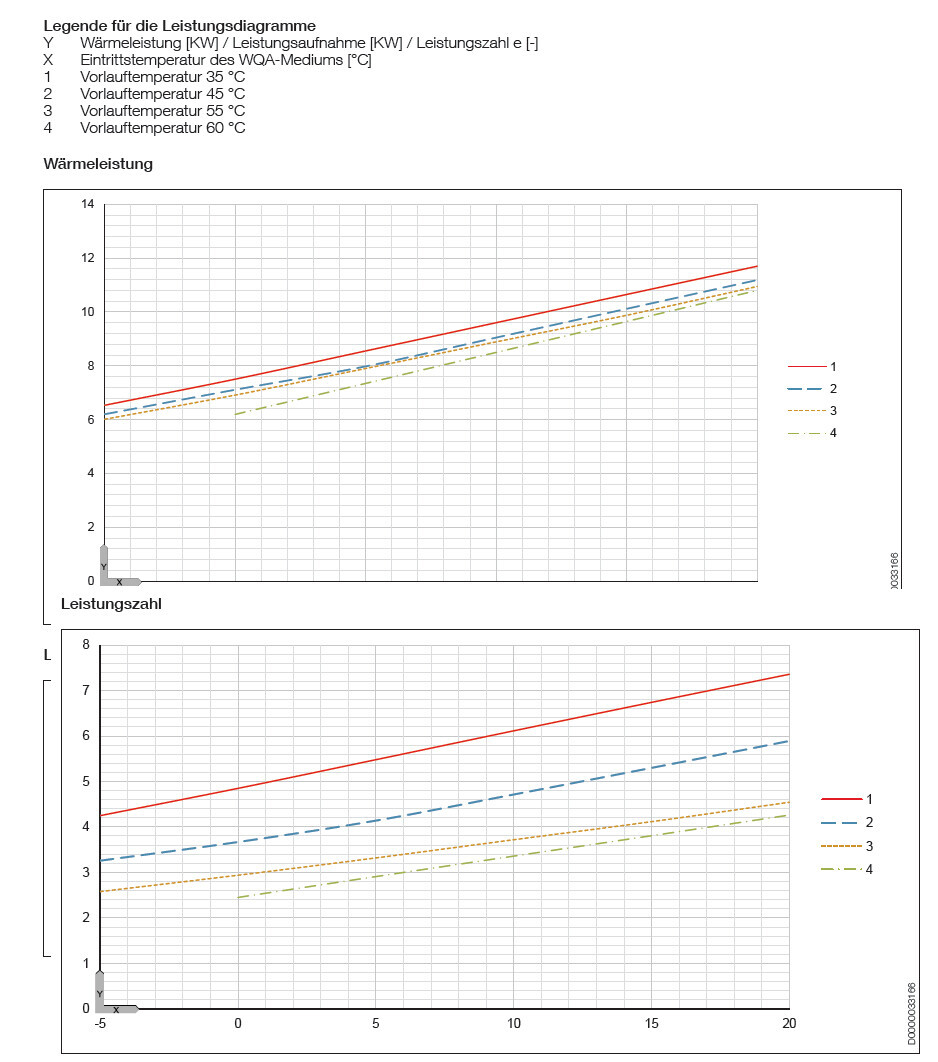
[Edit] The coefficients of performance don’t look very impressive yet, but with an outdoor temperature of 0°C (32°F) and a flow temperature of about 25°C (77°F), when the brine temperature is between 5 and 10°C (41 and 50°F), you are already in the upper 6 range.
As evidence, I have taken the technical data from a brine-to-water heat pump manual (about 4 years old, a model similar to mine) and compiled it into an image. I am sure you can find even better data from a current heat pump model of your choice by now. What can be read from it?
Up to a brine temperature of 0°C (32°F) inlet, the heat pump heats domestic hot water up to 60°C (140°F) with a coefficient of performance (COP) of 2.4, meaning 1 kWh of electrical energy produces about 2.4 kWh of heat energy. If you save energy by running the storage tank at only 55°C (131°F), you can operate even with colder brine or achieve better COP values. My borehole temperature has always remained positive at the inlet, even in winter usually around +5 to +10°C (41 to 50°F). However, these devices are designed to operate with negative brine temperatures as well, which is often the case with horizontal ground collectors — the freezing of the ground actually provides a lot of energy.
My brine-to-water heat pump has not once switched to electric backup heating mode in the last 4 years. No matter how cold it gets outside, the brine temperature has been stable and the efficiency good (at 0°C (32°F) brine temperature, the heat pump performance is sufficient down to about -30°C (-22°F) outdoor temperature).
I have to agree with the previous commenter: especially when it is very cold, the brine-to-water heat pump has advantages compared to an air-to-water heat pump.
[Edit] The coefficients of performance don’t look very impressive yet, but with an outdoor temperature of 0°C (32°F) and a flow temperature of about 25°C (77°F), when the brine temperature is between 5 and 10°C (41 and 50°F), you are already in the upper 6 range.
R
R.Hotzenplotz10 Jan 2018 21:29ares83 schrieb:
Why does the water heating rely on the electric heating element? With our air-to-water heat pump, the heating element didn’t even activate at -5°C (23°F) during water heating.It wasn’t about the outside temperature; he said the heat pump can only heat the water up to 25°C (77°F) using geothermal energy, and after that, the electric heating element kicks in. I need to find and read the manual for the Waterkotte AI 1 Geo. Although I’m always concerned that manufacturers provide overly optimistic theoretical values (see emissions scandal, etc.).
@Saruss
It’s really a huge problem to find someone who can solve this puzzle.
R.Hotzenplotz schrieb:
It wasn’t about the outside temperature; he said the heat pump can only heat the domestic hot water up to 25°C (77°F) using geothermal energy, and after that the electric heating element kicks in. That sounds like nonsense. A heat pump always uses a compressor, etc., to increase temperatures. An air-to-water heat pump naturally has to work harder than a ground-source heat pump, which is why it consumes more energy. This doesn’t initially relate to the electric heating element, which is only there for emergencies. You can easily find this out online within two minutes. I wouldn’t put any trust in this “expert’s” opinion.
R
R.Hotzenplotz10 Jan 2018 21:39Is it possible to specifically determine how efficient this heat pump is for hot water preparation?
I cannot find an operating manual. Does the heat pump consumption database help in any way? Unfortunately, I don’t see anything there that I could extract.
I cannot find an operating manual. Does the heat pump consumption database help in any way? Unfortunately, I don’t see anything there that I could extract.
Similar topics