
ᐅ Floor Plan Design for a Single-Family Home with Conservatory and Site Selection
Created on: 18 Dec 2017 15:13
N
Nanny Ogg
Development Plan / Restrictions
Plot size: approx. 550 m² (5900 sq ft)
Slope: slightly descending from west to east; approx. 1-2 m (3-7 ft)?
Plot ratio (floor space index):
Floor area ratio (FAR): 0.4
Building envelope, building line, and boundary: Building envelope: 15 x 15 m (49 x 49 ft); distance to the street 5 m (16 ft); distance to the right neighbor 3 m (10 ft); plot width at street side approx. 18 m (59 ft); plot length approx. 30 m (98 ft)
Edge development: Garage may be built directly on the left property boundary (viewed from the street)
Number of parking spaces:
Number of storeys: number of full storeys not specified
Roof style: no specifications
Architectural style: no specifications
Orientation: gable end either perpendicular or parallel to the street
Maximum heights / limits: wall height 4-7 m (13-23 ft); upper edge of building 7.3 - 10.5 m (24-34 ft)
Further requirements:
Client Requirements
Style, roof type, building type: gable roof; single-family house
Basement, storeys: no basement; 1.5 storeys with attic
Number of occupants, ages: currently 2 adults (30, 31 years) and one child (1.5 years); second child planned; space reserved for a third child desired
Room requirements on ground floor and upper floor:
Ground floor: open-plan living, dining, and kitchen area; utility room; small bathroom with shower; bedroom
Upper floor: 2 children’s rooms, guest room, office, bathroom with bathtub
Office: family use or home office? family use
Overnight guests per year: parents visit about 10 times a year for long weekends
Open or closed architecture: ?
Conservative or modern construction: ?
Open kitchen, kitchen island: open kitchen
Number of dining seats: daily 5; expandable to at least 8-10
Fireplace: no
Music / stereo wall: no
Balcony, roof terrace: no
Garage, carport: carport for 2 cars; bicycle garage
Utility garden, greenhouse: not planned for now
Additional wishes / special features / daily routine, including reasons why or why not:
- The ground floor bedroom should fit a family bed with two 140 cm (55 inch) mattresses; side access along the long side is sufficient.
- Fitness area with climbing wall bars and rings attached to the ceiling
- Guest room should be convertible into a children’s room if a third child arrives
- Conservatory adjacent to the dining area
- Mudroom behind the entrance door should not be a thoroughfare (stairs not directly behind the front door)
- Preferred construction method: solid wood house (methods like Holz100, only wood, etc.)
- Central ventilation system with heat recovery
House Design
Who designed the plan: do-it-yourself
What do you especially like? Why?
- Good use of space; all rooms accommodated without the house becoming too large
- Entire living and dining area faces the garden
- Separate entrance vestibule for muddy shoes
- Equally sized children’s rooms
What do you dislike? Why?
Cost estimate according to architect/planner: not available
Personal price limit for the house, including fittings: not yet defined
Preferred heating system: not yet decided; preferably with much renewable energy (geothermal?)
Key data of house design:
- Living area 135 m² (1453 sq ft); footprint 144 m² (1550 sq ft); building area 88 m² (947 sq ft) + 4 m² (43 sq ft) conservatory
- Roof pitch 38°
- Knee wall 1.15 m (3.8 ft)
- Tilt-and-slide door in conservatory
- Exterior walls 35 cm (14 in); interior wall next to kitchen 20 cm (8 in), otherwise 12 cm (5 in)
If you had to give up, which details or additional features
- you could do without:
- you could not do without:
Why was the design created as it is now?
Inspired by various standard plans and then modified independently.
What is the most important/basic question about the floor plan, summarized in 130 characters?
We want to build in a newly developed neighborhood that is not yet fully serviced. We have not yet chosen a plot (currently not for sale).
So I’m looking for advice both on the floor plan and choosing a suitable plot. Any of the shown plots are possible except those in the area with the city villas (for some I have entered approximate size and lengths). I initially selected a plot where the garden faces roughly west to catch the evening sun. The current floor plan would also fit the other green-marked plots.
Plot size: approx. 550 m² (5900 sq ft)
Slope: slightly descending from west to east; approx. 1-2 m (3-7 ft)?
Plot ratio (floor space index):
Floor area ratio (FAR): 0.4
Building envelope, building line, and boundary: Building envelope: 15 x 15 m (49 x 49 ft); distance to the street 5 m (16 ft); distance to the right neighbor 3 m (10 ft); plot width at street side approx. 18 m (59 ft); plot length approx. 30 m (98 ft)
Edge development: Garage may be built directly on the left property boundary (viewed from the street)
Number of parking spaces:
Number of storeys: number of full storeys not specified
Roof style: no specifications
Architectural style: no specifications
Orientation: gable end either perpendicular or parallel to the street
Maximum heights / limits: wall height 4-7 m (13-23 ft); upper edge of building 7.3 - 10.5 m (24-34 ft)
Further requirements:
Client Requirements
Style, roof type, building type: gable roof; single-family house
Basement, storeys: no basement; 1.5 storeys with attic
Number of occupants, ages: currently 2 adults (30, 31 years) and one child (1.5 years); second child planned; space reserved for a third child desired
Room requirements on ground floor and upper floor:
Ground floor: open-plan living, dining, and kitchen area; utility room; small bathroom with shower; bedroom
Upper floor: 2 children’s rooms, guest room, office, bathroom with bathtub
Office: family use or home office? family use
Overnight guests per year: parents visit about 10 times a year for long weekends
Open or closed architecture: ?
Conservative or modern construction: ?
Open kitchen, kitchen island: open kitchen
Number of dining seats: daily 5; expandable to at least 8-10
Fireplace: no
Music / stereo wall: no
Balcony, roof terrace: no
Garage, carport: carport for 2 cars; bicycle garage
Utility garden, greenhouse: not planned for now
Additional wishes / special features / daily routine, including reasons why or why not:
- The ground floor bedroom should fit a family bed with two 140 cm (55 inch) mattresses; side access along the long side is sufficient.
- Fitness area with climbing wall bars and rings attached to the ceiling
- Guest room should be convertible into a children’s room if a third child arrives
- Conservatory adjacent to the dining area
- Mudroom behind the entrance door should not be a thoroughfare (stairs not directly behind the front door)
- Preferred construction method: solid wood house (methods like Holz100, only wood, etc.)
- Central ventilation system with heat recovery
House Design
Who designed the plan: do-it-yourself
What do you especially like? Why?
- Good use of space; all rooms accommodated without the house becoming too large
- Entire living and dining area faces the garden
- Separate entrance vestibule for muddy shoes
- Equally sized children’s rooms
What do you dislike? Why?
Cost estimate according to architect/planner: not available
Personal price limit for the house, including fittings: not yet defined
Preferred heating system: not yet decided; preferably with much renewable energy (geothermal?)
Key data of house design:
- Living area 135 m² (1453 sq ft); footprint 144 m² (1550 sq ft); building area 88 m² (947 sq ft) + 4 m² (43 sq ft) conservatory
- Roof pitch 38°
- Knee wall 1.15 m (3.8 ft)
- Tilt-and-slide door in conservatory
- Exterior walls 35 cm (14 in); interior wall next to kitchen 20 cm (8 in), otherwise 12 cm (5 in)
If you had to give up, which details or additional features
- you could do without:
- you could not do without:
Why was the design created as it is now?
Inspired by various standard plans and then modified independently.
What is the most important/basic question about the floor plan, summarized in 130 characters?
We want to build in a newly developed neighborhood that is not yet fully serviced. We have not yet chosen a plot (currently not for sale).
So I’m looking for advice both on the floor plan and choosing a suitable plot. Any of the shown plots are possible except those in the area with the city villas (for some I have entered approximate size and lengths). I initially selected a plot where the garden faces roughly west to catch the evening sun. The current floor plan would also fit the other green-marked plots.
I would seek input even without owning a plot of land. Just visit the nearest model home village. Look at the houses. It gives you a sense of room sizes and provides initial talking points: what you like and what you don’t. Some salespeople or advisors take the time to give you input, for example, by customizing a model home to your needs. Not everyone does this. Some just deliver a 15-minute monologue about how great they are and how bad their competitors are.
It’s better to avoid a corner lot because you’ll have to clear a lot of pathways in winter.
I would choose a lot directly opposite yours: access from the northwest, garden in the southeast, terrace then wrapping around from southeast to southwest. So one of the three with a length of 30 meters (98 feet).
If the sun is still out in the evening, you can comfortably sit on the side of the house on the west side or enjoy the evening sun in the courtyard, possibly even have a party under the carport 😉
I would choose a lot directly opposite yours: access from the northwest, garden in the southeast, terrace then wrapping around from southeast to southwest. So one of the three with a length of 30 meters (98 feet).
If the sun is still out in the evening, you can comfortably sit on the side of the house on the west side or enjoy the evening sun in the courtyard, possibly even have a party under the carport 😉
N
Nanny Ogg21 Dec 2017 16:36@11ant:
All lots are still available since they are not currently on the market. Only the white lots on the right have been sold and are being/will be developed with single-family homes.
I have renumbered all the potential lots and added approximate sizes. Please note that all size measurements are rough estimates, as I measured them from a low-resolution draft. You can also still see the blue building zones faintly.
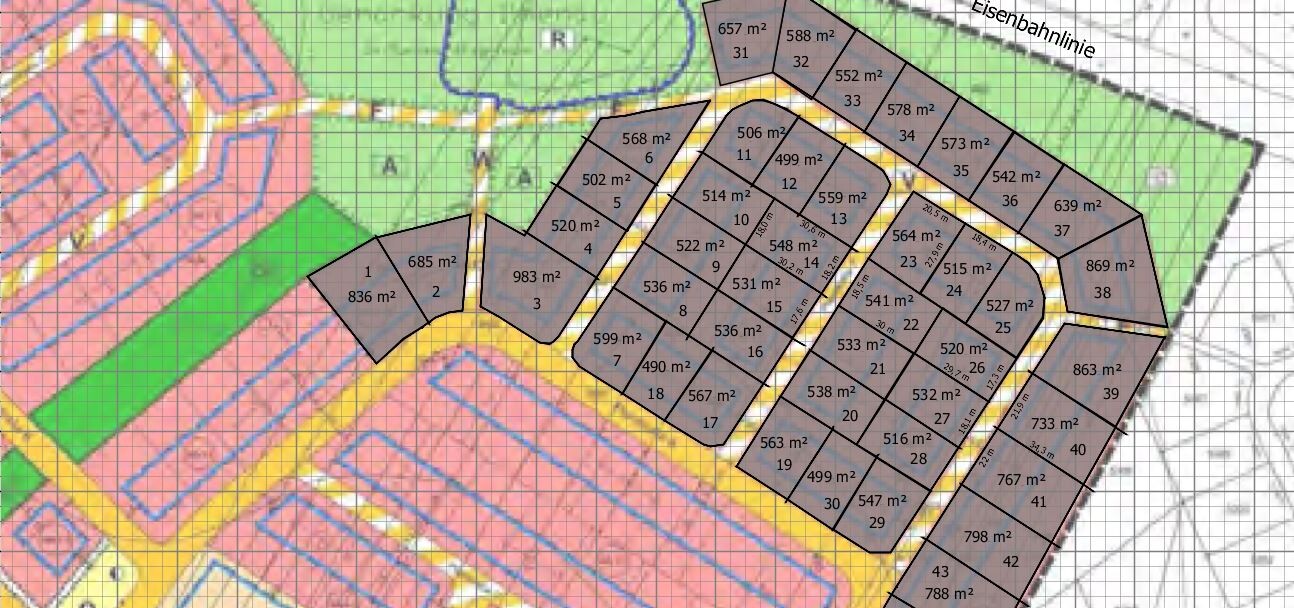
All lots are still available since they are not currently on the market. Only the white lots on the right have been sold and are being/will be developed with single-family homes.
I have renumbered all the potential lots and added approximate sizes. Please note that all size measurements are rough estimates, as I measured them from a low-resolution draft. You can also still see the blue building zones faintly.

Nanny Ogg schrieb:
I have renumbered all potential plots So, if all of them are equally suitable (not some rows having only semi-detached houses or only flat roofs, for example), then my favorites are numbers 6, 11 to 13, and 23 to 25. If you place a lot of importance on Yvonne’s argument about snow removal responsibility, then specifically 12 and 24—but these would have more neighbors sharing fence lines for the areas with less sweeping.
https://www.instagram.com/11antgmxde/
https://www.linkedin.com/company/bauen-jetzt/
ypg schrieb:
It’s better not to choose a corner lot because you have to clear a lot more pathways in winter.That was always my thought as well as my wife’s. Certainly a valid point, but it doesn’t necessarily mean there has to be a sidewalk everywhere, so that somewhat balances out.
An advantage of a corner lot, depending on its orientation, can be related to setback requirements, since you often share public space up to the middle of the street. This means you may have a bit more flexibility or more usable land, especially if the plot is rather small.
Regarding whether to consult an architect with or without a plot: we didn’t do it, but I can only recommend doing so. Sometimes (often) a plot that looks challenging to a layperson offers more design freedom and more interesting possibilities than a plot that seems perfect to non-experts.
The only potential difficulty is finding an architect during the current building boom who is willing to work proactively without a specific plot yet...
ruppsn schrieb:
Regarding hiring an architect with or without owning the land: we didn’t do it, but I can definitely recommend it. Sometimes (often) a plot of land that looks complicated to a layperson offers more design flexibility and more interesting possibilities than a plot that seems perfect to a layperson. Does that mean you let a princess slip away because, in laypeople’s eyes, she looked like Cinderella?
https://www.instagram.com/11antgmxde/
https://www.linkedin.com/company/bauen-jetzt/
Similar topics